
A small-payment crypto card with a 1% fee and a thin public trail
 Available in US
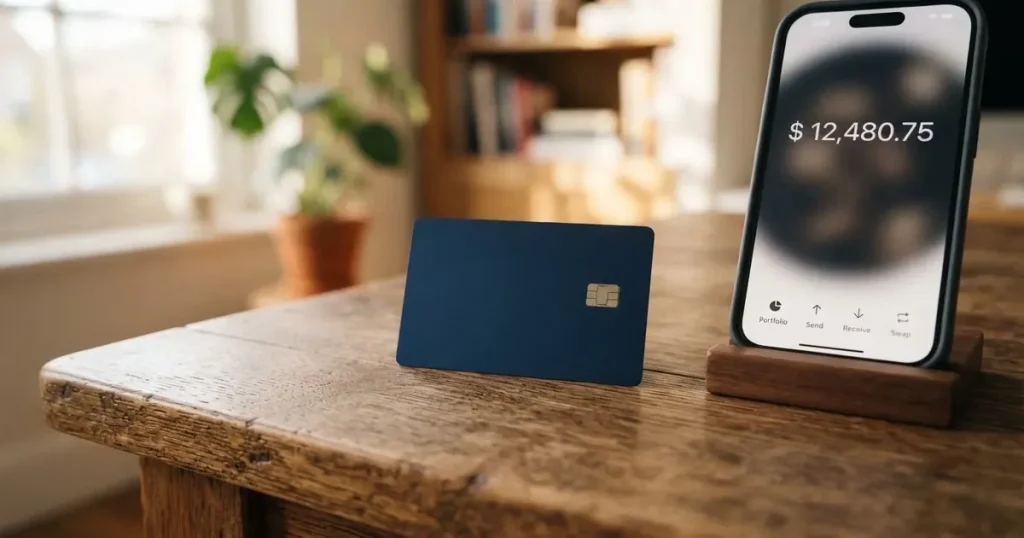
Moon is a Visa-branded payment card that draws on a crypto-funded balance denominated in US dollars. The marketing leans on the friction of the idea: you top it up with bitcoin, USDT, USDC or ETH, then spend at any merchant that takes Visa. In practice the product is narrower than the pitch. Moon publishes very little about who runs it, who issues the card, or which countries are fully supported, and the user reviews on independent platforms are sharply split between people who find it handy for small online USD purchases and people whose accounts have been frozen or whose refunds have stalled. I spent time with the card’s own pages, the terms that third-party sites quote, and recent user reports, and here is what I found.
Conditions are current as of October 28, 2026.
Verdict
Moon ends up at 5.6 out of 10. The pieces that work are real: the card is cheap to set up, the first Moon X is free, spending in USD has no foreign-transaction fee, and topping up with the main coins is straightforward. The pieces that pull the score down are equally real: the issuer and the legal entity are not named on the pages the public can read, the list of supported countries is not published, the major mobile wallets are not yet supported, and a meaningful share of recent user reports describe frozen accounts, withheld funds and refunds that only move after identity documents are re-submitted. The card suits a narrow reader — someone who needs to make quick small online payments in USD with crypto and is comfortable with that narrowness — and does not suit anyone who wants a full banking-style card with clear recourse when things go wrong.
Here is the criterion-by-criterion breakdown.
| Criterion | Mark | Reason |
|---|---|---|
| Who can get it | 8 / 10 | Unofficial sources describe over 130 countries for Moon X, but there is no public country list and sanctioned regions are excluded. |
| Cost | 6 / 10 | First Moon X is free, additional cards cost a few dollars, the 1% spending fee with a $1.00 minimum is clear; “no FX or foreign transaction fees” is stated, but little else is published. |
| Top-up options | 8 / 10 | BTC, Lightning, USDT on TRC-20, USDC on ERC-20 and ETH cover the coins most people actually hold. |
| Reliability and complaints | 2 / 10 | Issuer and entity not disclosed; Trustpilot at 2.5/5 across 276 reviews, with frozen accounts, withheld funds and refund delays as recurring themes. |
| Everyday use | 3 / 10 | Card is virtual and ready instantly, but Apple Pay, Google Pay and Samsung Pay are not yet supported and ATM access is not described. |
Moon is built for quick, small online USD payments funded from crypto. If that is the use case, the cost structure is reasonable. If it is not, there is not much here to make the card worth choosing.
Who will they give you the card
The card is positioned as broadly available, and the marketing reaches for the global angle. Unofficial summaries of Moon’s terms describe “over 130 countries” for Moon X, with sanctioned regions excluded outright. The same unofficial reading of the terms notes that not all products are available in all countries, and that purchases from disallowed countries will not go through even if the card itself was created somewhere else. There is no published list to check against, so the practical answer to “can I get it where I live” is that you can only find out by trying to sign up and seeing whether the service is offered in your region. That is a real gap for anyone whose situation is at all unusual: a non-standard residency, a country that sits near a sanctions boundary, or a citizenship the issuer might treat differently from the address.
The age rule is the standard 18+ and is described in those same unofficial summaries. The page I could read does not enumerate which identity documents Moon asks for or how the tiers of verification work. The most that the third-party reading of the terms commits to is that Moon may request proof of eligibility at any point, and that some merchants that initially decline a card “may open up after verification”. That is a polite way of saying that you may end up doing the KYC work after the first failed purchase rather than at sign-up.
I would put the access question this way: if you live in a country that is plainly inside the usual crypto-card map, you will probably be able to open an account. If you live in a country at the edge of that map, you should expect uncertainty, and you should not commit funds you cannot afford to have stuck in the system while a verification question is resolved. The lack of a public country list is the single most useful thing Moon could publish tomorrow, and the single most likely thing to leave a reader of this review dissatisfied.
How to get it
Sign-up is the part of Moon that is least papered over. The unofficial description of the terms is an email and a password, with two-factor codes arriving by email rather than by an authenticator app. There is no published document checklist, no published tiered KYC framework, and no published answer to how much you can do before Moon asks for an ID. The card itself comes in two flavours. Moon X is the reloadable product, the one that lives in your account and gets topped up with Moon Credit, valid for three years from purchase. Moon 1X is a single-load card aimed at US merchants, a smaller and simpler tool for a single purchase. Both are Visa, both are virtual by default and ready instantly, and neither has a published physical-versus-virtual split that I could find.
What that means in practice is that the path from “I want to try Moon” to “I have a card number I can type into a checkout” is short. You create an account, you put crypto into Moon Credit, and the card is there. The path from “I have a card” to “I can recover my money if something goes wrong” is much longer, and it is the part that the user reports on Trustpilot describe in the worst terms. Several reviewers in 2026 describe refunds being held until they re-submitted identification documents; others describe account freezes that began without a clear reason and ended only after they pushed the support channel. The cost of a fast sign-up is that the identity and recourse work happens later, under pressure, and on Moon’s schedule.
The delivery question — “when does a physical card arrive, and where” — is not answered on the public pages I could read. The Moon 1X product is a single-load card that you would not need a physical version of, and Moon X’s default is virtual. If you need a piece of plastic, you will want to confirm with support before paying the additional card fee.
What it really costs
The cost story has three layers: the one-off card fees, the per-transaction fees, and the operational fees you only meet when something goes wrong. The cleanest part is the upfront. Unofficial summaries of Moon’s terms describe the first Moon X as free, additional Moon X cards at $2.99, and Moon 1X cards at $1.49. There is no monthly fee stated, and Moon’s own copy says the card “does not charge any FX or foreign transaction fees”. The 1% transaction fee on Moon X, with a $1.00 minimum per transaction, is the working cost of using the card for everyday spending. The Moon 1X product has no transaction fee at all, which is the trade-off for being single-load.
| Fee or limit | Amount |
|---|---|
| First Moon X card | Free |
| Additional Moon X card | $2.99 |
| Moon 1X card | $1.49 |
| Moon X transaction fee | 1% with $1.00 minimum per transaction |
| Moon 1X transaction fee | None |
| Foreign transaction or FX fee | None stated by Moon |
| Decline / reversal / refund fee | $0.50 after 20 per month |
| Excess refund fee | $40 |
| Overdraw fee | $25 |
| Chargeback dispute fee | $17.50 |
| Moon X monthly spend limit | $4,000 across all cards |
| Card creation limit | 10 per day, 30 per month |
| Moon Credit purchase limit | $10,000 daily, $30,000 monthly |
| Moon 1X load | $5 minimum, $1,000 maximum per card |
| ATM access | Not stated |
A few of those lines deserve a closer look in plain language. The $0.50 fee for declines, reversals and refunds (a figure from third-party terms, not confirmed by the issuer) only starts after the twentieth such event in a month, so it is a backstop rather than a normal cost. The $40 excess-refund fee and the $25 overdraw fee are the kind of charges you only see when a refund or a transaction lands in a balance that is not big enough, and they are high enough to be worth planning around. The $17.50 chargeback fee is charged only if Moon decides to take a customer-requested dispute forward, so opening a dispute is not free, and not every dispute will run. The 1% fee with a $1.00 floor is what most readers will actually feel: a $5 coffee becomes $5.05 with the minimum, a $50 grocery shop becomes $0.50, a $200 train ticket becomes $2.00.
Three everyday examples make that concrete.
A $12 streaming subscription paid from Moon X. The 1% fee is $0.12, but the per-transaction minimum is $1.00, so you pay $1.00. The merchant sees a USD transaction on a Visa card, there is no FX fee, and your Moon Credit balance drops by the full $13.
A $4,000 monthly spend split into twenty payments of $200. The 1% fee on $4,000 is $40, paid across the twenty transactions at $2 each, comfortably above the $1.00 minimum. This is the upper edge of the Moon X monthly spend limit, so you would either stay at or below it, or split the rest onto another product. (Note: These figures are based on third-party terms and not officially confirmed by the card issuer.)
A $30 in-app purchase paid with Moon 1X. There is no transaction fee on Moon 1X, so the $30 is the $30. The single-load structure means the rest of the loaded balance, if you loaded more than $30, is tied up on a card you cannot reuse. If the merchant is not a US merchant, the card may not work in the first place.
The one cost line that is hard to plan around is the unused balance at expiry. When a Moon X card reaches its three-year validity, the remaining balance is charged as a fee rather than returned. Refunds are paid in bitcoin, minus network and partner fees, which is a different unit of account from the dollar you spent and a different kind of friction. If you load $200 onto a Moon X and spend $140 over two years, the last $60 is at risk of being eaten by the expiry fee; if you need it back in fiat, the refund path turns a USD balance into a BTC transfer with its own costs and confirmation time.
Top up
The supported coins for Moon Credit purchases are bitcoin (BTC), the Lightning Network, USDT on TRC-20, USDC on ERC-20 and ETH. That is a deliberately short list, and it lines up with what most people who already hold crypto actually hold. The decision to support USDT on Tron and USDC on Ethereum, but not the other way around, is also the standard one: Circle stopped supporting USDC on Tron in February 2024, so USDC on TRC-20 is not a native option, and Tether’s USDT on ERC-20 is a less common route than USDT on Tron because of gas costs.
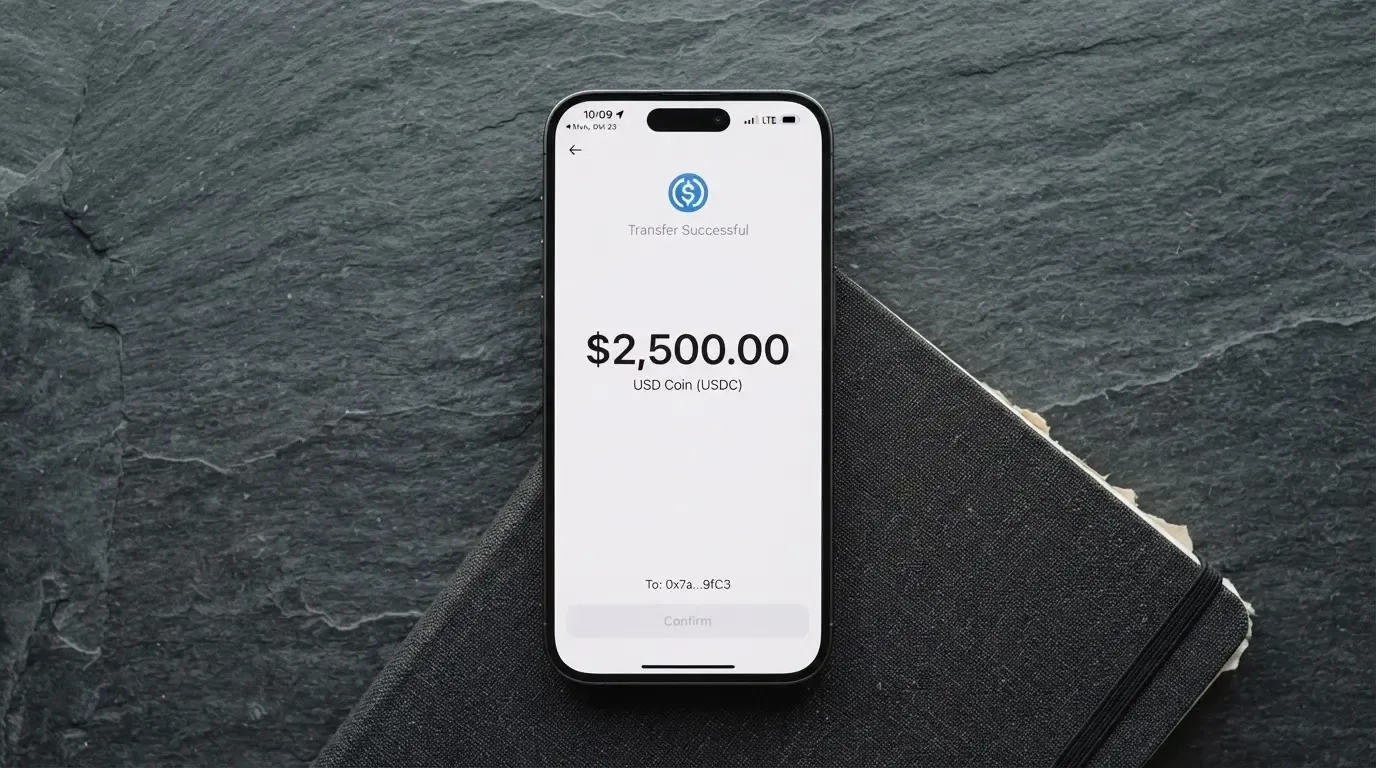
A few practical consequences follow from that list. First, “USDC over TRC20” is not a Moon option, and that combination has been a common support-ticket topic in the wider crypto-card world. Second, ERC-20 transfers need ETH to pay gas, so a wallet with USDC and no ETH cannot send; the same is true in reverse for networks that charge a native fee. Third, blockchain transfers are irreversible, so a deposit sent on a network Moon does not support, or to an address of another network, can be lost or need manual support recovery with no guarantee of success. Network fees on a deposit are charged by the blockchain, not by Moon, and the unofficial reading of the terms does not state who pays them or whether they are netted out of the credited amount.
Fiat top-up is not described in the public pages I could read. If you do not already hold crypto, there is no obvious on-ramp from a bank account to Moon Credit; you would have to buy crypto elsewhere, then move it to Moon. That is a real friction for anyone whose starting point is a paycheque rather than a wallet, and it is worth naming before you commit to a workflow.
The minimum load on a Moon 1X card is $5 (a figure from third-party terms, not confirmed by the issuer) and the maximum is $1,000, and that single load counts against the $4,000 monthly account maximum that also applies to Moon X. The account-level caps are reasonable for a small-payment card and a little tight for anyone trying to run a meaningful share of monthly spending through Moon.
Paying with it every day
The card is virtual by default and ready the moment the account is set up, which is the strongest part of the everyday-use story. The weaker parts are the parts Moon has not yet built. Apple Pay, Google Pay and Samsung Pay are described in unofficial summaries of the terms as not currently supported, with “on the way” as the stated position. That means a phone-wallet tap-to-pay flow, which has become the default in much of the world, is not available. The result is that the card lives in the “type the number into a checkout” world rather than the “tap to pay” world, and the user reviews reflect that.
ATM access is not stated in the unofficial terms, which is a soft warning sign. Crypto cards that support ATM withdrawals usually publish a daily and per-transaction cash limit; the absence of that here suggests that the card is built for online rather than in-person cash use, and anyone who needs cash should expect to need a different card.
The other soft warning is the existence of blocked merchants. Moon does not enumerate which merchant categories are blocked, but several issuers in the crypto-card category block MCC 7995 (gambling) and a small set of other categories, and the pattern is usually visible only when a payment is declined. The unofficial terms describe some blocked merchants “opening up after verification”, which is the same kind of post-hoc KYC pattern that the sign-up section described: the work happens at the point of friction rather than at the point of entry.
For the everyday case — buying a small item (like a $40 domain), paying a $20 monthly software subscription, settling a $12 streaming bill in USD — the card works. For the cases the card was not built for — contactless coffee, ATM cash, gambling, or any merchant that wants the issuer country on the card to match the billing country — the card is more likely to be the wrong tool.
What can go wrong
The risk section is the part of this review I spent the most time on, because the gap between Moon’s public pages and Moon’s user reports is unusually wide. The first thing to name is what is not published. The legal entity behind Moon is described as Moon LLC (“Pay with Moon”) in the copyright line, but the registration, the issuer bank and the licences are not on the pages I could read. The cards are issued by partner financial institutions under a Visa licence, which is the standard arrangement for this category of card, but “under a Visa licence” is not the same as naming the issuer and the regulator. For a reader who needs to know who holds their funds and under which law, the public answer is thin.
The Trustpilot profile is a useful counterweight, because the users who took the trouble to write there are describing what the public pages do not. The headline number is 2.5 out of 5 across 276 reviews, read on 21 October 2026, with 79 reviews in the last twelve months and a 47% / 44% split between five-star and one-star ratings. The themes that recur in the recent one-star reviews are:
- Frozen or restricted accounts, with funds held, from January to August 2026.
- Refunds delayed or made conditional on identity verification, from December 2025 to September 2026.
- Outages and cards cancelled in early December 2025 and again in January 2026.
- Unresponsive support, from November 2025 to May 2026.
The five-star reviews describe the opposite experience: a fast set-up, a card that works, and small payments that go through. The split matters. A 2.5/5 with this kind of bimodal pattern is not a card that most people have a smooth time with; it is a card that some people have a smooth time with and a non-trivial minority do not.
A second risk is platform shutdown. Moon describes itself as “not a custodial service”, which is the legal language that pushes responsibility for funds towards the user, but in practice the Moon Credit balance is held by Moon and the cards are issued by a partner, so the user’s relationship with their own money is at one remove from a self-custody wallet. The category has a record of card programmes being wound down. Visa terminated its global agreements with FTX on 13 November 2022 and the FTX US debit card was wound down by its issuer; WaveCrest, a Visa card issuer that supplied several crypto card brands, was suspended by Visa in Europe in 2018, closing all WaveCrest-issued Visa programmes; a single-source 2026 closure has also been reported. There is no official shutdown notice for Moon as of the date of this review, but the absence of a public issuer name and the absence of a clear custody story are the conditions under which a programme closure hurts the most.
A third risk is refund mechanics. Moon pays refunds in bitcoin, minus network and partner fees. If you spent $50, were overcharged, and the merchant returns $50 to Moon, you do not receive $50 in USD; you receive the bitcoin equivalent of $50 at the rate Moon uses, minus the bitcoin network fee, minus whatever Moon takes as a partner fee. The unit-of-account switch is a friction in itself, and the conversion rate is set by Moon. The $40 excess-refund fee (a figure from third-party terms, not confirmed by the issuer) applies when a refund lands in a balance that is too small, which is the kind of edge case that is rare in normal use and very annoying when it hits.
A fourth risk is the chargeback fee. The $17.50 (a figure from third-party terms, not confirmed by the issuer) is charged only if Moon decides to take a customer-requested dispute forward, so it is a fee on the act of asking, not a fee on the outcome. The time frame within which Moon makes that decision is not stated. The address-verification behaviour of foreign-issued cards in the US, Canada and the UK is a known source of declines, and the absence of a published issuer country on the public pages makes that harder to plan around.
A fifth risk is sanctions and citizenship. The unsupported regions rule is enforced, and the unofficial terms are explicit that purchases from disallowed countries will not go through. Sanctions screening is applied to citizenship and country of birth as well as to the country of address, which is the standard in the category but worth naming for any reader whose background is at all unusual.
The pattern that runs through all five is the same: the card’s published disclosures are short, the user reports describe a wider set of outcomes, and the distance between the two is where the risk lives.
What to take instead
Three cards come up as alternatives in the same broad category: a small-payment virtual card funded from crypto, with a thin public trail and an audience that overlaps with Moon’s. I am not endorsing any of them; I am laying out what the public pages and unofficial summaries actually say, so the reader can see the trade-offs.
Cardex scores 5.6/10 in the same scheme. Unofficial descriptions describe “one crypto card, 200+ countries” with no published country list or exclusions, and an App Store listing that frames the product as Naira-focused. The card is a debit crypto card on the Verve, Visa, Mastercard and UnionPay networks, with both virtual and physical versions, and card currency in Naira per the listing. Fees are described in unusual language: the site describes an “AI-Powered Conversion Rate” that scans global exchanges at the moment of payment and picks the best one, with no percentage published. Funding is via USDT, USDC and BTC wallets, with no networks stated and no rewards programme stated. The pitch is global coverage and a smart conversion rate; the public pages do not back either up with numbers.
CardFlow scores 4.9/10. The marketing is explicitly Nigerian (“Nigeria’s smartest fintech card platform”) and frames the audience as “Nigerians and global users” with no country list or exclusions stated. The card is a virtual USD Mastercard, created in minutes, with creation free per the site FAQ and no monthly fee stated. Fees and rewards are not stated. Funding is bitcoin, USDT, ETH or Naira bank transfer, with no networks stated. The pitch is fast virtual cards in USD; the public information is thin enough that the reader has to take the marketing on trust.
HyperCard scores 4.7/10. The official pages state no country list; the App Store says the card works in “more than 176 countries”, which is a statement about acceptance rather than eligibility. The product is a prepaid “HyperCard” with the network not stated on the App Store page and a balance in USD or EUR. The App Store page lists no fees, and no fee schedule is published on the pages I could read. Funding is deposit crypto such as USDT, BTC or ETH in the app, converted to USD or EUR on the card, with no networks stated. The pitch is a low-friction prepaid card; the public information is even thinner than Moon’s.
The honest summary is that all three alternatives share the same structural gap as Moon: a global pitch, a thin public page on fees, and a reliance on the user to test the card in their own situation. None of the three publishes a fee schedule as complete as Moon’s third-party-quoted one. None of the three names an issuer. The reader who wants the most disclosed cost structure is, awkwardly, best served by Moon, and the reader who wants the most disclosed legal entity is not well served by any of them.
Who I would recommend it to
Moon is a small, cheap, USD-denominated virtual card that funds from the most common coins. The first card is free, the per-transaction cost is clear, and there is no foreign-transaction fee. If that is the product you want, and you live in a country that is unambiguously inside the supported region, and you only need the card for small online USD purchases, Moon is a reasonable choice. The friction is real but predictable: top up with crypto, spend in USD, accept that refunds come back in bitcoin, and do not leave a balance sitting on a card that is about to expire.
Moon is not a good choice for anyone who needs a card with a published issuer and a published regulator, anyone whose country sits at the edge of the supported list, anyone who plans to spend more than the monthly cap, anyone who needs ATM access, anyone who plans to use a mobile wallet, and anyone who cannot afford to have a balance frozen for weeks while a verification question is resolved. The Trustpilot pattern is bimodal, and the 44% one-star share describes an experience the marketing does not prepare you for.
The most useful thing a reader can do before signing up is to check two things. The first is the current status of the country list against their own situation, because there is no published list to check. The second is the user’s own need for recourse: if a $200 balance being held for two months would be a problem, the card is not the right tool. The most useful thing a reader can do after signing up is to keep balances small, use Moon 1X for single purchases where there is no transaction fee, and not leave a Moon Credit balance idle on a card that is close to its three-year expiry.
Frequently asked questions
What is the Moon card?
Moon is a Visa-branded virtual payment card that draws on a balance called Moon Credit, funded from bitcoin, USDT on TRC-20, USDC on ERC-20, ETH, or the Lightning Network, and spent in US dollars.
How does the Moon card work?
You create an account, transfer crypto into Moon Credit at the supported coins and networks, and the card converts the balance to USD at the moment of spending, charging a 1% transaction fee with a $1.00 minimum on Moon X and no transaction fee on Moon 1X.
Is Moon a bank?
Moon describes itself as “not a custodial service” and the cards are issued by partner financial institutions under a Visa licence; the issuer bank and the regulator are not named on the public pages the user can read.
Who owns Moon?
The copyright line on Moon’s pages reads “© 2025 Moon LLC (Pay with Moon)”; the registration, the issuer bank and the licences are not published on the pages I could read, and “Moon LLC” is the only entity name available publicly.
Is the Moon card available in my country?
Unofficial summaries of Moon’s terms describe “over 130 countries” for Moon X with a public list that does not exist; the practical answer is that you can only find out by trying to sign up, and sanctioned regions are excluded.
How do I get a Moon card?
Sign-up is an email and a password with two-factor codes by email, per the unofficial terms; the Moon X virtual card is ready instantly, additional Moon X cards cost $2.99, and Moon 1X single-load cards cost $1.49.
Does the Moon card require KYC?
The unofficial terms describe sign-up without a published document checklist and note that Moon may request proof of eligibility at any point, with some blocked merchants opening up after verification.
How do I top up the Moon card?
You transfer BTC, Lightning, USDT on TRC-20, USDC on ERC-20 or ETH to the deposit address Moon provides; fiat top-up is not described in the public pages, and the network fees on a deposit are charged by the blockchain rather than by Moon.
Is the Moon card free?
The first Moon X is free, additional Moon X cards are $2.99, and Moon 1X cards are $1.49; Moon X charges a 1% transaction fee with a $1.00 minimum, Moon 1X has no transaction fee, and Moon states it does not charge FX or foreign transaction fees.
Can I add the Moon card to Apple Wallet?
Unofficial summaries of Moon’s terms describe Apple Pay, Google Pay and Samsung Pay as not currently supported, with “on the way” as the stated position; until that changes, the card is used by typing the number into a checkout rather than by tapping to pay.
Virtual card reviews – cryptocardcheck
Content created by the «cryptocardcheck» team