
A crypto debit card from one of Switzerland's best-known banks
 Available in US
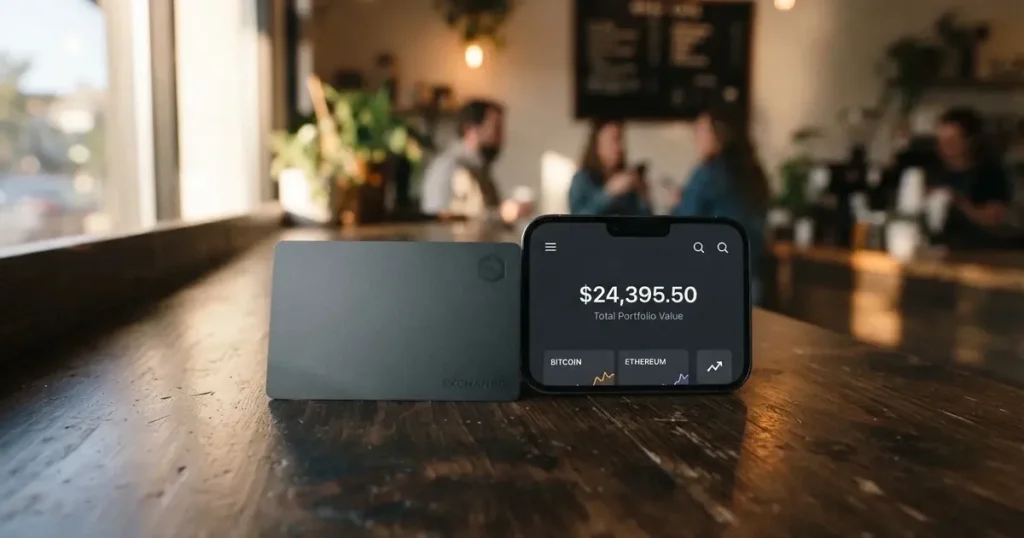
Swissquote is a name most people in this space already know: a publicly traded Swiss bank that has offered crypto trading alongside forex, stocks and bonds for years. The card in front of us today is the bank’s own payment card, issued on the Mastercard network and tied to a Swissquote account, so the balance being spent is a bank balance rather than a wallet in your pocket.
The headline of this card is straightforward: a debit card that draws on a Swissquote account, and where you can pick a crypto holding as the payment method inside the app. It is not a “crypto-native” card from a fintech start-up. It is a bank-issued product with crypto bolted on to the spending side, and that distinction shapes almost every part of the experience, from how you qualify to how you fund it.
Conditions on this page are current as of October 28, 2026.
Verdict
Swissquote scores 7.1 out of 10. That is a respectable middle-of-the-pack result for a crypto payment card, but it is not a card for everyone, and the reasons are worth walking through before anyone signs up.
Who it suits. If you already keep money or investments at Swissquote, or you want a card that comes from a regulated bank rather than an e-money licence, this is a natural fit. The same applies if you live in one of the countries where the physical Bright and Elite cards ship and you want a debit card that can also draw on Bitcoin, Ethereum or XRP at the till. Elite adds a metal card, fee-free foreign exchange up to a monthly ceiling and free ATM withdrawals, which makes sense for heavier spenders holding the required CHF 100,000 in assets at the bank.
Who it does not suit. If you want a card you can fund directly from an external crypto wallet, or top up with a stablecoin of your choice, this card is the wrong tool. The crypto here is sold from your Swissquote trading account, not received from outside. The same is true if your main interest is the lowest possible fee on a crypto-to-fiat payment: a number of pure-play crypto cards charge less on the conversion than Swissquote does.
Score breakdown
| Criterion | Mark | Reason |
|---|---|---|
| Who can get it | 7/10 | Product and pricing vary by country; physical cards ship to 15 named countries; not available everywhere |
| Cost | 8/10 | Light plan is free monthly; Bright CHF 6.90, Elite CHF 39; conversion 0.95% on 13 main currencies |
| Top-up options | 4/10 | Spends from the Swissquote account; only Bitcoin, Ethereum and XRP named, with “more planned” |
| Reliability and complaints | 7/10 | Swissquote Bank Ltd (FINMA) and Swissquote Bank Europe (CSSF, FGDL deposit guarantee); some user complaints about slow withdrawals |
| Everyday use | 9/10 | Virtual card on Light is immediate; Bright and Elite add physical and metal cards; Apple Pay and Google Pay supported; ATM withdrawals included |
| Total | 7.1/10 | A solid bank-issued card with crypto spending on top, limited by narrow funding and country coverage |
Who will they give you the card
The first thing to know is that the Swissquote card is not a standalone product. It is a payment card attached to a Swissquote bank account, and you can only get one if you already have that account in your own name.
Eligibility follows where you live. Swissquote splits the world into regions on its site, and the product, pricing and available card tiers depend on which one matches your residence: Switzerland, Europe, the UK, the Middle East, South Africa, Singapore, Hong Kong or Rest of World. The starting data goes further: physical Bright and Elite cards are listed for 15 specific countries, namely Switzerland, Liechtenstein, Italy, Austria, France, Germany, the UK, Cyprus, Spain, Malta, Monaco, the UAE, South Africa, Greece and Belgium. If you are not in one of those, the path is either a virtual Light card or no card at all.
A third-party site, CryptoCardHub, published an unofficial count in August 2026 of 35 countries served overall, with 13 restricted, including the US, Canada, Russia, Ukraine, Iran, Cuba and Venezuela. That list is unofficial and is not confirmed by Swissquote’s own card pages, so it should be treated as a directional indicator rather than a reliable answer to “is my country on the list”. The safest move is to look at the country selector on the Swissquote site before you start an application, because what you actually get depends on the answer it gives.
A point worth flagging for readers: the recent news is that in August 2026 Swissquote sent warning letters to roughly 600 customers, mostly users of its Yuh app, telling them their accounts could be closed. The CEO, Mark Burky, said the reasons were “exclusively economic in nature”. As of the news report, no accounts had been closed yet, and Swissquote said there was no plan to extend the action beyond the roughly 600 identified. The details on the public card pages do not state nationality-based exclusions, but this is the clearest current signal that who the bank will keep as a customer is being actively reviewed. Minimum age, document list and proof of address are not stated on the card pages.
How to get it
The path to the card goes through the bank, not the card itself.
You open a Swissquote account first. The bank advertises a simplified opening flow in its mobile app, and the desktop platform offers the same step. After the account is open you make a first deposit, then order the card from the app’s Bank tab or the desktop platform. Light is virtual, Bright is a physical plastic card plus a virtual one, and Elite is a metal card plus a virtual one. The pricing of those tiers is covered in the next section.
Elite is gated by assets rather than paperwork. You need at least CHF 100,000 in total assets at the bank at the time you take the subscription. The card pages do not state which assets count, so for an exact answer the bank itself is the right place to ask. Documents, proof of address and minimum age for the lower tiers are not stated on the pages I read, and the full banking KYC and anti-money-laundering checks do apply, so expect the usual flow of identity and address verification. Processing time and the specific reasons an application might be rejected are also not stated.
The virtual Light card is active the moment you order it. The card pages do not state delivery time or cost for the physical Bright and Elite cards, and replacement fees are CHF 5 on Bright and CHF 50 on Elite (Light is not stated). An unofficial review on Become Wealthy (March 2025) says the physical card arrives within three to four working days, and CryptoCardHub (August 2026) repeats the same window. Both are unofficial and not confirmed by the card pages, so treat them as indicative.
The 13 main currencies the card supports are CHF, USD, EUR, GBP, JPY, AUD, CAD, SEK, HKD, NOK, DKK, AED and SGD. If your spending is in any of those, the conversion fee is the headline rate; if not, see the costs section.
Fees: what it really costs
The Swissquote card has three published tiers, and the right way to read the costs is to start with the tier, then look at how you will actually use the card.
| Fee or limit | Light | Bright | Elite |
|---|---|---|---|
| Monthly fee | Free | CHF 6.90 (free first 6 months) | CHF 39 |
| Issuance fee | Not stated | Not stated | Not stated |
| Replacement | Not stated | CHF 5 | CHF 50 |
| Cancellation | Free | Free | Free after 6 months, else 2 monthly fees |
| Card payments (CHF) | Free | Free | Free |
| Conversion, 13 main currencies | 0.95% | 0.95% | Free up to CHF 5,000/month, then 0.25% per transaction |
| Conversion, other currencies | Mastercard rate + 1.5% | Mastercard rate + 1.5% | Mastercard rate + 1.5% |
| Crypto exchange at payment | Not stated on the pricing page | Not stated on the pricing page | Not stated on the pricing page |
| ATM, Switzerland | CHF 1.90 per withdrawal | 5 free per month | 5 free per month, then CHF 1.90 |
| ATM, abroad | CHF 4.90 per withdrawal | CHF 4.90 per withdrawal | 5 free per month, then CHF 4.90 |
| Monthly payments (CHF/EUR/USD) | 10,000 | 25,000 | 50,000 |
| Monthly ATM | 5,000 | 10,000 | 10,000 |
| Daily ATM | 1,000 | 2,000 | 5,000 |
| Contactless without PIN | CHF 80 | CHF 80 | CHF 80 |
A few things stand out from this table. First, the monthly fee on Bright is waived for the first six months, which makes trying the card essentially free if you cancel in time. Second, Elite’s main economic story is the free foreign-exchange window up to CHF 5,000 a month, beyond which the rate drops to 0.25%, and the free ATM withdrawals both at home and abroad up to the same monthly cap. The asset requirement of CHF 100,000 to subscribe to Elite changes who that makes sense for.
Third, the crypto exchange fee on payment is the one Swissquote is least explicit about. The pricing page does not state it, and an unofficial review on Become Wealthy (updated in early 2025) reports 1%. An earlier check on the starting data quoted a tiered 1% below EUR 10,000 of spend, 0.75% between EUR 10,000 and 50,000, and 0.5% above EUR 50,000. All of this is unofficial, so if the crypto conversion cost matters to you, ask the bank directly before you commit.
To make these fees concrete, here are three everyday payments and which line items bite.
Buying lunch in Zurich with a Light card. The transaction itself is free. You tap the virtual card on Apple Pay or Google Pay, the merchant receives Swiss francs and the amount is debited from your Swissquote account. No foreign exchange, no monthly fee, no ATM cost. This is the cheapest possible path on Swissquote.
Paying a hotel bill in Tokyo with Bright. You tap a plastic card issued in Switzerland, and the hotel charges in Japanese yen. The card’s main currency list does include JPY, so you fall under the 0.95% conversion tier, not the Mastercard rate plus 1.5%. On a JPY 50,000 stay, that is roughly CHF 2.70 in conversion cost, on top of your monthly fee. If you are on Bright in your first six months, the monthly fee is zero; from month seven, add CHF 6.90.
Withdrawing EUR 300 from an ATM in Berlin on Elite. The first five ATM withdrawals abroad each month are free on Elite, and the conversion is free up to CHF 5,000. As long as you are inside those two caps, the withdrawal costs nothing beyond the Mastercard network’s own FX. If you take a sixth withdrawal the same month, it is CHF 4.90.
How to top up
Top-up is where the Swissquote card behaves very differently from many of the cards it gets compared to.
The card is a debit card, so it spends from your Swissquote account. There is no “add money from an external wallet” flow. The way you bring crypto into the picture is to select crypto as the card’s payment method inside the app. At the moment of payment the app sells only the tokens needed to cover that specific purchase; the rest of your holding stays put.
What you can spend from is, for now, a short list. Swissquote names Bitcoin, Ethereum and XRP as supported, with “more planned” but no timeline. The funding side is a single channel: the Swissquote account, which holds the bank and trading balances in your name. External wallets and stablecoins of your choice are not listed. The pricing page notes that limits may apply when funding the crypto exchanges, which is a separate limit on the trading side, not on the card.
Cash, in the everyday sense, is taken from ATMs as described in the costs section. Trading Credit, the cashback currency used on this card, is not cash and cannot be withdrawn as such. The minimum first deposit, the deposit fee itself, and what happens to your account balance and any crypto on closure are not stated on the card pages; the balance is a Swissquote bank account, and the account terms cover the rest.
The practical effect is that this card is best suited to people who already keep assets at Swissquote and want to spend from that pool, including from crypto held in the Swissquote trading account. If you keep your crypto on a self-custody wallet and want a card that pulls from it, this is not it.
Paying with it every day
In day-to-day use the Swissquote card is closer to a normal bank card than to a crypto card, and that is mostly a good thing.
The Light card is virtual and active as soon as you order it. Bright adds a physical card, and Elite adds a metal one. Apple Pay and Google Pay are supported on the Luxembourg site, and the pricing comparison lists Samsung Pay as well; the Swiss page also lists TWINT and eBill, which are local payment rails. A blocked-merchant list is not stated on the card pages, so if a specific category matters to you, ask the bank.
Cashback is paid in Trading Credit, not in fiat. The published crypto-payment rate is 0.5% on Light and 1% on Bright and Elite. Unofficial sources, including CryptoCardHub in August 2026, say the regular purchase rate is 0.25% on Light and 0.5% on Bright and Elite, and that Elite adds 0.5% in gold cashback capped at CHF 25 a month (which requires roughly CHF 5,000 of spend). The same source says Trading Credit is not withdrawable and expires after three months. All of this is unofficial and is not on the Swissquote pricing page, so for any plan that depends on the cashback, verify directly.
The mobile app is the Swissquote banking app, with a Bank tab where the card is ordered and managed. Unofficial numbers from CryptoCardHub in August 2026 put the Swissquote app at 4.3/5 on the App Store from 47,913 ratings and 4.3/5 on Google Play from 8,090 ratings, but these are for the whole Swissquote app, not just the card, and are not read from the stores here. The card pages do not state whether 2FA or in-app card freeze is built in. If those matter, set them up as soon as you have the app and ask the bank to confirm.
Disputes are covered by the debit card terms in the Swissquote Bank Europe General Terms and Conditions. I could not read the PDF text in detail, so the dispute and chargeback time frames are not stated.
What can go wrong
The risk picture is mixed. The bank side is the strongest part of the story, and the funding and operational sides are the parts to watch.
The institution. On the Swiss site the card is from Swissquote Bank Ltd, a Swiss bank supervised by FINMA. On the Luxembourg site, the card is issued by Swissquote Bank Europe, supervised in Luxembourg by the CSSF and a member of the FGDL deposit guarantee scheme. Both are licensed banks, not e-money institutions, and the Luxembourg entity’s customer funds sit inside a deposit guarantee scheme. That is a higher bar than most crypto cards clear, and it is worth weighting.
The account actions. In August 2026 the bank warned about 600 customers, mostly Yuh users, that their accounts could be closed. The bank’s CEO described the reason as economic. The action has not been extended beyond that initial group as of the news report, but it is a clear example of the bank choosing to reduce its customer base for reasons it did not spell out in full. If your profile sits anywhere near that boundary, the lesson is to keep clean documentation of source of funds ready.
User complaints. On the unofficial side, Trustpilot sits at 3.7/5 from 3,371 ratings according to CryptoCardHub in August 2026, and that figure covers all of Swissquote rather than the card alone. A user-report aggregator, WikiFX, has roughly 49 complaints (undated in 2026) with the recurring themes of slow withdrawals, slow customer service, difficult activation, and account closure stalled by source-of-funds questions. There is also a 2026 user report of a failed flight booking with Bright. These are unofficial and not confirmed by the bank, and they sit alongside the more positive app-store ratings. Treat them as a reminder that even licensed banks can have slow support.
Operational risks. Delivery times and costs are not stated, so a delayed card is a real possibility. Crypto exchange for card payments is not stated on the pricing page, so the actual cost of paying in crypto is partly hidden. External-wallet top-up is not supported, so you are locked into the Swissquote funding path. And unlike some crypto cards, this one does not give you the option to keep your crypto in self-custody until the moment of payment, which means the usual counterparty risks of holding assets with a custodian apply for the time the funds sit on the Swissquote account.
Safeguards. Bank-held assets are custodial by nature. Virtual cards have built-in safeguards; a lost or stolen card can be blocked by calling Client Services on +352 2603 2003 (the Luxembourg number from the page). Two-factor authentication and in-app freeze are not stated on the card pages, so for a security check, confirm with the bank before you assume they are present.
What to take instead
Swissquote is one option in a wider set, and the alternatives section is a quick way to see whether the same job is done better elsewhere. All three of the cards below are presented with the same review framework.
| Card | Score | Best for | Watch out for |
|---|---|---|---|
| Swissquote | 7.1/10 | Bank-issued card with crypto spending on top | External-wallet top-up not supported; few named tokens |
| International Visa Card | 6.7/10 | US-dollar spending from a stablecoin-funded account | Long restricted-country list; physical card “coming soon” at the time of writing |
| UNi Card | 6.1/10 | Multicurrency spending with no annual or foreign-transaction fee | Country availability, top-up method and card type not stated |
| Whop Cards | 5.2/10 | US consumers and businesses wanting 5% merchant cashback | Only 31 US states for consumers; country list not given for businesses |
International Visa Card (6.7/10) is a US-issued Platinum Visa card that pays in USD. It is not available to residents of Belarus, mainland China, North Korea, Cuba, India, Iraq, Iran, Israel, Myanmar, Nepal, Nicaragua, Russia, Syria, Turkey, Ukraine, Venezuela or Vietnam, with FATF grey-list countries reviewed case by case. Purchases are blocked in North Korea, Cuba, Iran, Russia, Syria, Ukraine and Venezuela. The rule is by residence or registration rather than by citizenship. The card itself is virtual at the time of writing, with the physical version listed as “coming soon”. The virtual card costs $5 once, there is no maintenance fee, and plans run from free (Classic) to $19 a month (Max). Card use in USD is free on every plan; foreign currency carries the Visa exchange rate plus 2%. Deposits of USDC or USDT into the USD account are free at 1:1, and you can also fund with USD, EUR, SEPA, SWIFT or FedNow. No cashback is stated.
UNi Card (6.1/10) is a multicurrency card on the Mastercard network that spends from a UNi.Global account balance. The card has no annual fee, and the issuer states no foreign-transaction fee; assets are converted at live OTC rates, with no hidden exchange fees. The maximum “Spend-to-Earn” rate is 3% with the UNi Card. Country availability, top-up method and the physical-or-virtual split are not stated.
Whop Cards (5.2/10) work anywhere Visa is accepted online and in stores, and spend from a Whop balance. On the consumer side the card is available in 31 US states, with a long list of unsupported countries including Belarus, mainland China, Cuba, Hong Kong, India, Iran, Iraq, Israel, Myanmar, Nepal, Nicaragua, North Korea, Russia, Syria, Turkey, Ukraine, Venezuela and Vietnam; for businesses, the geography is different and includes a US-specific list. The page says “no extra fees” but does not list issuance, monthly, conversion or FX amounts. The backing is stablecoin collateral from a linked wallet, with no networks or coins stated. The cashback is 5% at a select list of merchants, currently Uber, with more planned. The currency and conditions of that cashback are not stated.
Who I would recommend it to
The honest read is that the Swissquote card is a good card for a specific kind of reader and a poor card for another.
I would recommend it to someone who already has a Swissquote account, or is planning to open one, and wants a debit card from a regulated bank rather than from an e-money licence. The combination of FINMA supervision on the Swiss side, CSSF supervision and FGDL deposit-guarantee membership on the Luxembourg side, and an explicit list of supported countries is a cleaner risk profile than most crypto cards offer. The published tier structure also makes the everyday math simple: pay in a main currency and you know the conversion cost; stay within the ATM allowance and you know withdrawals are free; choose Elite and the FX window pays for itself as long as your spend stays under CHF 5,000 a month.
I would not recommend it as a first stop for someone whose main interest is spending crypto on a card. The funding model is closed: Bitcoin, Ethereum and XRP from your Swissquote account, with “more planned” but no list and no stablecoins. The crypto exchange fee is not stated on the pricing page, and the unofficial 1% number is not a basis for planning a real budget. And if you keep your crypto in self-custody, this card does not let you spend from that wallet at all, which removes a major reason to choose a crypto card in the first place.
For the crypto-curious bank client with assets in Switzerland, Liechtenstein, Italy, Austria, France, Germany, the UK, Cyprus, Spain, Malta, Monaco, the UAE, South Africa, Greece or Belgium, this is a sensible way to add a card to a relationship you already have. For the US reader, or for someone whose crypto is on a hardware wallet and wants to spend it directly, the alternatives above are closer to the right answer.
Frequently asked questions
What is the Swissquote card?
The Swissquote card is a Mastercard debit card issued by Swissquote Bank Ltd in Switzerland or by Swissquote Bank Europe in Luxembourg, tied to a Swissquote bank account. You can choose to pay from a normal fiat balance or have the card sell only the crypto needed at the moment of payment, with Bitcoin, Ethereum and XRP named as the supported tokens.
Is Swissquote a bank, and who owns it?
Swissquote is a publicly traded Swiss bank. On the Swiss site the card is from Swissquote Bank Ltd, supervised by FINMA; on the Luxembourg site the card is issued by Swissquote Bank Europe, supervised by the CSSF and a member of the FGDL deposit guarantee scheme.
How does the Swissquote card work?
You open a Swissquote account, fund it, and order the card in the app’s Bank tab. At payment, the card draws on the Swissquote account; if you have set crypto as the payment method, the app sells only the amount of crypto needed for that purchase and the rest of your holding stays in place.
Is the Swissquote card available in my country?
It depends on the country selector on the Swissquote site, which matches products and pricing to your region. Physical Bright and Elite cards are listed for Switzerland, Liechtenstein, Italy, Austria, France, Germany, the UK, Cyprus, Spain, Malta, Monaco, the UAE, South Africa, Greece and Belgium; a virtual Light card is available in more places. Unofficial third-party sources list 35 countries overall and 13 restricted, but that is not confirmed by the card pages.
How do I apply for the Swissquote card?
Open a Swissquote account first through the app or the desktop platform, make a first deposit, then order the card from the Bank tab. Elite additionally requires at least CHF 100,000 in total assets at the bank at subscription. Documents, minimum age and processing time are not stated on the card pages.
Does the Swissquote card require KYC?
Yes, full banking KYC and anti-money-laundering checks apply because the card is tied to a Swissquote bank account. The exact document list and minimum age are not stated on the card pages.
Is the Swissquote card free?
The Light plan has no monthly fee. Bright is CHF 6.90 a month, free for the first six months. Elite is CHF 39 a month and is only available with at least CHF 100,000 in assets at the bank. Issuance fees, replacement fees, ATM fees, and a 0.95% conversion fee on 13 main currencies can still apply, so the free label applies only to the monthly fee on Light.
How do I add the Swissquote card to Apple Wallet or Google Pay?
After the card is ordered, open the Apple Wallet or Google Pay app on your phone, add a new card and follow the prompts. The Swissquote site confirms Apple Pay and Google Pay support on the Luxembourg page, and the pricing comparison also lists Samsung Pay.
How do I top up the Swissquote card?
The card is topped up by funding the underlying Swissquote account. There is no direct top-up from an external wallet, and the named tokens you can spend from are Bitcoin, Ethereum and XRP, with more planned. To spend in crypto, pick crypto as the card’s payment method in the app.
How do I withdraw money from the Swissquote card?
Take cash from an ATM: Bright and Elite include five free withdrawals a month in Switzerland (Elite also abroad) before a per-withdrawal fee. Transfers out of the Swissquote account itself follow the bank’s account terms, which are not detailed on the card pages.
Is the Swissquote card safe?
The card is from a regulated bank, and on the Luxembourg side customer funds sit inside the FGDL deposit guarantee scheme. The risk picture is the usual mix: account actions, slow customer service, and the fact that your assets are held by the bank, so you bear the counterparty and operational risks of a custodian until you withdraw.
Is the Swissquote card worth it?
For a Swissquote customer in one of the supported countries who wants a bank-issued card that can also spend from a Swissquote crypto balance, the answer is yes. For someone whose main interest is spending self-custody crypto on a card, or who wants stablecoin top-up from an external wallet, the card is not the right fit and the alternatives section is a better place to start.
App and neobank card reviews – cryptocardcheck
Content created by the «cryptocardcheck» team