
Quick no-KYC virtual cards, funded only in USDT — good for light use, thin on trust and everyday features
 Available in US

The VCCHQ card is a virtual Visa or Mastercard that you buy without any identity check and pay for entirely in USDT. If the reason you are reading about crypto cards at all is that ordinary bank cards have closed on you — because of where you live, how you look at the paperwork, or a bank that simply decided not to open an account — then this card removes the first wall: there is no KYC, no document upload, no selfie. You choose a card, enter an email, send USDT, paste the transaction hash, and support verifies it. That is the whole pitch, and it is a real one.
Conditions are current as of October 28, 2026.
But I went through the card’s own pages carefully, and what I found there is thin. The public information is one page of tiers and fees; the legal entity behind the card, its address and its issuer are not named. The only score it carries for everyday use is low, because there is no app, no stated Apple Pay or Google Pay, and no stated ATM withdrawal. Funding is USDT only, on two networks only. My overall mark for the card is 4.9 out of 10 — genuinely useful for a narrow job, not something I would build a month of spending on.
The score table below breaks down exactly where the marks come from.
| Criterion | Mark | Why |
|---|---|---|
| Who can get it | 9 / 10 | “Global”, no country list and no exclusions; no KYC; ordered by post/online |
| Cost | 2 / 10 | Standard issuance $3, Premium $6, Ultra BIN 428842 $15; loading costs $2 + 8%, e.g. a $30 top-up is $34.40 |
| Top-up options | 6 / 10 | USDT only, on TRC20 or BEP20; a wallet address is issued per order; minimum load $5 (Standard), $30 (Premium, Ultra) |
| Reliability and complaints | 4 / 10 | No legal entity, address or issuer named; footer reads “© 2018 – 2026 VCCHQ”; Trustpilot 3.5 out of 5, one negative report from December 2021 about a delayed order |
| Everyday use | 3 / 10 | Virtual Visa or Mastercard only, issued right after TXID verification; no app; Apple Pay, Google Pay and ATM are not disclosed |
| Total | 4.9 / 10 | A fast, cheap way to get a virtual card when KYC is the obstacle — with real gaps around trust, funding flexibility and daily convenience |
That headline marks do most of the talking. Nine out of ten on access, two out of ten on cost, three out of ten on everyday use. Let me walk through each of those in turn, in the order you would actually meet them.
Will they give you the card?
Yes — as far as anyone can tell, eligibility is almost a non-question. The card describes itself as “Global”, with no country list and no stated exclusions. That is about as open as a card gets. There is no residency test to pass, no branch to visit, no salary slip. The one thing the page does not tell you is the minimum age, which is not stated anywhere I could read; because prepaid cards in this category are usually adult-only, assume you need to be 18 or over and confirm if that matters to you.
This is the part of the card that genuinely stands out. Almost every regulated card in the space has to identify you, because anti-money-laundering law requires it. VCCHQ simply does not do it. So if your problem is a rejected application, a closed account, or a form you cannot complete, that problem simply does not arise here. What replaces it, of course, is a different set of problems, which I get to below. But the door itself is open.
How to get it
The process is unusually short, and it is worth understanding the shape of it before you start, because the whole flow is built around a crypto transaction rather than a bank application.
- Choose a card. There are three tiers: Standard, Premium, and Ultra. Premium is advertised with “Enhanced Approval BINs” and Ultra with BIN 428842, described as an “Elite Flagship BIN”. I explain what a BIN is in a moment; for now, note that a different BIN can behave differently at the checkout.
- Enter your email. That is the only personal detail the card asks for.
- Pay in USDT. You send stablecoin to an address the card gives you for that order.
- Submit the transaction hash (TXID). You paste the hash of the transfer so support can see it landed.
- Support verifies it and issues the card.
There are no KYC levels at all — the card states “NO KYC” in plain capitals, which is unusual and is the reason it keeps the 9/10 on access. You get a virtual Visa or Mastercard; the currency of the card itself is not stated, which matters more than it sounds and I will return to it in the cost section. Delivery is “Instant Delivery” once your TXID is verified.
Two questions people ask me that the card does not clearly answer: *does my identity need to match the payment?* No verification is described, so in principle not. And *what if the email bounces or the hash is wrong?* That is a support question rather than a policy one; the contact details are at the end of the risk section.
Fees: what it really costs
The cost section is where this card loses points, and the reason is not the issuance price — it is the recurring cost of loading money onto it. Here is everything the card’s pages state, and just as importantly, the things they leave out.
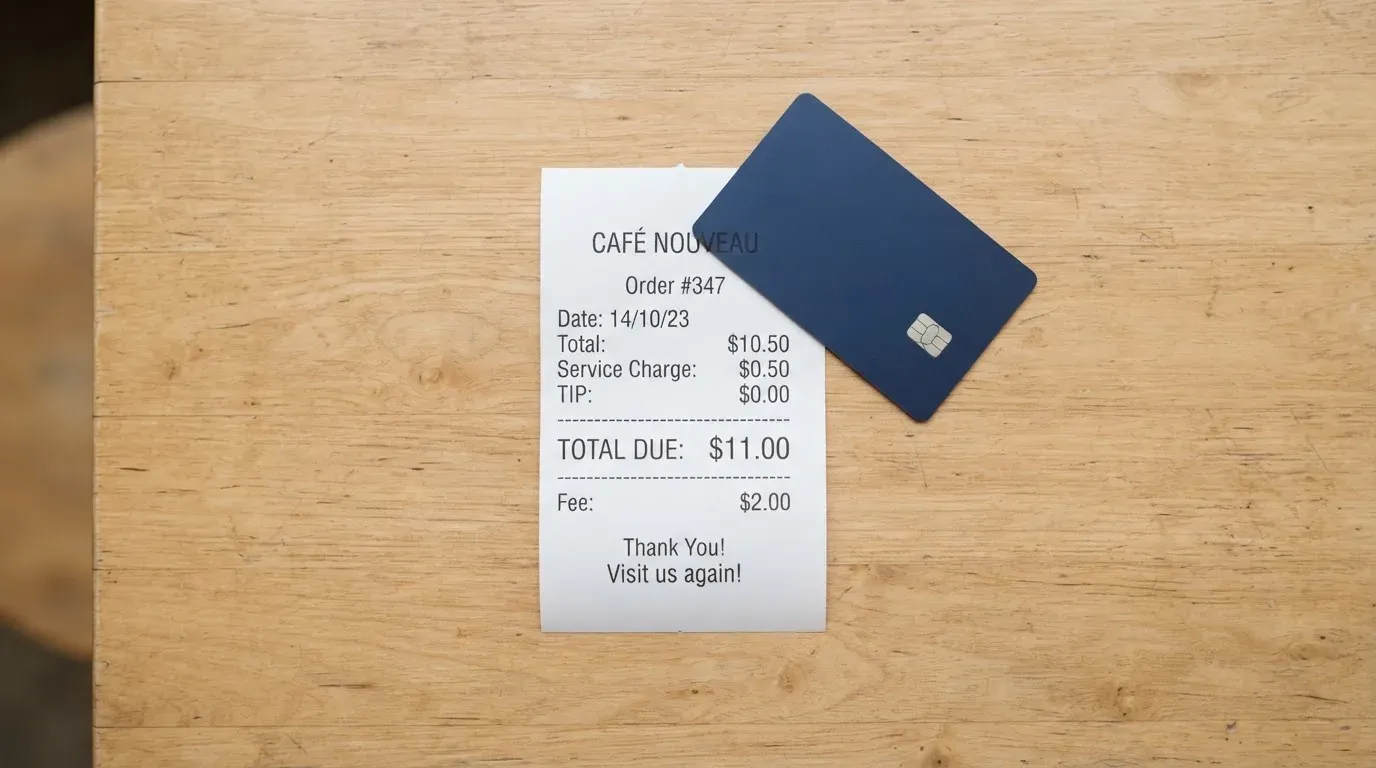
| Fee or limit | What the card says |
|---|---|
| Issuance — Standard | $3 |
| Issuance — Premium | $6 |
| Issuance — Ultra (BIN 428842) | $15 |
| Monthly fee | not stated |
| Top-up fee | $2 + 8% |
| Worked example | “$30 Top-Up = $34.40” |
| FX / currency conversion fee | not stated |
| ATM withdrawal fee | not stated |
| Minimum load — Standard | $5 |
| Minimum load — Premium, Ultra | $30 |
| Maximum, daily and monthly limits | not stated |
Now look at that table again and notice what dominates. The Standard card costs $3 to issue. Loading $30 onto it costs $34.40 — that is $4.40 of pure loading cost, plus whatever the blockchain charges you. If you only load small amounts, the $2 fixed component alone is enormous: a $5 minimum load on Standard carries a $2 plus 8% charge, so a meaningful fraction of the deposit is eaten before you spend any of it. This is why the cost score is 2/10 even though the entry price looks cheap. The card is cheap to buy and expensive to feed.
Two or three everyday payments, and which fees bite:
- A $12 coffee bought with a Standard card you loaded $30 onto. No additional fee is disclosed for the purchase itself, but the $4.40 you paid to load is already gone. If you loaded only $5 to be quick, the loading cost is proportionally far worse. The exchange rate you effectively receive is USDT converted into whatever the card spends, minus the 8% and $2.
- Anything priced in a currency other than the card’s own. The card’s currency is not stated and neither is any FX fee. That is a genuine unknown: if the card settles in dollars and you buy something priced in euros or naira, the conversion happens somewhere, and the cost lands on you. Nobody publishes here what it is.
- A larger purchase. There is no stated maximum, no daily cap and no monthly cap, so in principle you can spend the loaded balance — but because the balance is pre-loaded, the card simply runs out when the balance does. It will not overdraw; it will just decline.
The comparison to keep in mind: issuance here is $3, while the loading percentage of 8% is on the high side for the category, and it is charged on every single load. If you top up often — small amounts, weekly — that fee recurs relentlessly. If you load once, in a lump, it is a one-time haircut.
How to Top up
Funding is the narrowest part of the card, and you need to know this before you plan anything. The card accepts USDT only, and only on the TRC20 or BEP20 networks. Not TRC20 or BEP20 or Ethereum — TRC20 or BEP20, and nothing else.
Here is the sequence, and it is simpler than it looks:
- Order the card and receive a wallet address issued for that order — the address is generated per purchase, not per account, which is a sensible way to keep incoming transfers matched to deposits.
- Send USDT to that address over either the TRC20 or BEP20 network. Nothing else is accepted; USDT on any other chain, or a different coin, is not.
- Pay the top-up fee of $2 + 8% — the card’s own example is “$30 Top-Up = $34.40”.
- Submit the TXID so support can credit the balance.
A few things you should know rather than discover later:
- Network fees on your deposit are not covered by the card and are not even priced by it. Network fees are set by the blockchain, not by the card provider, so they come out of your transfer on top of the $2 + 8%. On Tron they are typically paid by burning TRX; on other chains they are paid in that chain’s own token.
- Sending on the wrong network can lose the money. Blockchain transfers are essentially irreversible. If you send USDT on a network the card does not support, or to an address that belongs to a different network, the funds can be gone and recovery is a manual, uncertain process.
- There is no stated withdrawal method. The card’s pages say nothing about cashing your balance back out, so do not assume the money is retrievable in the same way it went in. That gap deserves an answer from support before you load anything you would miss.
Why USDT-only matters: it is the most widely used dollar stablecoin, so this is not an obscure coin — but the restriction to two networks does remove options, and it ties you to those chains.
Paying with it every day
This is where the card is at its weakest, and the reason the everyday-use mark is 3/10. Be clear-eyed about what you are actually getting: a virtual card, delivered right after your TXID is verified. Not a physical card in the post. That single fact shapes everything else.
What the card does not mention, and what you would reasonably want to know:
- There is no app. No freeze button, no spending limits in-app, no push notifications, no transaction history beyond whatever support can show you.
- Apple Pay and Google Pay are not disclosed. Since the card is virtual, wallet support would be the natural way to make it usable at a physical terminal. Its absence in the card’s own information is a gap, not a “no” — but you should not plan around it.
- ATM withdrawals are not disclosed. No cash-out, no stated ATM fee, no stated ATM coverage.
- Cash-back, rewards or any incentive are not stated.
- How it converts your crypto at the moment of payment is not stated in detail — the card draws on a loaded balance, so the conversion effectively happens at load time.
- Disputes are the quiet spot. A Refund Policy is listed in the footer, but the text is not available to read. If a purchase goes wrong, you would be relying on support channels rather than a published process.
The pattern is not that the card does these things badly. It is that the card’s pages do not tell you at all, and in a review I can only report what exists. What you can genuinely say is this: a virtual card number that works online, obtained in minutes without paperwork, funded by a stablecoin you already hold. If that is the whole of what you need — a disposable number for a subscription, an online purchase from a country your bank will not serve — it does the job.
Two everyday realities apply to cards in this category generally, whichever provider you pick:
- Online payments can ask for 3-D Secure. Visa’s scheme is called Visa Secure, Mastercard’s Identity Check. For a card with no app and no stated verification process, what happens when you are challenged is worth asking about in advance.
- Some shops decline prepaid or foreign-issued cards. The first six to eight digits of a card identify the issuing institution and country; a merchant’s system can look at that and decide a card is prepaid or foreign, and decline it. A US dollar-pegged card with an unstated issuing country is exactly the kind that gets looked at twice.
What can go wrong
Let me take this section seriously, because it is where the information thinness becomes a practical risk.
- Who is behind the card is not stated. There is no legal entity, no registered address and no named issuer on the pages I read. The footer reads “© 2018 – 2026 VCCHQ” — that establishes a claimed trading period, but a copyright line is not a company. You are being asked to send real money to a website whose corporate details are not published.
- Complaint history is thin but not damning. On Trustpilot the card has 3.5 out of 5, with none in the last twelve months (as I read it on 21 October 2026). One negative report exists, from December 2021, about a delayed order. There is no official incident reported. So: no scandal, but also almost no track record under review.
- Fund segregation is not stated. You are told nothing about whether loaded balances are held in safeguarded, segregated accounts or commingled. In regulated markets a licensed electronic money institution must safeguard customer funds; whether this card operates under such a regime is not something its pages say.
- Card programmes can be closed. Cards like this are often issued by a partner institution, and the network — not the crypto brand — holds the real power. Closures follow a pattern: a notice period, then loading stops, then spending stops, then you are asked to withdraw. Combined with the card’s silence on withdrawal, that is a real tail risk worth weighing.
- Your stablecoin carries its own risks. Stablecoins are not always stable — TerraUSD collapsed in May 2022 and USDC briefly lost its peg in March 2023 — and Tether has historically frozen tokens tied to sanctioned activity. That is a fact about the coin, not about VCCHQ, but it is your exposure all the same.
- Security arrangements are not stated. No mention of two-factor authentication, instant freeze, or transaction alerts — unsurprising given there is no app, but it means your only control is the ones described above.
My honest summary of the risk picture: nothing here is alarming in itself, but a great deal is simply unknown, and you are being asked to trust a card with money on the strength of a copyright line and one old complaint.
Support contacts
The card publishes three ways to reach it: Telegram @worklinkx, WhatsApp +44 7723 833291, and the email [email protected]. Hours and languages are not stated. Given everything else is unstated, these channels are the practical substitute for a published policy — keep your TXIDs and order confirmations, because a conversation over Telegram is the record you may end up relying on.
What to take instead
If the no-KYC access here is not the problem you are trying to solve, one of these may serve you better. Here is how the alternatives I looked at compare.
| Alternative | Score | Access | Card and cost | Funding |
|---|---|---|---|---|
| VCCHQ | 4.9 / 10 | “Global”, no list, no KYC | Virtual Visa/Mastercard; $3–$15 issuance; $2 + 8% per load | USDT on TRC20 or BEP20 only |
| Cardex | 5.6 / 10 | “One crypto card, 200+ countries”, no list or exclusions | Debit crypto card on VERVE, Visa, Mastercard, UnionPay; virtual and physical; card currency Naira | USDT, USDC and BTC wallets; networks not stated |
| CardFlow | 4.9 / 10 | Aimed at Nigeria, plus “Nigerians and global users” | Virtual USD Mastercard, created in about 3 minutes; creating a virtual card is free | Bitcoin, USDT, ETH or Naira bank transfer |
| HyperCard | 4.7 / 10 | No country list; App Store says it works in “more than 176 countries” (acceptance, not eligibility) | Prepaid HyperCard; balance in USD or EUR; no fees listed on the App Store page | Deposits of crypto such as USDT, BTC, ETH, converted to USD or EUR in the app |
Read that table with care, because each of these alternatives solves a different part of the problem. Cardex scores highest here at 5.6/10 and is broader: it is a debit crypto card on four networks, offers physical as well as virtual, and takes three coins rather than one — though its card currency is Naira per its App Store listing, which suits its Nigerian focus more than a general reader. Its conversion is described as real-time at the moment of payment, with no fee percentage stated.
CardFlow matches VCCHQ’s 4.9 but removes the loading fee entirely — creating a virtual card is free, per its own FAQ — and takes Bitcoin, ETH, USDT or a Naira bank transfer. If your problem is the $2 + 8% loading charge rather than identity checks, this is the one to look at. It is aimed at Nigeria, though it invites global users.
HyperCard, at 4.7, is the closest in spirit: a prepaid card funded by depositing crypto in the app, converted to USD or EUR. Its pages list no fees, and its network is not stated on the App Store page. If you would rather hold a balance in a named currency than in dollars, that is its angle.
There is also a category-wide alternative I should name honestly: if a KYC route exists for you at all, an ordinary bank or a licensed card is still harder to lose money with, because the entity answering for your funds is named and regulated. These four are for the case where that route is closed.
Who I would recommend it to
I would recommend this card to one specific person: someone who cannot open a normal card for reasons of eligibility, who already holds USDT, who needs a virtual card number this week rather than this quarter, and who is content to lose a portion of every load in fees. For that person, VCCHQ does something the mainstream does not, and it does it quickly.
I would steer a different set of readers elsewhere:
- Anyone planning to live on this card. Three out of ten for everyday use is the card’s own weak point: no app, virtual only, no disclosed wallets or ATM.
- Anyone who will load small amounts often. The $2 plus 8% per load is the cost that decides it, and it recurs.
- Anyone whose money depends on where it is kept. No named entity, no issuer, no stated fund segregation, no stated withdrawal method — that combination is not something to build on.
- Anyone who needs Apple Pay, Google Pay or cash. None of those are disclosed here, and a virtual card without them is a browser tool, not a wallet.
If you are still weighing it, the questions I would put to support before loading money are the ones the pages leave open: what legal entity issues the card and under whose licence; what happens to a loaded balance if the programme ends; what currency the card settles in and what the FX arrangement is; whether Apple Pay and Google Pay work; and how a refund claim is actually handled. If those come back clearly, the card may deserve more than 4.9 from you. If they come back vague, your caution will be justified.
Frequently asked questions
What is the VCCHQ card?
The VCCHQ card is a virtual payment card that joins the Visa and Mastercard networks without any identity check. You choose a tier, enter an email, pay in USDT, submit the transaction hash, and support issues the card number for you to use online. It is aimed squarely at people who cannot complete ordinary bank KYC. It is a prepaid-style product: you load a balance and spend it.
How does the VCCHQ card work?
You load USDT onto the card, and the card spends from that loaded balance. Because it is prepaid rather than a true debit card, it cannot overdraw — when the balance runs out, payments simply decline. There is no app and no stated conversion detail at the point of sale. In practice your experience is: load, copy the card number into a checkout, and manage everything else through support channels.
Is VCCHQ a bank?
No — and the card’s own pages do not name any bank, legal entity, registered address or issuer. What they do show is a footer reading “© 2018 – 2026 VCCHQ”. A copyright line is a claimed trading history, not a company registration. This is the single largest gap in what I could verify, and the first thing you would want answered.
Does the VCCHQ card require KYC?
No. The card states “NO KYC” in capitals, and there are no KYC levels of any kind. The only personal detail collected is your email address. That openness is why it scores 9 out of 10 on access, and why it appeals to people whose applications are declined elsewhere. It also means you should expect no chargeback protection comparable to a bank.
Who owns VCCHQ?
That is precisely what is not stated. No owning company, founder, address or issuing institution appears on the pages I read. What I can tell you is that the site claims a history back to 2018, and that on Trustpilot it carries 3.5 out of 5 with no reviews in the last twelve months and one complaint, from December 2021, about a delayed order.
How do I get a VCCHQ card?
Four steps: pick Standard, Premium or Ultra; enter your email; send USDT to the address given for that order; then submit the transaction hash so support can verify the payment. The card describes delivery as instant once the TXID is checked. There is no application form, no documents and no identity check — and the minimum age is not stated on the pages.
How much does a VCCHQ card cost?
Issuance is cheap — $3 for Standard, $6 for Premium, and $15 for Ultra with BIN 428842. But loading is not: each top-up costs $2 plus 8%, so the card’s own example of a $30 top-up comes to $34.40. Network fees on your blockchain transfer are extra and are set by the chain, not the card. No monthly, FX or ATM fee is disclosed.
How do I top up the VCCHQ card?
Send USDT to the per-order wallet address the card generates, using either the TRC20 or BEP20 network, and nothing else. Then submit the TXID. Be careful: USDT on any other network, or a mismatched address, can be lost, because blockchain transfers are irreversible. The card does not state any withdrawal method, so check that before loading funds you would want back.
Is the VCCHQ card safe?
There is nothing here that would alarm you, but a great deal is simply unknown. No legal entity, issuer or fund-segregation policy is stated; security features are not stated; the single complaint dates from December 2021. My reading is that the risk is not fraud so much as opacity — you would be relying on a support conversation over Telegram, WhatsApp or email rather than a published policy.
Is the VCCHQ card worth it?
Worth it if KYC is the wall you are up against and you already hold USDT — access is excellent and it takes minutes. Not worth it if you will load small amounts often, since the $2 plus 8% recurs every time, or if you need a physical card, an app, Apple Pay or cash, none of which are offered. My overall mark is 4.9 out of 10.
Virtual card reviews – cryptocardcheck
Content created by the «cryptocardcheck» team