
Gleec Visa card reviewed: crypto spending, slim on disclosed fees
 Available in US
The Gleec card promises a familiar thing in an unfamiliar wrapper: a Visa you can spend from, funded not by a bank account but by crypto. If you have ever been refused a debit card, or you simply prefer to keep your spending tied to digital assets, the pitch is direct. You hold Gleec Coin, Bitcoin or a stablecoin, you top up a Visa in the app, and the merchant sees an ordinary card payment. The real question is whether the product behind the pitch holds up: who actually qualifies, what the fees are, and what happens if the company behind it has a bad month.
Conditions are current as of October 28, 2026.
This is a review of the Gleec card as it stands. I worked from the card’s own pages, the terms, the iOS app listing, and a small set of third-party sources, and I checked the facts in late October 2026. Where the card’s own pages do not say something, I say so plainly. The conditions are current as of 2026-10-20.
Verdict
Gleec scores 6.9 out of 10. That is a solid middle-of-the-pack result for a crypto card: the bones are there, a Visa network, plastic and virtual, ATM access, Apple Pay support, but the public information is thin, and the things that are not said (specific fees, licence details, the issuing bank) matter as much as the things that are.

In broad strokes, here is how the card breaks down across the criteria that drive the score.
| Criterion | Mark | Why |
|---|---|---|
| Who can get it | 8 / 10 | Marketed as “worldwide” for payments; explicit list of prohibited jurisdictions covers Afghanistan, Cuba, Iran, Iraq, Libya, North Korea, Syria, Yemen, Zimbabwe and around 20 others; no full eligible-country list is published. |
| Cost | 7 / 10 | The card’s own page says “convenience without abusive fees” and “no hidden fees”, but no actual numbers are given. Third-party reporting from 2022 (possibly outdated) suggests the physical card is free apart from delivery, with no foreign-transaction fee. |
| Top-up options | 6 / 10 | Gleec Coin, Bitcoin, Ethereum, USDT and other coins, converted to fiat in the app. Networks, on-chain fees and minimums are not disclosed. |
| Reliability and complaints | 6 / 10 | Operated by Gleec-BTC OÜ, an Estonian company, but the issuing bank and licences are not named. I could not find any public Trustpilot or Reddit complaints about the card. The iOS app has 4 ratings, all 5-star, which is too small a sample to mean much. |
| Everyday use | 7 / 10 | Visa acceptance, ATM withdrawals, virtual card works with Apple Pay, Google Pay is not mentioned. Blocked merchant categories are not stated. |
The audience this card fits best is people who already hold Gleec Coin or Bitcoin, live somewhere ordinary banking is hard to come by, and want a Visa they can spend with. If you want a card from a fully named issuer with disclosed fees and a track record you can search, this is not the one.
Who will they give you the card
The card’s own page talks about acceptance in broad strokes: payments are “worldwide”, which is a statement about where the card will be accepted by merchants, not about who can apply. The eligibility side is much narrower. The terms bar residents of what Gleec calls its Prohibited Jurisdictions. The list is the familiar sanctions-cluster plus a few extras: Afghanistan, Cuba, Iran, Iraq, Libya, North Korea, Syria, Yemen, Zimbabwe, and others. The terms also leave Gleec room to restrict other regions at its own discretion.
There is no published, country-by-country list of who *is* eligible. If you live somewhere that is not on the prohibited list, you may be able to apply, but you will only find out at the identity-verification stage. That is not unusual for this corner of the market, but it does mean you cannot tell from the website whether the card is for you before you sign up and hand over documents.
The card is also not for minors. The terms require users to be at least 18, and the eligibility flow will check your age along with the rest of the identity checks. People on sanctions lists are excluded, in line with what one would expect of any regulated payments product.
The category background matters here. In the EU, customer due diligence under anti-money-laundering rules requires the issuer to collect name, address, date of birth, nationality and identity documents, to run a sanctions check, and to ask what the relationship is for. The card is run by an Estonian company, and the rules the issuer follows will look a lot like this even if the company is not itself a bank. If you cannot complete the checks, the issuer is required to refuse you, and the card’s terms give it that option.
How to get it
The signup path is not laid out step by step on the card’s own pages. The terms point to a separate KYC and AML policy, and the only detail I could find outside the official pages (an unofficial 2022 report from crypto.news, almost certainly outdated) is that onboarding includes identity verification. The shape of the signup will be familiar if you have used a crypto on-ramp before: download the iOS app, create an account, complete the KYC checks, choose virtual or physical card, and fund it.
The card itself is a Visa, available in both plastic and virtual form. The App Store listing describes a physical card or a virtual card for Apple Pay. The currency the card settles in is not stated, which is unusual: most crypto cards will tell you, at least in passing, that the balance is in euros, dollars or a multi-currency wallet. With Gleec, you only learn the card currency at the point of funding, when the app converts your crypto into whatever the card balance is denominated in. I would not be comfortable starting the signup without knowing which currency the balance will be in; that is something to confirm in-app before you send any crypto.
Delivery timelines for the plastic card are not published. A crypto-to-fiat card that is silent on shipping is a small flag: if you need the card urgently, do not assume it arrives in a week. The virtual card, if it is the same as at the beta launch, is issued immediately and is what you would use with Apple Pay while you wait for the plastic to arrive.
What you do not get from the official pages is a sense of how heavy the KYC is, how long it takes, or what the success rate is. Unofficial reports say the onboarding is “short”, but the lack of any official description, beyond pointing to a separate KYC policy, means the only way to know is to start.
What it really costs
This is the section where the gap between the marketing and the details is widest. The card’s own page says “convenience without abusive fees”, and the App Store listing says “no hidden fees”. Both are claims, not fee tables.
A 2022 report from crypto.news (unofficial, and almost certainly outdated by the time you read this) says the physical card is free to obtain apart from a delivery fee, and that foreign-transaction fees are zero. If that still holds, it is competitive. But neither the card’s own pages nor the app listing gives an issuance fee, a monthly fee, a conversion fee, a foreign-exchange margin, an ATM fee, or an ATM allowance. There is also no published daily or monthly spending limit. The App Store listing describes the limits as “high”, which is not a number.
The pattern in this part of the market is that the headline fee is often the issuance or monthly fee, and the real cost is in the spread between the on-chain crypto price and the rate at which the app converts it to fiat. With Gleec, the spread is not disclosed.
Here is what the official and unofficial sources add up to.
| Fee or limit | What Gleec says | What third parties say (unofficial, possibly outdated) |
|---|---|---|
| Card issuance | Not stated | Free apart from delivery of the physical card (crypto.news, May 2022) |
| Monthly fee | Not stated | “Monthly fees are low” (crypto.news, May 2022) |
| Crypto-to-fiat conversion | “Convenience without abusive fees” | No figure (crypto.news, 2022) |
| Foreign transaction / FX | “No hidden fees” | Zero (crypto.news, May 2022) |
| ATM withdrawal | Supported (App Store listing) | Fee and allowance not stated |
| Daily and monthly spending | “High spending limits” (App Store listing) | Up to €10,000 per month (crypto.news, May 2022) |
| Card currency | Not stated | Not stated |
| Tiered plans (metal, premium, etc.) | Not stated | None published |
Three everyday payments, walked through the lens of what *is* stated.
You buy a train ticket at a French rail website with the virtual card tokenised in Apple Pay. The merchant sees a Visa. The conversion from whatever crypto you loaded happens inside the app; the spread between the on-chain rate at the moment you topped up and the rate the app used is the cost you cannot see. The merchant is paid in euros; if your card balance is in a different currency, the Visa cross-border rate applies and you eat that, too. The card’s own page does not quote either number.
You tap a €5 coffee in Berlin with the plastic card. Same conversion question, same lack of a published spread. If the foreign-transaction fee really is zero (unofficial, 2022), you save on what a normal bank might charge. The catch is that you do not know what the issuer’s FX margin is, and that is where crypto cards tend to make their money.
You pull €100 out of an ATM in Lisbon. The App Store listing confirms ATM withdrawals are supported. Whether the issuer charges a flat fee, a percentage, or a monthly allowance is not stated. The 2022 reporting is silent on ATM. This is the place where crypto cards most often sting the user, because flat fees of a few euros plus a percentage of the withdrawal can quickly add up.
The honest summary: the card presents itself as fee-light, and it may well be, but the public information does not let you check. Before you commit any meaningful balance, top up a small amount, make a small purchase, and check the app’s history for what was actually deducted.
Top up
Funding the card starts with a transfer. The App Store listing names Gleec Coin, BTC, ETH and USDT as the supported assets; the card’s own page broadens that to “Gleec Coin, BTC and other crypto”, with the conversion to fiat happening inside the app. The page also says the top-up happens “in seconds”, which is the same language you see from many crypto card providers and usually refers to the time from a confirmed on-chain transaction to a spendable balance.
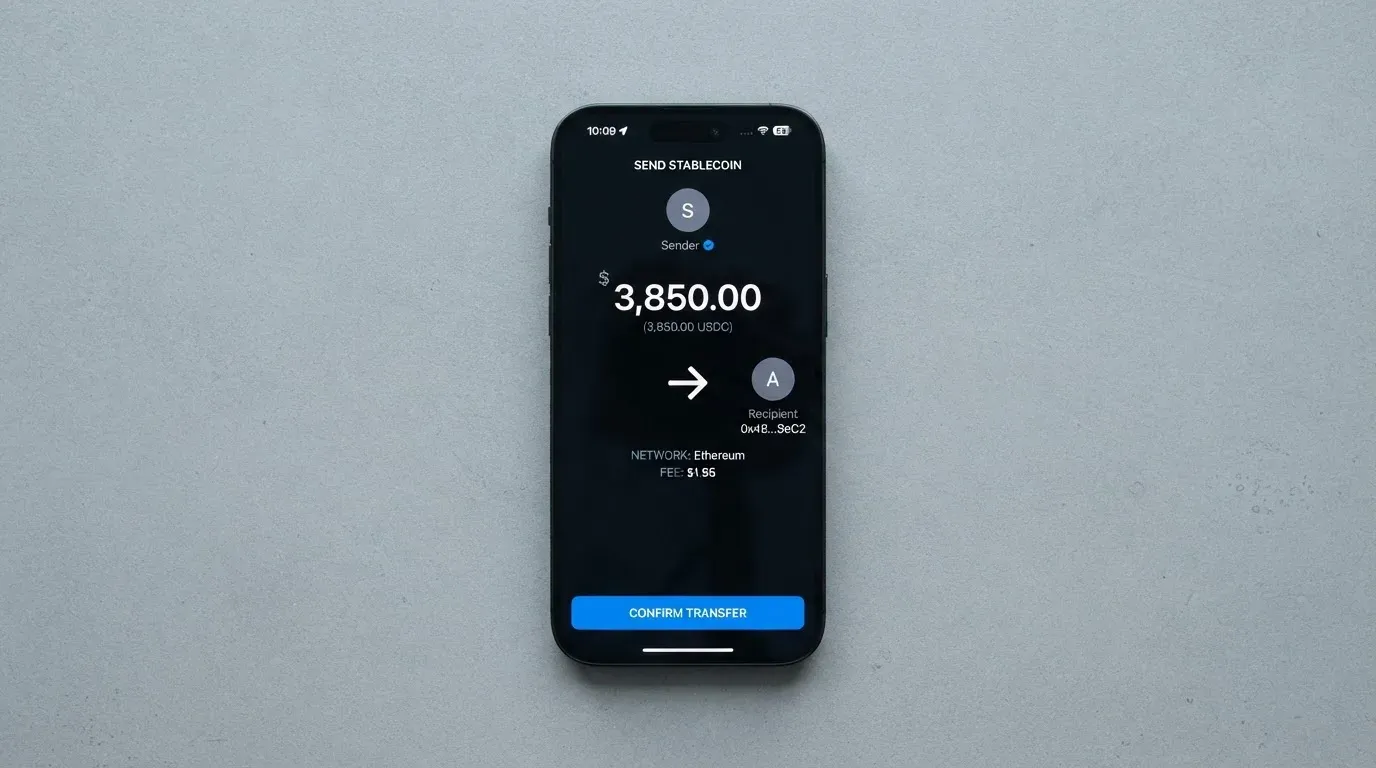
Three things are not stated, and they are the things that catch people out.
First, the networks. ETH can be sent on Ethereum mainnet, Arbitrum, Base, Optimism, Polygon, and others. USDT can be sent on Ethereum (ERC-20), Tron (TRC-20), Solana, Avalanche, Polygon, and more. A deposit sent on a network the card provider does not support can be lost, or at best stuck in a manual recovery process with no guarantee. Category background: blockchain transfers are irreversible, and a stablecoin sent to the wrong network, or to an address on the wrong chain, is not something the card company can simply undo. Always check which network the app expects *before* you send.
Second, the on-chain fee. Whatever the card charges on top, you will also pay the network fee (gas on Ethereum and EVM chains, bandwidth and energy on Tron, paid in TRX). That is a function of the blockchain, not of Gleec, but it is a real cost on Ethereum in particular. If you are topping up a small balance, an ERC-20 USDT transfer can cost more in gas than the value of the top-up.
Third, the minimum and the rate. Neither is published. With most crypto cards, there is either a minimum top-up (a few euros or dollars) or a minimum conversion amount, and the rate used is the app’s quoted rate at the moment you confirm. The card’s pages do not say what the rate source is (a major exchange, an aggregated mid-market price, a proprietary feed) and they do not say whether the rate includes a margin.
For cashing out, the App Store listing says crypto can be withdrawn at any time, with funds sent to a bank “in seconds”. Again, the fees for that path are not stated. In practice, “in seconds” usually describes the in-app balance movement, not the bank transfer itself, which can take a working day or two depending on the rails and the destination country.
If you are topping up from a hardware wallet or an exchange, send a test transaction first. This is the single most useful habit for any crypto card.
Paying with it every day
Once the card is loaded, the day-to-day experience is meant to feel like any other Visa. The plastic card works at point-of-sale terminals and online, the virtual card works for online payments, and the virtual card can be added to Apple Pay. Google Pay is not mentioned on any of the official pages I read, which is a real gap if you are on Android. Many Android users in this market simply do not have a tap-to-pay option.
ATM withdrawals are supported (the App Store listing confirms this) but the fee and allowance are not stated. ATM is the area where I would most expect to find a hidden cost, so if you plan to use the card for cash, test with a small withdrawal first.
What the card does not tell you is also worth knowing. The blocked merchant categories are not published. Most crypto cards, even the most permissive, block gambling (MCC 7995) and a few other high-risk categories, but the list varies by issuer and by programme. If you need the card for a specific category, ask support before you load it.
The app is the iOS app “Gleec Card Crypto-powered card”, free, at version 34.8 as of 19 May 2026. The rating on the App Store at the time of checking was 4 from 4 ratings. Four ratings is not a track record; it just means the people who reviewed it liked it. I did not check the Google Play listing.
There is no mention of rewards, cashback, staking yield, or any incentive for spending. That is consistent with a card that positions itself as a utility: a way to spend what you already hold, not a way to earn.
Disputes (chargebacks, fraud claims, merchant non-delivery) are not addressed in the public pages. The general category background is that a chargeback is a refund ordered by the card issuer under network rules, and that the rights attached to a prepaid card vary by jurisdiction. If you ever need to dispute a transaction, the only route described in public is the support email, and you should expect to be asked for receipts and a written explanation.
What can go wrong
The honest list of risks for this card is shaped as much by what is not said as by what is.
The company behind the card is Gleec-BTC OÜ, registered in Estonia, registration number 14477970, with a registered office at Tornimäe 5, 2nd floor, 10145 Tallinn. The terms were last updated on 6 June 2023. The issuing bank is not named in the public materials I read, and neither are the licences the card is issued under. The card is on the Visa network, but Visa does not issue cards to consumers directly; it licenses issuers. Not knowing who the issuer is, and under what licence they are operating, is a real gap. In a card programme collapse, the named issuer is who you would turn to.
A small bit of category context: in the EU, an electronic money institution (EMI) can issue e-money, payment cards and e-wallets but cannot lend, and customer funds must be safeguarded, typically by segregation in dedicated accounts or insurance, but those safeguarded funds are not bank deposits and are not covered by deposit guarantee schemes. Under MiCA, the EU’s crypto regulation that took effect in stages from June 2023, e-money tokens may be issued only by a credit institution or an electronic money institution. The card’s pages do not say which of these the issuing setup is.
The card programme itself could be wound down. The category has examples. In November 2022 Visa terminated its global agreements with FTX and the FTX US debit card was wound down by its issuer. In 2018, WaveCrest, which supplied several crypto card brands in Europe, was suspended by Visa and every WaveCrest-issued Visa programme closed. A 2026 closure of an unrelated programme was reported by a single secondary source, with new loads ending 8 July 2026 and spending stopping 8 August 2026, which I could not confirm and you should not rely on. The general pattern is that programme closures give a notice period, stop spending, then ask users to withdraw any remaining balance, and the speed of the wind-down depends on the issuer and the regulator.
The crypto side has its own risks. If you top up from a custodial exchange, you carry the exchange’s counterparty risk: exchanges have failed before, with Mt. Gox (about US$350 million reported stolen between 2011 and 2014), Coincheck (about US$400 million in 2018), and Ronin Network (US$625 million in 2022) the historical examples. If you top up from your own self-custody wallet, you carry the risk of lost keys, phishing, and clipboard-hijacking malware that swaps the address you copied. Crypto transfers are irreversible, and a stolen private key has no built-in recovery.
The app-side security is also not described in detail. An unofficial 2022 report says the wallet uses two-factor authentication and encryption, but that is the wallet, not the card. The card’s own pages do not say whether the app uses 2FA, whether the card supports instant freeze, or whether 3-D Secure is enabled by default. 3-D Secure (Visa Secure, in this case) is the standard online-payment step-up that requires the cardholder to confirm with a one-time code or biometric. Assume it is available, but do not assume it is on.
Support is through [email protected] and the in-app chat, which the App Store listing describes as 24/7. The app listing is in English only, which may be relevant if you are more comfortable in another language. Customer support quality is one of the most common things crypto card users complain about when things go wrong, and I could not find any Trustpilot or Reddit reviews of the card to compare against. The absence of complaints is not the same as a good track record; it can simply mean the card has not been widely used yet, or that the people who had a problem did not write about it in a place I can find.
There is one more risk worth naming: sanctions and jurisdiction. The card’s terms bar residents of the Prohibited Jurisdictions, and Gleec reserves the right to restrict other regions at its own discretion. If you live in a country whose status changes, or if you move, the card can stop working for you. The terms also require users to be at least 18, not on sanctions lists, and to pass the standard identity checks. Nationality is screened separately from residence, because sanctions policy is often applied to citizenship and country of birth as well as to the country of address.
What to take instead
If the parts of the Gleec card that are not stated worry you more than the parts that are, the alternatives below are the cards in the same broad crypto-to-Visa category that I considered for this review. None of them is a perfect swap, and each has its own gaps. I have given each a score out of 10 from the same research.
Cardex scores 5.6 out of 10. It positions itself as a single card for “200+ countries”, which is a wider claim than Gleec’s, but the public pages do not actually list the eligible countries or exclusions. The card runs on VERVE, Visa, Mastercard and UnionPay, which is unusual and useful if you need any of those networks. Card currency, per the App Store listing, is Naira. The headline feature is a real-time crypto-to-fiat conversion at the moment of payment, with what the site calls an “AI-Powered Conversion Rate” that scans global exchanges and picks the best one. There is no published fee percentage, and the funding assets (USDT, USDC, BTC) are listed without networks. Rewards are not described.
CardFlow scores 4.9 out of 10. It is aimed at Nigeria, with the site describing it as “Nigeria’s smartest fintech card platform” and “Nigerians and global users”. The card is a virtual USD Mastercard, created in a few minutes. The site FAQ says creating a virtual card is free, and the monthly fee is not stated, nor is the per-transaction fee. Funding is via Bitcoin, USDT, ETH or a Naira bank transfer; networks are not stated. Like Cardex, it does not describe a rewards programme.
HyperCard scores 4.7 out of 10. The official pages do not state a country list. The App Store page says the card works in “more than 176 countries”, which is a statement about acceptance, not about who can apply. It is a prepaid “HyperCard” on a network that is not named on the App Store page, with a balance in USD or EUR. No fees are listed. Funding is by depositing crypto such as USDT, BTC or ETH in the app, converted to USD or EUR on the card. Networks are not stated. No rewards are described.
If you want a card from a fully named issuer with disclosed fees and a long public track record, you are not in this row of alternatives. You are looking at cards from regulated e-money institutions in the EU or UK with public fee tables, and that comparison is wider than what I have presented here.
Who I would recommend it to
The Gleec card is a reasonable choice if you already hold Gleec Coin or Bitcoin, you live somewhere ordinary banking is hard to get, and you are comfortable being an early user of a programme whose issuer and licence are not named in public. It is also reasonable if you are testing the water on crypto-to-fiat spending in general, you plan to load small amounts, and you will be alert to the spread at the point of conversion and to the ATM fee if you withdraw cash.
I would not choose it if you need a card with a fully transparent fee table, a named issuer and licence, support for Google Pay on Android, or a long public track record. The gap between the marketing (“no hidden fees”) and the disclosure (no fee table) is the part that would stop me from loading a large balance. The card is also not the right choice if you are in one of the Prohibited Jurisdictions, or if you cannot pass standard KYC, or if you need a card that explicitly supports a specific merchant category the issuer has not confirmed.
If you do decide to try it: start with the virtual card, top up a small amount from a self-custody wallet, send the crypto on the network the app tells you to use, and check the app’s transaction history to see what was actually deducted before you load anything more.
Frequently asked questions
What is the Gleec card?
The Gleec card is a Visa debit card issued by an Estonian company called Gleec-BTC OÜ. It comes in plastic and virtual form, and it is funded by crypto: Gleec Coin, Bitcoin, Ethereum, USDT and other coins, converted to a fiat balance inside the app. The card’s own pages describe it as a payment card for worldwide use with “no hidden fees”, though the actual fee table is not published.
How does the Gleec card work?
You create an account in the iOS app, pass the identity checks, and choose a virtual or physical Visa. You send crypto from your own wallet or an exchange to the address the app gives you, the app converts it to a fiat balance, and you spend the balance with the card. ATM withdrawals are supported. The virtual card can be added to Apple Pay.
Is Gleec a bank?
No. Gleec-BTC OÜ is an Estonian company, not a bank. The card is on the Visa network, and Visa itself does not issue cards to consumers; it licenses issuers. The card’s own pages do not name the issuing bank or the licences under which the card is issued, which is one of the gaps to be aware of.
Who owns Gleec?
The card is operated by Gleec-BTC OÜ, registered in Estonia under registration number 14477970, with a registered office at Tornimäe 5, 2nd floor, 10145 Tallinn. The terms of service were last updated on 6 June 2023. The wider ownership of the company is not described in the public materials I read.
Is the Gleec card available in my country?
The card’s page says payments are “worldwide”, which is about merchant acceptance, not about who can apply. The terms list a set of Prohibited Jurisdictions (Afghanistan, Cuba, Iran, Iraq, Libya, North Korea, Syria, Yemen, Zimbabwe, and others) and let Gleec restrict other regions at its own discretion. If you are not in the prohibited list, you may be able to apply, but the only way to know is to start the signup and pass the identity checks.
Does the Gleec card require KYC?
Yes. The terms require users to be at least 18, not on sanctions lists, and to pass identity checks under a separate KYC and AML policy. The full KYC steps are not described on the public pages; an unofficial 2022 report says onboarding includes identity verification. In the EU, regulated issuers are required to collect name, address, date of birth, nationality, identity documents, run sanctions checks, and assess whether the customer is a politically exposed person.
How do I top up the Gleec card?
You send crypto from your own wallet or an exchange to the deposit address the app gives you, choosing the network the app specifies. The app converts the crypto to a fiat balance, and the card spends that balance. Supported assets, per the App Store listing, include Gleec Coin, BTC, ETH and USDT; the card’s own page broadens this to “Gleec Coin, BTC and other crypto”. The networks, fees and minimums are not published. Send a test transaction first.
Is the Gleec card free?
The card’s own pages say “convenience without abusive fees” and “no hidden fees”, but the actual fee numbers are not given. An unofficial report from May 2022 (possibly outdated) says the physical card is free apart from delivery and that foreign-transaction fees are zero. There is no published monthly fee, conversion fee, ATM fee or spending limit. Treat the official claim as marketing, not as a fee table.
How do I add the Gleec card to Apple Wallet?
Open the app, go to the virtual card, and follow the prompt to add it to Apple Pay. The virtual card works with Apple Pay according to the App Store listing. Google Pay is not mentioned on any of the official pages I read, so Android users may not have a tap-to-pay option.
Is the Gleec card safe?
The card is on the Visa network, which means online payments can be protected by 3-D Secure (Visa Secure), and the virtual card uses tokenisation through Apple Pay so the real card number is not stored on Apple servers. Beyond that, the card’s pages do not describe 2FA, instant card freeze, or other app-side safeguards in detail. The bigger question is counterparty risk: the issuing bank and licences are not named in public, and the card’s programme can in principle be wound down, as has happened with other crypto cards in the past.
Virtual card reviews – cryptocardcheck
Content created by the «cryptocardcheck» team