
Bitypay looks free on paper, but the card's own pages don't say much
 Available in US
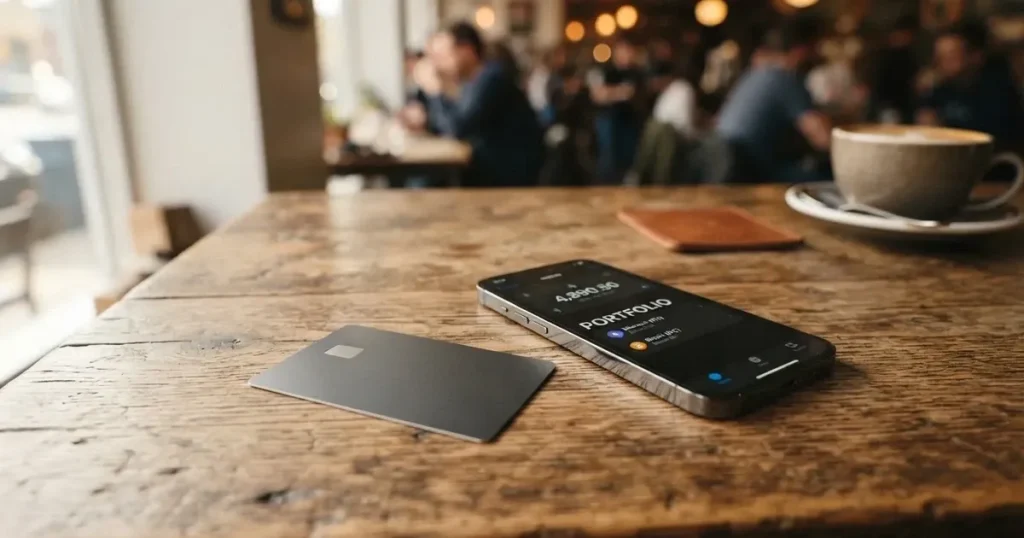
If you have been refused an ordinary bank card, or you live somewhere where opening one is a months-long project, then a crypto-linked card is not a hobby for you — it is a practical question. The Bitypay card comes up in that conversation, and on paper it reads like the answer: a Visa Infinite, virtual and physical, spending straight from stablecoins you already hold, with fees listed as free. The problem is that almost none of that is confirmed by Bitypay itself. You should treat the details in this review as unverified until you have read the card’s own pages with your own eyes.
Conditions described here are current as of October 28, 2026.
Verdict: 7.4 out of 10, with an asterisk
My score for the Bitypay card is 7.4 out of 10. That is a good number for a card whose details I could not read on the official site, and it is not a number you should treat as a recommendation to apply today. The score splits into six parts, and the shape of the split matters more than the total.
| Criterion | Mark | Why |
|---|---|---|
| Who can get it | 6 / 10 | Issuing countries are not disclosed and the official site was unreachable; unofficially, full “Level 4” verification, and one Reddit comment suggests access depends on your citizenship |
| Cost | 9 / 10 | Unofficially, issuance and the monthly fee are free, FX and ATM free, USDC top-up 0%; on the same page, transaction and maintenance fees are “not publicly disclosed” |
| Top-up options | 7 / 10 | USDC held as collateral in a self-custody wallet on Base or Arbitrum; unofficially USDC and USDT |
| Reliability and complaints | 6 / 10 | Brand owned by Codego Group, issuer and licences not named, official site returned 403; unofficially self-custody; no complaints found for this card |
| Everyday use | 9 / 10 | Unofficially, Visa Infinite, virtual and physical, Apple Pay and Google Pay, contactless, ATM with no fee |
| Total | 7.4 / 10 | High marks where behaviour matters, low marks where paperwork and identity would matter |
Two things stand out. The card scores 9 on cost and 9 on everyday use, and both of those scores rest entirely on unofficial sources. It scores 6 on who can get it and 6 on reliability, and those are the categories where the missing official site hurts most. In other words: the Bitypay card looks strongest exactly where I could verify it least. Read the rest of this page with that in mind.
So who does this card suit? On the evidence, it suits you if you already hold USDC, you want a Visa Infinite that spends that balance, and you are comfortable treating the fee schedule as something to confirm yourself before you rely on it. The audience this card is built for, in short, is a holder of USDC who wants a Visa Infinite card.
And who should keep away? If your priority is knowing in advance exactly what a payment will cost you, this is the wrong card today, because the transaction and maintenance fees are exactly what nobody has published. If you are in a country where you are not sure you are eligible, this is also the wrong card to try first, because the issuing countries are not stated and one report suggests citizenship gates access. I would rather you read that as “come back to this in six months when the site is up” than as “give it a try and see.”
Will they give you the card?
Here is the plainest thing I can tell you, and it is not what you hoped to hear: Bitypay’s public pages do not state which countries it issues cards in. That is the finding. The site did not load for me, so I have no official list of eligible countries, no official residency rule, no official age rule, and no official statement about whether your nationality matters.
What I do have is a single unconfirmed comment on Reddit, reported second-hand, suggesting that whether you can use the card depends on your citizenship and on regulatory gating. I have not read the thread; I am telling you it exists because it is the only signal I found about eligibility, and one comment is not a rule. Treat it as a reason to ask before you invest an afternoon in onboarding.
The general rule of thumb in this category, which is not Bitypay-specific, is that cards like this are usually open to adults of 18 and over, and some issuers set higher limits on that. But that is the category default, not a Bitypay term. I am not going to dress a default up as a promise.
What this means for you in practice: you cannot pre-qualify yourself from public information. If you are someone who has been turned down by regular banks, the temptation is to treat “not stated” as “probably yes, probably for me.” I understand the temptation. But the honest reading is that you will find out only by starting the application, and the starting point costs you time and your identity documents. Decide whether you are willing to spend that before you begin.
How to get it
Bitypay’s own pages do not state the application steps, the verification requirements, the card format, or the delivery terms. That is the whole official picture, and it is blank.
What a third-party card directory describes, unofficial and unconfirmed by Bitypay as far as I can tell: sign-up involves a full “Level 4” verification — email, phone, identity document, proof of address, and a selfie. If you have been through crypto KYC before, “Level 4” will feel familiar; it is the deepest tier most platforms use, and it is the tier where the address proof is not optional.
The same directory describes the card itself, unofficial: a Visa Infinite, available as both a virtual and a physical card. That matters more than it sounds. A physical Visa Infinite is a specific tier of card — it carries lounge access and a higher level of acceptance expectation than a plain debit card. It is also the single most useful thing to confirm yourself, because “we issue a Visa Infinite” and “we issue a card that looks like a debit card with Visa on it” are very different products.
Delivery time, delivery cost, and which countries ship are not stated. If you need the physical card quickly for a trip, that is a question to ask before you order anything.
My honest guidance: read the unofficial steps as a reasonable guess at the shape of the process, but assume nothing about how long it takes or what it costs. The categories worth double-checking once you are inside the app are the verification list (is proof of address really required?), the card tier (is it really Infinite?), and delivery.
Fees: what a payment really costs
The cost of using this card is the part I can tell you least about, because Bitypay’s own pages do not publish a fee schedule. Here is the third-party picture, unofficial, and you should read the internal contradiction at the end of the table as seriously as I did.
| Fee or limit | What the third-party source says | Confirmed by Bitypay? |
|---|---|---|
| Card issuance | Free | No — not stated officially |
| Monthly fee | Free | No — not stated officially |
| Foreign-exchange fee | Free | No — not stated officially |
| Declined transaction fee | Free | No — not stated officially |
| ATM withdrawal fee | Free | No — not stated officially |
| USDC top-up fee | 0% | No — not stated officially |
| Transaction fees | “Not publicly disclosed” | No |
| Maintenance fees | “Not publicly disclosed” | No |
| Daily spending limit | Unlimited | No — not stated officially |
| Monthly spending limit | Unlimited | No — not stated officially |
| ATM limit | Unlimited | No — not stated officially |
| Card currency | Not stated | No |
There is a contradiction inside that third-party page that you should notice before you trust any of it. The same page lists issuance, monthly, FX and decline fees as free, and on that very same page says transaction and maintenance fees are “not publicly disclosed.” A page cannot both tell you the fees are free and tell you they are not disclosed. Either the free entries mean “no separate fee item exists for this” while the real charges live inside an undisclosed transaction fee, or the disclosure is simply incomplete. I cannot tell you which, and neither can anyone who did not read a fee table that does not exist publicly.

Now let me walk through three ordinary payments, because that is where abstract fees become real money.
A coffee in your own country. You tap the card, the terminal asks Visa’s network to route the payment, and somewhere a stablecoin balance is converted to your local currency at the network’s rate. If the FX fee is genuinely free and there is no undisclosed transaction fee, this coffee costs you roughly what a normal bank card coffee costs. If there is an undisclosed transaction fee, every tap of this kind carries it. You cannot tell which from public information.
A purchase in a currency you don’t hold. This is the payment most likely to expose a hidden fee. The claim is that the FX fee is free, which would make a Bitypay card unusually generous compared with most bank cards. Again: unofficial, and sitting next to a row on the same page that says fees are undisclosed. If FX really is free and you spend abroad a lot, that is the strongest argument for this card and the argument I would test first, with one small transaction, before you commit.
A cash withdrawal from an ATM. The claim is no ATM fee, and no limit. If that holds, this is a card that does not ration your cash. Unofficially, of course, and ATM limits are a place where issuers routinely tighten terms without announcement.
The category lesson that applies regardless of Bitypay: on-chain network fees for your deposit are charged by the blockchain, not by the card provider. So a “0% top-up fee” can still leave you paying a few dollars of gas on the way in. Those are two different costs, charged by two different parties.
The honest summary of this section: Bitypay’s cost profile is the strongest part of the card on paper and the least documented part of the card in reality. Before you rely on any of it, find one real transaction, small, and see what your statement says.
Top up: how money gets onto the card
The one confirmed fact about funding is the design: USDC is held as collateral in a self-custody wallet, on Base or Arbitrum, and the card spends over Visa’s rails with no manual conversion step. That is from the card’s own material, not a third party. It tells you the shape of the system, and the shape is the interesting part.
Self-custody means you keep the private keys. In plain terms: control of the crypto belongs to whoever holds the private key or seed phrase. With a custodial wallet, the provider holds the credentials and you have to trust them completely; with this one, the funds stay in your own wallet until the moment of payment. The catch that comes with that arrangement is equally clear from the category: the user bears sole responsibility for key loss, for phishing, and for clipboard-hijacking malware that swaps a copied address. A seed phrase — typically 12 to 24 words — is the unencrypted private key itself, and anyone who obtains it can restore the wallet and spend the funds. Blockchain transfers are also typically irreversible; a stolen key has no built-in recovery, because the network cannot freeze or return what it never sees.
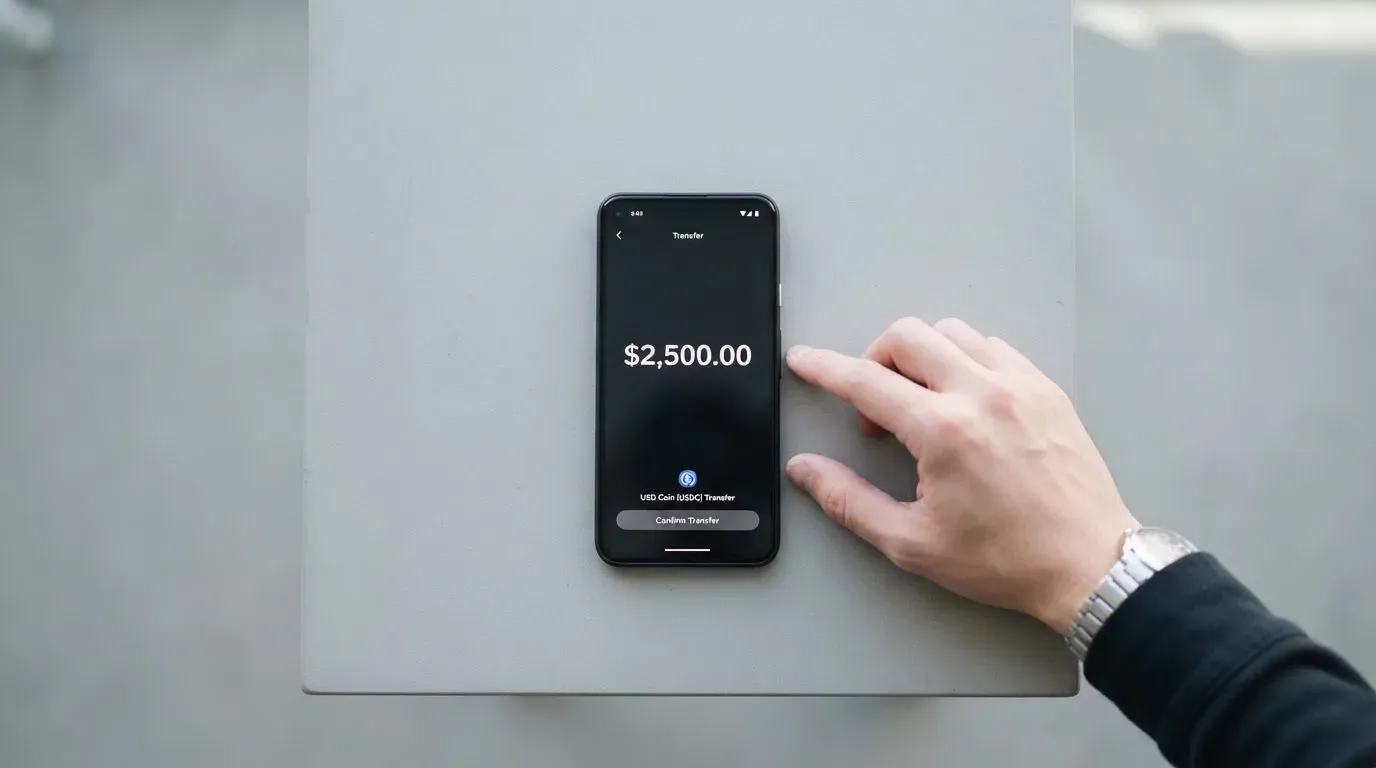
The rest of funding is unofficial. A third-party directory adds USDT alongside USDC, repeats Base and Arbitrum as the networks, and claims a 0% deposit fee on USDC. Whether you can top up in USDT, and whether that deposit fee is really zero, is something to confirm in the app.
Here is the single most practical warning in this whole review. A deposit sent on a network the card provider does not support, or sent to an address belonging to a different network, can be lost entirely, or need manual support recovery with no guarantee of success. “USDC over the wrong network” is the classic way people lose money with cards like this. If the app tells you Base or Arbitrum, send on Base or Arbitrum — one of those two — and nothing else.
The category background also explains why your top-up can cost money even at 0%. ERC-20 is the Ethereum token standard; gas is paid only in ETH, so a wallet holding USDT with no ETH cannot send. Tron prices fees with bandwidth and energy resources and often burns TRX. And Circle stopped supporting USDC on Tron in February 2024, so “USDC over TRC20” is not a native option — an old tutorial telling you to send USDC on Tron is out of date.
Paying with it every day
Unofficially, this is a Visa Infinite you can hold virtual or physical, add to Apple Pay and Google Pay, and tap — and the ATM fee is listed as free. That is a genuinely good everyday package, and on paper it is why this card scores 9 for everyday use. Again, none of it is confirmed by Bitypay’s own pages.
Why Apple Pay matters more than it looks. Apple Pay replaces the card number with a device-specific Device Account Number stored in the Secure Element, never on Apple’s servers, and each payment uses a one-time dynamic security code. In practical terms, tapping to pay with this card leaks no usable card number to the shop, which is a real improvement over handing over plastic.
A note on perks, unofficial: no cashback, staking, welcome bonus or referral bonus is listed, but free access to over 1,300 airport lounges is. For a card billed as Visa Infinite, that is the one benefit that matches the tier’s reputation. Whether you would use a lounge is a personal question; I would not pay for a card on that basis alone.
Where everyday use gets genuinely hard, for this card and every card like it, is not the payment but the decline. Three category facts explain most of them:
- Merchants can look up the BIN — the 6- or 8-digit issuer number at the front of the card — to see which institution and which country issued it, and may apply extra scrutiny when the issuer country differs from your billing address. This is why a card issued in one country can look “foreign” to a shop in another.
- Address Verification Service compares the numeric parts of the billing address you type with issuer records. It is mainly offered in the US, Canada and the UK, and is generally unavailable for foreign-issued cards — which causes declines.
- Some merchants decline prepaid or foreign BINs precisely because the lookup reveals the card type and issuer country.
There is a category pattern here worth knowing before you pick any card in this space: many crypto cards behave like prepaid cards, drawing on a stored balance rather than a linked bank account. Prepaid cards are the type most often declined at unfamiliar merchants. If a payment of yours is refused, the reason is more likely the merchant’s policy than anything broken about the card.
Disputes and chargebacks are not stated for this card. A chargeback is a refund ordered by the issuer with reason codes such as fraud, duplicate billing or goods not received; in the US, debit reversal rights come from Regulation E and prepaid-card coverage varies and should not be assumed. I would not rely on dispute handling for this card until you have seen the terms.
What can go wrong
The honest list here is short: I found no complaints specific to this card. Searches return the unrelated legacy BitPay (bitpay.com), a different company with a confusingly similar name — be careful not to confuse the two. There is no Trustpilot page for Bitypay that I could find, and no negative reviews circulating that I could locate.
That is not the same as a clean record. It is closer to a card nobody has written about, and I would rather say so than dress silence as safety. The specific risks I would focus on are these.
Who is behind it, and who issues the card. The brand is owned and operated by Codego Group; the issuer and licences are not stated. This is the single most important fact for you, and it is the one you cannot verify from public sources today. Why it matters: a payment card number starts with an issuer identification number that identifies the card-issuing institution, and merchants look it up. A card’s real issuer — the bank or e-money institution licensed under Visa’s licence — is who stands behind your money when something goes wrong, not the crypto brand on the app. The brand is often only a programme manager or front-end. If you cannot name the issuer, you cannot name who pays you a chargeback.
Regulation. A card is regulated as a payment service, separately from the crypto side; a crypto card often depends on two licences. In the EU, an electronic money institution can issue e-money and payment cards but cannot lend, and may serve the whole EU/EEA from a licence granted in one member state. MiCA — the EU’s markets-in-crypto-assets regulation, in legal effect since June 2023 — governs the crypto side, with its rules on asset-referenced tokens and stablecoins applying from 30 June 2024 and the remaining provisions, including crypto-asset service provider rules, from 30 December 2024. Under MiCA, e-money tokens may be issued only by a credit institution or an electronic money institution. Providers operating under national law have a transitional period until 1 July 2026 or until they receive or are refused authorisation, whichever comes first. ESMA keeps an interim register of authorised providers that you can check. What Bitypay appears on, I cannot tell you.
Programme shutdown is a real category risk. Visa and Mastercard do not issue crypto cards to consumers themselves; they license issuers and can suspend a programme. In November 2022 Visa said it had “terminated our global agreements with FTX” and the FTX US debit card was wound down. In 2018 Visa suspended WaveCrest in Europe, closing all WaveCrest-issued Visa programmes. How a closure typically plays out: a notice period, then loading and spending stop, then users are asked to withdraw remaining balances. If your balance is on a self-custody wallet, your crypto is safer in a shutdown than a custodial balance would be — but your ability to spend it would stop. That is the trade the self-custody design makes.
Sanctions and screening are real. Nationality is recorded and screened separately from residence because sanctions screening is often applied to citizenship and country of birth, not just address. Tether says it disables tokens in wallets on the OFAC sanctions list and has frozen funds tied to illicit activity — stablecoins are not censorship-proof. If due diligence cannot be completed, EU rules require the institution to refrain from the transaction or end the relationship, which is why accounts close or freeze pending documents. That is where that single Reddit comment about citizenship-dependence becomes relevant: if you hold a nationality that trips screening, having a good card and a clean balance may not be enough.
Two operational warnings. If you make a transaction that is declined, a hold on your funds can remain for several days, typically up to 7. And stablecoins can depeg — TerraUSD collapsed in May 2022, USDC temporarily lost its peg in March 2023 — so the value your card spends can move under you independent of anything the card does.
The category’s own history is the reason I would not skip this section: custodial platforms have failed repeatedly (Mt. Gox, Coincheck, Ronin Network). This card’s self-custody design is a genuine answer to that. But self-custody hands you the key risk in exchange, and it does nothing about issuer risk.
What to take instead
If the Bitypay card’s open questions — who issues it, which countries, what the fees are — are the things stopping you, then the honest comparison is not “Bitypay bad, others good.” It is that these alternatives publish their eligibility and their fees, which is exactly what Bitypay does not. Here is how they look on the details Bitypay leaves open.
| Bitypay | TokenPocket | MetaMask | KAST | |
|---|---|---|---|---|
| Score | 7.4 | 5.8 | 7.1 | 6.1 |
| Card | Visa Infinite (unofficial) | Visa/Mastercard debit, Arbitrum | Mastercard | Visa Platinum / Infinite tiers |
| Countries | Not stated | Listed list of countries/territories | 45 listed countries/territories | Residence list at KYC, not published |
| Card cost | Free (unofficial) | Small NFT fee partly covered | Virtual free; metal $199/year | $0 / $1,000 / $10,000 per year by tier |
| Key fee | Undisclosed transaction fee | 1% crypto deposit fee | Minimal per-transaction fee | 0% stablecoin top-up and USD spend; FX 0.5–1.75% |
| Rewards | No cashback; 1,300+ lounges | 1% deposit fee refunded later via rewards | 1% virtual, up to 3% metal cashback in mUSD | 1.5% / 2% / 3% cashback by tier |
TokenPocket is the most transparent on eligibility and the thinnest on product. Visa debit for a list of European countries and territories, Mastercard debit for Australia, Canada, Hong Kong, Japan, Taiwan, New Zealand, Singapore, South Korea, the UK and others, with the Americas planned. The cards are described as virtual. It charges 1% on crypto deposits, refunded later through rewards or reduced transaction fees, and states no additional fees beyond that.
MetaMask is the most conventional. Mastercard, virtual card instantly, metal pre-orderable, one card per user, issuer Monovate, card provider Crypto Life. Virtual is free with no annual fee; metal is $199/year. Proof of residency required, sign-up open in 45 listed countries, other regions on a waitlist, and ineligible regions limit sign-ups rather than spending. Cashback is paid in mUSD: 1% on virtual, 3% headline on metal with a footnote capping 3% at the first $10,000 spent.
KAST is the most expensive and most feature-complete for those who can pay. Virtual and physical, up to 10 cards, Visa Platinum and Visa Infinite metal tiers, stablecoin deposits converted 1:1 with 0% spread. Membership is $0, $1,000 or $10,000 a year by tier. It is also unusually explicit about eligibility: the residence list appears at KYC, and its own wording notes that living in a supported country is not enough if your ID is from a restricted region, that dual citizens with a supported-country ID may pass, and that only the account holder’s own ID counts. That candour is what Bitypay currently lacks.
My recommendation between these: if your blocker is paperwork, pick the card whose eligibility rules you can read in full before you apply. That is MetaMask or KAST over Bitypay on today’s evidence.
Who I would recommend it to
I would recommend the Bitypay card, with caveats attached, to exactly one kind of person: someone who already holds USDC on Base or Arbitrum, in a self-custody wallet, who wants a Visa Infinite to spend that balance and is comfortable treating the fee schedule and the eligibility rules as things to confirm in the app rather than things to rely on from a review. For that person, the design is sound — stablecoin as collateral, spending over Visa’s rails with no manual conversion, and self-custody so a shutdown or a provider failure does not take the crypto itself.
I would tell the rest of my readers to wait. Not forever — but until Bitypay’s own site loads and states three things plainly: which countries it issues in, who the issuing institution and licence are, and what the transaction fee is. Those three answers would probably move my score, in either direction. A card that publishes them honestly deserves a higher number than one that publishes nothing. Right now I cannot give you a recommendation to apply, only a recommendation to check back.
What I would not do, on any evidence: send funds to a card to “test” it, use the wrong network for a top-up, or hold a large balance on the assumption that silence about complaints means safety. Check the network every time. Read the fee table yourself if it appears. And if you need the card in a specific country for a specific reason — a trip, a subscription, a merchant that will not take prepaid cards — resolve that question before you rely on this one, because acceptance is where cards like this get declined.
Frequently asked questions
What is the Bitypay card?
It is a payment card that spends a stablecoin balance instead of a bank account, described unofficially as a Visa Infinite available as a virtual and a physical card. USDC is held as collateral in a self-custody wallet on Base or Arbitrum, and purchases go over Visa’s network with no manual conversion step. Bitypay’s own public pages were unreachable when I checked, so most of what is known comes from third-party sources.
Is Bitypay a bank?
There is no indication that it is one, and the issuer and licences are not stated on its public pages. The brand is owned and operated by Codego Group. A crypto card usually involves three separate parties — the card network, a licensed issuing bank or e-money institution, and the crypto brand as front-end — and only the issuer holds your money when something goes wrong. Find out who that issuer is before you trust the card with anything.
Who owns Bitypay?
The brand is owned and operated by Codego Group, according to the card’s own file and a third-party card directory. Beyond that ownership, the details that usually matter are not stated publicly: not the issuer, not the licences, not the registering entity. ESMA maintains an interim register of authorised crypto-asset service providers in the EU, which is where you would check whether the crypto side of the business is authorised.
Does the Bitypay card require KYC?
Unofficially, yes, at the deepest level. A third-party directory describes full “Level 4” verification: email, phone, identity document, proof of address, and a selfie. Bitypay’s own pages do not state the requirements, so treat this as a good guess rather than a fact. Expect the address proof to be the fiddly part if you have moved recently or your documents are in an old name.
How do I top up the Bitypay card?
By sending USDC to the card’s address in a self-custody wallet on Base or Arbitrum — the two networks named in the card’s own material. Unofficially, USDT is also accepted and USDC deposits carry a 0% fee. The critical rule: only send on the network the app specifies. A transfer on an unsupported network, or to an address belonging to another network, can be lost with no guaranteed recovery.
What does the Bitypay card cost?
Unofficially, nothing: issuance, monthly fee, FX fee, decline fee and ATM fee are all listed as free, with unlimited daily, monthly and ATM limits. The problem is that the same source says transaction and maintenance fees are “not publicly disclosed”, which contradicts the free entries. Bitypay publishes no official fee schedule. Also remember that blockchain gas for your deposit is charged by the network, not the card provider.
Is the Bitypay card safe?
Safety depends on two separate things here. On the crypto side, the self-custody design is a real strength: your funds stay in your own wallet until you pay, so a provider failure or shutdown does not take your balance — but you are fully responsible for your seed phrase, phishing, and malware that swaps copied addresses. On the card side, the unknown issuer and undisclosed fees are the open risk. No complaints specific to this card surfaced, but silence is not a safety record.
Can I use the Bitypay card in my country?
I cannot tell you, and neither can anyone reading public information today. Bitypay’s issuing countries are not stated and the official site was unreachable. One unconfirmed Reddit comment suggests usability depends on your citizenship and regulatory gating, which is worth taking seriously if you hold a nationality that might trip sanctions screening. If you need a definite answer before you apply, ask the company directly.
Is the Bitypay card worth it?
Worth it if you hold USDC on Base or Arbitrum, want a Visa Infinite to spend it, and can tolerate confirming the fees yourself; on those terms the self-custody-plus-Visa design is genuinely appealing. Not worth it if you need certainty before committing, because the fee schedule, the issuing countries, and the issuer are all unconfirmed. I would treat it as a card to check back on rather than a card to switch to today.
How do I add the Bitypay card to Apple Wallet?
Unofficially, Apple Pay and Google Pay are supported, and contactless payments work, so adding the card is done in-app through the usual wallet flow — the details are not stated on Bitypay’s pages. One thing worth knowing about how this works generally: Apple Pay replaces your card number with a device-specific number stored in the phone’s secure hardware, never on Apple’s servers, and generates a fresh one-time code for each payment. Tapping with Apple Pay is therefore safer than handing over the plastic card.
Wallet card reviews – cryptocardcheck
Content created by the «cryptocardcheck» team