
A crypto Visa with a $25 entry tier and a great deal still left unsaid
 Available in US
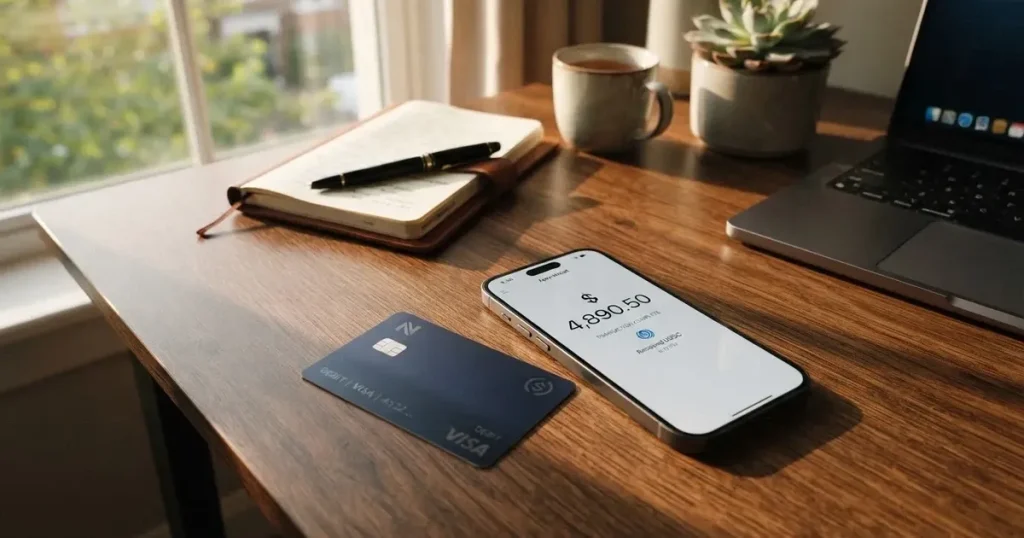
The TXBFI card is a Visa that you feed with crypto instead of a bank account. You load it with BTC, SOL, SUI, XRP, XLM, USDT or USDC, the balance turns into spendable money, and you then pay with it like an ordinary card — in shops, online, or in a mobile wallet. There are four tiers: Virtual, Plastic, Metal and Gold. The entry point is very low, the top end is very high, and everything interesting about this card lives in the gap between those two facts. My score is 5.8 out of 10, and that number is not a shrug. It reflects a product that does one thing plausibly well and leaves the questions a careful buyer would ask first mostly unanswered.
The conditions described here are current as of October 28, 2026.
Verdict: 5.8 out of 10
Who this suits: someone who already holds crypto, is comfortable with self-custody concepts, and wants a spending card today rather than a banking relationship. If your reason for looking at a crypto card is that ordinary bank cards are hard to get in your situation, TXBFI deserves a look — but you should know that the card’s own pages do not tell you whether your country is one of the allowed ones.
Who it does not suit: anyone who needs to know what happens when something goes wrong. There is no named card issuer, no VASP licence number, no chargeback process described, and no published reviews anywhere I could find. If you plan to hold a serious balance on this card, that absence is the fact to weigh — not the tier price.
| Criterion | Mark | Why |
|---|---|---|
| Who can get it | 7 / 10 | No country list published; no exclusions named either, only a general jurisdiction notice |
| Cost | 3 / 10 | No monthly fee, but entry tiers run $25 to $10,000 and top-up costs 2.6% at the bottom |
| Top-up options | 7 / 10 | Seven assets accepted, from BTC to USDC; networks not published |
| Reliability and complaints | 5 / 10 | A named Czech company, but no issuer, no licence number, no reviews, an app in beta |
| Everyday use | 8 / 10 | Four tiers, both mobile wallets on the virtual card, ATM limits that scale with price |
| Total | 5.8 / 10 | A usable card with real gaps in disclosure |
The card’s own summary of who it is for is “crypto holders wanting a Visa from virtual to gold”, and reading it that way explains the whole shape of the product: this is a ladder for someone who already has crypto and wants to spend it, not an on-ramp for someone who wants to buy their first coin.
Will They Give You the Card?
Yes for some applicants, and I cannot tell you which ones. The card’s public pages carry no list of eligible countries and no list of excluded ones. What they carry instead is a single sentence: “Service availability is subject to jurisdiction, eligibility, applicable law and provider requirements.” That is a real condition, but it tells a reader nothing about their own position.
This matters more than usual with a card like this, because a crypto card is not one relationship but at least two. The card side is a payment service, regulated separately from anything to do with crypto, and the crypto side — holding, exchanging, transferring — is regulated on its own track. MiCA, the EU’s markets-in-crypto regulation, took legal effect in June 2023; its rules on asset-referenced and e-money tokens applied from 30 June 2024 and the remaining provisions, including crypto-asset service provider rules, from 30 December 2024. So a card that lives in Europe tends to lean on two licences at once, and if you cannot see either of them, you are being asked to trust.
There is one more layer. Your nationality is recorded and screened separately from where you live, because sanctions checks and issuer risk policy are applied to citizenship and country of birth as well as to address. That means a reader who lives in one country with citizenship in another is in a genuinely different position from a reader whose details line up, and neither of them can read that off this website.
So: how do you find out? You register, you submit documents, and the answer arrives as an approval or a refusal. There is no published eligibility questionnaire. Plan for that, and plan for the possibility that you spend an afternoon on KYC and hear nothing.
How to Get It
The application path is short and, on its face, ordinary. You register on the web platform, pass identity verification, choose a tier, pay the one-time price, and top up. That is the whole sequence, and there is no separate enrolment queue or branch visit.
For the identity check you need a government photo ID — passport, national ID card or driver’s licence — plus proof of address dated within the last three months, such as a utility bill or bank statement. On top of the documents there is a biometric or liveness check, and the terms describe sanctions and PEP screening plus wallet screening. Most accounts are approved within 24 hours. One account per person.
Two things are not stated and are worth planning around. The minimum age is not stated, which for prepaid-style cards in most markets would normally be 18 or over. And the reasons for rejection are not stated, so if you are refused you get no published list of what to fix.
There is only one KYC path. Every tier uses the same document set and the same liveness check; the tiers differ in price, ATM access and limits, not in onboarding. Whether delivery is physical, how long it takes, or what it costs is not stated either — so if you are buying Metal or Gold, ask before you pay rather than after.
Fees: What It Really Costs to Use TXBFI
There is no monthly or annual fee. The stated annual figure is $0. That is the good news, and it is genuinely unusual for a card at this price range. The bad news is that the one-off price is steep at the middle and the top, and that the recurring costs sit in the top-up and conversion lines instead of a monthly statement.
| Item | Virtual | Plastic | Metal | Gold |
|---|---|---|---|---|
| One-time price | $25 (launch promo, from $200) | $300 | $1,000 | $10,000 |
| Monthly or annual fee | None ($0) | None ($0) | None ($0) | None ($0) |
| Deposit / top-up fee | 2.6% | 2.6% | 2.4% | 1.8% |
| ATM withdrawal fee | No ATM access | $2.50 domestic, $3.50 international | $2.50 domestic, $3.50 international | $2.50 domestic, $3.50 international |
| ATM daily limit | None | $1,000 | $1,500 | $3,000 |
| Single-tap limit | $15,000 | $15,000 | $40,000 | $100,000 |
| Forex on international payments | 0.6% | 0.6% | 0.6% | 0.6% |
| Crypto-to-crypto exchange in-app | 0.2% | 0.2% | 0.2% | 0.2% |
| Cross-chain swap | 0.2% | 0.2% | 0.2% | 0.2% |
Upgrading between tiers costs the difference, so moving from Plastic to Metal later means paying $700 rather than starting again at $1,000.
One caveat before you plan around these numbers. The same page shows a heading reading “Why 2.7% upfront” and a header marked “3%” for top-up, which do not match the 2.6% / 2.4% / 1.8% in the fee detail. Where a page contradicts itself, I use the detailed fee breakdown above and treat the loose headings as unverified.
Now, three everyday payments, so you can see which lines actually bite.
A $30 lunch abroad, on a Virtual card. The top-up fee on Virtual is 2.6%, so loading $30 costs an extra $0.78. Then the international conversion adds 0.6%. The tier you hold changes the price of ordinary life more than the price of the card does.
A $200 online subscription, paid in your home currency. No forex line applies if the merchant bills in the same currency as the card, and I cannot tell you what currency that is, because the card’s currency is not stated — the home page mentions “20+ currencies” without naming them. The load still costs 2.6% on Virtual or Plastic, which is $5.20 on $200. A declined authorisation can also leave a hold on the money for several days, typically up to seven, so a failed payment is not necessarily a neutral event for your balance.
A $40 cash withdrawal in the country you are in, on a Plastic card. The fee is $2.50 domestic, and the daily limit is $1,000 so the amount itself is not the problem. On a Virtual card this is not possible at all — there is no ATM access. That single line is the most concrete difference between the bottom tier and the one above it, and it is worth deciding which side of it you fall on before you buy.
The FX line deserves one more sentence. The 0.6% is described as a fixed spread over mid-market, which is a real, published number — but the card currency is not stated, so I cannot tell you which currency your balance actually sits in while you spend. For a reader whose everyday spending is in a currency other than the one they hold, that is a question to ask before you commit money.
Top Up: How the Money Gets In
You can load the card with seven assets: BTC, SOL, SUI, XRP, XLM, USDT and USDC. That is a good spread — two majors, a mix of altcoins, and both of the stablecoins that matter. The BIS put roughly 90% of stablecoin market capitalisation in USDT and USDC as of July 2025, so covering both is the right call for anyone who just wants something that holds its value.
The deposit fee is 2.6% on Virtual and Plastic, 2.4% on Metal, 1.8% on Gold. Deposits into the in-app exchange are free. The card’s home page also mentions local bank transfers and SEPA, with fees not stated.
Here is the practical problem, and it is the single most important thing to understand before you send anything. The networks are not published. That is not a small omission. A blockchain transfer sent on the wrong network, or to an address belonging to another network, cannot simply be reversed — transfers are typically irreversible, and a deposit to an unsupported network can be lost entirely or need manual support recovery with no guarantee. If a provider will not tell you which networks it accepts, you cannot safely pick one yourself.
The good news: USDT and USDC exist on many chains, so the asset list sounds more flexible than the network list can safely be. Circle stopped supporting USDC on Tron in February 2024, so “USDC over TRC20” is not a native option — a detail that matters more than it sounds, because USDT is issued on Ethereum, Tron, Solana, Polygon, Avalanche and others, while USDT sent over Tron pays its fees in a resource model rather than the chain’s own token.
Minimum top-up is not stated, and neither is who pays network fees. One thing to keep in mind: on-chain gas for your deposit is charged by the blockchain, not by the card, so that cost sits outside every percentage in the table above.
Paying With It Every Day
The tiers cover a wide range of use. Virtual is virtual only. Plastic, Metal and Gold are physical cards. Apple Pay and Google Pay both work on the virtual card; on the physical cards Google Pay is the one listed. There is a conflict here worth knowing: a trust badge on the home page shows both wallets for all tiers, while the FAQ separates them. The FAQ is the more specific statement, so I would plan around Google Pay only on a physical card unless you have seen it work yourself.
Where you can spend is not entirely published either. Blocked merchant categories are not stated, and no free ATM allowance is stated. The general category behaviour is worth understanding, because most of it is not about crypto at all. Merchants classify businesses with a four-digit merchant category code assigned under ISO 18245, and one of those codes — 7995, covering casinos, betting and lotteries — is blocked by many issuers as policy rather than by law, with the blocked list differing per issuer. If a payment of yours is declined and you cannot see why, that list is a plausible reason.
Declines have a second common cause. A card number begins with a six or eight digit issuer identification number that any merchant can look up, which reveals the issuing institution and country. Shops may apply extra scrutiny when that country differs from the billing address, and some merchants decline prepaid or foreign BINs outright. That is the same reason a card issued in one country can look foreign to a shop in another. Address verification is part of the same picture: the comparison of the numeric parts of the billing address is mainly offered in the US, Canada and the UK, and is generally unavailable for foreign-issued cards, which can cause declines.
Then there are the card’s own rewards. BTC cashback runs 0.05% on Virtual, 0.1% on Plastic, 0.2% on Metal and 0.4% on Gold, uncapped, credited within 24 hours. Brand discounts are listed as 1% / 2% / 4% / 7–9%. On a Virtual card, 0.05% back is a rounding error — I would not count it in any decision. On Gold, 0.4% in bitcoin plus a discount band that reaches 9% is genuinely worth having, which is the strongest argument the card makes for its top tier.
The app is where daily life happens, and it is the weakest link right now. iOS is distributed as an iOS beta through TestFlight and Android as a beta through Google Play testing, with a “V2 launching soon” note and no published store rating. A beta app is normal for a young product; it also means the interface you read about may not be the interface you get.
What Can Go Wrong
The honest list is longer than the reassuring one.
The issuer is not named. The site calls TXBFI a technology platform. The card issuer and programme manager are not identified. In practice a card programme has three parties — the network (here Visa) which routes and sets rules, the issuer which holds the licence and the programme, and often a brand that is only a front end. When something fails, you need to know which of the three you are dealing with, and here you are not told.
The licence claim has no number attached. The FAQ states that the company holds a VASP licence and complies with EU and Czech AML rules. No licence number is given. Under MiCA, e-money tokens may be issued only by a credit institution or an electronic money institution, and ESMA maintains an interim public register of authorised providers, their white papers and non-compliant entities — a register you can check yourself before you trust a claim.
The company is real but small. The named entity is TheXBanky s.r.o., IČO 21932506, Děčínská 552/1, Střížkov, 180 00 Prague 8, Czech Republic. A home page badge reads “Offshore Banking Sublicense” with no supporting detail. Treat that badge as decoration until someone points at a document.
Nobody has written about this card. In a search for TXBFI card reviews on Trustpilot and Reddit, I found no Trustpilot page and no Reddit threads. No official incidents came up either — but with a card this young and this quiet, absence of complaints is closer to absence of users than to a clean record. Compare it with the field it is entering: custodial platforms have a documented history of failure, including Mt. Gox at about US$350 million reported stolen between 2011 and 2014, Coincheck at about US$400 million in 2018, and Ronin Network at US$625 million in 2022.
There is no chargeback process described. This is the one I would not accept quietly. A chargeback is a refund ordered by the issuer to settle a dispute, with reason codes such as fraud, duplicate billing or goods not received. Cardholder rights differ by market — in the US, debit reversal rights come from Regulation E and credit card rights from Regulation Z — and prepaid-card coverage varies and should not be assumed. Here there is no described process at all, only terms pointing to Czech law and Czech courts and a Complaints Policy link whose text is not available to me. For a card you hold money on in another country, that is a thin position.
Custody cuts both ways. The FAQ says TXBFI does not take custody of your assets or control your private keys, and that assets are held by third-party providers. That is the good version: your keys, your risk. The other version is that key loss, phishing and clipboard-hijacking malware become your problem alone, and a seed phrase — typically twelve to twenty-four words — is an unencrypted form of the private key that anyone who obtains it can use to restore the wallet and spend it. There is no built-in recovery; the network cannot freeze or return stolen funds. Whether two-factor authentication or an in-app freeze exists is not stated.
The account can be closed by the provider. If due diligence cannot be completed, EU rules require the institution to refrain from the transaction or relationship and, where necessary, end existing relationships. That is why accounts close or freeze pending documents — it is the system working, not a fault. On your side, the account is deletable in the app under Profile > Delete Account or by email, but what happens to a remaining balance on closure is not stated.
The app is a beta. Two betas, no published rating.
Support runs on Telegram, Discord, in-app tickets, a contact page, [email protected] and X. Several channels is good; none of them is a regulator.
What to Take Instead
I looked at three comparable cards and scored them on the same basis. None of them is obviously better; each fails in a different place, and the honest comparison is between kinds of missing information.
| Card | Score | Card type | Cost stated | Fees stated | Main gap |
|---|---|---|---|---|---|
| TXBFI | 5.8 / 10 | Visa, virtual to Gold | $25–$10,000 one-off, no monthly | Top-up 2.6–1.8%, FX 0.6% | No issuer, no licence number, no reviews |
| Cardex | 5.6 / 10 | Debit on VERVE, Visa, Mastercard, UnionPay | Not stated | No percentage stated | Naira-focused listing; pricing opaque |
| CardFlow | 4.9 / 10 | Virtual USD Mastercard | Free to create | Not stated | Aimed at Nigeria; no fee disclosure |
| HyperCard | 4.7 / 10 | Prepaid, network not stated | Not stated | Not stated on readable pages | Acceptance claimed in 176+ countries, not eligibility |
A note on how to read this table: three of these scores sit close together, and the gaps between them are smaller than the gaps inside any one of the cards. None publishes a chargeback process, a licence number or a support record in the places I could read. The category is young, and it is regulated in ways that produce paper rather than clarity.
On Cardex: it markets itself as “one crypto card, 200+ countries” with no list of exclusions, and it runs on four networks including Visa and Mastercard, which is a broader network reach than a single-network card. Its conversion story is that an “AI-Powered Conversion Rate” scans global exchange rates and picks the best one at the moment you spend — a reasonable-sounding mechanism with no percentage attached. You load with USDT, USDC or BTC.
On CardFlow: it calls itself “Nigeria’s smartest fintech card platform” and targets Nigerians and global users, issues a virtual USD Mastercard, and says creating one is completely free. You can fund with Bitcoin, USDT, ETH or a Naira bank transfer. What it does not publish is any fee at all, which for a free card is either very good or not yet true.
On HyperCard: the official pages state no country list, while the app listing claims the card works in more than 176 countries — which is a statement about where the card is accepted, not about who can open one. You deposit USDT, BTC or ETH and the balance sits in USD or EUR. The app listing names no network and no fees.
The pattern across all three alternatives is the one worth taking away: everyone markets reach, almost nobody publishes eligibility, and almost nobody publishes the numbers you would use to compare. If you are choosing between these cards, the differentiators you can actually verify are the ones published here — asset support, tier prices, ATM limits, mobile wallet support — not the country claims.
Who I Would Recommend It To
I would recommend TXBFI to a specific person: someone already holding crypto who wants to spend it this week, who is comfortable sending a blockchain transfer to an address the provider has not told them about, and who treats the balance on the card as money they could afford to lose. Under those conditions the card is coherent — no monthly fee, seven ways to load, two mobile wallets on the virtual tier, and a top-up cost that falls as you climb.
I would not recommend it to someone whose main worry is what happens when a payment goes wrong, or to someone in a country whose eligibility is unclear to them. In both cases the card’s own pages do not contain the answer, and the gap is not one I can fill from outside.
Two things would move my score more than any feature could. The first is naming the issuer and the licence number, in plain text, with a register I could check. The second is publishing the networks and the chargeback process. Either one alone would tell me more about whether this card is safe to hold money on than another $1,000 tier does.
If you want a quick verdict rather than a long one: the payment mechanics look fine, the prices are steep in the middle, the disclosure is thin where it matters most, and the absence of any public review history means you would be among the first users rather than one of many. That is a legitimate reason to try it with a small balance. It is not a reason to move your main funds.
Frequently asked questions
What is TXBFI card?
TXBFI is a Visa payment card you fund with cryptocurrency rather than a bank account. You load it with BTC, SOL, SUI, XRP, XLM, USDT or USDC and spend the resulting balance in shops, online, or through Apple Pay and Google Pay. It comes in four tiers — Virtual, Plastic, Metal and Gold — from a $25 promotional entry price up to $10,000, with no monthly fee at any level.
How does TXBFI card work?
You register online, pass identity verification, choose a tier and pay the one-time price, then top up. When you pay, the card behaves much like a prepaid card: it draws on a stored balance rather than a linked bank account, so it cannot overdraw. The crypto side sits behind the card side — the payment network routes the transaction while a separate issuer holds the programme. That separation is normal, but TXBFI does not name its issuer.
Is TXBFI a bank?
The published information does not describe it as one. The named company is TheXBanky s.r.o., a Czech entity registered in Prague, and the site calls TXBFI a technology platform. The card issuer and programme manager are not named anywhere I could find. An electronic money institution can issue cards and wallets under EU rules but cannot lend, which is a different business from banking — and neither label tells you how much money to leave on it.
Is TXBFI card safe?
Safe enough is not a question the site answers for you. The FAQ says the company does not take custody of assets or control private keys, which means key loss and phishing risk sit with you. There is no chargeback process described, the app is a beta on both platforms, and there is no published review history on Trustpilot or Reddit. Treat the balance as money you could afford to lose, and check the licence claim yourself against ESMA’s public register.
Does TXBFI card require KYC?
Yes. You need a government photo ID — passport, national ID or driver’s licence — plus proof of address dated within the last three months, such as a utility bill or bank statement. There is a biometric or liveness check, and the terms describe sanctions, PEP and wallet screening. Most accounts are approved within 24 hours, one account is allowed per person, and the minimum age is not stated.
How much does TXBFI cost?
There is no monthly or annual fee at any tier, and that $0 line is real. The one-time prices are $25 for Virtual as a launch promotion (from $200), $300 for Plastic, $1,000 for Metal and $10,000 for Gold, with upgrades charged at the difference. The recurring costs sit elsewhere: a 2.6% deposit fee on Virtual and Plastic, 2.4% on Metal, 1.8% on Gold, and 0.6% on international transactions.
How do I top up the TXBFI card?
Send BTC, SOL, SUI, XRP, XLM, USDT or USDC to the card’s address, at a deposit fee of 2.6%, 2.4% or 1.8% depending on tier; deposits into the in-app exchange are free. The home page also mentions local bank transfers and SEPA. Before you send anything, ask which networks are supported — they are not published, and a transfer on an unsupported network is typically irreversible.
Can I use TXBFI card in my country?
The card’s public pages contain no country list, eligible or excluded. The only guidance is that “service availability is subject to jurisdiction, eligibility, applicable law and provider requirements.” Note that nationality is screened separately from residence, so a reader with mismatched details faces a different question from one whose details align. The only way to find out is to register and submit your documents.
What are the fees on everyday payments?
Loads cost 2.6% on Virtual and Plastic, which on a $30 top-up is $0.78 before you spend anything. International payments add 0.6% on top of that. ATM withdrawals are $2.50 domestic and $3.50 international, and there is no ATM access at all on the Virtual tier. Cashback is 0.05% on Virtual and 0.4% on Gold, credited within 24 hours.
Is TXBFI card worth it?
Worth it if you already hold crypto, want to spend it immediately, and can absorb the loss of the balance — the Virtual tier’s $25 promo makes that a cheap experiment. Not worth it if you need dispute resolution, a named issuer, or confidence that your country is eligible, because none of those are published. Compare it against Cardex, CardFlow and HyperCard: their scores sit within one point of this one, so the real differentiators are the published numbers, not the claims.
Virtual card reviews – cryptocardcheck
Content created by the «cryptocardcheck» team