
A Telegram-only virtual Visa for USDT on Tron, useful for a narrow job and thin on everything else
 Available in US
Tegro is a virtual card that lives entirely inside Telegram. You pay $13 once, send USDT to an address, and get card details you can drop into Apple Pay or Google Pay — no passport, no selfie, no identity check. In exchange you give up a lot of the things a normal bank card comes with: there is no plastic, no app, no named issuing bank, no cash withdrawals, and only one network will top the balance up. I gave it 4.7 out of 10. That is not a verdict on the idea, it is a verdict on how thin the offering is around a genuinely useful core.
Conditions described here are current as of October 28, 2026.
Verdict: 4.7 out of 10
Let me show you where the marks come from, criterion by criterion, because the shape of the number matters more than the number itself. Two criteria came out respectable. Everything else landed in the middle or below, and the pattern is consistent: this is a working product with a very narrow surface, not a card trying to be your everyday money.
| Criterion | Mark | Why, in short |
|---|---|---|
| Who can get it | 7 / 10 | Works wherever Visa is accepted; no country list published, but people from sanctioned countries are excluded |
| Cost | 3 / 10 | $13 issuance once, no subscription or monthly fee, 4% deposit fee, $50 minimum, and a $50 card works out at $65 |
| Top-up options | 4 / 10 | USDT on Tron (TRC-20) only; other networks have to be converted to TRC-20 first |
| Reliability and complaints | 4 / 10 | Issuer is an unnamed “Visa programme partner bank”, operator is Libermall LLC, licences not disclosed; no complaints found, one positive review |
| Everyday use | 5 / 10 | Virtual Visa in a Telegram bot only, Apple Pay and Google Pay supported, no plastic and no ATM |
| Total | 4.7 / 10 |
Who suits it: someone already holding USDT on Tron who wants a card number for subscriptions and online payments, and who does not want — or cannot supply — identity documents. That is a real and sizeable group, and for them this does one specific thing well.
Who it does not suit: anyone treating it as a primary bank card. There is no physical card, no ATM, no named bank, no chargeback timetable and no insurance story. If your money has to survive a bad month, a frozen account or a dispute, this is the wrong shape of product.
Will they give you the card?
Yes, with two conditions the card states plainly and one it does not state at all.
The stated conditions: you confirm you are 18 or older, and you confirm you are not in a country under international sanctions. The service is unavailable to people from sanctioned countries and to anyone on sanctions lists. No country is named either way.
What is not stated: there is no country list. The card’s position is that it works “wherever Visa is accepted”. That is a statement about merchant acceptance, not about eligibility, and it is worth keeping the two apart in your head. So the honest answer to “is Tegro available in my country?” is that the pages I read do not answer it directly. What they answer is that there is a sanctions screen, and nothing more specific than that.
For you, the practical consequence is this: if you are somewhere the card’s operator might treat as high-risk, you will find out by trying, not by reading. And if you are in a sanctioned country, do not try — the terms exclude you, and I am not going to describe a way around a sanctions screen, because there isn’t one that is legitimate.
How to get it
The whole flow is three steps, and all three happen in Telegram.
- Open the Telegram bot @TegroCardbot.
- Order a card. The issuance fee is $13, charged once.
- Send USDT on Tron (TRC-20) to the address the bot gives you.
No documents. The card’s own words for it are “zero KYC” and “a Telegram account is enough — no documents”. For the virtual card specifically, there is no passport, no selfie and no verification step.
That is not quite the whole story, and you should know the rest before you rely on it. Verification is described as applying to “some products” with extended features — and for those, the data collected includes name, date of birth, citizenship, address, ID and a selfie. Monitoring for unusual activity can also trigger a request for more information. The card does not publish the rejection reasons, so if you are refused on a verification request, you will not find a written explanation waiting for you.
What you get is virtual only. The card details arrive in the Telegram chat; there is no plastic coming in the post, and no delivery to wait for.
Fees: what it really costs
Two charges are set, and they are the whole visible price list. Two more you would expect to find are simply not there, and a third area is unstated.
| Fee or limit | Value |
|---|---|
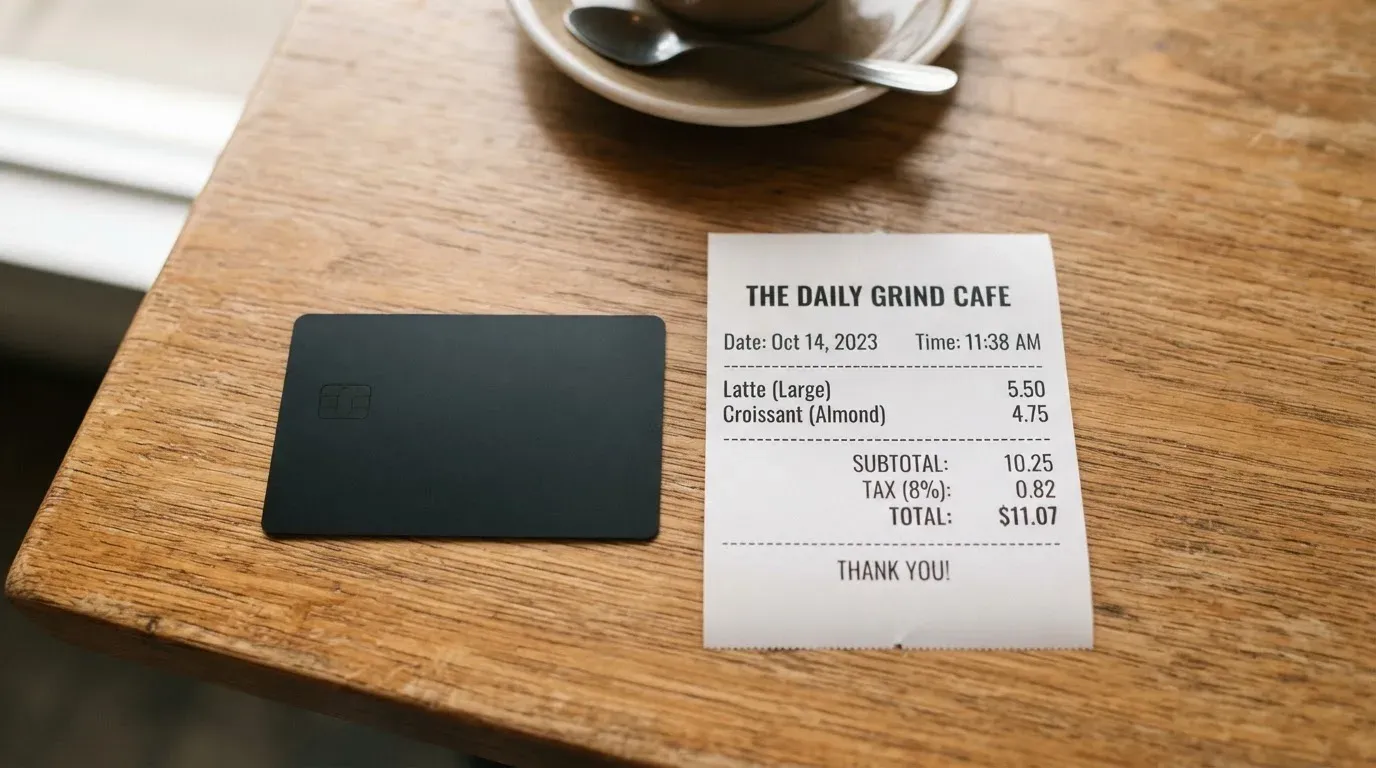
| Issuance | $13 one-time |
| Monthly fee | None — “no subscriptions” |
| Top-up (deposit) fee | 4% of the amount |
| Conversion fee | Not stated |
| FX / foreign-currency fee | Not stated |
| ATM | Not mentioned; virtual card only |
| Minimum card balance | $50 |
| Starting card limit | $1,000 |
| Daily spend limit | Not stated |
| Monthly spend limit | Not stated |
| Card currency | USD |
| Cashback / rewards | None mentioned |
There is one tier. One virtual Visa product, no tiers, nothing to upgrade to.
Now let me walk through a few ordinary payments, because the fees read differently in the abstract than in a day of actual spending.
Paying $30 for a subscription you already hold USDT for. You send USDT on TRC-20 and pay the 4% deposit fee. That is the only charge that appears in the published numbers. If the merchant bills in dollars, you are inside the card’s own currency and nothing extra is described.
Paying $30 for something priced in euros. You are now spending outside the card’s stated USD denomination, and what that costs is not stated. There is no published conversion rate, no published spread, no published FX percentage. This is the single biggest gap in the price list, and it is the gap most likely to cost you real money in the background.
Paying $30 at somewhere that charges an authorisation hold. A declined authorisation can leave a hold on your balance for several days — typically up to 7 — and with a $50 minimum balance and a $1,000 starting limit, a hold is a meaningful slice of what you have. Whether Tegro authorises holds, and how long they last here, is not something the pages tell you.
Also worth internalising: limits “depend on card type and may change”. The $1,000 starting figure is a starting figure. There are no published daily or monthly ceilings, which means the real constraint on your spending may be invisible to you until you hit it.
How to top up
USDT on Tron, TRC-20. That is the whole list.
The bot issues you an address and a unique amount to send. The top-up is credited automatically, matched by that unique amount. Minimum balance $50, and the example the card gives is concrete: a $50 card costs $65 in total, which is the $50 plus the 4% deposit fee plus the $13 issuance.
If your USDT sits on another network — Ethereum, BEP20, Solana, anything else — you have to convert it to TRC-20 first, which is a second step, another interface and another set of fees that belong to that conversion rather than to Tegro. No fiat top-up is offered, so this is not a bridge between your bank account and your spending; it is a bridge between a stablecoin balance and a card balance, on one specific chain.
Three things about withdrawals, since people ask. First, whether and how you can withdraw back to your own wallet is not stated. Second, the terms say crypto transfers are irreversible. Third, you can stop using the service at any time, and the operator can suspend or terminate access for violations of the terms, legal requirements or fraud prevention — but what happens to your balance on closure is not stated. That last one is the sentence I would want to see filled in before I parked meaningful money here.
The question of who pays the Tron network fee is also not stated. Network fees for your deposit are charged by the blockchain rather than by the card provider, so they exist either way; whether Tegro passes them on, absorbs them or quietly includes them in the 4% is not something I could confirm from the pages.
Paying with it every day
Everyday use is where the design shows. You spend through a Telegram bot, Apple Pay or Google Pay — there is no app. Everything is in the chat.
What that means concretely:
- Apple Pay and Google Pay: supported. You add the card to your phone’s wallet and it behaves like any contactless card. This is the practical reason a virtual-only card is tolerable.
- No app, no separate login. The bot is the interface. If the Telegram account is compromised, the card is compromised with it.
- No cash, ever. Virtual only means no ATM withdrawal, and ATM is not mentioned at all.
- Blocked spending categories: not stated. No merchant category list is published, so you cannot tell in advance whether gambling, adult content, ticket resale or fuel will work. What works and what does not, you will discover per merchant.
- Cashback or rewards: not mentioned. There is nothing to earn back.
On disputes, the card points you at the payment networks’ rules and at its partners’ timetables: try the merchant first, then contact support. No time frames are published. Governing law is Wyoming, USA — the one concrete legal anchor on the page, and it is an unusual one for a product whose entire interface is a Telegram bot in two languages.
One practical detail about mobile wallets that is worth knowing generally, because it applies to any virtual card: Apple Pay replaces your card number with a device-specific number stored in the phone’s Secure Element, and each payment carries a one-time dynamic code. Your actual number never sits in Apple’s servers. That is a genuine security benefit, and it is one of the better reasons to use a card like this through a wallet rather than typing the number into sites.
What can go wrong
This is where the missing information becomes the story.
You do not know who issued the card. The card says it is issued by an unnamed “partner bank under the Visa programme”. Tegro is the ordering and support interface. The company entity and its licences are not stated. The terms page is titled “Libermall Card” and names Libermall LLC as the operator, but nothing on the pages I read discloses what regulatory permissions that entity holds. If your money is in this system, you are trusting an interface to an unnamed bank through an entity whose licensing I could not verify.
Custodial means the balance is not yours in the usual sense. Control of crypto belongs to whoever holds the private key. Here the card is issued by a partner bank and Tegro is the interface — so you are trusting a custodian, and custodian risk is a category with a history: Mt. Gox (about US$350 million reported stolen, 2011–2014), Coincheck (about US$400 million, 2018), Ronin Network (US$625 million, 2022). None of those were this card, and I am not suggesting they will happen here. I am saying the structure carries the same shape of risk.
No safety features are described. No two-factor authentication, no in-app freeze, no insurance. The card says Tegro may pause an operation or restrict access on risk. The one piece of concrete advice given is the standard one and it is the right one: never share your PAN and CVV, and do not store them unencrypted.
Irreversible transfers meet a single supported network. Blockchain transfers cannot be reversed. A deposit sent on a network the provider does not support, or to an address belonging to a different network, can be lost or need manual recovery with no guarantee. With TRC-20 as the only accepted network, that is not a corner case — it is the single most likely way to lose money here.
Programmes like this do close. In November 2022 Visa said it had terminated its global agreements with FTX and the FTX US debit card was wound down. WaveCrest, a Visa issuer that supplied crypto card brands, was suspended by Visa in Europe in 2018, closing all WaveCrest-issued Visa programmes. Closures typically mean a notice period, then loading and spending stop, then users are asked to withdraw remaining balances — and this card’s pages do not tell you what withdrawal looks like. One 2026 closure reported by a secondary source ended new loads on 8 July 2026 and spending on 8 August 2026; that is a single unconfirmed source, so I would not lean on the dates, only on the pattern.
On complaints, there is almost nothing either way. A user report found one 5-star Trustpilot review dated June 2026 calling the card simple, adding that support and clear limits and fees “will matter”. No substantive complaints were found and no Reddit threads. A listing site shows 0 upvotes and 1 comment with no user feedback. One important caveat: that Trustpilot page is on the tegro.cash domain, a possibly related brand, not confirmed to be this card. So treat this not as reassurance but as an absence of evidence — nobody has written much, either warmly or badly, in a way I could verify.
Support is a Telegram chat. @Tegro_bot, with replies promised “within a day”. The ordering bot is @TegroCardbot. The site is in Russian and English. Hours are not stated. If your card fails at a payment you cannot dispute in time, your first and only channel is a chat window in an app you cannot phone.
For context on the regulatory side: a card is a payment service regulated separately from the crypto side, so a product like this often depends on two licences rather than one. In the EU, MiCA took legal effect in June 2023, with its rules on stablecoins applying from 30 June 2024 and the remaining provisions, including crypto-asset service provider rules, from 30 December 2024. Under MiCA, e-money tokens may be issued only by a credit institution or an electronic money institution, and its transitional period lets providers operating under national law continue only until 1 July 2026 or until they receive or are refused a MiCA authorisation, whichever comes first. ESMA keeps an interim register of authorised providers that you can check. In the US, FinCEN guidance treats administrators and exchangers of convertible virtual currency as money transmitters. None of this is a verdict on Tegro, whose jurisdiction I could not determine from the pages — but it is the frame in which to read a product whose operator’s licences are unstated.
What to take instead
If the no-KYC virtual card idea appeals to you but the specifics here bother you — the single network, the unnamed issuer, the thin fee disclosure — the same category has other options. Here is how they compare on what is actually published.
| Tegro | Azul Card | Telecard | OnCards | |
|---|---|---|---|---|
| Score | 4.7 / 10 | 5.3 / 10 | 6.1 / 10 | 4.6 / 10 |
| Card | Virtual Visa | Virtual Mastercard | Virtual Mastercard | Virtual Mastercard / Visa |
| Cost | $13 once, no monthly | $20 creation (refunded after $2,000 spent), $5 / month | $5 one-time standard; VIP $49 setup then $19 / month | Not stated |
| Top-up fee | 4% | 4% crypto, $0.25 per transaction | Advertised 0% deposit; 0.5 USDT gas per transaction | Not stated |
| FX | Not stated | Not stated | 1.5% conversion on non-USD; FX and cross-border “up to 3% each” | Not stated |
| Networks | USDT TRC-20 only | Not named | USDT TRC-20 or ERC-20, USDC ERC-20; Polygon not supported | USDT BEP20 only |
| Extra | No cashback mentioned | Referral pays “up to 40% of our fees” | Referral points and cashback, rate not stated | Bank transfers not accepted |
Azul Card scores highest of the three alternatives at 5.3, and it is the more transparent about where it does not work: it excludes Russia, Belarus, North Korea, Iran, Syria, Cuba, Sudan, Venezuela, Ukraine and the Crimea, Donetsk, Luhansk, Zaporizhzhia and Kherson regions, and states that “the restrictions apply regardless of the user’s nationality” — nobody can use it in those places, whatever their passport. That clarity alone puts it ahead of a card with no country list. It costs $5 a month, which for light use is worse than Tegro’s one-off $13; its creation fee is refunded after $2,000 in spending. Top-ups are 4%, same as Tegro, plus $0.25 per transaction. Coins and networks are not named in the pages I read, and first top-up can take up to 10 minutes.
Telecard is the strongest of the four at 6.1, and mostly because it publishes the most: 1.5% currency conversion on non-USD payments, FX and cross-border fees “up to 3% each”, a 0.5 USDT gas fee per successful card transaction, and a $99 minimum deposit described as “NOT a fee” because it stays in your wallet. It accepts USDT on Tron or Ethereum and USDC on Ethereum, so you are not locked to one chain — though Polygon is not supported and bank transfers are “coming soon”. Its catch is structure: a VIP plan at $49 setup then $19 a month, and identity checks that are “available in most major regions”. The site says the basic plan is free to sign up with no monthly fee, which is consistent with the $5 one-time standard plan.
OnCards scores 4.6, lowest of the group, and the reason is disclosure rather than function. Fees are described as “simple and clear — no hidden charges” with no amounts at all. No country list, no currency, no cashback. It takes USDT on BEP20 only and does not accept bank transfers. The one thing it states plainly is its network.
Two patterns are worth naming. First, every one of these is virtual-only — nobody in this comparison is mailing you plastic, and if a physical card matters to you, none of them solves it. Second, the cards that score better than Tegro do so mostly by publishing more, not by offering more. Telecard wins on transparency. Azul wins on telling you plainly where it will not work. Tegro’s 4% deposit fee is unremarkable; its silence on conversion, FX, limits and licensing is what drags the score down.
Who I would recommend it to
I would recommend Tegro to a specific person: someone holding USDT on Tron who wants to pay for online subscriptions without handing over identity documents, and who has a small, defined budget they can afford to lose. If that is you, the product does what it says. $13, a Telegram bot, a Visa number in your phone’s wallet, and no questions.
I would not recommend it to you if any of these are true:
- You need a physical card, an ATM, or cash.
- This would be your only card or your main spending money.
- You plan to pay in currencies other than dollars, since the conversion cost is not stated.
- You intend to hold a meaningful balance, because custodial risk and balance-on-closure are both unresolved.
- You plan to travel, since the country position is sanctions-only and otherwise silent.
- You need chargebacks with a clock attached, since no dispute timeframes are published.
The honest summary is that this is a competent, narrow tool with thin documentation. The functionality that is documented works as described. The gaps are all in the places where a payment card normally protects you — who issued it, what a foreign-currency payment costs, what a disputed payment is worth, what happens to your balance on day one of an account freeze. For small amounts you control closely, that is an acceptable trade. For anything more, the 4% deposit fee is not the real cost — the unknowns are.
Frequently asked questions
What is Tegro card?
Tegro is a virtual Visa card you order and manage entirely through the Telegram bot @TegroCardbot, rather than an app. You pay a one-time $13 issuance fee, send USDT on the Tron (TRC-20) network to an address the bot gives you, and receive card details in the chat. Card amounts and limits are in USD. There is no physical card: the details are meant to be added to Apple Pay or Google Pay.
How does Tegro card work?
You fund a prepaid-style balance and spend from it. Minimum balance $50, starting card limit $1,000, and a 4% fee on each deposit — so the card’s own example is a $50 card costing $65 in total. Payments run through Visa wherever Visa is accepted. Apple Pay and Google Pay are supported. Everything happens in Telegram: there is no separate app and no cash withdrawal.
Does Tegro card require KYC?
No, not for the virtual card. The card describes “zero KYC” and says a Telegram account is enough, with no passport, selfie or verification. Verification is described as applying to “some products” with extended features, where name, date of birth, citizenship, address, ID and a selfie are collected. Monitoring of unusual activity can also trigger a request for more information.
Is Tegro a bank, and who owns it?
No — Tegro is not a bank. The card says it is issued by an unnamed “partner bank under the Visa programme”, with Tegro acting as the ordering and support interface. The terms page is titled “Libermall Card” and names Libermall LLC as the operator. The company entity and its licences are not stated, and I could not confirm them from the public pages.
Which countries can I use Tegro card in?
No country list is published. The card says it works wherever Visa is accepted and states two conditions: you must be 18 or older, and not be in a country under international sanctions or on a sanctions list. Those are the only eligibility statements. So the answer for any specific country is that the public pages do not say — and the card explicitly excludes people from sanctioned countries.
How do I top up the Tegro card?
With USDT on the Tron network (TRC-20) only. The bot gives you an address and a unique amount, and the top-up is credited automatically when that amount arrives. No fiat top-up is offered. If your USDT is on another network, you must convert it to TRC-20 first — and since blockchain transfers are irreversible, sending on the wrong network can mean lost funds.
Is Tegro card free?
No. Issuance costs $13 once, there is no subscription and no monthly fee. But every deposit carries a 4% fee, and the minimum balance is $50, which the card illustrates as a $50 card costing $65 total. The FX fee, conversion spread, and any fee for paying in another currency are not stated.
Can I add the Tegro card to Apple Wallet?
Yes — Apple Pay and Google Pay are supported, and with a virtual-only card these wallets are the practical way to pay. When a card goes into Apple Pay, the device stores a device-specific number in its Secure Element rather than your actual card number, and each payment uses a one-time dynamic code. Note that no cash withdrawal is possible, since there is no physical card.
Is Tegro card safe?
That depends on who you trust. The balance is custodial — a partner bank issues the card and Tegro is the interface — so it carries counterparty risk of the kind seen at Mt. Gox, Coincheck and Ronin Network. No two-factor authentication, in-app freeze or insurance is described, and the issuer is unnamed. The card does say never to share your PAN and CVV and not to store them unencrypted.
Is Tegro card worth it?
For a small, defined budget spent on online subscriptions out of USDT you already hold on Tron, and if you would rather not supply identity documents, it does one job clearly for $13 plus 4% per top-up. For anything larger, the unstated parts decide it: conversion and FX costs, daily and monthly limits, dispute timeframes, and what happens to your balance if access is suspended are all missing. Judge it on those gaps, not on the headline price.
Virtual card reviews – cryptocardcheck
Content created by the «cryptocardcheck» team