
A premium metal credit card repaid in stablecoins: how the Decard Luminaries actually works
 Available in US
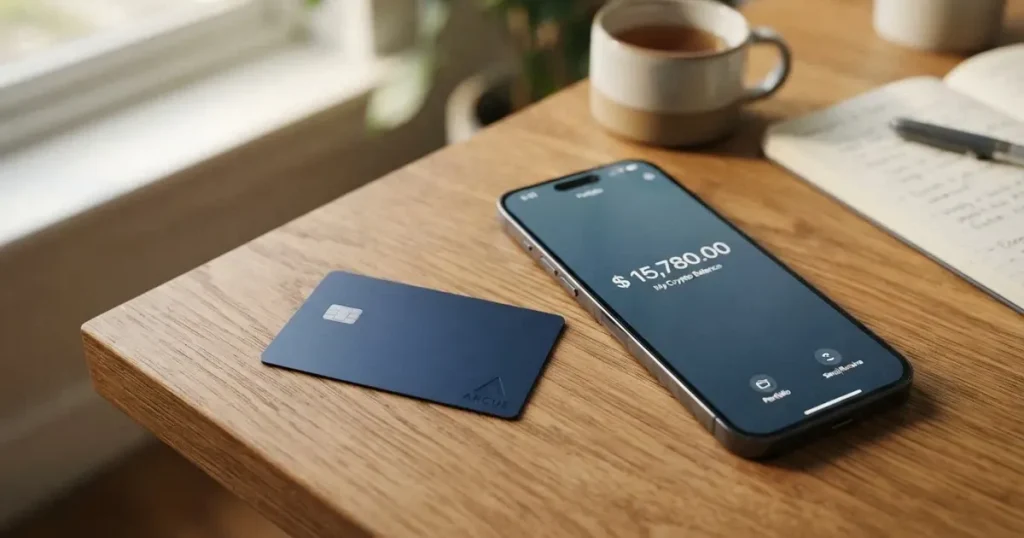
The Decard Luminaries sits in an unusual corner of the crypto-card market. It is not a prepaid debit card funded by stablecoins, and it is not a debit card that converts crypto at the till. It is a Singapore-issued metal Visa credit card, denominated in Singapore dollars, and the only place crypto enters the picture is when you repay the balance: USDT or USDC goes into a “D-Vault” page and pays down what the card has already spent. That single structural choice shapes everything else about this product, from who can get it to what it really costs. After going through the card’s terms, the product pages and the publicly available company information, I have given it 4.8 out of 10, and the breakdown below explains why.
Conditions are current as of October 28, 2026.
Verdict
The Decard Luminaries is, on paper, a premium offering. You get a 22-gram alloy Visa with laser engraving, a virtual card, cashback up to 10%, two DragonPass lounge visits and travel accident cover up to US$1,000,000. None of that is cheap to provide, and the card prices itself accordingly: US$388 a year, charged in Singapore dollars, with no option to waive it. The catch is that almost every other detail, from which countries you can apply from to which crypto networks you can repay with, is left unstated on the public pages. The card is run by a Singapore entity called DCS Card Centre Pte. Ltd., but the issuing bank and the exact licences are not named where I read them. And the headline “0% foreign transaction fees” sits next to a clause in the terms about a “Foreign Exchange Conversion Charge”, which the reader has to square for themselves.

Here is the score, broken down by criterion.
| Criterion | Score | Reason |
|---|---|---|
| Who can get it | 5 / 10 | Countries are not listed, age is 21 to 65, no minimum income, access by invitation or application. Singapore citizens and PRs go through Singpass. |
| Cost | 2 / 10 | US$388 annual fee that cannot be waived; the metal card is included. The “0% FX” claim on the product page coexists with a Foreign Exchange Conversion Charge in the terms. |
| Top-up options | 4 / 10 | This is a credit line, not a prepaid card. USDT and USDC can only repay what is already owed, through the D-Vault “Pay to card” page. Networks are not stated. |
| Reliability and complaints | 7 / 10 | The operator is DCS Card Centre Pte. Ltd. in Singapore and the terms follow MAS recommendations, but the issuing bank and licences are not named. No Trustpilot, Reddit or news complaints were found. |
| Everyday use | 7 / 10 | A physical metal Visa plus a virtual Visa. Cash advances are allowed at ATMs outside Singapore. Apple Pay and Google Pay support is not disclosed. |
| Total | 4.8 / 10 |
The audience this card is built for is narrow and specific: someone who wants a premium metal credit card and is comfortable settling the balance in USDT or USDC each month. If that is not you, the US$388 annual fee has very little to justify it. If it is you, the missing details about networks, countries and the FX charge mean you should be prepared to do more homework than usual before applying.
Who Decard will issue the card to
The eligibility rules for Decard are unusually sparse. The product pages I read do not list the countries the card is available in, so I cannot tell you, sitting in the reader’s seat, whether you are eligible from where you live. What the card does state is the age range (21 to 65) and the fact that there is no minimum income requirement. Access is by invitation or by application, and every application is reviewed before approval. There is no public tier system on the product side; DeCard Luminaries is described as a single “premium evolution of DeCard” rather than a ladder of products.
For Singapore citizens and permanent residents the verification path is clear: you go through Singpass, the national digital identity system. For everyone else, the application asks you to upload an identity document (a passport is given as an example) and a proof of address, and the application is reviewed by hand. The terms do not list the documents that will be accepted, the typical processing time, the reason an application might be rejected, or whether there is an appeals path. If you are reading this from outside Singapore, the only honest answer to “am I eligible?” is to start an application and find out.
A few structural points are worth flagging up front, because they shape every other section of this review.
- This is a credit product, not a prepaid or debit product. The credit limit is set by DCS “at our sole and absolute discretion” and can be revised without notice. The amount is not stated up front, so you do not know what you will be approved for until after you apply.
- The card account is denominated in Singapore dollars. The annual fee is charged in SGD, and any non-SGD spending goes through the issuer’s own conversion flow, which I cover in the costs section below.
- The operator is a Singapore company. Singapore law and Singapore courts govern the terms. If you are a consumer in another country, the protections you are used to may not apply.
How to sign up for Decard
The signup flow has three steps and one point that catches people out. You start either with an invitation link or by submitting an application on the Decard website. Singapore citizens and permanent residents verify through Singpass, and the rest upload their passport and a proof-of-address document. The application is then reviewed, and you find out whether you have been approved.
Here is the part that is easy to misread. The virtual card is issued only after approval, and both the physical metal card and the activation of the virtual card happen once the annual fee is paid. So you pay US$388 (in SGD) before the card works, and the physical card is then sent out. The card pages do not state which countries the physical card can be delivered to, how long delivery takes, or how much it costs to ship. Replacement cards are issued “on terms we stipulate” per clause 15.6 of the terms, and the fee for a replacement is not stated.
Two practical consequences. First, if you are not approved, the annual fee is the gating event rather than a usage cost, so make sure you are comfortable losing it before you start. Second, if you are an existing crypto user who is used to onboarding in minutes, the manual review and document upload mean this is a slower process than most crypto cards, and you should plan for it. The “iOS” and “Android” apps are listed as “DCS DeCard” on the App Store and as com.dcs.decard.android on Google Play; I did not read the store ratings, so I cannot tell you what other users have reported about app quality.
What Decard really costs
The costs table below is built only from the figures the card publishes. Where the card does not publish a number, the cell says “not stated” rather than guessing. This is deliberate, because for a US$388-a-year product the missing numbers matter.
| Fee or limit | Amount |
|---|---|
| Issuance fee | Not stated separately; included with the membership |
| Annual fee | US$388, charged in SGD, cannot be waived |
| Crypto conversion fee | Not stated on the public pages |
| Foreign exchange (product page) | 0%, “No foreign transaction fees on any overseas spending” |
| Foreign exchange (terms) | “Foreign Exchange Conversion Charge” per clause 1.5.3 |
| ATM cash advance | Outside Singapore only, fee per advance not stated |
| Starting credit limit | Set by DCS, amount not stated |
| Daily / monthly spend limits | Not stated |
| Inactivity fee | Possible after 90 days without transactions (terms) |
| Early termination fee | Possible within 180 days of approval (terms) |
| Late payment charge / interest | Apply after the Due Date; rates published in the website FAQ, not in the terms PDF |
Three everyday payments are worth walking through, because they show how these line items interact in practice. Imagine you are sitting at a café in London with your Decard and you tap to pay for a coffee in pounds.
- You pay £4.50 for a coffee. The card settles in SGD through the “DCS retail rate of exchange”. The product page says this costs nothing extra (“0% FX”); the terms reserve the right to add a “Foreign Exchange Conversion Charge”. The two statements are not reconciled on the page, so I cannot tell you which applies in practice.
- The same coffee at the same shop, paid with the virtual card on a subscription. Same conversion, but the merchant’s processor may also decline the card because the BIN shows a Singapore issuer while the billing address is in your country. This is a known pattern with foreign-issued cards and I cover it in the everyday-use section.
- You withdraw £100 from an ATM in London. Per the terms, ATM cash advance is allowed “at any automated teller machine outside Singapore” up to a limit set by DCS, with a service fee per advance (the rate is not stated) and no rewards on ATM disbursements.
The metal card itself is included with the membership, and the card’s own marketing values it at US$100; that value is folded into the US$388 fee, so you should not count it as a separate perk. The benefit bundle the card does publish clearly: cashback up to 10%, capped at up to US$200 per month, one DePoint per US$1 spent, two DragonPass lounge visits, and travel accident cover up to US$1,000,000.
A few things to check before you commit to the annual fee, because they are the items I would push the card to clarify:
- The crypto conversion fee. If you repay in USDT or USDC, what does the conversion cost? The public pages do not say, and the difference between a 0.5% spread and a 2% spread on a US$5,000 monthly repayment is real money over a year.
- The exact FX treatment. The “0% FX” claim and the “Foreign Exchange Conversion Charge” clause need to be reconciled by asking the support team directly, in writing, before you apply.
- The credit limit. Without knowing what you will be approved for, you cannot compare the annual fee against a usage scenario that makes sense for you.
How to top up a Decard
This is the section where the card’s logic diverges most from the way most crypto cards are described online, and where readers are most likely to misunderstand what they are buying. Decard is a credit line, not a prepaid card. The crypto is not loaded onto the card and then spent. The card is spent first, and crypto is used to repay the resulting balance.
The flow runs through the D-Vault page in the app or on the website. The only cryptocurrencies the card names for repayment are USDT and USDC. You go to “Pay to card”, send the stablecoins, and the equivalent amount is applied to your outstanding balance. The card’s own pages do not state which blockchain networks are supported for these transfers, so I cannot tell you whether to send on Ethereum, Tron, Solana, Polygon or another chain. A third-party aggregator has mentioned Polygon in passing, but I have not used that as a source for the review because it is unofficial and the card’s own pages do not confirm it. Sending on the wrong network is a permanent loss, so this is the single most important question to answer with Decard’s support team before you transfer anything.
The implications run in both directions.
- On the way in, you do not top up a balance and then spend it. You spend, then you repay. This means you do not need to pre-fund the card to use it, and the card cannot run out of balance in the middle of a trip. It also means you carry a real credit obligation, with a Due Date, late-payment charges and interest if the full Outstanding Balance is not paid on time. The interest rates are not in the terms PDF; the card says they are published in the website FAQ.
- On the way out, there is no balance to “withdraw” in the usual sense. Termination is handled through DeCard Live Chat or the app, and it is not allowed within 90 days of issuance unless DCS agrees. An early-termination fee may apply within 180 days of approval, and on termination the annual fee is not refunded and any outstanding liabilities have to be repaid immediately. An inactivity fee is possible after 90 days without transactions, which matters if you apply, get approved, pay the fee, and then change your mind before using the card.
For anyone used to a stablecoin debit card where “top up” means “convert USDC and load it”, this takes some mental adjustment. You are not moving crypto onto a card; you are moving crypto to a creditor, to settle a debt the card has already run up.
Paying with Decard every day
The card form factor is straightforward. You get a physical metal Visa and a virtual Visa, both denominated in SGD. The metal card is 22 grams of alloy with laser engraving, which the marketing values at US$100. The virtual card is issued in the app after the annual fee is paid, and the physical card follows in the post once payment is taken.
The card’s own pages do not state whether Apple Pay or Google Pay are supported, and they do not list the merchant categories that are blocked. In practice that means you should not assume you can tap to pay with a phone until you have checked, and you should not assume gambling or other high-risk MCCs are blocked or open. In the broader crypto-card market, blocked categories vary widely between issuers and are policy choices rather than legal requirements.
Three everyday situations are worth thinking through.
- Online subscriptions. The virtual card is the one you will use for these. Online merchants increasingly apply 3-D Secure challenges, and Decard’s terms do not say what the cardholder experience is. If you are used to a frictionless tap-to-pay flow, be ready for an extra confirmation step on first use at a new merchant.
- In-person shopping abroad. Because the card is issued in Singapore, a foreign merchant’s fraud system may treat it as a foreign-issued card. This is a well-known issue with cross-border cards: the BIN reveals an issuer country that may not match the billing address, and Address Verification Service is generally unavailable outside the US, Canada and the UK. The result is that perfectly normal purchases can be declined at the till. There is no published data on how often this happens with Decard specifically.
- ATM cash. The terms allow cash advances at ATMs outside Singapore, up to a limit set by DCS, with a service fee per advance. The rate is not stated, and ATM withdrawals do not earn rewards. If you are planning to use the card as a primary travel card, this is a real gap.
The reward structure is the part of everyday use the card does describe clearly. Cashback is up to 10%, capped at up to US$200 per month, with one DePoint per US$1 spent on top. The terms also give you two complimentary DragonPass lounge visits and travel accident cover up to US$1,000,000. None of the public pages state the currency in which cashback is paid.
If you do run into a problem with a transaction, the terms tell you to raise the dispute with the merchant directly and not to withhold payment. Disputed charges that are not resolved by the statement date do not qualify for promotions. The terms do not state chargeback time frames, and the legal framework is Singapore law and Singapore courts, which matters if you are used to consumer-protection regimes in the EU, the UK or the US.
What can go wrong with Decard
The risks of using Decard fall into three buckets, and the order I would worry about them in is the same as the order below.
The first is the missing information. The card’s public pages do not list the supported countries, the issuing bank, the licences DCS holds, the FX charge, the crypto conversion fee, the credit limit, the daily or monthly caps, the ATM fee, the cashback payout currency, the Apple Pay and Google Pay support, or the blocked merchant categories. Most of these are routine details that a US$388-a-year card should have on a single pricing page. Their absence is not by itself proof of a problem, but it makes it much harder for a prospective user to do the math, and it pushes the burden of clarification onto you.
The second is the regulatory picture. The operator is DCS Card Centre Pte. Ltd., with “Powered by DCS Group” on the homepage and DCS SERV PTE. LTD. also listed. The homepage says the card is “backed by regulated issuing infrastructure”, and the terms follow the Monetary Authority of Singapore E-Payments User Protection Guidelines. None of the pages I read named the issuing bank or the specific licences DCS relies on to issue a Visa credit card. The terms PDF is dated 2 October 2026 (56 pages) and governs the Luminaries product; the Luminaries card was launched with Visa in September 2025, the IDEMIA metal card partnership was announced on 15 December 2025, and the underlying DeCard Visa product launched in May 2025 per an aggregator. If you are a reader who cares about which regulator stands behind your card, that answer is not on the card’s public pages.
The third is the operational history, which is short and quiet. I searched specifically for Trustpilot, Reddit and news complaints under “Decard DCS Card Centre card complaints review reddit trustpilot” and the results were unrelated sellers, not consumer complaints. A second search on 2026-10-20 returned press releases and app-store pages but no consumer complaint material. So there are no complaint themes to report, but neither is there a long public track record.
A few practical safeguards you should still take, because the card’s own pages do not promise them.
- The terms limit the cardholder’s liability for a lost or stolen card only if the cardholder notifies immediately and files a police report or statutory declaration. Keep a record of the time and channel of any notification, and do not delay.
- The card has transaction alerts with a notification threshold, but the threshold is not stated. Ask support what it is set to, and consider whether it is appropriate for your spending pattern.
- The terms do not mention in-app card freeze or insurance of funds. Treat these as unavailable unless you confirm them, not as defaults.
- Help is offered through a help centre with FAQs and a chatbot (the robot icon on the homepage), DeCard Live Chat in the app and on the website, [email protected], and the X account @DCS_DeCard. Telegram is not on the product page. Hours and language coverage are not stated, with English shown on the materials I read.
What to take instead of Decard
Decard is one of a small group of crypto cards that are explicitly credit products, and the alternatives I have lined up cover the other models. If Decard’s annual fee and the credit-line structure do not fit, one of these three will probably be closer to what you want.
| Card | Score | Model | Cost | FX fee | Top-up / funding | Rewards |
|---|---|---|---|---|---|---|
| Sponge | 4.9 / 10 | Virtual Visa, credit card issued by Rain | Not stated | Not stated | USDC collateral moved from the Sponge wallet | Not stated |
| Nexo | 6.3 / 10 | Virtual and physical Mastercard, issued by DiPocket UAB | No monthly, annual or inactivity fee; virtual card needs US$50 to activate; physical card needs US$5,000 in digital assets and Gold tier | 0.2% EEA/UK/CH on weekdays, 2% rest of world; 0.7% and 2.5% on weekends | 100+ digital assets; Debit Mode uses stablecoins, crypto and FiatX | NEXO or BTC cashback in Credit Mode, by tier, with $5,000 minimum |
| Xplace | 7.7 / 10 | Virtual and physical Visa, four tiers (Basic, Silver, Gold, Platinum); Cash and Credit modes | Free, US$99/y, US$249/y, US$999/y; no origination fee on borrowing | 0% on Platinum, others not stated; stablecoin spending has “no hidden spread” | BTC (cbBTC), ETH (wETH), SOL, JitoSOL, USDC, USDT, xStocks on Solana | Cashback by tier (0.5%–2%) in Credit Mode, paid in USDC at settlement |
A few things stand out when you put them side by side. Nexo is the closest thing to a fee-free credit-card experience in the comparison: no monthly, annual or inactivity fees, and a free physical card once you hold US$5,000 in digital assets and reach Gold tier. Its rewards are paid in NEXO tokens or Bitcoin, and the tier depends on the share of NEXO in your portfolio, so it rewards existing Nexo customers more than newcomers. Sponge is a virtual-only card with very little pricing detail on its public pages, which is its own kind of risk. Xplace has the clearest fee ladder and the broadest stablecoin and token support, and the Platinum tier’s 0% FX and 2% cashback is a strong premium product if you can justify the US$999 annual fee.
If you came to this page because you wanted a metal Visa and you are happy to settle the balance in stablecoins, Decard Luminaries is in a small group, and Nexo is the most obvious alternative to weigh against it. If you came here because you wanted a stablecoin-funded card you can load and spend, the comparison set is wider than this table, and you should look at the dedicated reviews for Sponge, Nexo and Xplace before committing.
Who I would recommend Decard to
Putting it all together, the Decard Luminaries is a coherent product for a narrow audience and a poor fit for almost everyone else. I would recommend it to a reader who already keeps most of their net worth in USDT or USDC, who travels frequently and values lounge access and travel insurance, who is comfortable with a US$388 annual fee that cannot be waived, who lives in a country where Decard actually issues (and accepts the need to confirm that with support), and who is happy to settle a Singapore-dollar credit-card bill with stablecoins each month. If that is you, the metal card, the cashback up to 10% (capped at US$200/month) and the benefit bundle are genuinely attractive.
I would not recommend it to a reader who is looking for a cheap way to spend stablecoins day to day, who is outside Singapore and uncomfortable with the legal and regulatory reach of a Singapore-only consumer framework, who needs Apple Pay or Google Pay to work without checking, who is sensitive to FX surprises, or who simply wants to know the issuing bank and the licences before paying US$388. For each of those readers, the comparison set above is a better starting point, and the rest of the crypto-card market is wider still.
The honest one-line summary is this: Decard is a real credit card, with a real annual fee, repaid with stablecoins, and the parts of the deal that should be on a pricing page are instead in the small print or in a question to support. If the things that are not stated do not bother you, the card is worth a closer look. If they do, the score is 4.8 out of 10 for a reason.
Frequently asked questions
What is the Decard card?
The Decard card, marketed as DeCard Luminaries, is a premium metal Visa credit card issued in Singapore dollars, with a 22-gram alloy physical card and a virtual card. The operator is DCS Card Centre Pte. Ltd., and the card is positioned as a credit product that you repay in stablecoins (USDT or USDC) rather than a debit card you preload with crypto.
How does the Decard card work?
You apply, get reviewed, and once approved you pay the US$388 annual fee. A virtual Visa is issued and a metal Visa is dispatched, both denominated in SGD, and you spend on credit in the usual way. At the end of the billing cycle, you repay the outstanding balance in USDT or USDC through the D-Vault “Pay to card” page, with the supporting blockchain network not publicly listed.
Is Decard a bank?
No, Decard is not a bank. It is operated by DCS Card Centre Pte. Ltd., a Singapore company, and the card programme is described on the homepage as “backed by regulated issuing infrastructure”. The specific issuing bank and the licences DCS relies on are not named on the public pages I read, so you should treat the bank relationship as undisclosed rather than confirmed.
Who owns Decard?
The copyright on Decard’s pages is held by DCS Card Centre Pte. Ltd., with “Powered by DCS Group” on the homepage and DCS SERV PTE. LTD. also listed. The group structure beyond that, including any parent company, founders or investors, is not detailed on the product pages, and no regulator is named as the owner.
Is the Decard card available in my country?
The card’s public pages do not list the countries it serves. Eligibility is stated as ages 21 to 65, no minimum income, access by invitation or application, with Singapore citizens and permanent residents verified through Singpass and other applicants uploading identity and proof-of-address documents. The only reliable way to find out whether you can apply from your country is to start an application.
How do I apply for the Decard card?
You apply on the Decard website, either through an invitation link or by submitting an application directly. Singapore citizens and PRs verify with Singpass, other applicants upload a passport and a proof of address, and the application is reviewed manually. After approval you pay the US$388 annual fee in SGD, which triggers the issuance of the virtual card and the dispatch of the physical metal card.
How do I top up the Decard card?
You do not top up Decard in the usual sense, because it is a credit line, not a prepaid card. You spend first and then repay the balance with USDT or USDC through the D-Vault “Pay to card” page. The card’s own pages do not state which blockchain networks are supported for these transfers, so the safe move is to ask support before sending anything.
Does the Decard card charge foreign transaction fees?
The product page says 0% (“No foreign transaction fees on any overseas spending”), but the terms reserve the right to apply a “Foreign Exchange Conversion Charge” per clause 1.5.3. The two statements are not reconciled on the public pages, and the rate that would apply is not published, so the practical FX cost is something to confirm with support before relying on the card overseas.
Is the Decard card safe?
The card’s terms follow the Monetary Authority of Singapore E-Payments User Protection Guidelines, and the operator is a named Singapore company. The cardholder’s liability for a lost or stolen card is limited only on the condition of immediate notification and a police report or statutory declaration. The card has transaction alerts with an unstated threshold, and the public pages do not promise in-app card freeze or insurance of funds, so those should be treated as unavailable unless confirmed.
How do I close my Decard account?
You close the account by contacting DeCard Live Chat in the app or on the website, or through the app directly. Closure is not allowed within 90 days of issuance unless DCS agrees, an early-termination fee may apply within 180 days of approval, the annual fee is not refunded on termination, and any outstanding liabilities have to be repaid immediately. An inactivity fee can also apply after 90 days without transactions.
Credit and cashback card reviews – cryptocardcheck
Content created by the «cryptocardcheck» team