
A young wallet's Visa card with two cards, one PIN and a fee schedule nobody publishes
 Available in US

Here is the thing I keep coming back to when I read through a card like this one: the product is described in the present tense, as though it has always existed, while the information a person actually needs — how much it costs, which countries it serves, when the plastic arrives — is either absent or one word long. The SpotPay Calypso card is a Visa, virtual and physical, on an app for iPhone and Android, from a company that says it is a financial services platform and not a bank. That much is clear. The rest is a set of gaps.
I’ve scored it 6.5 out of 10. That is not a dismissal. On everyday use it is the strongest card in this comparison — two cards, one ATM PIN, Apple Pay and Google Wallet — and I would score that category 9 out of 10 without hesitation. The mark is dragged down by the two categories that decide whether a card is worth your money at all: what it costs, and what you can read about it before you commit. Both are thin. On costs I scored it 5 out of 10 because the public pages do not disclose the issuance fee, the monthly fee, the conversion fee, the foreign-exchange fee, the ATM fee or the limits. On top-up options, also 5 out of 10, because the card spends from a wallet balance and the coins and networks behind that balance are not named.
If you are choosing a card because a normal bank card is hard to get — because of where you live, your status, or how long you have been abroad — then the shape of this product is the right shape: a Visa that spends a balance you control the timing of, a virtual card you can start using before any plastic arrives, and a company that describes itself in terms that leave room for crypto balances. If you are choosing a card because you want to know what a coffee costs, or because you intend to hold it for years and rely on chargebacks and complaint handling, the missing fee schedule and unnamed issuer are a real problem, and no app rating fixes that.
Conditions described here are current as of October 28, 2026.
Score breakdown
| Criterion | Mark | Why |
|---|---|---|
| Who can get it | 7 / 10 | The site says spend “worldwide” and publishes no exclusion list; earlier data points to 40+ countries with separate US and international programmes and sanctioned countries shut out |
| Cost | 5 / 10 | Issuance and fees are not disclosed; the site speaks only of “clear fees” on transfers |
| Top-up options | 5 / 10 | The card draws on the SpotPay wallet balance; coins and networks are not named |
| Reliability and complaints | 7 / 10 | SpotPay, Inc. is a FinCEN-registered money services business and “not a bank”; the issuer is not named; no complaints found, App Store 4.2 from 41 ratings |
| Everyday use | 9 / 10 | Virtual and physical Visa, a shared ATM PIN, Apple Pay and Google Wallet |
| Total | 6.5 / 10 | Strong daily mechanics, thin disclosure |
Two of those rows deserve a word about what they rest on. The 7 out of 10 for eligibility is generous rather than proven: the claim rests on a single word — “worldwide” — with no country list and no exclusions published on the pages I read, plus earlier starting data that is not something the company confirms. The 7 out of 10 for reliability is not about trustworthiness in the abstract. It is a combination of a company that describes itself honestly as a non-bank, a regulatory registration I could verify in the category, an unnamed card issuer, and a complaint search that returned nothing at all.
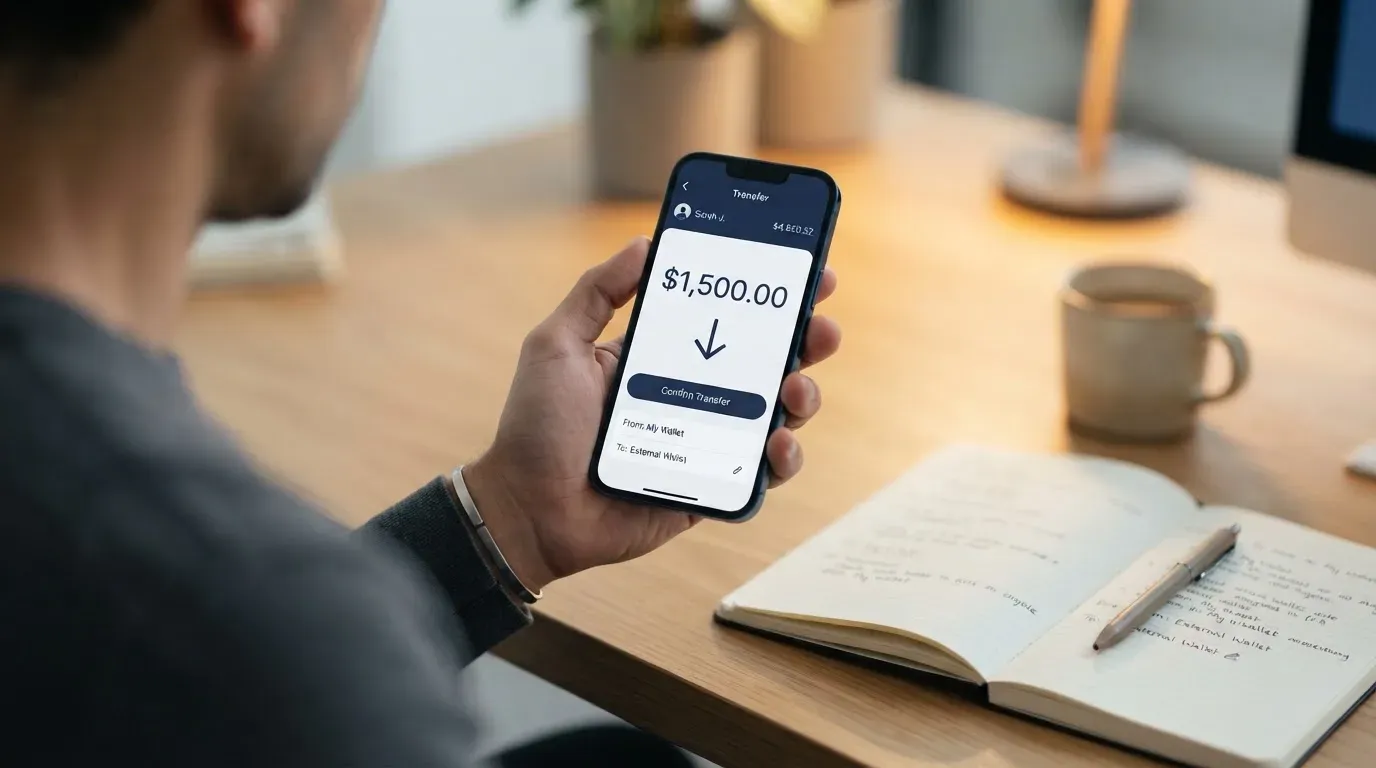
Who this suits, concretely: app users who want a Visa, virtual and physical, and who already live with the fact that banking access is the hard part of their life. Who it does not suit: anyone who needs a published fee schedule before opening an account, anyone whose country’s rules make a US-issued or non-local card uncomfortable, and anyone planning to hold a large balance for a long time on the strength of a page that says funds are protected by industry-standard safeguards without saying what they are.
Who gets the card
The site’s answer to “where can I use this” is the word “worldwide”. There is no country list on the pages I read, and no exclusions published either — which means the absence of a restriction is not the same as a published permission. Earlier starting data, which the company does not confirm, described 40 or more countries with separate programmes for the United States and for international customers, with sanctioned countries closed. Treat that as a starting point rather than a rule.
So how do I judge this at 7 out of 10? Because “worldwide” is at least the right shape of promise for the reader I’m writing for. Many people reading this have a list of countries where they simply cannot open an ordinary account, and a card that says worldwide and means it is worth looking at. But the honest reader’s next question is: worldwide except where? Every card in this category publishes a boundary, even if only in a help article. This one doesn’t, and that means you learn your position at the point of application rather than before it.
What the page also doesn’t say: nothing about age, nothing about residency, nothing about what happens if you’re in a sanctioned jurisdiction. Identity verification details are not stated either, and the levels of verification the platform applies are not stated. Those aren’t small omissions for someone who needs to know in advance whether this is worth their time.
How to get it
The signup story the site tells is short and modern: a guided setup that takes minutes. That is the whole claim. There is no walkthrough to check, because there are no steps published.
The card you get is a Visa — the app describes it as accepted anywhere Visa is accepted — and there are two of them, virtual and physical. According to the App Store listing, both share a single ATM PIN, so the card you hold and the card in your phone use the same PIN. That’s a genuinely nice design decision: no memorising two four-digit codes, no confusion at the ATM about which card belongs to which code. Your name can also be printed on the card.
What nobody has published: delivery time for the physical card, whether it ships internationally or only to one address, what it costs to have it sent, whether the virtual card arrives before the physical one, or whether you can use the virtual one while waiting. Card currency is not stated. And the identity question — which documents, whether proof of address is required, what the minimum age is — is not stated. If you are someone who has been turned away by a bank for missing paperwork, this is precisely the section where you needed detail and got none.
What the card actually is, technically
Worth knowing, because it explains a lot of what you can’t find written down. A payment card number begins with six or eight digits that identify the issuing institution, followed by an account identifier and a check digit. Merchants can look that prefix up and see which institution and country issued the card, and some apply extra scrutiny when the issuer country differs from the billing address. That’s why a card issued in one country can look “foreign” in a shop in another. Your card will look foreign somewhere. Not because anything is wrong, but because the lookup says so.
Two more structural facts. A prepaid card draws on a stored balance, while a standard debit card asks the bank to withdraw from a linked account at the moment of purchase — and many crypto cards behave like the first kind, converting and loading a fiat balance for you to spend. And in the pre-loaded model, the card can spend only what you’ve loaded, so it cannot overdraw. When you read later in this review that the card draws on a wallet balance, that is the model: you control the timing.
Fees
This is the weak point, and I’ll say it plainly: the card’s public pages do not state the issuance fee, the monthly fee, the conversion fee, the foreign-exchange fee, the ATM fee, the daily limit or the monthly limit. Not one of those numbers is published. The site does say transfers have “clear fees”, which tells you fees exist and that someone intends them to be legible — at the transfer level, not the card level.

That’s the honest state of things. So let me be careful about what I do next: I’m not going to guess figures, and I’m not going to reconstruct them from similar products. What I can do is show you exactly which numbers are missing, and then walk two or three everyday payments through the questions you’d need answered.
| Fee or limit | What the pages say |
|---|---|
| Card issuance | Not stated |
| Monthly / maintenance fee | Not stated |
| Crypto-to-fiat conversion | Not stated (site mentions only “clear fees” on transfers) |
| Foreign-exchange fee | Not stated |
| ATM withdrawal fee and allowance | Not stated — ATM use is implied by the shared PIN, but no fee or allowance is published |
| Daily limit | Not stated |
| Monthly limit | Not stated |
| Tiers or plan levels | Not stated |
| Card currency | Not stated |
| Deposits into the wallet | Wallet supports local and international transfers and is described as multi-currency |
Now the three payments. A coffee in your own country. You need two numbers: what the conversion costs when the balance is loaded, and what happens when the terminal asks for a currency other than the card’s own. You have neither, and you don’t even know what the card’s own currency is. If the card settles in dollars and you’re paying in euros, someone is converting and you’re paying part of that; the site’s silence means you cannot estimate it.
A subscription priced in dollars while you’re paid in another currency. Same problem, larger number, and here the reversal asymmetry bites. A declined authorisation can leave a hold on funds that stays for days — typically up to seven — so a card that fails at the till can cost you twice: the failed payment and the frozen balance while you sort it out.
Withdrawing cash from an ATM. The existence of a shared PIN across both cards tells you ATM use is intended. It tells you nothing about the fee, the daily allowance, or who bears it. Some programmes charge per withdrawal plus a percentage; some bundle a small number free each month; some cap it and decline beyond that. You will learn this by being charged, not by reading.
The wider category has one fee that never appears on any card’s schedule and that you should hold in mind separately: when you move crypto onto the network to fund the card, the blockchain charges the network fee for that transfer, not the card provider. So the real cost of getting money into a crypto card is the card’s own fees plus a network cost you cannot negotiate. And if the card is funded from crypto, tax is a separate matter I won’t advise on here — in the US the IRS treats digital assets as property, so converting them into dollars for a purchase generally produces a taxable gain or loss measured at fair market value on the date, which means each card payment funded from crypto can be its own disposal event. I mention it only so you can seek advice before you start, not as advice itself.
How to top it up
The card spends from the SpotPay wallet balance. That’s the mechanism, stated plainly on the site: funds are added to the wallet, and the wallet can receive payments. Coins and networks: not stated. Earlier starting data describes collateral coming from a self-custodied wallet, but the pages I read don’t confirm that, so treat it as unverified. Top-up methods are not stated, and neither is how to withdraw money from the wallet or the card.
So the practical shape of a top-up is: move value into a multi-currency wallet that supports local and international transfers, then spend whatever sits in that wallet balance. Everything specific is missing. Which coins are accepted. Which networks those coins must arrive on. Minimum and maximum amounts. Time to credit. Whether an on-chain deposit is required at all, or whether bank transfer works.
That last set of gaps is not pedantry. Blockchain transfers are irreversible. If you send on a network the provider doesn’t support, or to an address belonging to a different network, the funds can be lost or need manual recovery with no guarantee. Sending USDC over Tron, for example, is not a native option — Circle stopped supporting USDC on Tron in February 2024. Anyone who has handled stablecoins will recognise this as the single most common way people lose money in this category, and it is precisely why “which network” needs to be answerable before you send, not after.
Two more things a careful reader will want in mind. On Ethereum, fees are paid in ETH, so a wallet holding USDT with no ETH cannot send at all. On Tron, fees are met with internal resources and often burn TRX. And a stablecoin is not a guarantee: despite the name, stablecoins are not necessarily stable — TerraUSD collapsed in May 2022, and USDC temporarily lost its peg in March 2023 during the US banking crisis. Both of the two largest dollar stablecoins are backed in the way their issuers describe, but “pegged” is a description, not a promise.
Paying with it every day
This is where the card is genuinely good, and it earns its 9 out of 10 without qualification.
- Virtual and physical Visa cards, both from one account.
- One ATM PIN shared by both cards.
- Apple Pay and Google Wallet supported anywhere Visa is accepted.
- Your name can appear on the card.
- Apps for iPhone and Android; the iOS app is “SpotPay: Global Wallet”, rated 4.2 out of 5 from 41 ratings, age 4+, version 1.4.12, developer SpotPay, Inc.
- The pre-loaded balance model means the card cannot overdraw.
Two of these deserve a technical note, because they’re the reason a virtual card is safer than it looks and better than a photograph of your card. Apple Pay replaces the card number with a device-specific number held in the phone’s secure hardware, never on Apple’s servers, and each payment carries a one-time dynamic code. A screenshot of your card number is worth nothing at a shop; a tokenised phone is something else entirely. And when you pay online, 3-D Secure adds an identity check: the issuer assesses the risk and either approves frictionlessly or challenges you with a one-time code or biometrics. Visa’s version is called Visa Secure.
What isn’t published: which merchant categories are blocked. That matters more than it sounds. Gambling has its own category code, and many issuers block it on specific cards by policy rather than by law — and the blocked list varies from issuer to issuer. If betting or lottery is something you do, “not stated” here is not neutral. Also unstated: any rewards or cashback. The App Store rating is thin evidence — 41 ratings is a small sample — but nothing negative surfaced in it.
The Google Play rating I did not read. I’d rather say that than imply I checked both stores.
What can go wrong
Nobody has published an incident, and my two searches on 21 October 2026 found no user reports and no news. There is no Trustpilot page and no Reddit page. That’s the good news and it’s genuine — with an obvious caveat: a brand founded in 2025 will not have a complaint history, and the absence of complaints tells you more about its age than about its reliability.
The structural risks are more useful.
The issuer is not named. The card is a Visa, and a card network doesn’t issue consumer cards itself — it licenses issuers and can suspend a programme. The parties behind a crypto card are usually three: the network routes the messages and sets the rules, the licensed issuer holds the card programme, and the crypto brand is often only a programme manager and front end. Here, the first two are unnamed in the public material. That is a gap you will feel if you ever have to ask someone to reverse a payment, because you’d be asking the brand, not the issuer.
It is not a bank, and says so. SpotPay, Inc. describes itself as “a financial services platform, not a bank”. In the US, that’s the money-services-business category: FinCEN guidance treats administrators and exchangers of convertible virtual currency as money transmitters, while people merely buying goods with it are not. Being an MSB is a registration, not a deposit insurance. If it were an EU electronic money institution instead, customer funds would have to be safeguarded — segregated or insured — and even then they aren’t bank deposits and may not sit under any deposit guarantee scheme. Either way, understand that your balance is not a bank balance.
Programmes end. Visa terminated its global agreements with FTX in November 2022 and the FTX US debit card was wound down. Visa suspended WaveCrest in Europe in 2018, closing all WaveCrest-issued Visa programmes. The usual sequence is a notice period, then spending and loading stop, then you’re asked to withdraw what remains. A 2026 closure reported by a secondary source ended new loads on 8 July and spending on 8 August — single source, unconfirmed, and I’m including it only to show the pattern, not as a prediction about this company.
Some merchants will decline you. Address verification, which compares the numeric parts of your billing address with issuer records, is mainly offered in the US, Canada and the UK and is generally unavailable for foreign-issued cards — which causes declines. Some merchants decline prepaid or foreign card prefixes outright, because the lookup reveals what you’re holding. And with 3-D Secure, liability for a fraudulent online payment can shift away from the merchant — to your bank, or, as critics put it, to you.
Custody is the question you can’t answer. Whether your funds sit with the provider or stay in your own wallet is not stated. The difference is not cosmetic. With a custodial wallet, the provider holds the credentials and you must trust them completely. With a self-custody-linked card, funds stay yours until the moment of payment, and you bear the full responsibility for key loss, phishing, and clipboard-hijacking malware that silently swaps an address you copied. Historically the custodial side has the worse record: Mt. Gox reported about US$350 million stolen over 2011–2014, Coincheck about US$400 million in 2018, Ronin Network US$625 million in 2022. Transfers are irreversible by design; the network cannot freeze or return them.
What the site does claim for safety: industry-standard fund protection, secure authentication that locks the account to the owner, and real-time monitoring for unauthorised activity. Reasonable things for a fintech to say. Vague enough that I’d want the specifics.
Not stated: support arrangements, and any news or announcements I could find.
One regulatory point worth knowing as you read all of this. A card is a payment service, regulated separately from crypto. Under MiCA — the EU’s markets-in-crypto regulation, in legal effect since June 2023, with stablecoin rules applying from 30 June 2024 and crypto-asset service provider rules from 30 December 2024 — the crypto side and the payment side are governed by different instruments, so a crypto card often depends on two licences. Providers operating under national law could continue only until 1 July 2026 or until a MiCA authorisation was granted or refused, whichever came first. There’s an ESMA register you can check a provider against. None of that tells you where SpotPay sits; it tells you what questions to ask.
What to take instead
Three alternatives, with their own trade-offs. I’m not recommending any of them — I’m showing you the shape of each so you can see which gap matters less to you.
| SpotPay Calypso | International Visa Card | UNi Card | Whop Cards | |
|---|---|---|---|---|
| Score | 6.5 / 10 | 6.7 / 10 | 6.1 / 10 | 5.2 / 10 |
| Network | Visa | Visa, US-issued Platinum | Mastercard, multicurrency | Visa |
| Card form | Virtual + physical | Virtual; physical “coming soon” | Not stated | Not stated |
| Issuance fee | Not stated | $5 one-time | Not stated (“no annual fee”) | No extra fees, amounts unlisted |
| Monthly fee | Not stated | None; plans Classic free, Pro $9.00, Max $19.00 | None | No extra fees, amounts unlisted |
| Foreign-exchange fee | Not stated | Visa exchange rate + 2% FX fee | None stated; live OTC rates, no hidden exchange fees | Not stated |
| Funding | SpotPay wallet balance; coins and networks not stated | USDC or USDT into a USD account, free; also USD, EUR, SEPA, SWIFT, FedNow | Not stated | Whop balance |
| Rewards | Not stated | No cashback stated | Spend-to-Earn up to 3% | 5% cashback at select merchants, currently Uber |
| Main caution | Fees and issuer unnamed | Hard country exclusions | Eligibility not stated | US-state scope; fee amounts not listed |
International Visa Card is the closest competitor and the only one that publishes a complete price list. It’s explicit about what it won’t do: no account or card for residents or legal registrants of Belarus, mainland China, North Korea, Cuba, India, Iraq, Iran, Israel, Myanmar, Nepal, Nicaragua, Russia, Syria, Turkey, Ukraine, Venezuela or Vietnam, with FATF grey-list countries reviewed case by case subject to compliance approval. Purchases are blocked in North Korea, Cuba, Iran, Russia, Syria, Ukraine and Venezuela. Two things to note carefully: the rule runs on residence or registration, not citizenship, and the exclusion list is long — seventeen jurisdictions. In exchange you get a U.S.-issued Platinum Visa, virtual, paying in USD, with $5 issuance, no maintenance fee, free card use in USD, free deposits of any kind, and a named 2% FX fee on foreign currency.
UNi Card is a multicurrency card on Mastercard spending from a UNi.Global account balance. It states no annual fee, no foreign transaction fee, conversion at live OTC rates and no hidden exchange fees — and offers Spend-to-Earn rewards up to 3%. The catch is that eligibility isn’t stated and the funding route isn’t stated, so you learn as much about it after signing up as before.
Whop Cards are Visa cards that spend from a Whop balance — pending balance usable as soon as a payment arrives, standard withdrawals using settled funds — with 5% cashback at select merchants, currently Uber. The scope is the tightest of the four: consumers in 31 US states (Alabama through Wyoming, listed), businesses in 41 states, and unsupported consumer countries include Belarus, mainland China, Cuba, Hong Kong, India, Iran, Iraq, Israel, Myanmar, Nepal, Nicaragua, North Korea, Russia, Syria, Turkey, Ukraine, Venezuela and Vietnam. Whether the test is citizenship or residence isn’t stated. The page says “no extra fees” without listing amounts.
The pattern worth naming: the three cards with published numbers are the ones where you can actually plan. The two with “clear fees” or “no extra fees” and nothing else are the two where you can’t.
Who I’d recommend this to
I’d recommend the SpotPay Calypso card to someone whose immediate problem is not being able to hold a normal card, and whose second problem is having something that works in a wallet. If your route to a bank card is closed and your fallback is cash or an expensive transfer service, having a virtual Visa you can start with and a physical one to follow is worth a lot — and the shared PIN, the tokenised mobile wallets and the balance model mean it behaves like a normal card rather than an experiment. I’d also say this to someone who is comfortable with crypto mechanics: the card spends from a wallet you top up, you know how networks work, and you can absorb the possibility that a fee or a limit turns out not to be what you expected.
I would not recommend it to someone whose main question is “how much does this cost per transaction”. That answer is not public, and you should not open an account and find out. I would not recommend it to anyone planning to keep a large balance long-term on the strength of a phrase like “industry-standard fund protection” without knowing who holds it and whether it’s a bank deposit or not. And I would not recommend it to anyone who needs chargebacks and complaint handling to work in a specific, documented way — the issuer is unnamed, the dispute process is not stated, support arrangements are not stated, and prepaid-card coverage varies and shouldn’t be assumed.
If you can get an ordinary card, get an ordinary card. The comparison above makes the reason plain: a mainstream card comes with published fees, a named issuer, deposit protection and a complaints procedure, and none of those need to be inferred from a marketing page. This card is for the situation where that isn’t on the table — and I think it’s a credible option in that situation, provided you go in knowing what the pages don’t say, which is most of what matters.
Frequently asked questions
What is the SpotPay Calypso card?
It’s a Visa card issued through the SpotPay mobile wallet app, offered in both virtual and physical form. The virtual card is for online and mobile use; the physical card is the one you’d carry. Both share a single ATM PIN, according to the App Store listing. Spending draws on your SpotPay wallet balance rather than on a bank account. The apps are available for iPhone and Android.
How does the SpotPay Calypso card work in practice?
You add funds to the SpotPay wallet, and the card spends whatever balance sits there — a prepaid-style model, which means it can’t overdraw because there’s nothing to overdraw. Your name can be printed on the card. You can load the card into Apple Pay or Google Wallet and pay with your phone anywhere Visa is accepted. Unlike a normal debit card, no bank is asked to authorise the purchase from a linked current account at the till.
Is SpotPay a bank?
No, and it says so itself: SpotPay, Inc. describes the company as “a financial services platform, not a bank”. It is registered as a Money Services Business with FinCEN in the US, which is a money-transmitter registration rather than a banking licence or deposit insurance. That distinction matters if you’re keeping a balance there — a non-bank balance doesn’t carry the protections a bank deposit would, and the card’s actual issuer isn’t named on the public pages.
Who owns SpotPay?
The registered company is SpotPay, Inc., the developer listed on the App Store. Unofficial information, which the company itself does not confirm, describes it as San Francisco-based, founded in 2025, a Y Combinator W26 company with founder and CEO Zsika Phillip-Baptiste, sourced from a third-party profile with no date on it. That last part matters: a young company with no public track record is exactly why the absence of complaints tells you little.
Which countries can I use the SpotPay Calypso card in?
The site says you can spend “worldwide” and publishes no country list and no exclusions. Earlier starting data, not confirmed by the company, describes 40+ countries with separate US and international programmes and sanctioned countries excluded. Treat it as unverified until you apply. Worth knowing generally: some merchants decline foreign-issued or prepaid card prefixes when they look them up, so “worldwide” describes the card network’s reach, not a guarantee at every till.
How do I apply, and how long does it take?
The site describes a “guided setup” that takes minutes, through the iPhone or Android app. Nothing more is published — no eligibility criteria, no minimum age, no list of required documents, no proof-of-address requirement, and no delivery time for the physical card. If you have been refused by an ordinary bank for missing paperwork, that absence is the first thing to raise with their support before you commit.
Does it require KYC, and how do I activate the card?
The pages don’t state what verification is performed, which documents are needed, or what the verification levels are. As a general rule, regulated businesses must verify customers and screen them under anti-money-laundering law, and where due diligence can’t be completed the institution must decline the transaction or close the relationship. That’s why accounts freeze pending documents — and it’s not a judgement about you. Activate it through the app, and ask support what they need before you assume you’re done.
How do I top up, and which coins and networks work?
The card spends from the SpotPay wallet balance, and you add funds to that wallet; the wallet supports local and international transfers and is described as multi-currency. Which coins and which networks are accepted is not stated, and neither are minimums, maximums or credit times. Be careful here: transfers are irreversible, sending on an unsupported network can lose the funds, and on Ethereum you need ETH for the fee even if you’re sending USDT. USDC over Tron isn’t a native option since February 2024.
What are the fees?
The public pages state none of them: no issuance fee, no monthly fee, no conversion fee, no foreign-exchange fee, no ATM fee, and no daily or monthly limits. The site says only that transfers have “clear fees”, which refers to transfers rather than card use. If per-transaction cost decides your choice, this card can’t be evaluated from what’s published — ask their support for the schedule in writing before you top up.
Is it safe, and what happens if something goes wrong?
No incidents have been published and I found no user complaints or news in two searches, though a young company hasn’t had time to build a complaint history. The site cites industry-standard fund protection, owner-locked authentication and real-time monitoring; whether funds are held custodially or by you isn’t stated, and that question carries real risk either way. Also know that the issuer is unnamed, so reversing a payment or resolving a dispute means going through a brand rather than a bank.
App and neobank card reviews – cryptocardcheck
Content created by the «cryptocardcheck» team