
MetaMask Card reviewed: real self-custody spending, with rough edges
 Available in US
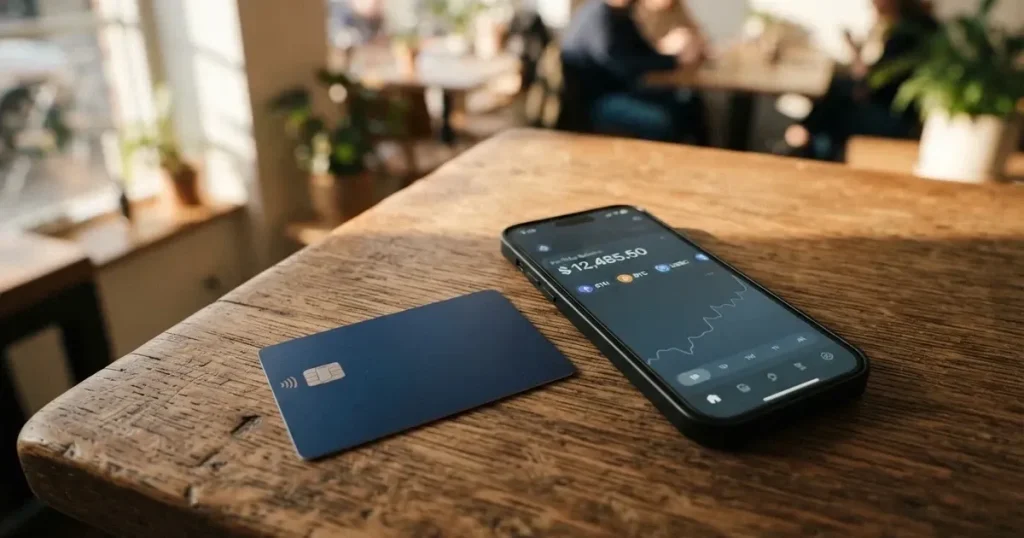
The MetaMask card is one of the more interesting cards in this category, because it spends straight from a wallet you control instead of from a balance held by a company. That single design choice produces both the card’s best feature and its hardest edges: your crypto never leaves your own keys, but you also carry the whole responsibility for tokens, networks and fees. I scored it 7.1 out of 10. In practice this suits people already running a self-custody wallet in Europe or Latin America who want to spend from it daily and have had trouble getting an ordinary bank card. It suits you far less if you want a bank account, a predictable statement, or help from a human being when something goes wrong.
The conditions described here are current as of October 28, 2026.
Verdict: 7.1 out of 10
| Criterion | Mark | Why |
|---|---|---|
| Who can get it | 7 / 10 | Sign-up is open in 45 listed countries and territories, but other regions sit on a waitlist, and US and UK sign-ups are temporarily closed |
| Cost | 8 / 10 | The Virtual card is free with no annual or monthly charge, Metal is $199 a year, and there is no foreign transaction fee — but each transaction carries a “minimal fee” with no amount stated |
| Top-up options | 8 / 10 | It spends directly from the connected wallet on Linea, Base, Monad and Solana, across mUSD, wETH, EURe, GBPe, USDC and USDT |
| Reliability and complaints | 4 / 10 | Issuer Monavate, card provider Crypto Life, and reports of refunds stuck in a Credits balance, looping tickets and card freezes |
| Everyday use | 9 / 10 | Instant virtual card plus Metal, Apple Pay and Google Pay, and ATM limits of $1,000 a day on Virtual and $5,000 on Metal |
| Total | 7.1 / 10 | Strong on cost and daily use, held back by support and reliability |
The split in that table is the honest picture. Cost and everyday use are genuinely good: a free card, no FX markup, wallet-to-merchant spending, and mobile wallets that work. Reliability is where it falls short, and reliability is what you notice at the worst possible moment — a hotel pre-authorisation, a card frozen at a till, a refund that never lands.
Before you decide anything else, ask one question: do I already hold crypto in a self-custody wallet? If yes, this card is designed for you and the answer is fairly simple. If no, you are signing up for a crypto product before you have crypto, and the value proposition is much thinner.
Will they give you the card?
Yes, if you live in one of 45 listed countries or territories — otherwise you are waiting.
The card says sign-up is open in 45 listed countries and territories. Examples named include Andorra, Argentina, Brazil, Canada, Mexico, Germany, France, Spain and Uruguay. The full official list is: Andorra, Argentina, Austria, Belgium, Brazil, Bulgaria, Canada, Chile, Colombia, Costa Rica, Croatia, Cyprus, Denmark, Dominican Republic, El Salvador, Finland, France, Germany, Gibraltar, Greece, Guatemala, Guernsey, Hungary, Iceland, Ireland, Isle of Man, Italy, Jersey, Liechtenstein, Luxembourg, Malta, Mexico, Monaco, Netherlands, Norway, Panama, Poland, Portugal, Romania, Slovakia, Slovenia, Spain, Sweden, Switzerland, Uruguay. Russia, Belarus and Turkey are not in it.
That list is worth reading properly rather than skimming, because “is it available in my country” has two different answers here and people conflate them. Sign-up and *spending* are not the same gate. The card’s own line on this is worth repeating: ineligible regions limit sign-ups, not spending. In other words, a card you already hold keeps working when you travel; you simply cannot obtain a new one from certain places.
If you are outside the 45, other regions join a waitlist. That is a real queue with no published timing, so plan on not having the card.
Two more things the card’s public pages do not say, and I would rather tell you plainly than guess. The citizenship rule is not stated — only residence is addressed. And sign-ups in the United States and United Kingdom are temporarily closed per the FAQ, which is worth noting because the same set of pages describes the Metal card as available in the US. US availability remains contradictory and unclear.
| Region | What the card states |
|---|---|
| 45 listed countries and territories | Sign-up open |
| US and UK | Sign-ups temporarily closed per FAQ; a separate line says Metal is available in the US |
| All other regions | Waitlist |
| Traveling to a non-listed country | Spending continues; only sign-up is affected |
How to get it
You need proof of residency, you do not need a credit check, and you get a virtual card almost immediately.
The route is short. You apply in the MetaMask app, prove where you live, and — once approved — a virtual Mastercard appears in the app instantly. The Metal physical card can be pre-ordered in the app after the Virtual card is approved. One card per user.
What the card’s own pages actually specify is narrow: KYC is handled by Crypto Life, proof of residency is required, and there is no credit check. There is no credit check because there is no credit — this is not a borrowing product, so nothing here depends on your credit history. A verified address is needed if you want the Metal card shipped.
The specifics that are not stated on the public pages, and which I would not want you to assume:
- Which KYC documents are accepted. The card does not publish a list.
- The minimum age. Not stated.
- The KYC levels, the processing time, and the stated reasons for rejection. Not stated.
- The card currency. Not stated.
- Metal delivery time, delivery cost, and replacement cost. Not stated.
Against that, there are unofficial reports worth knowing about because they tell you what to expect, though the card has not confirmed them. Per cryptocards.so, in 2026 email, phone and ID were required, while address proof and a selfie were not — which sits oddly beside the card’s own requirement of proof of residency. The same source reports fast, near-instant KYC approval. Also from that source: one App Store reviewer reports a Metal card promised in two weeks that arrived after more than a month. Treat all of this as third-party reporting, not card policy. If a two-week delivery is decisive for you, ask support directly before you pay $199.
On support: MetaMask Card Support is available 24/7 for assisted replacement in your region. That is a genuine service, and it is also the one thing likely to matter most if a card goes missing.
Fees: what it really costs
The Virtual card is free. Metal is $199 a year. Every transaction carries a small fee the card never puts a number on, and there is no foreign transaction fee.
This is the section where I have to be most careful, because the card’s pages are honest about the shape of the fees and vague about the numbers. What is stated: a “minimal fee for each transaction” — amount not stated on the card’s pages, with a fee table linked — and “no additional MetaMask fees”. There is no foreign transaction fee, and the Mastercard rate is used for conversion.
| Item | Value |
|---|---|
| Virtual card issuance | Free, no annual or maintenance fee |
| Metal card | $199/year |
| Fee per transaction | A “minimal fee”, amount not stated |
| Additional MetaMask fees | None |
| Foreign transaction fee | None; Mastercard rate used |
| ATM limit | $1,000/day (Virtual), $5,000/day (Metal) |
| Free ATM withdrawals | “Up to $1,200/mo”, tier unclear |
| Daily card spend limit | $15,000 (Virtual), $30,000 (Metal) |
A third-party site (cryptocards.so, 2026) lists monthly, issuance, ATM, FX, top-up and decline fees as free. That contradicts the card’s own “minimal fee for each transaction” and the $199/year for Metal, so I would not plan around it. The official position is the one to assume.
Now the part that matters more than the table: what happens when you actually pay for something. Three everyday cases.
- Paying in your card’s own currency, or in a currency where no conversion is needed. You pay the merchant’s amount plus the minimal per-transaction fee. That is the whole cost.
- Paying in a different currency. The conversion uses the best rate Mastercard allows, with no added FX fee on the card’s side. What you can still lose to is the network’s own conversion spread, and gas or deposit fees when tokens move across networks — see the top-up section.
- Withdrawing cash at an ATM. Subject to the daily ATM limits above, and the free-allowance line is confusing: “up to $1,200/mo” with the tier it belongs to unclear. Do not assume it applies to Virtual.
One conflict you should know about rather than discover later: the official FAQ states that cash withdrawals are available only to US card users, while the card page lists ATM limits for Virtual and Metal without a country condition. Older and newer versions of these pages disagree. If ATM access matters to you, treat it as unconfirmed for your country and ask support before you rely on it. Similarly, an older FAQ cites daily limits of 8,750 EUR or 10,000 USD where the card page now says $15,000 and $30,000 — the newer card-page figures are the ones I would use, but the disagreement itself tells you the documentation is not synchronised.
| Product | Virtual | Metal |
|---|---|---|
| Price | Free | $199/year |
| Card spend limit | $15,000/day | $30,000/day |
| ATM limit | $1,000/day | $5,000/day |
| Cashback | 1% | 3% to the first $10,000 spent, then 1% |
| $FLY bonus | 5X | 7X |
Whatever card you take, you can set your own daily, weekly and monthly limits in the app. Given the freeze complaints in the risks section, I would set them before you need them.
Top up: there is no top up
This is the concept that trips people up. The MetaMask card does not work by preloading a balance. There is nothing to top up.
What actually happens: spending draws on tokens delegated to the card from your connected wallet. No preloading, no stored float, no app screen asking you to buy a card balance first. The card balance view shows the highest-priority token set under Manage.
Where the money comes from — the networks are Linea, Base, Monad and Solana. The tokens named are mUSD, wETH, EURe, GBPe, USDC and USDT, and the page says nine, so the list you see on screen is the authoritative one. One important exception: a wallet that is on Solana only cannot withdraw credit.
Fees on the way in are not stated. The network fee, any deposit fee, and any minimum top-up are all unstated, and the support fee table returned no figures. No fiat top-up is stated either — this is a crypto-from-crypto card, not a bridge from your bank account. That is the single biggest thing to understand before you apply if your crypto sits with an exchange.
Two further points on moving money. First, withdrawals go out as mUSD: Money Account holders receive vault Monad mUSD, others receive Linea mUSD at their priority EVM address. Second, Monad withdrawals have sponsored gas, so a withdrawal there is cheaper than the general case. Withdrawal fee itself: not stated. To close the card, you contact Crypto Life support — and when the card is frozen or deactivated, your funds stay in your own wallet, which is the single best structural feature of this design.
Paying with it every day
It works well, and on the things you do most often it is close to frictionless.
Apple Pay and Google Pay are supported, which in practice matters more than the physical card ever will. The virtual card activates instantly, with nothing mailed at signup, and the Metal card can follow later. The card is managed inside the MetaMask app, with transaction alerts and activity monitoring.
Rewards are worth understanding properly, because the headline and the footnote differ. Cashback is paid in mUSD into the Money Account: 1% on Virtual. On Metal the headline is 3%, but the footnote limits 3% to the first $10,000 spent and 1% after that. Separately, a $FLY bonus of 5X (Virtual) or 7X (Metal) is available through the Blackbird dining app. Metal holders can also opt into a 90-day Club Regular trial.
| Perk | Virtual | Metal |
|---|---|---|
| Cashback | 1% | 3% up to $10,000 spent, then 1% |
| $FLY multiplier (Blackbird) | 5X | 7X |
| Other | — | 90-day Club Regular trial available |
One community-reported trap worth knowing: bridging to Linea or Base can erode your cashback, because the network cost eats the reward. If you are bridging in order to spend, do the maths on a 1% cashback before you complain about the reward rate.
If a payment goes wrong, the process the card describes is: ask the merchant for a refund first; if that fails, request a chargeback from Crypto Life support. Refunds go to the Credits balance. Time frames are not stated. That Credits balance is exactly where community reports say money gets stuck, so I would read the refunds section again before you assume a lost refund is recoverable.
What can go wrong
Four risks, in the order I would weigh them for someone in your position.
Refunds and support. This is the weak point and the reason the reliability mark is 4 out of 10. Community reports on cryptocards.so (2026) describe refunds trapped in a Crypto Life “Credits” balance, support tickets looping through automated replies, and slow responses with copy-paste email replies and no live chat. Trustpilot shows 1.4 out of 5 from 647 reviews for MetaMask the wallet overall (rfp.wiki, read 2026-10-20) — that is the wallet, not the card, but the themes are poor support and slow resolution. Official pages add two further irritants: sign-ups paused in the US and UK, and FAQ versions on limits and ATM that contradict each other. I read no dated official announcements.
Frozen cards. Community posts describe cards frozen at lifetime transaction limits until a manual upgrade, and account closure for inactivity. Nobody should freeze an account for being quiet, so if you use this card, use it regularly enough to stay inside your own configured limits.
Geography and status. The card is a Mastercard, and Mastercard’s network means the ordinary rules apply. Merchants can look at the issuer identification number and see which institution and country issued the card, and may apply extra scrutiny when that differs from your billing address — which is why a card issued in one country can look “foreign” in another. Some merchants decline prepaid or foreign BINs for the same reason. Address Verification Service, which compares the numeric parts of a billing address, is mainly offered in the US, Canada and the UK and is generally unavailable for foreign-issued cards, which can cause declines. Online payments can also be challenged by 3-D Secure (Mastercard calls it Identity Check). And a declined authorisation may leave a hold on your funds for several days, typically up to 7.
Onboarding and timing. Which documents are accepted, the age requirement, processing time and rejection reasons are all unstated on the public pages. If your situation is not straightforward — a recent address change, a residence in one of the 45 countries but citizenship elsewhere — that silence will be resolved by support, or by a rejection.
The reassuring part: this is non-custodial. Your private keys stay in your wallet. You can freeze or replace the card instantly in the app, funds stay in your wallet, and the Virtual card stays active for your subscriptions. Transaction alerts and user-set limits are there. Insurance is not stated, so do not assume deposit-guarantee-style protection — these are not bank deposits.
Who is behind it
The card provider is Crypto Life; the issuer is Monavate. The site footer reads “Copyright 2026 Consensys, Inc.”, but the FAQ does not say Consensys provides the card — worth separating the brand from the contracting parties. The issuer’s registered country and licences are not stated. Unofficial, per a community post cited by cryptocards.so (2026): Monavate Limited is named as the FCA-regulated entity for UK complaints. Since UK sign-ups are closed, that would matter mainly to existing UK users or for complaint-handling purposes.
What to take instead
If you need a different trade-off, these are the three alternatives I compared, all at lower headline scores.
| Alternative | Score | Card | Where | Headline cost |
|---|---|---|---|---|
| MetaMask | 7.1 / 10 | Mastercard, virtual + Metal | 45 countries, US/UK sign-ups closed | Free virtual; Metal $199/year |
| TokenPocket | 5.8 / 10 | Mastercard/Visa debit | European list; Mastercard for Australia, Canada, Hong Kong, Japan, Taiwan, New Zealand, Singapore, South Korea, UK | Small portion of an NFT creation fee; 1% on crypto deposits |
| KAST | 6.1 / 10 | Visa, virtual + physical, up to 10 cards | Residence-based, list shown at KYC | Standard 0 USD/year; Premium 1,000 USD/year; Private 10,000 USD/year |
| Zeal | 6.1 / 10 | Visa, virtual | Spend in 150+ countries; programme live in EU, UK, Brazil, Colombia, Mexico, Japan, Singapore, Philippines, Indonesia, Thailand | Not stated |
TokenPocket is the cheapest-looking and the messiest on crypto. It charges 1% on depositing cryptocurrency into the card, which it says is refunded later through rewards or reduced transaction fees — that is a deferral, not a cancellation. It runs on Arbitrum, balances sit in EUR24 and USD24, Fiat24 cards are virtual with no physical card mentioned, no cashback is stated, and specific coins and networks are not listed in its FAQ. Its Americas expansion is marked “planned for Q2 2025”, which tells you how fresh that claim is.
KAST is the transparent-fee option, and its price tiers are the real story. Stablecoin top-up 0%, card spend in USD 0%, transaction fee 0%, Apple and Google Pay 0%; the FX fee for non-USD is 0.5%–1.75% depending on your residence country, transaction country and card programme, with $0.10 on non-USD transactions under $25 and $0.50 for a decline on insufficient balance. But membership costs $1,000/year for Premium and $10,000/year for Private, billed annually upfront, plus $2 for an extra virtual card, $40 delivery on a Standard physical card, and a $1/month inactivity fee after 12 months. Eligibility is decided at KYC and depends on both residence *and* which ID you hold — living in a supported country with an ID from a restricted region may still fail. Cashback is 1.5% / 2% / 3% on the first $2,000 / $10,000 / $40,000 a month. If you spend heavily and want clean, published numbers, this is the one to model carefully.
Zeal is the one to look at if you want travel rather than home. Spend in 150+ countries, Visa, virtual card for online use, addable to Apple Pay, accounts in EUR, USD and GBP, spending from balances in the card Safe. Up to 4% cashback paid in GNO on Gnosis Chain — you must hold GNO in the card Safe to qualify, and rates can change. No FX fee is added by Zeal, conversion at the Visa wholesale rate, though Gnosis Pay fees such as ATM may still apply. What is not stated: the cost schedule itself, and whether a physical card exists.
My honest comparison: MetaMask wins on price, on non-custody, and on networks. KAST wins on documented fees. Zeal wins on reach. TokenPocket wins on nothing I would put in a recommendation.
Who I would recommend it to
If you already hold USDC, USDT, mUSD or similar in a self-custody wallet, you live in one of the 45 listed countries, you are comfortable choosing networks and checking an address twice, and you want to spend crypto without handing a company the keys — yes, take the free Virtual card. It costs nothing to find out whether it fits.
If you want the Metal card specifically, my test is whether you spend enough for $199 a year to be obvious and whether you will actually carry it. Buy it for the limits and the cashback tier, not for the metal.
I would hold off if any of these is true. You do not yet hold crypto and were planning to use the card as a way in — there is no fiat top-up stated. You want a bank account or a normal bank card with dispute handling you can trust. You travel constantly to places where prepaid or foreign-issued cards get declined. You are in the US, the UK, or outside the 45 and hoping the waitlist moves. Or you simply cannot accept that the help you get is largely automated email — in which case, given the refund reports, this is the wrong card for you.
Frequently asked questions
What is the MetaMask card?
The MetaMask card is a Mastercard that spends directly from a self-custody wallet you control, rather than from a balance held by a crypto company. It comes in two forms: a free Virtual card available instantly in the app, and a Metal physical card at $199 a year. Because it is non-custodial, your private keys never leave your wallet, and your funds stay there even if the card is frozen.
How does the MetaMask card work?
You connect a wallet, tokens are delegated to the card, and each payment draws on those tokens at the moment of purchase — there is no balance to preload. Supported networks are Linea, Base, Monad and Solana, with named tokens including mUSD, wETH, EURe, GBPe, USDC and USDT. A wallet on Solana only cannot withdraw credit, and withdrawals go out as mUSD.
Is MetaMask a bank?
No. MetaMask is a wallet brand and card programme manager, not a bank. The card provider is Crypto Life and the issuer is Monavate; the site footer carries a Consensys copyright, but the FAQ does not say Consensys provides the card. Card payments involve the network, the issuer holding the programme, and the crypto brand in front — so your contractual counterparty is not MetaMask itself.
Who owns MetaMask?
MetaMask is associated with Consensys, Inc., whose name appears in the site footer copyright. The card itself is issued by Monavate and provided by Crypto Life. The issuer’s registered country and licences are not stated on the card’s public pages, and an unofficial community post names Monavate Limited as the FCA-regulated entity for UK complaints.
Is the MetaMask card free?
The Virtual card is free, with no annual or maintenance fee. The Metal card costs $199 a year. There is no foreign transaction fee, and the Mastercard rate is used for conversion, but every transaction carries a “minimal fee” whose amount the public pages do not state. So: free to hold, not free to spend.
How do I get the MetaMask card?
Sign-up is open in 45 listed countries and territories, including Andorra, Argentina, Brazil, Canada, Mexico, Germany, France, Spain and Uruguay; other regions join a waitlist. You need proof of residency and there is no credit check. Once approved you get the Virtual card instantly, and can pre-order Metal in the app. US and UK sign-ups are temporarily closed.
Does MetaMask card require KYC?
Yes, proof of residency is required and KYC is handled by Crypto Life. The card’s public pages do not specify which documents are accepted, the minimum age, the processing time, or the reasons for rejection. Unofficial 2026 reporting from cryptocards.so says email, phone and ID are required and no selfie, which sits awkwardly beside the stated residency requirement.
How do I top up the MetaMask card?
You don’t — there is no preloading. Spending draws on tokens delegated to the card from your connected wallet, and the balance view shows the highest-priority token set under Manage. Network fees, any deposit fee and any minimum top-up are not stated, and no fiat top-up is offered, so the crypto has to come from a wallet you already control.
Is the MetaMask card safe?
The structure is the safest part: non-custodial, instant freeze and replacement in the app, funds remaining in your wallet, transaction alerts and your own spending limits. The risks are operational — community reports of refunds stuck in a Credits balance, looping support tickets, cards frozen at lifetime transaction limits, and account closure for inactivity. Card-based disputes follow Mastercard rules, and insurance is not stated.
Where can I use the MetaMask card, and can I use it in my country?
You can use it wherever Mastercard is accepted, and the card states that ineligible regions limit sign-ups, not spending — so travel does not invalidate a card you already hold. Some merchants decline prepaid or foreign-issued cards after checking the issuer identification number, and address verification is mainly offered in the US, Canada and UK, which can cause declines abroad.
Wallet card reviews – cryptocardcheck
Content created by the «cryptocardcheck» team