
Slash spends USDC in yen, and only in Japan
 Available in US
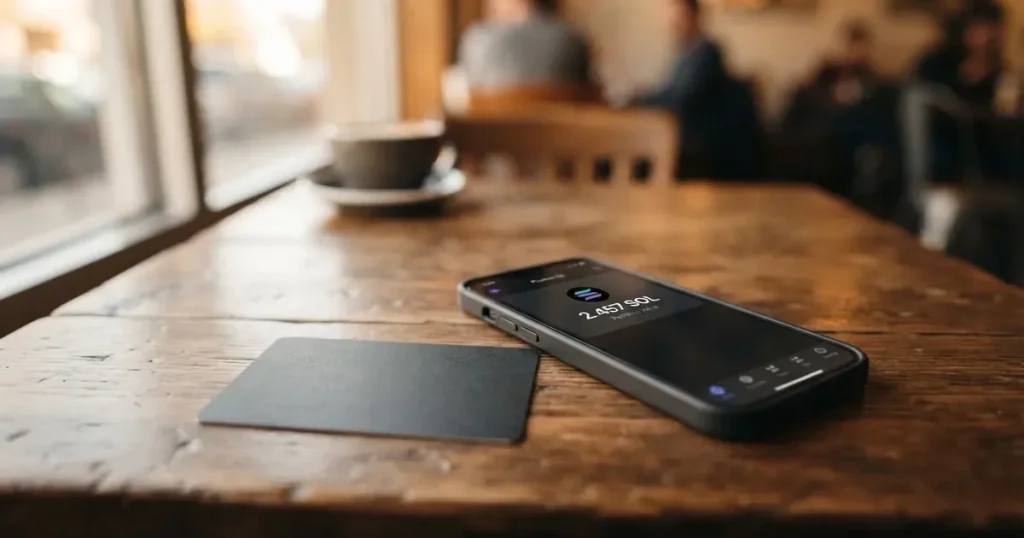
Slash is a Visa card that draws on a USDC balance instead of a bank account, and the site calls it Japan’s first credit card usable with stablecoins. That is a real thing, and it is also a narrow thing. If you live outside Japan, this card is not for you, and no amount of reading will change that. If you do live in Japan, hold on: the interesting part is not the card but how much about it the card’s own pages still do not say — the conversion fee, the ATM cost, the daily limits and the card currency are all absent from what I could find, and those are exactly the numbers you would want before you pay a subscription with it.
I gave it 4.6 out of 10. That is not a rounding error in either direction; it is a card with a clear, coherent idea and a public disclosure page that is not yet finished. The idea is good. The paperwork behind it is thin. Those two facts pull in opposite directions and they land at 4.6.
The conditions described below are current as of October 28, 2026.
Verdict: 4.6 out of 10, and eligibility is the whole story
Slash scores 4.6 out of 10. Who it suits is narrow and worth saying plainly: Japan residents spending USDC in yen. Everyone else — including every reader outside Japan, and including Japan residents who want to know what a purchase costs before they make it — is looking at the wrong card for now.
The reason the score is not lower is that the fundamentals are sound in the way most crypto cards are not. It is a Visa, it issues instantly in virtual form, it accepts USDC on two major networks, and it can be frozen from the app if it is lost. Those are real conveniences and they work. The reason the score is not higher is that the card’s own pages leave the cost of an actual purchase undefined, that it has no track record at all, and that the launch slipped before it happened.
| Criterion | Mark | Why |
|---|---|---|
| Who can get it | 2 / 10 | Residents of Japan aged 18+ only; physical cards ship within Japan |
| Cost | 3 / 10 | Opening an account is free; a physical card is 70 USDC (35 USDC in the launch campaign), a virtual card 20 USDC; the annual fee is free in year one, then 20 USDC; conversion is not disclosed |
| Top-up options | 6 / 10 | USDC top-up in the app on the Solana and Ethereum networks, with Base, Arbitrum and HyperEVM marked “coming soon” |
| Reliability and complaints | 7 / 10 | Issuer Iquitous; the programme is run by Slash Vision Pte. Ltd. in Singapore; Orico sponsors the BIN; no independent complaints found, but the launch slipped from 2025 to 20 April 2026 |
| Everyday use | 7 / 10 | A virtual card is issued instantly, a physical one exists, and contactless payment works in stores; Apple Pay, Google Pay and ATM support are not disclosed |
Add those up and you get 4.6 out of 10, and the shape of that number matters as much as the number: the two strongest marks are the two things you cannot change about your circumstances, while the weakest mark is the one that decides whether the card is worth your money. Who can get it is a wall, not a score you can push against. Cost, on the other hand, is exactly where an unfinished fee page costs you.
Will they give you the card?
They will give it to residents of Japan aged 18 and over. Physical cards ship within Japan. Access is residence-based, not citizenship-based, which is the friendlier of the two designs — it means your nationality does not by itself disqualify you, but your address does.
That single line is the reason this review stops being a general crypto card review and becomes a Japan-only one. The site calls the card Japan’s first credit card usable with stablecoins, and it describes the physical card as delivered nationwide across Japan. If you are reading this in Berlin, São Paulo, Nairobi or Busan, there is nothing further here for you. Card availability in crypto is nearly always territorial — issuers license in a specific jurisdiction — and the alternatives below open their own country lists for the same reason.
One thing the public pages do not tell you: whether any higher verification levels exist. There is a single identity-verification step as far as I can see, and no tiers are published.
How to get it
Account creation and identity verification happen inside the Slash App, and the verification step is called *honnin kakunin* — real-name confirmation in Japanese. News coverage of the product mentions a driver’s licence and biometric authentication as routes into that step. Whether you need to supply proof of address is not stated anywhere I could find, which is the detail I would want settled before starting, because it is the one that most often turns into a second trip to a post office.
The path itself is short and I can walk you through it because it is only three steps:
- Download the Slash App and create an account.
- Complete identity verification in the app.
- Receive your card — a virtual card instantly, or a physical one by delivery.
You can hold more than one card of each kind. The card is a Visa, offered as virtual or physical, and the site describes it as usable with stablecoins. What currency the card itself carries is not stated, though news reporting has merchants being paid in yen.
On delivery: the physical card is delivered nationwide within Japan and the virtual one appears instantly. The delivery time, any shipping cost, and whether a lost card can be replaced are not stated. That last one is worth a second thought, because the app lets you freeze a card instantly — but freezing a card you can never replace is a very different feature.
Fees: what a Slash payment actually costs
Here is the honest version: I can tell you what the card costs to open and maintain, and I cannot tell you what it costs to spend, because the card does not say. Let me show you the disclosed figures first, then the ones that are missing, because the missing ones are the ones that decide whether this card is cheap or expensive for you.

| Fee or limit | What the card states |
|---|---|
| Account opening | Free |
| Physical card | 70 USDC (35 USDC under the launch campaign) |
| Virtual card | 20 USDC |
| Annual fee | Free in year one, 20 USDC from year two |
| Conversion fee | Not stated |
| Foreign-exchange fee | Not stated |
| ATM withdrawal | Not stated |
| Card currency | Not stated |
| Daily limit | Not stated |
| Monthly limit | Not stated |
So: opening is free, the virtual card costs 20 USDC, the physical one 70 USDC or half that right now, and year two costs you 20 USDC for the privilege of continuing. The last part is worth pausing on. A 20 USDC annual fee is not nothing for a card that lets you spend a stablecoin balance, and it sits oddly against the free first year, which reads like a launch offer rather than a permanent price.
Now the gap. Take three everyday payments and ask what each one actually costs.
A lunch in Tokyo. The shop charges a fiat amount. Your balance is in USDC. The card does not convert your stablecoin per purchase — that is the point of the design — and merchants are paid in yen or another fiat currency. But what converts the USDC into yen, at what rate, and with what fee, is not stated. You know the amount you will be charged and you do not know the cost of charging it.
A larger train ticket. Same arithmetic, but the fee applies to a larger purchase. The not-stated conversion fee is the same fraction of a bigger amount, which is how a small undisclosed percentage becomes visible.
A purchase in another currency, if you travel. The card currency is not stated, and the foreign-spend fee is not stated. Those two blanks together mean I cannot tell you what happens to a euro or dollar charge. And this is where geography bites twice: a Japanese card used abroad is a foreign BIN, and merchants can and do decline prepaid and foreign-issued cards precisely because the BIN lookup reveals the issuer country.
There are member tiers, but they are marked “coming soon”, with the ranking described as based on service usage and the perks unspecified. Today this is a single product with two card formats. If you are waiting for tiers to make the economics work, you are waiting.
What I can say in the card’s favour on cost: if the conversion is executed at the spot rate, spending a USDC balance should be cheaper than the spread most crypto-to-fiat exchanges charge. That is a reasonable expectation, not a stated fact, and I would rather you check the app’s own rate display than take my word for it.
How to top it up
You fund the card with USDC, and you do it in the app. Two networks are live: Solana and Ethereum. Base, Arbitrum and HyperEVM are marked “coming soon”. Nothing beyond that is stated — no minimum top-up, no top-up fee, no way to add money by bank transfer or card from a normal bank account. As far as the public information goes, the on-ramp is a crypto transfer and nothing else.
That single sentence is the whole funding section, and it decides who this card is for. If you already hold USDC, or you are comfortable buying it, the card is usable. If you want to load it from a salary account, the material I have does not describe a way to do that.
One practical warning, because this is where people lose money. Blockchain transfers are irreversible, and sending on a network the card does not support — or to an address belonging to a different network — can lose the funds or require a support request with no guarantee of recovery. The card supports Solana and Ethereum today. “Coming soon” is not support. Check the network twice, from the app and from your wallet, before you send.
Withdrawals out are not stated: how to get money back off the card, what it costs, whether it is possible at all. Unstated is different from unavailable, but from where I sit it is the same practical problem.
Paying with it every day
Day to day this works the way crypto cards usually work, and the mechanics are simple. You tap the card at a store and it draws down the balance you loaded. The virtual card appears instantly, the physical one arrives by delivery, and contactless payment in stores is supported. The card can be frozen in the app, which is the single most useful control on the whole product.
What is not disclosed: whether Apple Pay or Google Pay work, and which merchant category codes are blocked. Both matter more than they sound. If a blocked list includes gambling — the category covering casinos, betting and lotteries, which many issuers block by policy rather than by law — that saves you a decline at a till. If mobile wallets do not work, then a virtual card is much less useful, because a virtual card’s entire purpose is usually to be tokenised into a phone wallet.
On the app itself: it exists on iOS and Android. Store ratings are not stated, which for a young product is unremarkable, but it does mean you will be reading first-hand reports rather than an accumulated history.
Rewards are thin and speculative. No cashback is stated. There is a referral reward when a friend you referred issues a card and makes a first payment. And the member tiers again — “coming soon”. News coverage mentions planned rewards of up to 1.5%, which the site does not confirm.
Unofficial reporting, which the card itself has not confirmed, describes three planned tiers — Virtual, Normal and Premium — with Premium at up to 1.5% cashback that may change, and a referral worth about the USD equivalent of 10 per friend after that friend’s first payment. Treat all of it as a plan rather than a feature. And if cashback does arrive, it will likely be denominated in the same USDC you spend, not in yen, which keeps the stablecoin exposure rather than closing it.
One last everyday item: disputes are not stated. The help centre has categories, but the articles behind them were not part of what I could check, so I cannot tell you how a merchant dispute is handled or whether the usual consumer protections apply.
What can go wrong
The most obvious risk is that this card has no history. One search turned up no independent reviews and no complaints — and that is not the reassuring result it sounds like. It means the card is too new for anyone to have formed an opinion, not that it has been found clean. Most of the coverage I found is press-release material, which is written by the people with something to sell.
The launch date itself is a fact worth sitting with. The programme was announced on 13 February 2025, pre-applications opened in June 2025, and issuance began on 20 April 2026 — roughly a year later than first indicated. News outlets reported the slip, and reported that a general public opening was planned for around August 2026; one outlet reports the card actually opened to the general public on 15 October 2026, with a driver’s licence then accepted as ID. A launch that moves by a year is normal for a regulated product and is not in itself a warning sign. What it does mean is that the operational history this card has is weeks old at most.
Behind the card sit three companies, and it helps to know which is which. Iquitous (iKitas) Inc. is the card issuer handling customers. Slash Vision Pte. Ltd. in Singapore is the programme manager and brand owner. Orico sponsors the BIN and provides international brand support. Issuing bank licences are not stated on the site. This layering is completely normal for crypto cards — the network licenses the issuer, and the crypto brand is often just the front end — but it does mean your contractual counterparty is the issuer, not the name on the app.
On security, the card can be frozen instantly in the app if lost or stolen. The press release describes strict identity verification, transaction monitoring, international AML standards, and compliance with Japan’s Installment Sales Act and the Act on Prevention of Transfer of Criminal Proceeds. The custody model is not stated, which matters: with a custodial wallet the provider holds the credentials and you trust them completely, while with a self-custody-linked setup the funds stay in your own wallet until the moment of payment and the risk becomes yours — key loss, phishing, and malware that silently swaps a copied address. I cannot tell you which model Slash uses, so treat the counterparty risk as real.
Support is email at [email protected], with a Zendesk help centre at slash-card.zendesk.com/hc/ja, in Japanese, covering an issuance guide, a usage guide, and terms and policies. Hours and other languages are not stated.
The wider category risks apply here too, because they apply to every card of this shape. A programme can be closed: when that happens, loading stops, spending stops, and users are asked to withdraw remaining balances — one 2026 closure reported by a secondary source ended new loads on 8 July 2026 and spending on 8 August 2026, though that is a single unconfirmed source. Networks themselves can end support for a token: Circle stopped supporting USDC on Tron in February 2024, which turned a perfectly ordinary phrase into a lost transfer for anyone relying on it. And stablecoins can lose their peg — TerraUSD collapsed in May 2022, and USDC briefly lost its peg in March 2023 during the US banking crisis. The name is a claim, not a guarantee.
In Japan specifically, expect the card to look foreign in one more sense than usual: merchants can see the issuer country in the BIN, and some decline prepaid or foreign-issued cards on that basis.
What to take instead
If you are not a Japan resident, the comparison below is not really about Slash — it is about the fact that Slash is not an option. Three alternatives score higher, all 10, and each covers countries Slash does not.
| Card | Score | Who it is for | What it costs | Where it runs |
|---|---|---|---|---|
| Slash | 4.6 / 10 | Japan residents 18+ | Physical 70 USDC (35 launch), virtual 20 USDC, annual 20 USDC from year two | Visa, Japan only |
| KAST | 6.1 / 10 | Residence-based list shown at KYC; country list not published | Standard 0 USD, Premium 1,000 USD/year, Private 10,000 USD/year, billed annually upfront | Visa Platinum, Visa Infinite |
| TokenPocket | 5.8 / 10 | Visa debit across European countries; Mastercard debit across Asia-Pacific, the UK, Canada and others | A 1% fee on crypto deposits, refunded later through rewards; no additional fees otherwise | Arbitrum |
| MetaMask | 7.1 / 10 | Sign-up open in 45 listed countries/territories; other regions on a waitlist | Virtual free; Metal $199/year | Mastercard |
Three different shapes of product. KAST is the closest comparison on paper, and the contrast with Slash is instructive: KAST publishes its tier structure and its fee schedule in detail — non-USD foreign-exchange fees of 0.5% to 1.75% depending on your country of residence, a 0.10 USD fee on non-USD transactions under 25 USD, a 0.50 USD fee on a declined transaction for insufficient balance, an inactivity fee of 1 USD per month after 12 months — where Slash publishes none of those numbers. KAST’s membership costs real money, up to 10,000 USD a year for the Private tier, but you can read the price before committing. KAST also accepts stablecoins on Ethereum, Solana, Polygon, Arbitrum and TRON, and offers cashback of 1.5%, 2% or 3% depending on tier, capped by monthly spend. Its own terms page lists USDT and USDC as the acceptable tokens, which conflicts with the PYUSD and RLUSD the app shows — a small reminder that documentation in this category lags reality in both directions.
MetaMask is the strongest of the three at 7.1. It spends directly from a connected wallet rather than from a pre-loaded balance, on Linea, Base, Monad and Solana, with mUSD, wETH, EURe, GBPe, USDC and USDT named. It publishes cashback at 1% for the virtual card and a headline 3% for Metal with a footnote capping that at the first 10,000 USD of spend, plus an FLY bonus multiplier. It is also the one that documents its operational limit most honestly: US and UK sign-ups are temporarily closed per the FAQ, and ineligible regions limit sign-ups rather than spending. Compared with Slash, the costs are also inverted — the virtual card is free and the metal one costs $199 a year, where Slash charges for the virtual card and gives the first year away.
TokenPocket sits between them at 5.8, runs on Arbitrum, and charges a 1% fee on crypto deposits that it says will be refunded later through rewards or reduced transaction fees. It does not state an FX fee, and extra charges can come from inter-institution settlement.
What none of the four publishes as clearly as they might: what happens to your balance if the programme shuts.
Who I would recommend it to
I would recommend Slash to one person: someone living in Japan who already holds USDC, spends most of their money in yen, and is comfortable with a financial product that is a few weeks old and does not yet disclose what a purchase costs.
For that person the case is real. A Visa that accepts a stablecoin balance, issues a virtual card instantly, works contactless in stores, and can be frozen from the app if it goes missing is a genuinely useful tool for someone who does not want — or cannot get — an ordinary bank card. The fact that merchants are paid in yen while your balance stays in USDC is the sensible design choice here, and I would rather see it than not.
For everyone else I would wait, and I would wait for a specific reason rather than a general one. The missing conversion fee, the missing ATM cost, the missing card currency, the missing limits and the missing dispute process are not minor omissions. They are the difference between a card you can predict and a card you cannot, and a card you cannot predict is a card whose real cost you learn the hard way, at a till, on a purchase you cannot cancel. Slash has the harder half of the problem already solved — the rails, the issuer, the compliance work, the instant virtual card. The disclosure is the easier half, and it is the half that is missing.
If you want to act now, check three things yourself inside the app before you commit: the actual rate and fee at the moment of a conversion, whether a foreign-currency purchase works and what it charges, and what happens to your balance if you want it back out. Then decide with the numbers in front of you rather than mine.
Frequently asked questions
What is Slash card?
Slash is a Visa card, offered as virtual and physical, that spends a USDC balance rather than drawing on a bank account. You load USDC through its app and the card pays merchants in yen or other fiat. The site describes it as Japan’s first credit card usable with stablecoins. Issued by Iquitous, the programme is managed by Slash Vision Pte. Ltd. in Singapore, with Orico sponsoring the BIN. Issuance began 20 April 2026.
How does Slash card work?
You fund the card with USDC, and it behaves like a prepaid card drawing on that stored balance. Because you do not convert the stablecoin per purchase, and merchants are paid in yen, the card handles the currency side at authorisation time. Contactless payment works in stores, the virtual card is issued instantly, and you can freeze the card in the app if it is lost or stolen. The card’s own pages do not state the conversion rate or the fee applied.
Is Slash a bank?
No — not as far as its public pages describe. The card issuer is Iquitous (iKitas) Inc., while Slash Vision Pte. Ltd. in Singapore runs the programme and owns the brand, and Orico sponsors the BIN. Issuing bank licences are not stated on the site. This is a common structure for crypto cards: the brand markets the product, a licensed issuer holds the card programme, and your contractual counterparty is the issuer rather than the app.
Who can get Slash card?
Residents of Japan aged 18 or over, and only residents — access is based on where you live, not your citizenship. Physical cards ship within Japan, delivered nationwide. If you are outside Japan, there is no application route. That narrowness is the single biggest reason the card scores 2 out of 10 on eligibility, since no reader elsewhere can act on this review at all.
How much does Slash cost?
Opening an account is free. A virtual card costs 20 USDC and a physical card 70 USDC, or 35 USDC under the launch campaign. The annual fee is free in year one and 20 USDC from year two. What is not stated: the conversion fee, the foreign-exchange fee, ATM withdrawal cost, the card currency, and the daily and monthly limits. Those omissions make the real cost of a purchase impossible to calculate from public information alone.
How do I top up Slash card?
You top up with USDC inside the app, on the Solana or Ethereum networks. Base, Arbitrum and HyperEVM are marked “coming soon”. No minimum, no top-up fee, and no bank-transfer or card-based way of adding money is stated — the on-ramp described is a crypto transfer and nothing else. Send on the wrong network and the transfer is irreversible, so check the network in both the app and your wallet before sending.
Can I add Slash card to Apple Wallet?
Not stated, and this is worth pressing the card about. Whether Apple Pay and Google Pay are supported does not appear on the public pages, nor does any list of blocked merchant category codes. It matters because a virtual card is usually most useful once tokenised into a phone wallet. If you rely on paying with your phone, this is the first thing to confirm before you rely on the card.
Is Slash card safe?
Too new to judge honestly. The card can be frozen instantly in the app, and the press release cites strict identity verification, transaction monitoring, international AML standards, and compliance with Japanese law. Against that, the custody model is not stated, there are no independent reviews or complaints to read because the product is weeks old, and my search found mostly press-release coverage. Treat counterparty risk as real and keep balances modest while the record builds.
Is Slash card worth it?
For a Japan resident already holding USDC and spending mainly in yen, possibly — the instant virtual card, contactless use and instant freeze are real conveniences. For anyone else, wait. The conversion fee, card currency, ATM cost, limits and dispute process are all unstated, so you cannot yet tell whether the card is cheap or expensive in use. Watch for the fee schedule and any first independent reviews before loading it with meaningful money.
Can I withdraw money from Slash?
Not stated. The public pages do not describe how to get funds back off the card, what it would cost, or whether it is possible at all. Unstated is not the same as unavailable, but until you can see it in the app, plan on the balance being spend-only rather than something you can pull back out.
Wallet card reviews – cryptocardcheck
Content created by the «cryptocardcheck» team