
BananaCrystal promises a Visa paid from stablecoins. The price of getting there is high, and the fine print is thin.
 Available in US
BananaCrystal sells itself as a Visa payment card you load with USDT or USDC and then spend anywhere Visa is taken — in shops, online, or at an ATM. On paper that is exactly the use case many people outside the reach of a normal bank account are looking for. In practice, the card carries a 400-dollar issuance fee for its cheapest physical tier, a 100-dollar annual fee, and a loading fee that starts at 3.125%, which together make it one of the more expensive ways I have seen to convert stablecoin into a swipe of plastic.
Conditions on this page are current as of October 28, 2026.
Verdict
BananaCrystal scores 6.2 out of 10 in my reading. That is not a “do not touch” score, but the cost line is what drags it down: a 1 out of 10 for cost against 9 out of 10 for “who can get it” and 9 out of 10 for everyday use is a card that is easy to obtain and easy to spend with, yet expensive to own and to load. If you are weighing it, the question to ask yourself is whether the convenience of a Visa settled in stablecoins is worth paying several hundred dollars up front plus a 3% loading fee on every top-up.
Below is how I arrived at the score. The criteria are the same ones the card is judged on, with a short reason for each.
| Criterion | Mark | Why I scored it this way |
|---|---|---|
| Who can get it | 9 / 10 | “Over 200 countries” advertised; the list of unsupported countries did not load, and the starting data names only Belarus, Russia and a handful of others |
| Cost | 1 / 10 | 400 USD plastic, 620 USD Metal Black, 100 USD/year, 3.125% loading on plastic, 0.75% on every POS and ATM transaction |
| Top-up options | 6 / 10 | USDT and USDC are listed; settlement is on Hedera, but the supported deposit networks are not stated |
| Reliability and complaints | 7 / 10 | Banana Crystal Inc was founded in 2020 and is registered as a money services business in Canada (FINTRAC) and the US (FinCEN); the bank-issuer is not named and no public complaints have surfaced |
| Everyday use | 9 / 10 | Plastic, metal and virtual Visa; Apple Pay and Google Pay on the virtual card; ATM access worldwide |
This is a card aimed at a specific reader: a holder of USDT who wants a Visa with global ATM access and is willing to pay a premium for it. If that is not you — if you mostly need a card to shop online, or if you want to spend other coins — the price-to-utility ratio is hard to justify.
Who they will give the card to
BananaCrystal says it serves “over 200 countries worldwide”. Two FAQ entries — “Countries where our virtual card is unavailable” and “Which countries are restricted for KYC” — point to lists that did not load when I checked, which is the first place I would look before signing up if I were you. The starting data the project gave me only flags Belarus, Russia, and a small number of others as virtual-card-unavailable; for the rest, the only honest answer is that the public list is missing in action, and the safest move is to register and see whether KYC is requested in your country before paying for anything.
A few things the public pages do not say, and that I want to flag:
- The card issuer is not named; an FAQ from 16 July 2024 says card transactions are processed “via VISA and UnionPay partnerships with an offshore banking partner”. For a card that handles real money in 200-plus countries, that is thinner disclosure than I would like.
- Whether the rule is by citizenship or by country of residence is not stated. In practice most issuers screen both, but if you are a citizen of one country and a resident of another, do not assume either is enough.
- Age, proof of address, and the exact documents accepted beyond an ID, passport, or driving licence are not stated. The three ID types are listed; a utility bill or bank statement is not.
On the upside, the “over 200 countries” claim is unusually wide for a crypto card. The closest comparable, the International Visa Card, explicitly rules out a long list that includes Belarus, mainland China, North Korea, Cuba, India, Iran, Israel, Russia, Syria, Turkey, Ukraine, Venezuela and Vietnam, so if you sit in one of those countries BananaCrystal is worth a closer look — provided the cost works for you.
How to get it
The signup flow is the standard one: create an account, complete KYC, pick a tier, pay the issuance fee, wait for the card. The FAQ says approval “typically takes less than 10 minutes”, and that if you have not received an email within 48 hours you should follow up manually. Rejection reasons are not stated on the public pages, which is a small flag: when a provider publishes what can go wrong with KYC, it usually means they have a real process behind it; when they do not, the rejection can feel arbitrary.
KYC accepts three documents: a National Identity Card, an International Passport, or a Driver’s Licence. That is enough for most adults, but it does mean the card is not “no KYC” by any stretch — it is the same kind of identity check you would get from a European EMI.
There are five card products to choose from:
- Virtual — 10 USD, instant, USD-denominated Visa
- Plastic — 400 USD, USD-denominated Visa
- Metal Black — 620 USD, marked “MOST POPULAR” on the page
- Metal Silver — 770 USD
- Metal Gold — 1,120 USD
All four physical tiers come with what the page calls an “offshore bank account”; the virtual card does not. That is worth pausing on: a bank account bundled with a metal card is not a US or EU bank account, and “offshore” is a deliberately loose word. Treat it as a payment rail, not a deposit account, and do not expect FSCS-style protection.
Shipping takes 7 to 30 days depending on local couriers. The replacement fee for a lost or stolen card exists in the FAQ; the amount is not stated, and the list of countries the card ships to is also not stated. So if you are outside a major delivery route, expect the upper end of that range, and possibly longer.
Once the card is in your hand or in your virtual wallet, the path is the same: load USDT or USDC, watch the platform convert at the loading rate, and spend. That is the easy part. The hard part is the next section.
What it really costs — fees, in detail
This is where the card and the audience it suits start to pull apart. Let me lay the costs out as plainly as I can, because the headline is unfavourable and the details only make it more so.
| Fee or limit | Amount |
|---|---|
| Virtual card issuance | 10 USD one-time |
| Plastic issuance | 400 USD one-time |
| Metal Black issuance | 620 USD one-time |
| Metal Silver issuance | 770 USD one-time |
| Metal Gold issuance | 1,120 USD one-time |
| Annual fee | 100 USD (all tiers) |
| Loading / conversion fee, Plastic | 3.125% |
| Loading / conversion fee, Metal Black | 2.875% |
| Loading / conversion fee, Metal Silver | 2.625% |
| Loading / conversion fee, Metal Gold | 2.125% |
| Loading / conversion fee, Virtual | not listed |
| POS and online purchases | 0.75% (every tier) |
| ATM withdrawal | 0.75% (every tier) |
| Non-USD foreign exchange fee | not stated (FAQ title exists, figure not read) |
| Monthly spending cap, Plastic | 20,000 USD |
| Monthly spending cap, Metal Black | 30,000 USD |
| Monthly spending cap, Metal Silver | 50,000 USD |
| Monthly spending cap, Metal Gold | unlimited |
| Monthly spending cap, Virtual | not listed |
| Daily ATM withdrawal cap | not published; depends on a “VIP Bypass” request |
| Free ATM allowance | not stated |
| Minimum balance for ATM | 10 USD, below which a withdrawal may be declined |
A few things to notice:
- The loading fee is the same number as the conversion fee, because the page treats them as one operation: the moment you top up in stablecoin, the platform converts and credits your card. So 3.125% on Plastic is what you lose on the way in, and 0.75% is what you lose on the way out at a shop.
- Annual fee of 100 USD applies to every tier, including the 10 USD virtual card. That is a structural problem: if you load 100 USD into the virtual card and do not spend it within a year, the annual fee eats the balance.
- ATM balance checks can be charged by the ATM’s own bank, on top of BananaCrystal’s 0.75%. That is not a BananaCrystal fee, but it is a fee you will see on a mini-statement.
- The non-USD FX fee is the single most important number for anyone spending outside the United States, and it is the one figure the page refuses to give you. If you are in Europe, the UK, or anywhere else where the merchant’s currency is not USD, ask before you load.
What three everyday payments actually look like
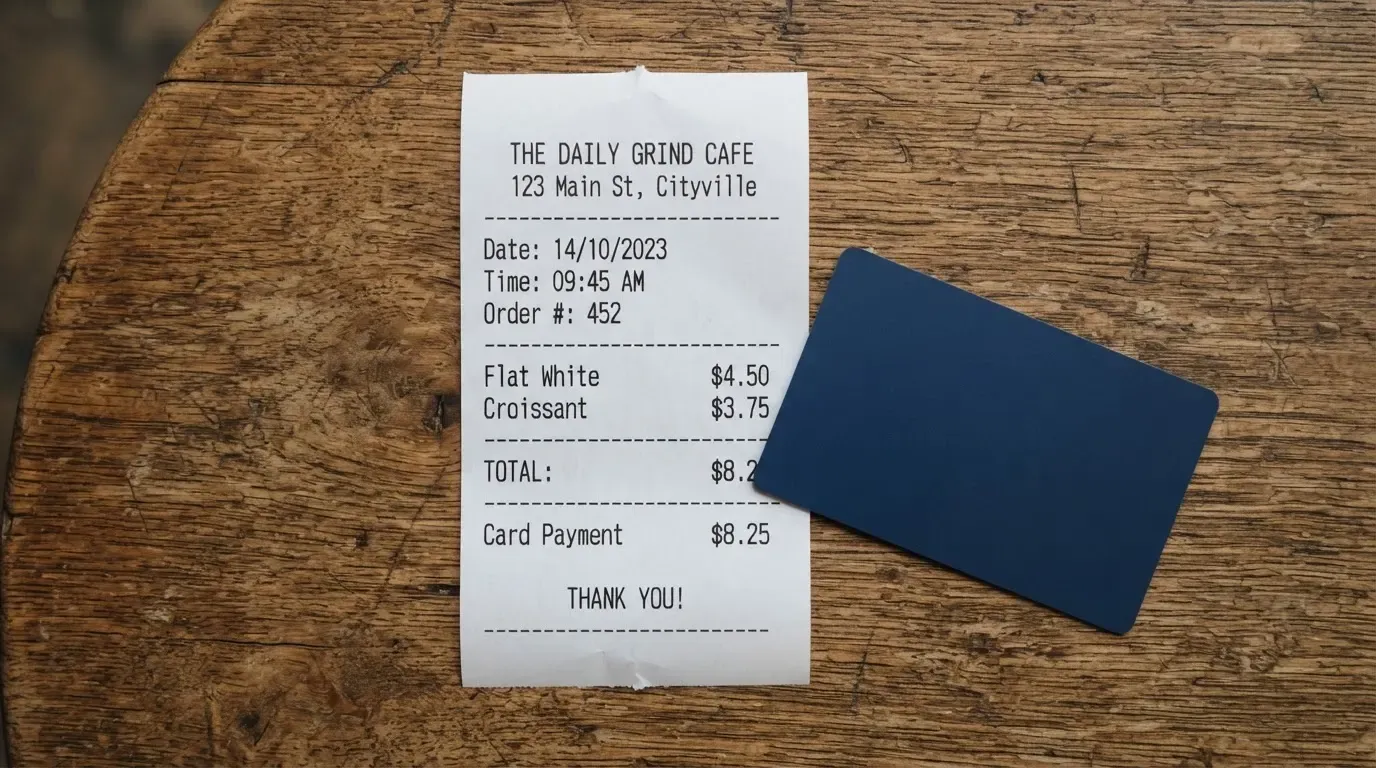
A receipt and a card on a café table. The receipt says 4.50 USD; the question is what left the card.
- A 4.50 USD coffee paid in USD on a Plastic card: you pay 4.50 USD plus 0.75% = 4.53 USD on the card. The cost of that coffee in USDT terms depends on the rate at the time of loading, plus the 3.125% you already paid on top-up. If you loaded 100 USDT this morning, the card has about 96.88 USD on it, and your 4.53 USD purchase drops it to 92.35 USD.
- A 60 EUR online subscription paid from the same card: the merchant charges 60 EUR, the card network converts to USD, and BananaCrystal takes its 0.75% on top. Without a published FX fee, the worst case is the card network’s wholesale rate plus 0.75% — which is not unreasonable, but you should confirm that figure with support before relying on the card.
- A 200 USD ATM withdrawal abroad: 0.75% on the way out (1.50 USD) and possibly a foreign ATM surcharge from the ATM’s own bank, on top of the 3.125% you paid on the underlying load. If your home currency is not USD, the FX conversion is the wildcard. Below a 10 USD balance, the withdrawal can be declined — so the card effectively traps the last few dollars.
The cost stack is the part that hurts. Compared to a card like the International Visa Card, which has no issuance fee on its virtual product and no maintenance fee at all, the entry price of even the cheapest physical BananaCrystal is 80 times higher, and that is before the annual fee.
Top up
A phone showing a stablecoin transfer screen. The first step is the right network; the second is the right address.
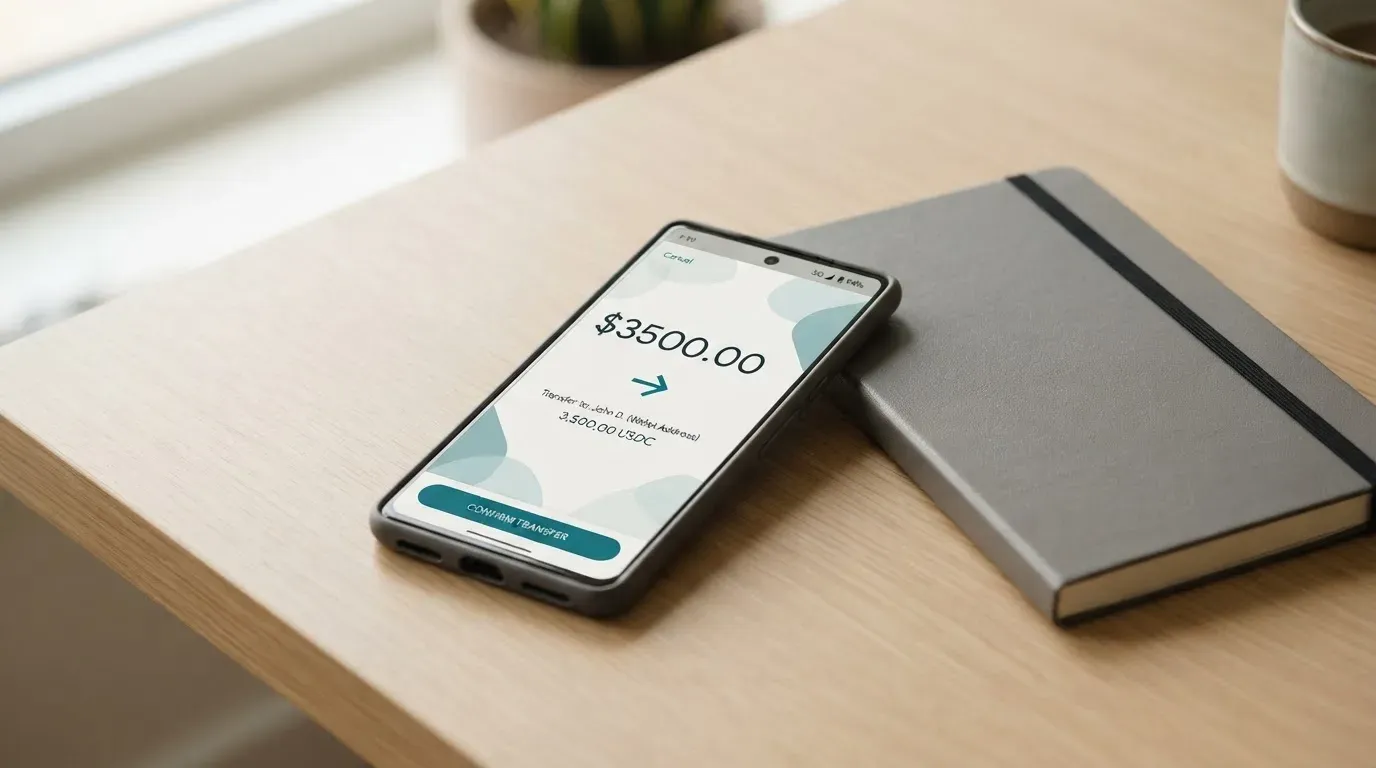
BananaCrystal says you can load “directly from any USDT wallet”, and the fund page lists USDT and USDC as supported. Settlement happens on Hedera (“Settled on Hedera”, per the platform description). Beyond that, the page does not state which networks you can actually send from — Ethereum, Tron, Solana, Polygon, Avalanche, the Hedera-native equivalent, or something else. That is a real gap, and it is the kind of gap that costs money when it goes wrong, because blockchain transfers are irreversible: send USDT on the wrong network, or to an address of a different chain, and the funds are usually lost.
What we do know:
- The loading fee on Plastic is 3.125%, dropping to 2.125% on the top Metal Gold tier. The virtual card’s loading fee is not listed.
- The fee the underlying blockchain charges (gas, bandwidth, energy) is on you, not the platform.
- You can also fund by bank or USDC, per the fund page; the costs of those rails are not stated.
- A minimum top-up amount is not stated; the same is true of the closing-balance rules for an account you decide to wind down.
If you are topping up, my practical advice is to test with a small amount first, confirm the credit hits the card, and only then send the full balance. The page asks you to do exactly that with stablecoins anywhere; here, where the supported networks are not published, it is more than good practice.
Paying with it every day
The card is a Visa, with a virtual option that supports Apple Pay and Google Pay. Plastic and metal versions do not have wallet support listed, so the everyday-pay case is strongest if you use the virtual card on your phone. The “every day” part of the score (9 out of 10) leans on that.
What is not stated on the public pages:
- Blocked merchant categories. MCC 7995 covers gambling and a number of issuers block it by policy; this card does not say either way. If gambling, adult, crypto purchases, or another category matters to you, the only safe answer is to assume it might be blocked and to test.
- Spending rewards. The card does have a referral programme, but cashback on purchases is not stated. So the offset to the loading fee is zero, not a percentage back.
- A mobile app. The page says “Mobile App support is coming soon”, so as of right now everything goes through the web platform. That is a real ergonomics gap if you spend a lot of time on a phone.
For disputes and unauthorised transactions, the procedure is to email [email protected] with your name and card number, and you can ask for a temporary freeze. Time frames for resolution, chargeback eligibility, and the standards the card holds itself to are not stated, and the dispute mechanism described (an email plus a freeze) is thinner than the in-app dispute flow that mainstream issuers offer.
What can go wrong
Risk on a card like this has two flavours: the risk of the platform itself failing, and the risk of a specific transaction going wrong.
On the platform side:
- Banana Crystal Inc was founded in 2020. It is registered as a money services business in Canada (FINTRAC) and in the US (FinCEN). That is real registration, but it is not a banking licence and it does not mean your funds are deposit-insured. In the EU, e-money institutions are required to safeguard customer funds; in the US, the equivalent is a state-by-state money-transmission regime. The page does not state which of those it relies on, and it does not say where client funds are held.
- The card-issuing bank is not named. The FAQ from 16 July 2024 says transactions are processed “via VISA and UnionPay partnerships with an offshore banking partner”. “Offshore” is a loaded word, and the fact that the partner is not named means you cannot, on your own, check the partner’s regulator.
- No public complaints have surfaced in my research, and there is no Trustpilot page. That can mean the card is too small to attract complaints, or that complaints have not migrated to review sites yet. It is not, on its own, a clean bill of health.
On the transaction side:
- A custodial platform wallet holds the balance. Custodial wallets have a long record of failures (Mt. Gox, Coincheck, Ronin, and others), and the section below on how crypto cards work goes into that. The page does not say whether customer funds are segregated from operating funds, or whether they sit in a separate trust. “Military-grade encryption” is marketing language, not a fiduciary commitment.
- 2FA and a card lock after three failed PIN attempts are the stated security features. There is no insurance fund, no FDIC or FSCS coverage, and no public claim about hot-versus-cold storage of the underlying assets.
- Support is described as 24/7, with live chat for signed-in users and email at [email protected]. A “personal consultation” option is mentioned. Real response time and quality I cannot verify from the public pages.
For you, the practical takeaway is that the card behaves like a prepaid card, not a bank account. Treat the balance on it like cash in a wallet, not like money in a current account.
What to take instead
Three alternatives I have looked at, with the trade-offs you should weigh against BananaCrystal:
- International Visa Card — 6.7 out of 10. A U.S.-issued Platinum Visa, virtual for 5 USD, no maintenance fee, and three plans (Classic free, Pro 9 USD/month, Max 19 USD/month). Card use in USD is free on every plan; foreign-currency transactions take the Visa exchange rate plus a 2% FX fee. Deposits of USDC or USDT into the USD account are at 1:1 with no platform fee, and you can also deposit USD, EUR, SEPA, SWIFT, FedNow. The catch is the country list: residents or legal registrants of Belarus, mainland China, North Korea, Cuba, India, Iraq, Iran, Israel, Myanmar, Nepal, Nicaragua, Russia, Syria, Turkey, Ukraine, Venezuela and Vietnam cannot get the card, and purchases are blocked in North Korea, Cuba, Iran, Russia, Syria, Ukraine and Venezuela. If you are outside those countries, this is materially cheaper than BananaCrystal.
- UNi Card — 6.1 out of 10. A multicurrency Mastercard on the UNi.Global account, with no annual fee and no foreign-transaction fee. Conversions run on live OTC rates. Spend-to-Earn rewards go up to 3%. The trade-off is the funding story is thin on the public page: networks, fees, and minimums are not stated, and “no hidden exchange fees” is not the same as “zero cost to convert”. Worth a look if you want Mastercard and rewards; less so if you need a clear, published fee schedule.
- Whop Cards — 5.2 out of 10. A Visa that spends from a Whop balance, with 5% cashback at select merchants (currently Uber, more planned). The cost story on the public page is “no extra fees”, and no issuance or monthly amounts are listed. The country list is the binding constraint: consumers in 31 US states (Alabama, Alaska, Arkansas, California, Colorado, Connecticut, Florida, Hawaii, Illinois, Indiana, Iowa, Kansas, Kentucky, Maine, Massachusetts, Michigan, Minnesota, Montana, Nebraska, New Hampshire, New Jersey, New York, North Carolina, Oklahoma, Pennsylvania, South Carolina, Texas, Utah, Virginia, West Virginia, Wyoming) can get one; for businesses the list is 41 states. Unsupported countries include Belarus, mainland China, Cuba, Hong Kong, India, Iran, Iraq, Israel, Myanmar, Nepal, Nicaragua, North Korea, Russia, Syria, Turkey, Ukraine, Venezuela, Vietnam, with Russia and Belarus also cut off at the corporate level. The narrower reach and the unstated fee schedule hold it back.
Compared with those three, BananaCrystal is the easiest to obtain (200+ countries versus 31 US states or a much smaller restricted list) and the most expensive to own. The International Visa Card is the closest competitor on cost; if your country is on its allowed list and you do not need a physical card, that is the comparison I would make first.
Who I would recommend it to
I would point a reader at BananaCrystal in two specific cases.
The first is a USDT holder who cannot get a card from a US- or EU-licensed issuer. The country coverage is genuinely wide, and the card works in jurisdictions where International Visa Card and Whop Cards are not available. The price is high, but the price of not being able to pay at all is higher.
The second is a user who specifically wants Apple Pay or Google Pay from a stablecoin balance, with a physical card as a backup, and is willing to pay 400 USD for the plastic and 100 USD a year for the privilege. The combination of a virtual card in a phone wallet and a physical backup is real, and it is unusual in this category.
I would not point a reader at BananaCrystal if the goal is the cheapest way to spend stablecoins; this is not that. I would also not point a reader at it if the goal is a card for everyday life in a country with a normal banking system, where a 0.75% POS fee and a 100 USD annual fee are a heavy surcharge on routine spending.
If the card-issuing bank were named, and the non-USD FX fee were published, the picture would be clearer. Until those two numbers are on the page, treat the card as a niche tool for a specific reader, not as a default.
Frequently asked questions
What is the BananaCrystal card?
The BananaCrystal card is a Visa-branded prepaid card (or UnionPay, per one FAQ entry) issued through an unnamed offshore banking partner. You load it with USDT or USDC, the platform settles on Hedera, and you spend the resulting USD balance anywhere Visa is taken — online, in shops, or at an ATM.
How does the BananaCrystal card work?
You create an account, pass KYC, pay the issuance fee for the tier you want, top the card up with stablecoin, and spend. The platform converts your stablecoin into USD at the loading rate, and the card draws down that balance. The plastic, metal and virtual tiers are all prepaid: the card cannot overdraw, and it stops working when the balance is gone.
Is BananaCrystal a bank?
No. Banana Crystal Inc is registered as a money services business with FINTRAC in Canada and FinCEN in the United States. The card itself is issued by an offshore banking partner that the company does not name. That is not the same as a bank account, and the funds on the card are not deposit-insured in the way a US or EU bank account would be.
Who owns BananaCrystal?
Banana Crystal Inc is the company behind the card. It was founded in 2020. The owners, leadership, and corporate structure are not stated on the public pages I reviewed.
Is the BananaCrystal card available in my country?
The card is advertised in “over 200 countries”, and the public list of unavailable countries did not load when I checked. The starting data I worked from flags only Belarus, Russia, and a small number of others as virtual-card-unavailable. The most reliable test is to register and see whether KYC is requested in your jurisdiction before paying any fee.
How do I get a BananaCrystal card?
Sign up on the website, complete KYC with a National ID, International Passport, or Driver’s Licence, choose a tier, pay the issuance fee, and wait. The FAQ says approval usually takes under 10 minutes; physical shipping takes 7 to 30 days depending on local couriers.
Does the BananaCrystal card require KYC?
Yes. KYC is required to issue any of the five tiers. Accepted documents are a National Identity Card, an International Passport, or a Driver’s Licence. Proof of address and the minimum age are not stated on the public pages.
How do I top up the BananaCrystal card?
You top up with USDT or USDC, sent from any external wallet, and the platform settles on Hedera. The list of supported deposit networks is not stated in the public material, so the safest workflow is to send a small test amount first, confirm the credit, and only then send the full balance. Loading fees are 3.125% on Plastic and drop to 2.125% on the top Metal Gold tier; the network’s own gas or bandwidth fee is on top of that.
Is the BananaCrystal card safe?
In the narrow sense: yes, the card is regulated as a money services business in Canada and the US, supports 2FA, and locks after three failed PIN attempts. In the broader sense: the issuing bank is not named, the funds are not deposit-insured, and the platform is custodial, so the usual counterparty risks of a custodial stablecoin product apply. Treat the balance as cash, not as a bank balance.
Is the BananaCrystal card worth it?
It depends on what you are comparing it to. Against a card you cannot get in your country, yes. Against a US-based virtual card with a 5 USD issuance fee and no annual fee, no — the price gap is several hundred dollars a year before you have spent a cent. The honest framing is that this is a niche product at a premium price, and the right reader for it is a USDT holder in a country where the cheaper alternatives are not available.
App and neobank card reviews – cryptocardcheck
Content created by the «cryptocardcheck» team