
A promising Asia-focused crypto card priced by guesswork
 Available in US
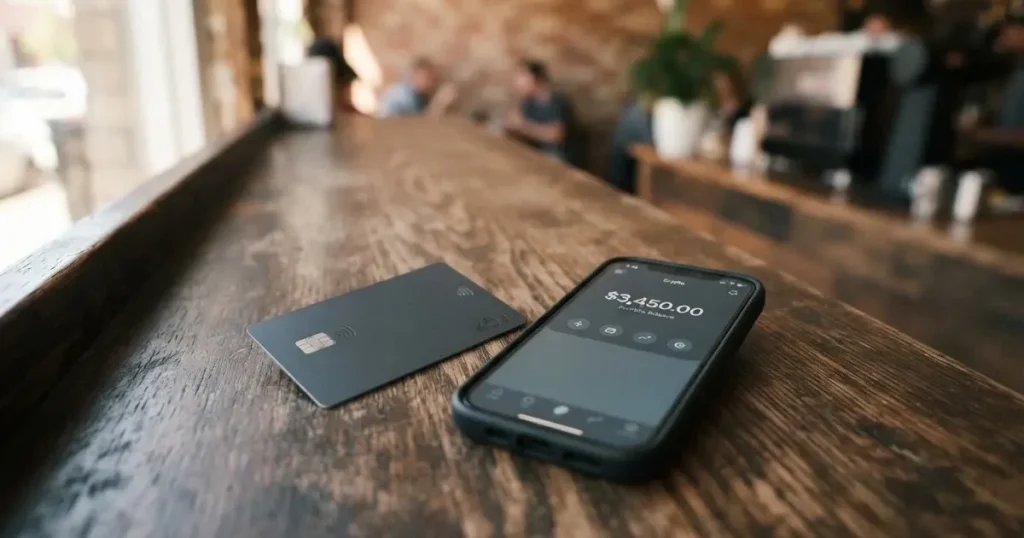
Anytap is a crypto payment card that converts your balance into fiat at the point of sale and lets you spend it like an ordinary Visa — online, in a shop, or at an ATM. On paper that is exactly what a crypto card should do, and the card’s public pages describe a clean, well-trodden path: sign up with your email, pay a fee, activate, top up in USDT or USDC, and spend. It scores 7.7 out of 10 in my assessment, and the reason it does not score higher is not that anything looks wrong — it is that almost nothing important is actually published. The fee numbers exist only in press releases carried by third-party news sites. The issuer and licences are unnamed. There are no reviews, no Trustpilot page, no Reddit threads, and, as far as I can find, no app.
That combination is unusual, and it changes how you should read this review. I could not find a card with a worse story; I found a card with almost no story yet. For someone who already holds USDT and USDC, pays across Asia, and wants a Visa that spends a crypto balance, that is a workable deal with an unusual amount of homework attached. For anyone hoping for a well-documented everyday card with a clear fee table and a customer service number, it is not there yet.
The conditions described here are current as of October 28, 2026.
Verdict: 7.7 out of 10, built for Asia-first crypto holders
My score comes from five criteria: who can get the card, what it costs, how you top it up, how reliable and well-documented the provider is, and how it holds up in everyday use. Three of those are strong. Two are held back almost entirely by missing information rather than by bad information.
| Criterion | Mark | Why |
|---|---|---|
| Who can get it | 9 / 10 | Worldwide except OFAC-sanctioned countries on the starting data; the launch is aimed at Asia first, per third-party reporting |
| Cost | 6 / 10 | Issuance is paid but the amount is not disclosed; fees appear only in unofficial figures |
| Top-up options | 9 / 10 | USDT and USDC, with USDT on TRC-20 described as faster and cheaper, and 350+ supported coins |
| Reliability and complaints | 6 / 10 | US-headquartered per the starting data; issuer and licences unnamed; no reviews, Trustpilot page or Reddit discussions found |
| Everyday use | 9 / 10 | Virtual or physical Visa, Apple Pay, Samsung Pay, Google Pay and ATM access |
| Total | 7.7 / 10 | Strong on the crypto side, thin on published detail |
The card suits a specific person: someone already holding USDT or USDC, spending across Asia, who has a real reason not to use a normal bank card — because ordinary banking is awkward for them, slow, expensive, or simply unavailable in a way I do not need to detail here. The card’s whole value to that person is that the crypto side is well built. Two assets, two networks named, one of them explicitly flagged as cheaper, and a wide coin list behind it. That is a competent design.
It does not suit someone who needs certainty about the numbers before they commit money. The issuance fee is not stated. The monthly fee is not stated. The cross-border fee and the ATM fee are not stated on the card’s own pages. Every figure you will find quoted for this card online comes from press releases republished by news sites, not from Anytap’s own materials, and I have not been able to confirm any of them with the card. I treat them throughout as unofficial.
And it does not suit anyone who is uneasy about holding a balance with an unnamed issuer. That is not a peculiar complaint. It is the ordinary situation for anyone choosing a prepaid-style card, and the information needed to assess it is exactly what is missing here.
Will they give you the card?
On the starting data — which I could not verify against a page of my own — Anytap is open worldwide except in countries sanctioned by OFAC. The application form lists the United States, Singapore, the UAE, the United Kingdom, Vietnam, Japan and an “Other” option. That list is a form, not a policy: it tells you which boxes exist, not which ones are approved.
Where the card is actually aimed is clearer, though the source is unofficial. A press release carried by nny360.com and kdhnews.com describes the launch as targeting Asia, “starting with South Korea, Japan and Indonesia.” I did not read the date on that release, so treat both the timing and the framing as unconfirmed.
Here is the honest picture of who gets a card and who might not:
- On the starting data, most countries outside OFAC sanctions, with no citizenship restriction I could find.
- In practice, the launch focus is South Korea, Japan and Indonesia, per unofficial reporting — which suggests the Asian markets are where the product is being built and tested first.
- The form’s country list includes the United States, Singapore, the UAE, the United Kingdom, Vietnam and Japan, but that list says nothing about eligibility or approval rates.
- Prepaid and debit cards are generally available to adults (18+) across this category, and some issuers set higher limits for some customers. Anytap’s own age and limit rules are not stated.
What I cannot tell you, and what you should insist on finding out yourself before you upload a passport, is whether your specific nationality is accepted. Nationality is recorded and screened separately from residence in this industry, because sanctions screening and issuer risk policy are often applied to citizenship and country of birth as well as to the country on your address. “Worldwide except sanctioned countries” is not the same statement as “everyone, any nationality, anywhere.”
How to get it
The signup path the card describes is short. You register on the web with your email, name and address. You pay the issuance fee. You activate the card. Verification is a passport or ID plus a selfie, and the card’s own wording is that applications are “approved in minutes.”
That is the whole published process, and there are real gaps in it.
- What you give up: your name, address, email, and an identity document with a selfie. Your photo is now attached to a financial account permanently.
- What is not stated: whether proof of address is required beyond the address field itself, what the minimum age is, how many identity checks you go through on top of the first one, and how long a decision can take when the “minutes” do not apply.
- What you get: a Visa debit card, virtual or physical. The card currency is not stated — which matters, because your account may hold a balance in one currency and the card may present a different one to the merchant.
Some things you would want to know before applying, and cannot:
| Question | What the public pages say |
|---|---|
| How long does the physical card take to arrive? | Not stated |
| What does the card currency show at checkout? | Not stated |
| Can you hold several cards? | Unofficial: up to three per person, all on the Visa network |
| How many KYC checks or tiers exist? | Not stated |
| Is there an app to manage the card? | No Anytap card app found in the App Store search on 2026-10-22; Google Play not found |
That last row deserves a second look. I searched the App Store on 2026-10-22 and found no Anytap card app — only an unrelated app called “AnyTap Accessible Camera.” Google Play I could not locate. For a card whose main feature is managing crypto balance and converting it to fiat at the point of sale, the absence of a published app is unusual. It may exist in a specific regional store or under a different name, or the product may be run entirely through a web dashboard that I was not able to find. But if you are signing up, one of your first questions should be: where do I see my balance and my transactions?
Fees: what it really costs
This is the weakest part of the card’s public presentation, and the section where the difference between what I can confirm and what I cannot is largest.
What the card itself states: an issuance fee is payable before activation. That’s it. The amount is not stated. No monthly fee is stated. No conversion fee is stated. The starting data describes the crypto as converted to fiat at the point of sale, which tells you the mechanism but not the price of it.
What circulates around the card is more specific. A press release on nny360.com describes a cross-border transaction fee of 1% plus $0.30 per transaction, and an ATM cash withdrawal fee of 2% of the amount with a $1 minimum. Neither of these appears on Anytap’s own pages as I read them. I am recording them because they are the figures a reader will meet, and I am not vouching for them.
| Fee or limit | What is stated |
|---|---|
| Issuance | A fee is paid before activation; the amount is not stated |
| Monthly fee | Not stated |
| Conversion | Not stated officially; starting data says crypto is converted to fiat at the point of sale |
| Cross-border | Unofficial: 1% + $0.30 per transaction, from a press release on nny360.com |
| ATM | Withdrawals available; the fee and allowance are not stated officially. Unofficial: 2% of the amount, minimum $1 |
| Limits (daily, monthly) | Not stated |
| Card currency | Not stated |
| Tiers | Not stated |
| Top-up fee | Unofficial: 3%, per the starting data; who pays the network fee is not stated |
Let me make that concrete, because percentages are only meaningful against a purchase. Three everyday payments, using the unofficial figures so you can see the shape of them — adjust them and they are no more reliable:
- A $12.50 flat fee in another country. The cross-border figure would put the cost at $0.125 + $0.30, so about $0.43 on the transaction, on top of whatever the merchant and your own conversion spread amount to. On a $30 flat fee the same fixed 30 cents is a smaller portion of the total cost, and on a $3 transit ticket it is a third.
- Withdrawing $50 from an ATM. The unofficial 2% would make it $1.00, exactly at the stated minimum, so $50 costs you $51 before the network’s own charges.
- Withdrawing $20 from an ATM. The same 2% would be $0.40, so the $1 minimum takes over and the fee becomes a substantial portion of what you took out. Small withdrawals are where percentage fees stop being small.
Two things follow. First, the fixed 30-cent component punishes small purchases, and crypto card users tend to make small purchases. Second, if you plan to use this card as a cash card rather than a spending card, the ATM figure is the one that matters most — and it is the one with the least support behind it.
And remember what is missing: if there is a monthly fee, a conversion spread, or a tier system, none of them appear in anything I could read. The honest total cost of this card is not knowable from public information at the moment.
Top up: how the money gets in
The funding side is the card’s best feature, and it is where the design feels like a real product rather than a shell.
Anytap supports USDT and USDC directly. USDT can be sent on TRC-20, which the card describes as “faster and cheaper,” and the starting data also lists ERC-20 as an option for USDT. Behind those two, the card advertises 350+ supported coins. A top-up fee of 3% is described in the starting data; who pays the blockchain network fee for the deposit is not stated.
- USDT — the main asset; TRC-20 is the route the card itself recommends for cost and speed.
- USDC — supported directly. One thing to know: Circle stopped supporting USDC on Tron in February 2024, so “USDC over TRC20” is not a native option — sending it that way is not a shortcut.
- 350+ supported coins — the widest part of the offer, though the public pages do not say which of them can actually reach the card balance.
Unofficial figures give a minimum top-up of 30 USDT, and describe moving balances between your own cards and withdrawing loaded funds to an external wallet. Both come from the same press release, so both carry the same caveat.
Before you send anything, one warning that applies to every card in this category and to this one more than most: blockchain transfers are irreversible. Send to a network the card does not support, or to an address belonging to another network, and the funds can be lost or need manual recovery with no guarantee of success. Check the deposit address and network on the provider’s own screen, and check them again. Also keep a little of the gas asset on hand — on ERC-20, fees are paid only in ETH, so a wallet holding USDT but no ETH cannot send at all, and on Tron fees are paid through bandwidth and energy resources, often by burning TRX.
And one reassurance that is not really one: stablecoins can move away from their peg. TerraUSD collapsed in May 2022, and USDC briefly lost its peg in March 2023 during the US banking crisis. The dollar-pegged tokens in your balance are not a bank deposit.
Paying with it every day
In the checkout sense, Anytap behaves like an ordinary Visa debit card. Virtual or physical, it should work online and in person; it supports Apple Pay, Samsung Pay and Google Pay; and it can be used at ATMs. That is the whole everyday-use story the card publishes, and it is a good one.
The unofficial line from the press release adds a caveat worth hearing: mobile wallet support — Apple Pay, Samsung Pay, Google Pay — “rolled out progressively depending on card type and local market conditions.” In plain terms, the wallet you want may not be live on your card in your country on the day you sign up. Ask, and get the answer in writing.
Some of the ways cards like this get declined have nothing to do with the card’s quality:
- Foreign BINs. The first six or eight digits of a card number identify the issuer and country. Merchants can look it up, and may apply extra scrutiny if the issuer country differs from the billing address. This is why a card issued in one country can look “foreign” to a shop in another — and it is why some merchants decline prepaid or foreign-issued cards outright.
- Address verification. AVS compares the numeric parts of the billing address you type with the issuer’s records. It is mainly offered in the US, Canada and the UK and is generally unavailable for foreign-issued cards, which can cause declines at US checkout.
- Blocked merchant categories. Gambling, for instance, is category 7995, and many issuers block it by policy rather than by law, with a different list per issuer. Anytap’s blocked categories are not stated, so treat any category as a question rather than an assumption.
- Holds. A declined authorisation can leave a hold on your funds that stays for several days — typically up to seven.
Two features that normally make a card painless are worth naming. Tokenised mobile wallets replace your card number with a device-specific number stored in the phone’s secure element, never on Apple’s servers, and each payment uses a one-time code. And 3-D Secure adds an identity step to online payments, with Visa’s brand called Visa Secure. Whether Anytap offers frictionless approval or a code at checkout, and whether it restricts tokenised numbers to certain channels, is not stated.
The app question from earlier belongs here too. Managing a crypto-balance card without a published app means a web dashboard or regional app store listing. There are no stated rewards, and no stated rewards is normal for this category — but it also means there is nothing pulling you back to it.
What can go wrong
I found no official incidents involving Anytap. That is a good sign and a thin one: a brand with no complaints and no reviews looks the same as a brand nobody has used. There is no Trustpilot page, no Reddit discussion, and no review corpus at all, which means for the ordinary questions — is it safe, how fast is support, how do disputes work — there is simply no community record to consult.
The provider side is where the risk concentrates. On the starting data, Anytap is a US-headquartered fintech. The issuer and its licences are not named. That is the single most important gap in this review, and here is why it matters.
When you hold a prepaid-style balance, you are trusting whoever is licensed to hold it. A payment card involves several parties: the network (Visa) routes messages and sets the rules, the issuer is the bank or e-money institution licensed under that network’s licence and actually holds the programme, and the crypto brand is often only a programme manager or front-end. Anytap publishes which of those it is? Not that I could find.
This is not hypothetical worry. Card programmes do end. Visa terminated its global agreements with FTX on 13 November 2022, winding down the FTX US debit card. WaveCrest, a Visa issuer that supplied crypto card brands, was suspended by Visa in Europe in 2018, closing all WaveCrest-issued Visa programmes. When a programme closes, the pattern is a notice period, then spending and loading stop, then users are asked to withdraw remaining balances — which means your money, not your coffee money, is what you are waiting on.
Two structural points about protection. Electronic money institutions must safeguard customer funds by segregating them in dedicated accounts or insuring them, and such funds are not the same as bank deposits and may not be covered by deposit guarantee schemes. In the US, debit card reversal rights come from Regulation E and prepaid-card coverage varies and should not be assumed. Chargebacks exist — a refund ordered by the issuer with reason codes such as fraud, duplicate billing or goods not received — but Anytap’s dispute process is not stated, so I cannot tell you how one would work here.
Security details are not stated either: no 2FA, no freeze, no spending limits, no support channel. If you fund this card, treat the safeguards as unverified until you see them in the app.
What is not stated about the company, its licences, its disputes, its security and its support, all amount to the same request: before you load meaningful money, find out who the issuing institution is and which licence it holds. If there is no answer, that is your answer.
What to take instead
The alternatives below are the crypto cards I looked at alongside Anytap. None of them is clearly better, and I want to be honest about why — this category is young and thin on published detail, and Anytap’s low profile is not unique.
| Card | Score | Who it targets | What stands out |
|---|---|---|---|
| Anytap | 7.7 / 10 | Crypto holders paying across Asia | Best stated top-up story: USDT and USDC, TRC-20 flagged as cheaper, 350+ coins |
| Cardex | 5.6 / 10 | 200+ countries; App Store listing is Naira-focused | Runs on VERVE, Visa, Mastercard and UnionPay; an “AI-Powered Conversion Rate” picks the rate at spend time, but no fee percentage is published |
| CardFlow | 4.9 / 10 | Nigeria (“Nigeria’s smartest fintech card platform”) and global users | Virtual USD Mastercard in minutes; creating a virtual card is free |
| HyperCard | 4.7 / 10 | No country list published; App Store says the card works in more than 176 countries | Prepaid, balance in USD or EUR; deposit crypto such as USDT, BTC or ETH and it converts to the card balance |
Reading that table honestly: Cardex, CardFlow and HyperCard each publish something Anytap does not — Cardex a conversion mechanism, CardFlow a free virtual card, HyperCard a clear currency pair. And each of them publishes much less about everything else. Cardex states no fee percentage for its conversion; CardFlow states no fees and no country list; HyperCard states no network on the App Store page and no fees at all. Anytap’s edge is that its crypto side — the assets, the networks, the speed claim — is stated clearly.
What none of these cards gives you is a published fee table. That is the honest summary of the category.
A different comparison, briefly: if you are not tied to Asia and your priority is documented certainty rather than crypto flexibility, a regulated bank’s own card or a long-established exchange card in your own jurisdiction will publish more, cost more, and be easier to complain about. If your priority is holding USDT off an exchange and spending it directly, Anytap is a reasonable candidate — subject to everything in the previous section.
Who I would recommend it to
I would recommend Anytap to someone in a specific position: you already hold USDT or USDC, you spend across Asia, you want a Visa rather than a closed-loop wallet, and you are comfortable being an early user of a product with almost no public track record. For you, the 9s in the table are real — the funding options are the best I found in this comparison, and virtual-or-physical plus the three mobile wallets covers ordinary life.
I would tell someone else to wait. If you need to know what a payment costs before you make it, this card cannot tell you, because the fee figures exist only in third-party press coverage. If you need to know who holds your balance when something goes wrong, that answer is not published. If you need a customer service channel, a rewards programme, or a documented dispute process, none of those are stated. If you want to read what other users experienced, there is nothing to read — no reviews, no Trustpilot page, no discussions.
Before you fund it, four questions, and I would not load money until I had answers to all of them: Who is the issuing institution and what licence does it hold? What does the issuance fee cost, and is there a monthly fee? What exactly does a payment cost at the point of sale — the conversion, the cross-border charge, the whole thing? Where is the app, and what does support look like when something is wrong?
If those four answers come back clearly, you have a card that works. If they do not, you have a product with a nice top-up flow and an unnamed issuer behind it — and the score drops fast.
Frequently asked questions
What is the Anytap card?
It is a crypto payment card that converts your balance into fiat when you spend, so it behaves like an ordinary card rather than a closed-loop wallet. You can hold it as a virtual or physical Visa debit card. The card supports Apple Pay, Samsung Pay and Google Pay, and withdrawals at ATMs are available. The card currency itself is not stated on the public pages.
How does the Anytap card work?
You load it with stablecoins, and the crypto is converted to fiat at the point of sale. In practice this is a pre-loaded balance model: you can only spend what you have loaded, so the card cannot overdraw. Unlike a standard debit card that asks your bank for money at each purchase, the balance sits with the card provider until you spend it — which is the detail worth thinking about.
Is Anytap a bank?
Not on any evidence I could find. The starting data describes a US-headquartered fintech, and the issuer and its licences are not named. A card like this usually involves three parties: the network (Visa), a licensed issuing bank or e-money institution, and the crypto brand as front-end. I could not establish which of those Anytap is.
Who owns Anytap?
The public pages point to a US-headquartered fintech, but I found no named issuer, no named licence and no corporate disclosure I could verify. There is also no app in the App Store as of my 2026-10-22 search, no Trustpilot page and no Reddit threads — so the usual places where ownership becomes clear are all empty.
Does the Anytap card require KYC?
Yes. Sign-up requires a passport or ID plus a selfie, and the card says applications are approved in minutes. Note that KYC is not a formality in this industry: regulated businesses must verify customers, screen for sanctions, monitor transactions and report suspicious activity, and where due diligence cannot be completed, accounts get frozen pending documents.
How much does the Anytap card cost?
The card confirms an issuance fee is payable before activation but does not state the amount, and states no monthly fee. Unofficial figures from a press release on nny360.com describe 1% plus $0.30 per cross-border transaction and a 2% ATM fee with a $1 minimum. Treat all three as unconfirmed and check before you rely on them.
Is Anytap card free?
No — there is an issuance fee, though how much is not stated. Card creation being free is something competitors advertise; Anytap does not, and it does not publish a monthly fee either. So the honest answer is that the cost is known to be non-zero and unknown in amount.
How do I top up the Anytap card?
With USDT or USDC. USDT on TRC-20 is the route the card describes as “faster and cheaper,” and the starting data also lists ERC-20; 350+ supported coins sit behind those two. A 3% top-up fee appears in the starting data and an unofficial minimum of 30 USDT in the press release coverage. Always match the network exactly — blockchain transfers are irreversible.
Is the Anytap card safe?
I found no official incidents, and I want to be careful about what that means: a brand with no complaints and no reviews looks identical to a brand nobody has used. Safeguards I would look for — 2FA, instant freeze, spending limits, 3-D Secure — are not stated for Anytap. The bigger question is who holds your funds, and that is not published either.
Can I use the Anytap card in my country?
On the starting data, worldwide except OFAC-sanctioned countries, and the application form lists the United States, Singapore, the UAE, the United Kingdom, Vietnam, Japan and an option for everywhere else. Unofficial reporting says the launch targets Asia, starting with South Korea, Japan and Indonesia. Eligibility by nationality is not the same as eligibility by residence, so ask before you upload documents.
Virtual card reviews – cryptocardcheck
Content created by the «cryptocardcheck» team