
Revolut's crypto card is good news if you already bank there, and thin pick if you don't
 Available in US
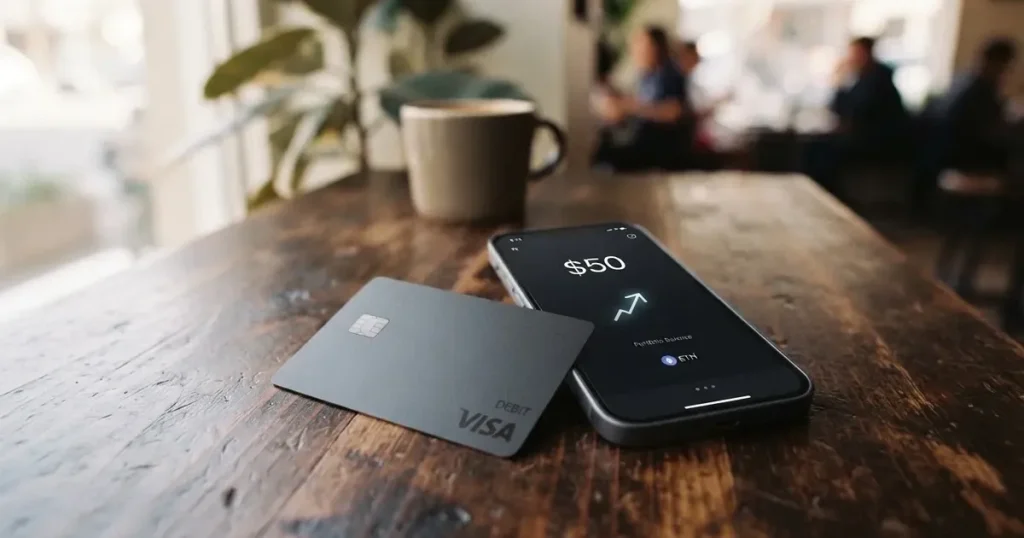
If you have hit a wall trying to open an ordinary bank card — a rejected application, a country your bank will not serve, a blocked payout — then Revolut is one of the names that comes up, because it runs a card alongside a banking app and, according to third-party listings, offers a virtual card that can be funded from a crypto balance. That is genuinely useful in a narrow situation. But it is not a purpose-built crypto card, and reading it as one sets up the wrong expectations.
I checked what Revolut’s own public pages say, compared it against what third-party aggregators report, and weighed it against three alternatives. My score is 6.5 out of 10. The conditions described here are current as of October 28, 2026.
The single most useful thing I can tell you up front: almost nothing about how this card actually behaves — which coins, which networks, what the exchange fee is today, how identity checks work — is stated on Revolut’s public pages. Much of what circulates about the crypto card comes from third-party sites, and I mark it as unofficial throughout. Two of the numbers that matter most to you even contradict each other between sources. Treat this as a card with a strong banking app attached and a crypto feature whose details you must confirm yourself, not as a specialist crypto card.
The score, criterion by criterion
| Criterion | Mark | Why |
|---|---|---|
| Who can get it | 6 / 10 | Availability officially depends on country and plan; unofficial listings put it at 37 countries, with 12 restricted |
| Cost | 6 / 10 | Virtual cards are listed as free on Standard, Plus and Ultra; crypto exchange fees apply by plan, unofficial at 1% above £1,000/month on Standard with a 1% weekend markup |
| Top-up options | 8 / 10 | Unofficial: debit from a chosen crypto or fiat account, 250+ tokens for spending, 30+ fiat currencies; officially the coins are not disclosed |
| Reliability and complaints | 7 / 10 | Unofficial: issuer Revolut Ltd, Revolut Bank UAB, EU crypto through Revolut Digital Assets Europe Ltd; high Trustpilot rating alongside complaints about account closures and hard disputes |
| Everyday use | 6 / 10 | A virtual crypto card; unofficial support for Apple Pay and Google Pay, ATM allowance varies by plan |
| Total | 6.5 / 10 | Strong banking app, thin crypto disclosure |
So who does this suit? In my view, EU and UK customers who already use Revolut and simply want their crypto balance to pay for things without a second app. It suits a person for whom the banking side is already settled and the crypto card is a convenience feature on top. Who it does not suit: anyone in a restricted country hoping to work around the restriction; anyone who needs a physical card urgently; anyone who wants to hold their own keys and spend from their own wallet; and anyone for whom “not stated” on the fee schedule is not an acceptable answer.

Will they give you the card?
The honest answer is that Revolut’s public pages do not say. The card’s country rules are not stated officially. What circulates instead is third-party data, and I would check it against the app before you commit to anything.
According to one aggregator (unofficial, August 2026), the crypto card is available in 37 countries: Australia, Austria, Belgium, Brazil, Bulgaria, Croatia, Cyprus, Czech Republic, Denmark, Estonia, Finland, France, Germany, Greece, Hungary, Iceland, Ireland, Italy, Japan, Latvia, Liechtenstein, Lithuania, Luxembourg, Malta, Netherlands, New Zealand, Norway, Poland, Portugal, Romania, Singapore, Slovakia, Slovenia, Spain, Sweden, Switzerland, UK. The same source lists 12 restricted countries: Belarus, Canada, Cuba, India, Iran, Libya, Myanmar, North Korea, Russia, Sudan, Syria, United States. A second aggregator puts the figure higher at 48+ countries — the two disagree, which is worth noticing.
Two things to hold onto. First, this is a residency or availability picture, not a citizenship one, as far as the third-party data goes; do not read it as a rule about your passport. Second, and more practically: the United States appears on that restricted list. If that is where you are reading this, the honest answer is that this card is not a route in. Anyone in a sanctioned or restricted jurisdiction should also remember that evading those rules is not something I will help with, and that financial institutions are required to screen, not to work around, such lists.
How to get it
What Revolut’s own pages establish is narrow but real: this is a virtual crypto card linked to your Revolut account. The network and the card currency are not stated. Revolut’s fee schedules do list virtual cards as free on the Standard, Plus and Ultra plans.
Beyond that, the practical steps come from third-party sources and are marked unofficial. The card is described as a Visa or Mastercard prepaid debit, with the network depending on region. Signing up is described as requiring full KYC — a government ID, possibly a selfie — and source-of-funds declarations may be requested if you make large crypto transactions. On delivery, unofficial figures for a physical standard card are around £4.99 or €5.50, with Plus paid, Premium free express, and Metal and Ultra free priority; replacements run roughly £5 or €6 on Standard, Plus and Premium, and more on Metal and Ultra. Officially, delivery terms are not stated.
There is one more thing worth saying plainly about the application itself, even though it is not a product feature. Revolut is an e-money and payments business, and in the EU that means it operates under anti-money-laundering law. Identity verification is not a formality you can talk your way past, and if the checks cannot be completed the rules require the institution to decline the transaction or, where needed, end the relationship. That is the ordinary explanation for a refused or frozen account, and it is a large part of the complaint picture I look at further down.
What it really costs: Fees, tiers and the everyday numbers
This is where I would slow down, because the cost picture is the most confusing part of the card. Virtual issuance is listed as free on Standard, Plus and Ultra — but that is from older fee schedules, and I did not read a current one. The distinction that matters is between the *card* being free and the *conversion* being free, and those are very different things here.

What Revolut’s help page says (in its German version) is that there is no exchange fee for crypto transactions with the Revolut card, but that fair usage fees may apply depending on plan. An older schedule gives a shape rather than a current number: exchange limit of GBP 1,000/month then 1% fee on Standard, GBP 3,000/month then 0.5% on Plus, and no limit on Premium, Metal and Ultra. The FX fee was not read.
The unofficial figures, which are the ones most people will actually meet, are these:
- Weekend FX markup: 1% on Standard, 0.5% on Plus, 0% on Premium, Metal and Ultra (unofficial, per third-party sources).
- Fair usage fee: 1% above £1,000/month on Standard, 0.5% above £3,000/month on Plus.
- Plan fees UK/EEA: Standard 0, Plus £3.99/€2.99, Premium £7.99/€7.99, Metal £14.99/€13.99, Ultra £55/€60 per month (unofficial, per third-party sources).
- ATM: free up to £200/month (Standard, Plus), £400 (Premium), £800 (Metal), £2,000 (Ultra), then 2%; daily ATM limit £3,000 (unofficial, per third-party sources).
- Limits unofficial: single transaction around £100,000, exchange count 200 per 24 hours — which directly contradicts the official help-page figure below.
- 2023 terms, for historical comparison: crypto fee 1.99% or £0.99 whichever is greater on Standard and Plus (unofficial/historical context).
There is also a helpful structural point about how these cards behave generally. A prepaid card draws on a stored balance; a standard debit card asks your bank to withdraw from a linked account at the moment of purchase. Many crypto cards behave like the first kind: crypto is converted and loaded as fiat balance. That means the card spends only what you have loaded, so it cannot overdraw — but it also means conversion happened earlier, at whatever rate and fee applied then.
| Fee or limit | What it says | Source |
|---|---|---|
| Virtual card issuance | Free on Standard, Plus and Ultra | Revolut fee schedules (older); current schedule not read |
| Plan fee | Standard 0; Plus £3.99/€2.99; Premium £7.99/€7.99; Metal £14.99/€13.99; Ultra £55/€60 per month | Unofficial (CryptoCardHub, Aug 2026) |
| Crypto exchange fee | No exchange fee per the help page; fair usage fees may apply by plan | Official help page (German version) |
| Fair usage / exchange threshold | Standard 1% above £1,000/month; Plus 0.5% above £3,000/month; Premium/Metal/Ultra no limit | Older schedule; also reported unofficial |
| Weekend FX markup | Standard 1%; Plus 0.5%; Premium/Metal/Ultra 0% | Unofficial (CryptoCardHub, Aug 2026) |
| ATM allowance | £200/month Standard and Plus, £400 Premium, £800 Metal, £2,000 Ultra, then 2% | Unofficial (older schedule excerpt) |
| Daily ATM limit | £3,000 | Unofficial (CryptoCardHub, Aug 2026) |
| Crypto exchanges per 24 hours | 100, with coin-dependent minimum and maximum | Official help page excerpt |
| Exchange count per 24 hours | 200 — contradicts the official 100 | Unofficial (CryptoCardHub, Aug 2026) |
| Single transaction | About £100,000 | Unofficial (CryptoCardHub, Aug 2026) |
| Spend limits | Not stated | — |
| Card-specific ATM fees, network, card currency | Not stated | — |
Let me run three ordinary payments through that, because that is where the fee structure becomes real.
A £20 lunch in London on a Saturday, Standard plan. The card is free, so issuance costs nothing. But this falls on a weekend, where the unofficial markup is 1%. If the £20 is charged in a currency other than pounds, that markup is the price of the meal’s foreign-currency portion. No ATM fee arises if you do not touch a cash machine.
A €40 hotel in Paris on Plus. No weekend markup on Plus only outside weekends — this is a weekday, so weekend rules do not bite, and Plus carries a 0.5% weekend markup anyway (unofficial, per third-party sources), not an FX fee for card purchases. The real cost of the Plus plan is £3.99 or €2.99 a month, which you pay whether or not you spend. A single €40 hotel night does not recover that.
£300 of crypto converted in a month on Standard. Here the old schedule shape applies: the first £1,000 per month, then a 1% fee. So a £300 conversion sits inside the allowance. A £1,500 month crosses it, and roughly the excess is charged at 1% (unofficial). Note that the 2023 terms quoted a much harsher structure — 1.99% or £0.99, whichever is greater — which is a reminder to read the current schedule rather than any of these older figures.
The honest summary: the card itself is cheap, the plan may not be, and the conversion and FX numbers are the ones to pin down in the app before you rely on them.
How to top it up: getting value onto the card
Officially, this is the part the card does not describe. Coins and networks were not read, and the card’s public pages do not state which assets can fund it. There is also a caller note worth flagging because it is a hard limitation rather than a fee: Pro and Business accounts cannot link the card.
The unofficial description is that the card draws from a chosen crypto or fiat account, with fallback to other accounts, and supports 250+ tokens for spending and 30+ fiat currencies. Revolut’s own materials do not disclose the coins.
Here is why that gap matters more than it sounds. A blockchain transfer is irreversible. If you send on a network the card provider does not support, or to an address belonging to a different network, the funds can be lost, or need manual support recovery with no guarantee. That is a category-wide fact about crypto transfers, not a criticism of Revolut, but it means “which network” is not a detail you can afford to be vague about. Before your first transfer, confirm three things in the app: which assets are accepted, which network each must arrive on, and the minimum deposit per coin.
A second structural point: on-chain network fees for your deposit are charged by the blockchain, not by the card provider. So the amount that lands in your account is not the amount you sent.
And a caution that belongs here rather than in a later section. Circle says USDC is redeemable 1:1 for USD and 100% backed by cash and cash equivalents, mostly in an SEC-registered government money market fund, with monthly reserve attestations by a Big Four firm, and lists USDC as natively supported on 38 networks as of 16 September 2026, including Ethereum, Solana, Base, Polygon PoS, Avalanche, Arbitrum and Stellar. Tether describes USDT as a token built on multiple blockchains with reserves intended to back it 1-to-1, and it has been issued on networks including Ethereum, Tron, Solana, Polygon and Avalanche. Circle stopped supporting USDC on Tron in February 2024, so “USDC over TRC20” is not a native option. Stablecoins are not risk-free instruments: TerraUSD collapsed in May 2022 and USDC temporarily lost its peg in March 2023.
Paying with it every day
What can be said officially about the crypto card’s daily use is minimal: wallets, rewards, the app experience and the disputes process are not detailed in Revolut’s public documents. The unofficial picture is more useful.
Wallets: Apple Pay and Google Pay are supported. That matters more than it sounds. Apple Pay replaces the card number with a device-specific Device Account Number stored in the Secure Element rather than on Apple’s servers, and each payment uses a one-time dynamic security code — so tokenising the card into a phone is a meaningful security upgrade over a stored number, and it removes most of the reason to fear an ATM abroad.
Rewards: unofficial, cashback of 0.1% on Metal and Ultra in eligible European countries and 1% elsewhere, capped at roughly one month’s fee, and none on Standard, Plus or Premium. Read that cap carefully — it is close to self-financing on the tiers that offer it, and nothing at all on the tiers most people are on.
The app: unofficial ratings of App Store 4.8/5 from 140,618 ratings, Google Play 4.5/5, and Trustpilot 4.6/5 — note that the Trustpilot figure differs from another source’s ~4.5 with roughly 425K reviews. Two Trustpilot numbers for the same company means neither should be quoted as fact.
Where a payment can still fail is worth understanding before it happens to you. Address Verification Service compares numeric parts of the billing address you typed with issuer records; it is mainly offered in the US, Canada and the UK and is generally unavailable for foreign-issued cards, which can cause declines. Merchants can look up your BIN — the 6 or 8 digit issuer identification number at the start of a card number — see which institution and country issued it, and apply extra scrutiny if the issuer country differs from your billing address. Some merchants decline prepaid or foreign BINs for exactly that reason. Merchant category code 7995 covers gambling, and many issuers block it on specific cards by policy rather than by law, with the blocked list varying by issuer. And a declined authorisation can leave a hold on funds that stays for several days, typically up to 7.
None of that is Revolut-specific. It is what happens when a card is issued under one jurisdiction and spent in another, which is a fair description of most crypto card use.
What can go wrong
This is the section I would not skip, because the risks here are concentrated in three places: who holds your money, what happens when something goes wrong with an account, and the plain fact that crypto transfers do not reverse.
Who holds the funds. Unofficially, the issuer is Revolut Ltd in the UK, Revolut Bank UAB in the EU, and regional partner banks elsewhere, with EU crypto handled through Revolut Digital Assets Europe Ltd in Cyprus as a MiCA CASP. The structural point: the card network routes messages and sets rules, the issuer holds the card programme, and the crypto brand is often only a programme manager or front end. Two further facts to keep in mind. An e-money institution in the EU can issue e-money, payment cards and e-wallets but cannot lend, and must safeguard customer funds by segregating them in dedicated accounts or insuring them — such funds are not the same as bank deposits and may not be covered by deposit guarantee schemes. And on the regulatory side, a card is a payment service regulated separately from the crypto side, so a crypto card often depends on two licences; under MiCA, e-money tokens may be issued only by a credit institution or an electronic money institution.
Account closures and stuck money. This is the most repeated complaint theme, and it is not a fringe concern. Trustpilot sits around ~4.5/5 with roughly 425K reviews, and the recurring themes are account closures without clear reasons, hard fraud and chargeback cases, and a crypto deposit held for 2.5+ months. There is also a concrete adjudicated case: a UK Financial Ombudsman decision, DRN-5705456, on card payments to a crypto platform, which found a scam and no grounds for chargeback. Expect a case like that to be decided against you.
The reason is regulatory, and knowing it does not make it pleasant. Under EU rules, customer due diligence covers name, address, date of birth, nationality and identity documentation, a sanctions check, the purpose of the relationship, and whether you are a politically exposed person. If due diligence cannot be completed, the institution must refrain from the transaction or, where necessary, end existing relationships. In the US, the customer identification programme requires name, date of birth, address and an identification number. Nationality is recorded and screened separately from residence, because sanctions screening and issuer risk policy often apply to citizenship and country of birth as well as country of address.
Programme and platform risk. Card programmes do get closed. WaveCrest, a Visa card issuer that supplied crypto card brands, was suspended by Visa in Europe in 2018, closing all its Visa programmes. Visa terminated its global agreements with FTX on 13 November 2022 and the FTX US debit card was wound down. The pattern is usually a notice period, then spending and loading stop, then users are asked to withdraw remaining balances. Neither Visa nor Mastercard issues crypto cards to consumers directly; they license issuers and can suspend a programme. On the regulatory register, ESMA keeps an interim register of authorised CASPs, white papers and non-compliant entities — worth checking your provider there, since MiCA’s transitional period lets providers operating under national law continue only until 1 July 2026 or until they receive or are refused a MiCA authorisation, whichever comes first.
Custody risk. With a custodial wallet the provider holds the credentials, so you must trust it completely; a seed phrase is typically 12 to 24 words and anyone who obtains it can restore the wallet and spend the funds; transfers are typically irreversible with no built-in recovery. This is not theoretical — Mt. Gox (about US$350 million reported stolen, 2011-2014), Coincheck (about US$400 million, 2018) and Ronin Network (US$625 million, 2022) are the standing precedents. A self-custody-linked card keeps funds in your own wallet until the moment of payment, but then you bear sole responsibility for key loss, phishing and clipboard-hijacking malware that swaps copied addresses. Revolut is on the custodial side of that line. Tether says it disables tokens in wallets on the OFAC sanctions list and has frozen funds tied to illicit activity, so stablecoins are not censorship-proof either.
One tax note, not advice. The IRS treats digital assets as property, so exchanging them for goods, services, dollars or other digital assets generally produces a taxable gain or loss. For personal holdings the result is a capital gain or loss, short-term if held one year or less, measured in local fiat currency at fair market value on the transaction date — which means each card payment funded from crypto may be a separate disposal. Your own jurisdiction will differ; take your own advice.
What to take instead
If the gap in Revolut’s case is disclosure, then a comparison is fair. Three alternatives, with their own scores.
| Alternative | Score | Card | Cost | Fees |
|---|---|---|---|---|
| Revolut | 6.5 / 10 | Virtual crypto card, network and currency not stated | Virtual card free on Standard/Plus/Ultra; plans £3.99–£55 | Fair usage fees by plan; weekend FX markup unofficial 0–1% |
| International Visa Card | 6.7 / 10 | U.S.-issued Platinum Visa, virtual, pays in USD; physical “coming soon” | $5 one-time issuance, no maintenance; Classic free, Pro $9.00/mo, Max $19.00/mo | Free in USD on all plans; foreign currency “Visa exchange rate + 2% FX fee” |
| UNi Card | 6.1 / 10 | Multicurrency on Mastercard, spends from UNi.Global balance | No annual fee | No annual or foreign transaction fee; converted at “live OTC rates” |
| Whop Cards | 5.2 / 10 | Visa, works anywhere Visa is accepted | “No extra fees” stated, no amounts | Not stated; 5% cashback at select merchants, currently Uber |
International Visa Card scores marginally higher, at 6.7. Its card is explicit — U.S.-issued Platinum Visa, virtual, paying in USD — and its fee structure is stated plainly: $5 one-time issuance, no maintenance fee, free use in USD on all plans, and for foreign currency a “Visa exchange rate + 2% FX fee”; deposits of any kind are free, with USDC or USDT going into the USD account free at 1:1, and USD, EUR, SEPA, SWIFT and FedNow also accepted. It has no cashback. Its availability rule is by residence or registration — not available to residents or legal registrants of Belarus, mainland China, North Korea, Cuba, India, Iraq, Iran, Israel, Myanmar, Nepal, Nicaragua, Russia, Syria, Turkey, Ukraine, Venezuela and Vietnam, with FATF grey-list countries reviewed case by case — and purchases are blocked in North Korea, Cuba, Iran, Russia, Syria, Ukraine and Venezuela. So the 2% FX fee (stated on their site) is a real trade against Revolut’s possible (unofficial/third-party) 0% weekend markup on higher tiers.
UNi Card, at 6.1, has no annual fee and no foreign transaction fee, converts at “live OTC rates” with “no hidden exchange fees”, and offers spend-to-earn rewards up to 3%. It is a multicurrency Mastercard spending from the UNi.Global account balance. Its availability and funding details are not stated, so the disclosure problem is not solved here either.
Whop Cards, at 5.2, is a Visa that works anywhere Visa is accepted, with 5% cashback at select merchants, currently Uber. Its funding model is unusual: it spends from a Whop balance, pending balance is usable as soon as a payment arrives, and starting data is backed by stablecoin collateral from a linked wallet. Coins and networks are not stated, and neither are its fees. Availability is the widest restriction of the four — 31 US states for consumers, 41 for businesses, with unsupported consumer countries including Belarus, mainland China, Cuba, Hong Kong, India, Iran, Iraq, Israel, Myanmar, Nepal, Nicaragua, North Korea, Russia, Syria, Turkey, Ukraine, Venezuela and Vietnam.
The pattern across all four is the same, and it is worth stating once: each is a card spending a stored balance, and each pulls its crypto through a custodial provider. None of them lets you spend straight from a wallet you hold the keys to.
Who I would recommend it to
I would recommend Revolut’s crypto card to the person who already has a Revolut account, already uses it daily, and wants the crypto balance they hold there to pay for ordinary things without opening another app or moving funds to a third party. In that situation the card is a convenience feature inside a product you have already judged, the virtual card is free on the tiers listed, and the FX and fair-usage structure — if the unofficial figures hold — is competitive on the higher plans.
I would not recommend it as a first move. If you have never used Revolut, the crypto card is the wrong thing to evaluate first, because almost none of what you would need to know is published: which coins, which networks, what today’s exchange fee is, how long delivery takes, what the identity thresholds are. You would be deciding on third-party numbers that contradict each other.
And I would steer away from it entirely if any of these are true: you are in a restricted country and the attraction is that the list is long; you need a physical card this week; you want to keep custody of your keys; you intend to rely on chargeback for a crypto purchase, given how the Financial Ombudsman case came out; or you are in the United States, which appears on the unofficial restricted list.
If you do go ahead, do it in this order: confirm in the app that the crypto card exists on your plan and in your country; find the current fair-usage and FX numbers rather than relying on older schedules; check ESMA’s register for your provider’s authorisation status; run one small test conversion before committing real money; and note that on-chain deposit fees are the blockchain’s, not theirs. I am not promising any of this is safe, or that your account will not be closed — only that these are the checks I would want completed before I used it.
Frequently asked questions
What is Revolut’s crypto card?
It is a virtual payment card linked to a Revolut account, intended to be funded from a crypto balance rather than a bank account. What Revolut’s public pages confirm is the virtual form and the linkage to your account; the card network and currency are not stated, and third-party sources describe it as a Visa or Mastercard prepaid debit varying by region. Revolut’s fee schedules list virtual cards as free on Standard, Plus and Ultra.
How does a Revolut crypto card actually work?
Much like other crypto cards, it behaves closer to a prepaid card than a debit card: crypto is converted and loaded as a fiat balance, and the card spends only that balance, so it cannot overdraw. The card network routes the payment and sets the rules, the issuer holds the programme, and Revolut is the front end you manage it from. The balance is custodial, not held in a wallet you control.
Is Revolut a bank?
Partly, and the distinction matters. Revolut operates through a UK entity and Revolut Bank UAB in the EU, with regional partner banks elsewhere — and in July 2024 the PRA granted Revolut a UK banking licence with restrictions. EU crypto is handled through Revolut Digital Assets Europe Ltd in Cyprus as a MiCA CASP. Where it is an e-money institution, customer funds must be safeguarded in segregated accounts or insured, which is not the same as a bank deposit.
Which countries can get the Revolut card?
Unofficial third-party data, from August 2026, lists 37 countries including EU and EEA members, the UK, Australia, Japan, Singapore and New Zealand, with 12 countries restricted including the United States, India, Canada and Russia. A second aggregator says 48+ countries, so the figures disagree. Revolut’s own public pages do not state the country rules, so confirm in the app before you rely on it.
How much does the Revolut card cost to hold?
The virtual card itself is listed as free on Standard, Plus and Ultra, though from older fee schedules. The plan fee is a separate matter: unofficial UK/EEA figures put Standard at zero, Plus at £3.99/€2.99, Premium at £7.99/€7.99, Metal at £14.99/€13.99 and Ultra at £55/€60 per month. Those monthly fees apply whether you use the card or not.
What fees apply when I spend or convert?
Revolut’s help page says there is no exchange fee for crypto transactions with the card, but fair usage fees may apply by plan. Unofficial figures: a weekend FX markup of 1% on Standard, 0.5% on Plus and 0% on Premium/Metal/Ultra, plus fair usage of 1% above £1,000 a month on Standard and 0.5% above £3,000 on Plus. Older 2023 terms quoted 1.99% or £0.99, whichever was greater.
Does the card require KYC?
Yes, in practice, though the specifics are not stated on Revolut’s public pages. Under EU anti-money-laundering rules, customer due diligence covers name, address, date of birth, nationality, identity documentation, a sanctions check and politically exposed person status, and if it cannot be completed the institution must decline the transaction or end the relationship. Third-party sources describe full KYC with a government ID and possibly a selfie.
Which coins and networks can I use to top up?
Not stated by Revolut, and this is the gap I would most want you to close yourself. Third-party sources describe debiting from a chosen crypto or fiat account with fallback to other accounts, 250+ tokens for spending and 30+ fiat currencies. Transfers are irreversible, so sending on an unsupported network or to an address on a different network can lose the funds. Network fees are charged by the blockchain, not by the card provider.
Is the Revolut card safe to use day to day?
Define safe carefully. The issuer structure, safeguarding rules and app security are the card’s side; custody risk is the other. Complaints on Trustpilot, around 4.5/5 with roughly 425K reviews, repeatedly mention account closures without clear reasons, hard fraud and chargeback cases, and a crypto deposit held for 2.5+ months. A UK Financial Ombudsman decision, DRN-5705456, found no chargeback grounds for a scam payment to a crypto platform.
Can I add the Revolut card to Apple Wallet?
Unofficial sources say Apple Pay and Google Pay are supported, though Revolut’s public pages do not confirm it. Doing so is a real security improvement: Apple Pay stores a device-specific number in the Secure Element rather than on Apple’s servers, and each payment uses a one-time dynamic code. Worth noting that card issuers can restrict a tokenised number to certain channels, so some transactions may still be declined.
How do I withdraw money or close my account?
How to withdraw money from Revolut is one of the most searched questions about it, but the card’s public pages do not state withdrawal terms, so I cannot give you a reliable answer from what I verified. What is worth knowing is that crypto transfers are typically irreversible and the network cannot freeze or return funds, and that closing an account does not necessarily mean an instant return of anything held. Check the current terms in the app before you rely on either.
App and neobank card reviews – cryptocardcheck
Content created by the «cryptocardcheck» team