
A virtual Visa you fill with crypto, sold to a Ukrainian audience and blocked in Ukraine itself
 Available in US
Trustee Plus is a virtual Visa Prepaid card that you load with stablecoins and then spend like an ordinary dollar card, most often through Apple Pay or Google Pay because the plastic is not actually available yet. The score here is 5.7 out of 10. That is not a “avoid” and not a “recommend” — it is a card with genuinely strong numbers on one side of the ledger and real structural weaknesses on the other. If you are a Ukrainian topping up a virtual USD card with stablecoins, the parts that work for you are exactly the parts that would frustrate anyone else. If you want cash from an ATM or a physical card in your hand, this is the wrong product.
Conditions described below are current as of October 28, 2026.
The verdict: 5.7 out of 10
| Criterion | Mark | Why |
|---|---|---|
| Who can get it | 3 / 10 | Ukrainians can get it regardless of country of residence, but the Terms require a supported country and that list is not published; new registrations in Ukraine have been stopped |
| Cost | 8 / 10 | Opening the virtual card is 10 USD, maintenance is 0 USD, payments are 0 %, card top-up is 0.5 %; the conversion rate markup is not disclosed, and an idle wallet costs 20 USDT a month after a year |
| Top-up options | 9 / 10 | USDC and USDT, 30+ coins and networks including TRC20, ERC20, SOL and NEAR, plus fiat through Smart P2P and a personal IBAN |
| Reliability and complaints | 5 / 10 | Issued by Wirex Limited in England, operated by MIKEPAY INC. in Panama; barred by the NBU in Ukraine in September 2025, with user reports of funds frozen after source-of-funds checks |
| Everyday use | 4 / 10 | Apple Pay and Google Pay are there, but the physical card sits on a waitlist and cash withdrawal is unavailable |
The 9 out of 10 on top-up options is the strongest thing about this card and I would not want to hide it behind the other numbers. Thirty-plus coins and networks, both major dollar stablecoins, and two separate fiat routes means very few people will fail at the loading step. The 8 out of 10 on cost is high for a card in this category, though I would hold it slightly below a perfect mark because the conversion markup is not disclosed anywhere I could find — you are told the Visa rate is applied and nothing about what sits on top of it.
The two marks that pull the total down are who gets the card and everyday use. Eligibility is genuinely unclear: the card’s own FAQ says Ukrainians can be approved regardless of where they live, but the Terms require residence or incorporation “in countries and territories We support” and that list does not appear on the public pages. One third-party site describes the card as being offered to EEA residents, which directly contradicts the official position. And a card without plastic and without cash withdrawal is not really a card for a wallet — it is a token in your phone. People searching for where to use a card, or whether they can use one in their country, will find the answer is “almost everywhere you can tap, and nowhere you need cash.”
Will they give you the card?
Short answer: if you are a Ukrainian, probably yes regardless of where you live — and that is the single fact that defines this card. Everyone else is in guesswork territory.
The Ukrainian FAQ page states plainly that Ukrainians can get the card regardless of country of residence, and that there is no list of issuing or excluded countries. That is a generous position and it is the reason this card exists in the shape it does. But the Terms tell a different story in the same breath: the user must reside or be incorporated “in countries and territories We support” and must not be a citizen or resident of any country on sanctions lists. Residents of sanctioned countries are not allowed, and the rule covers citizenship as well as residence — which means your nationality can disqualify you even if you live somewhere unremarkable. The list of “countries We support” was not found on the public pages, so I cannot tell you which countries are in it. Nor does the English version of the card page carry the eligibility FAQ at all.
A third-party site described the card in February 2026 as offered to residents of the EEA. That is unofficial and not confirmed by the card, and it sits awkwardly next to the official Ukrainian line. Treat both as claims to test with support rather than facts you can plan around.
Then there is the regulatory picture. In September 2025 Ukraine’s central bank, the NBU, barred the Lithuanian operator from providing payment services in Ukraine. The operator’s director said existing clients were unaffected, but new registrations in Ukraine were halted on 22 May. In August 2026 the Ukrainian news portal Kurs reported that availability for residents of Ukraine was “still being checked.” So if you are a Ukrainian living in Ukraine, the population most obviously targeted by this card, the practical answer may still be no. I would not sign up expecting a smooth path.
One more thing to know before you spend an afternoon on it: because the rules screen citizenship as well as residence, a sanctions hit can come from your passport, not your address. You cannot work around that, and you should not try — a mismatch found at onboarding is exactly what ends in a frozen account. The honest framing is that you need documents in good order and you need the checks to complete, and if they do not, the answer is no.
How to get it
The path is short: install the Trustee Plus app, pass identity verification, receive the virtual card in the app, then top it up. That is the whole sequence, and it is worth knowing that verification comes before the card, not after.
KYC happens in the app before you order anything, run through a partner called Kycaid. A Trustee guide describes what it asks for as a photo of a passport or ID card plus a selfie. Proof of address is not stated anywhere. The Terms set the age requirement at 18 or the legal age in your country. It is a single verification step rather than a tiered ladder — and here I have to be blunt about the limits of what the card publishes: the levels, the processing time and the reasons for rejection are not stated. So you cannot tell in advance what will make you fail, which is worth keeping in mind when you are weighing an application against other options.
The card itself is a Visa Prepaid in US dollars with a validity of 3 years and its own separate balance, distinct from the wallet balance. The physical version exists on paper — it is described as a card you can order — but it is unavailable and sits on a waitlist. Delivery countries, delivery time, delivery cost and what happens if a card is lost in the post are all not stated. The virtual card is issued in the app, and that is the version you will actually have.
There is one small distribution note worth flagging. The app is also distributed as an APK straight from the company’s own site. That is common across the industry and not a red flag on its own, but it does mean you have a choice to make about where you install from, and a card that holds real money is not the place to take shortcuts.
Fees: what it really costs
On paper this is one of the cheaper cards in the category: 10 USD to open the virtual card, nothing to keep it, nothing to spend from it, 0.5 % to move money from the wallet to the card. The catch is the same catch as everywhere else in crypto cards — the rate you are not shown.
| Fee or limit | Value |
|---|---|
| Virtual card opening | 10 USD |
| Card maintenance | 0 USD |
| Payments | 0 % fees |
| Card balance top-up | 0.5 % |
| Conversion of EUR, PLN, GBP payments | Automatic at the Visa rate; any markup not stated |
| Cash withdrawal at an ATM | Currently unavailable; fee and allowance not stated |
| Monthly limit | 30,000 USD per month in the table; FAQ says 30,000 USDC for monthly operations |
| Per-transaction and daily limits | Not stated |
| Idle wallet fee | 20 USDT equivalent per month after one year without transactions |
Now let me walk three everyday payments through this, because a fee table on its own does not tell you what a Tuesday costs.
A 40 USD subscription in euros. You pay 0 % in card fees. The conversion happens automatically at the Visa rate. What I cannot tell you is whether Visa’s rate is the whole cost or the base of it — the card says any markup beyond that rate is not stated, so if there is one, it is invisible on the public pages. Budget your own small margin for this and you will not be caught out; budget nothing and a euro charge might quietly cost more than the invoice.
A 25 USD transfer from your wallet to the card. 0.5 % on the Ukrainian page. That is the one number here that is disclosed precisely enough to plan around, and it is the price of the step most people take most often. The English page, notably, shows “0% fees on transactions” and lists no other fees — so the fee you will actually meet is the one on the Ukrainian page, not the English one.
Cash from an ATM. You cannot. Cash withdrawal is listed as a benefit of the physical card, and the physical card is unavailable, so the feature is described for a product you cannot hold. Fee and allowance are not stated because there is nothing to charge.
Two more things in the costs that are easy to miss. There is no cashback on the card page, and no tiered structure — a single tier, one virtual card, no tiers and no cashback; separate loyalty and referral programmes exist but that is a different thing. And the Terms contain two warnings: the Payment Card service “may be subject to fees,” and any wallet left without a transaction for a year pays 20 USDT a month. That second one is a trap for anyone whose card sat unused through a move, a hospital stay or a winter. Set yourself a reminder or spend something once a year.
Top up: where the money comes from
Top up is the strongest part of this product, and the reason people keep the card even after they have doubts about the issuer. The route is: load the Trustee Plus wallet in USDC (USDT is also named in the English guide), open the card section, and use “Top up” to move funds across to the card balance.
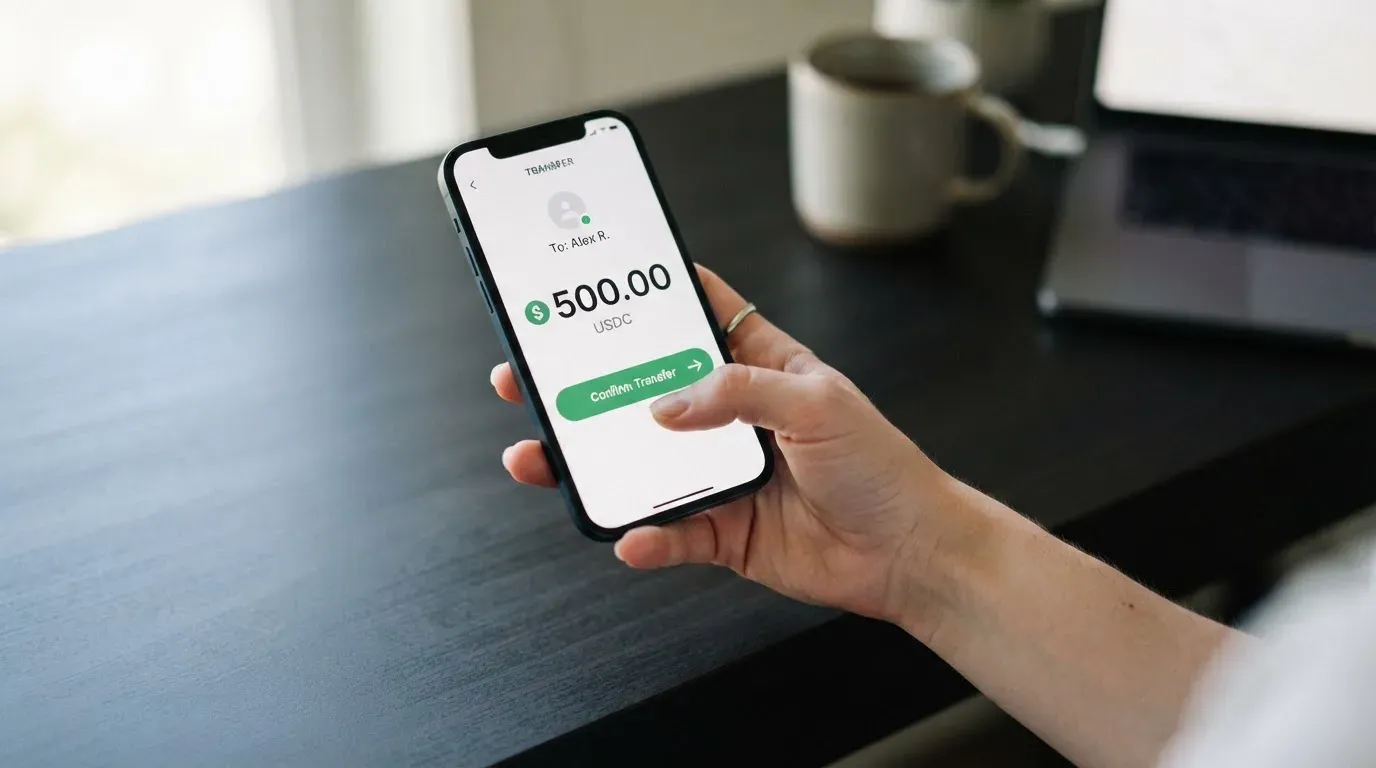
The wallet supports more than 30 coins and networks, including TRC20, ERC20, SOL and NEAR. That range matters more than it sounds. It means if you hold your stablecoins on Tron, on Ethereum, on Solana or on a Near-based chain, you have a path in. For most competing cards, the network your tokens already sit on is a hard constraint, and moving them costs gas and time. Here it is a menu.
There are fiat routes too. Smart P2P lets you buy with ordinary bank cards, and there is a personal IBAN for SEPA transfers. So the card is not only for people already holding crypto.
Two gaps to know. The network fee payer and the minimum top-up amount are not stated — someone new will want to know that before sending a first transfer, because a small deposit on a busy network can cost a meaningful share of itself. And moving the card balance back out, to crypto or to a bank account, is not stated at all: no fees given, no balance on closure given. If your reason for holding a card is that you may need to get money back out, that is a question to put to support in writing before you commit, not after.
One warning that belongs here rather than in a technical note. Choose the network as carefully as the address. Blockchain transfers are essentially irreversible, and a deposit sent on a network the card provider does not support, or to an address belonging to a different network, can be lost or need manual recovery with no guarantee attached. It is the single most common way people lose money to a card like this, and the app’s interface is what protects you — not any recovery promise.
Paying with it every day
Everyday use is where this card is thinnest, and the 4 out of 10 is honest about why. Apple Pay and Google Pay are both supported, and the card page claims 60+ million merchants worldwide, online payments and subscriptions. That covers a lot of ground: your phone is the wallet, and the card number never touches a terminal.
What you do not get: the plastic, and the cash. Both are on the waitlist or unavailable. So your day is tap-to-pay and online checkout, with nothing between you and a shop that insists on notes and coins.
There is also a subtler risk with virtual cards that merchants notice without saying anything. A card number begins with six or eight digits identifying the issuing institution, and shops can look that up and see where the card was issued. If the issuer country differs from the billing address you type, some merchants decline the payment or apply extra checks — which is exactly the situation a card issued in Britain and used from somewhere else often produces. On top of that, some merchants decline prepaid or foreign-issued cards by policy for the same reason.
Online authentication is handled the usual way: a risk check either approves the payment silently or asks you to confirm with a one-time code or a biometric. One thing to expect: address verification, which compares the numeric parts of your billing address against the issuer’s records, is mainly offered in the US, Canada and the UK and is generally not available on foreign-issued cards. Declines happen, and they are not always your fault.
If a payment is declined, a hold can stay on your funds for several days, typically up to a week. That is a small thing to know in advance and an unpleasant one to learn at the checkout.
Two practical notes. There is no cashback on the card, so no reward for spending. And if something goes wrong with a purchase — goods not received, a duplicate charge, a fraud — the card’s pages do not state how disputes work. That is not the same as saying you have no rights; it means you should not assume the process is smooth. Chargeback rules exist, but prepaid-card coverage varies by scheme and jurisdiction and should not be assumed.
What can go wrong
This is the section where I would ask the reader to slow down. The card’s own pages report no incidents. That is not the same as a clean record.
Start with the structure. The card is issued in Great Britain by Wirex Limited (company no. 09334596, 9th Floor, 107 Cheapside, London EC2V 6DN), while the service provider named in the Terms is MIKEPAY INC., registered in Panama. No licence or regulator registration is mentioned on the pages I could read. One third-party description goes further and calls it a crypto-funded prepaid Mastercard for EEA residents with the euro card and IBAN issued by a Polish payment institution — that is unofficial, it contradicts the official Visa Prepaid description, and I would not rely on it, but it is worth knowing that descriptions of this product online do not agree.
Then the money side. This is a custodial wallet with a card attached: the provider holds the credentials, so your trust in the company is what stands between your balance and someone else. There are real safeguards — two-factor authentication, Face ID, an AML Check, a bug bounty on HackenProof and Hacken audits of the apps. What is not stated: card freeze, and any insurance. Nor is dispute handling.
Then the reports. One June 2026 Trustpilot review cites slow USDT transfers, an unclear AML review, an unclear complaint procedure and confusing company information. Other reviews cite cards moving to a merged platform, failures to withdraw or pay, and funds frozen after source-of-funds checks. The Trustee Plus Trustpilot page is currently shown as unavailable for a guideline breach, so the picture there is incomplete.
Freezing after a source-of-funds check is the normal, lawful way anti-money-laundering rules work — under EU customer due diligence, if the checks cannot be completed, the institution is required to hold back the transaction or end the relationship. So it is not a malfunction. But it is also the single most common complaint in this category, and you should treat a card funded from exchange withdrawals as something you may have to document at some point, not something you set up and forget.
The regulatory action in Ukraine is the sharpest fact here: the NBU barred the Lithuanian operator from payment services in the country in September 2025, new registrations were halted on 22 May, and as of August 2026 availability for Ukrainian residents was still being reported as under review. If that is your country of residence, the card’s central promise is under active question.
And there is a category-level risk worth naming, because it is not specific to this card and it will outlive any review you read today. Card programmes do close. One crypto card brand’s issuing partner was suspended and all its programmes were shut; another network terminated its global agreements with a collapsed exchange in November 2022. Closures follow a pattern: a notice period, then loading and spending stop, then you are asked to withdraw whatever is left. Anything not withdrawn in time is the part you lose.
Two honest notes against all this. Transfers are irreversible by design, so a mistake with an address cannot be undone by anyone. And stablecoins are not censorship-proof either — issuers have frozen tokens tied to illicit activity, and one stablecoin issuer cut support for its token on one network, so “the network I use is supported” can change.
What to take instead
None of these is a recommendation for you specifically — you know your country, your documents and how you hold money, and I do not. But if something here does not fit, here is what the comparison looked like.
International Visa Card — 6.7 / 10. A U.S.-issued Platinum Visa, virtual, paying in USD; the physical card is “coming soon.” Issuance is $5 one-time with no maintenance fee, and plans run Classic free, Pro $9.00/month, Max $19.00/month. Card use in USD is free on all plans; foreign currency is “Visa exchange rate + 2% FX fee” — that 2 % is disclosed, which this card does not do. Deposits of any kind are free, in USDC or USDT at 1:1 into the USD account, and also by USD, EUR, SEPA, SWIFT and FedNow. Its eligibility list is the strictest of the group: no account or card for residents or legal registrants of Belarus, mainland China, North Korea, Cuba, India, Iraq, Iran, Israel, Myanmar, Nepal, Nicaragua, Russia, Syria, Turkey, Ukraine, Venezuela or Vietnam, with FATF grey-list countries reviewed case by case. Note that Ukraine is on that list. Purchases are blocked in North Korea, Cuba, Iran, Russia, Syria, Ukraine and Venezuela. If you are a Ukrainian, this one is out.
UNi Card — 6.1 / 10. A multicurrency card on the Mastercard network spending from the UNi.Global account balance. The pricing is the attraction: “no annual fee or foreign transaction fee,” conversion at “live OTC rates” and “no hidden exchange fees,” plus “Spend-to-Earn rewards” up to 3%. But eligibility is not stated, the physical-versus-virtual form is not stated, and top-up options are not stated. For someone who wants no FX fee and does not care about plastic, that is a strong proposition on paper — and thin on detail.
Whop Cards — 5.2 / 10. Visa, working anywhere Visa is accepted online and in stores. The page says “no extra fees,” with no issuance or monthly amounts and no conversion or FX amounts stated — which means the same opacity about rates that this card has, but with less disclosed elsewhere. It spends from a Whop balance, backed by stablecoin collateral from a linked wallet; coins and networks are not stated. The 5 % cashback at select merchants, currently Uber, is real and unusual, though the payout currency and conditions are not stated. Coverage is the widest of the three for Americans — 31 states for consumers, 41 for businesses — and unsupported consumer countries include Belarus, mainland China, Cuba, Hong Kong, India, Iran, Iraq, Israel, Myanmar, Nepal, Nicaragua, North Korea, Russia, Syria, Turkey, Ukraine, Venezuela and Vietnam. Whether eligibility runs on citizenship or residence is not stated, and with this card’s eligibility written that way, that question should be asked before you try.
| Alternative | Score | Fees you can actually see | Top up | The catch |
|---|---|---|---|---|
| International Visa Card | 6.7 / 10 | $5 issuance; plans free / $9 / $19 a month; 2 % FX on foreign currency; deposits free | USDC, USDT at 1:1, plus USD, EUR, SEPA, SWIFT, FedNow | Long exclusion list that includes Ukraine; physical card coming soon |
| UNi Card | 6.1 / 10 | No annual fee, no FX fee, live OTC rate, no hidden exchange fees | Not stated | Eligibility and top-up not stated |
| Whop Cards | 5.2 / 10 | “No extra fees”; nothing itemised | Whop balance backed by stablecoin collateral; coins and networks not stated | US-state coverage; 5 % cashback at select merchants only |
| Trustee Plus | 5.7 / 10 | 10 USD opening, 0 USD a year, 0 % payments, 0.5 % card top-up; conversion markup not stated | 30+ coins and networks, USDC and USDT, Smart P2P, personal IBAN | No plastic, no cash; Ukrainian regulator stopped new sign-ups |
Who I would recommend it to
If you are a Ukrainian outside the country, holding USDC or USDT, paying mostly online and in stores by phone, and you have a reason to need a US dollar card that your own bank will not give you — this is a card built for exactly that, and at 0 % maintenance, 0 % payments and 30-plus networks to load from, the everyday economics are better than most of what I looked at.
If you are a Ukrainian inside Ukraine, I would not start here. New registrations were stopped and availability was still being checked as of August 2026. Watch for the position to clear before spending time on it.
If you need cash, or you want a card in your hand for a shop that does not take a phone, this card cannot do that today.
If you are anywhere else and not a Ukrainian, you are reading eligibility rules that are not published. Ask support directly, in writing, and keep the answer.
And if what you actually want is to hold your own keys and spend from your own wallet, a custodial wallet-with-card is the wrong shape of product — the whole point of self-custody is that the funds stay with you until the moment of payment, and a card attached to a provider’s balance is the opposite. Whatever you choose, remember that a custodial arrangement trades your control for their convenience, and that card programmes have a habit of ending.
Frequently asked questions
What is Trustee Plus card?
Trustee Plus is a virtual Visa Prepaid card in US dollars that you load from a crypto wallet. It has its own balance, separate from the wallet, with a validity of 3 years. You spend it online or in stores through Apple Pay and Google Pay. A physical version is described but sits on a waitlist, so today the phone is the card.
How does Trustee Plus card work?
You install the app, pass identity verification through a partner called Kycaid, receive the virtual card in the app, then top up. The sequence is: pass KYC, get the card, load it from USDC or USDT, and pay. Because it is prepaid rather than a debit card, it draws on a stored balance and cannot go below zero.
Is Trustee Plus a bank?
No — the pages describe a card issued in Great Britain by Wirex Limited and a service provided by MIKEPAY INC., registered in Panama, and they do not mention a banking licence or a regulator registration. Cardholders’ funds are safeguarded in the manner used by payment and e-money institutions, which is not the same as a bank deposit guarantee. Treat it as a payment service provider, not a bank.
Who owns Trustee Plus?
The card programme’s issuer is Wirex Limited, registered in England under company number 09334596. The Terms name MIKEPAY INC., a company registered in Panama, as the service provider. Separately there is a non-custodial Trustee Wallet, which is a different product from the custodial wallet-with-card this review covers.
Does Trustee Plus card require KYC?
Yes, and it comes before the card. Verification runs in the app through Kycaid and involves a photo of a passport or ID card plus a selfie. Proof of address is not stated, and the Terms set the minimum age at 18 or your country’s legal age. Levels, processing times and rejection reasons are not published, which is worth factoring into your expectations.
Is Trustee Plus card free?
The virtual card costs 10 USD to open, then 0 USD a month to keep and 0 % on payments. Topping the card balance up from the wallet costs 0.5 %. Watch two things: the Terms say the Payment Card service may be subject to fees, and a wallet with no transactions for a year pays 20 USDT a month.
How do I top up Trustee Plus card?
Top up the wallet in USDC — USDT is also named — then open the card section and use “Top up” to move funds to the card balance. The wallet supports more than 30 coins and networks including TRC20, ERC20, SOL and NEAR, so you can usually deposit from whichever chain you already use. Fiat routes exist too: Smart P2P with bank cards and a personal IBAN for SEPA.
Can I use Trustee Plus card in my country?
Usually yes for payments, since it is a Visa accepted wherever Visa is, and the card claims 60+ million merchants. The exceptions are practical rather than legal: no cash withdrawal, and a shop may decline a prepaid or foreign-issued card. Separately, Ukraine’s regulator stopped new registrations and availability for Ukrainian residents was still being checked as of August 2026.
Is Trustee Plus card safe?
The app has 2FA, Face ID, an AML check, a bug bounty and outside audits — but the balance is custodial, so the provider holds it, and that is where your trust is being asked for. Funds frozen after source-of-funds checks are reported by users, which is also how anti-money-laundering rules are supposed to work. Card freeze and insurance are not stated. Weight it accordingly.
What are the main drawbacks?
No physical card — it is on a waitlist. No ATM withdrawal, so no cash at all. No cashback on the card. Conversion uses the Visa rate but any markup is not disclosed, which makes foreign-currency costs hard to predict. And the Terms name a supported-country list that is not published, so if you are not Ukrainian, your eligibility is genuinely unknown.
App and neobank card reviews – cryptocardcheck
Content created by the «cryptocardcheck» team