
Trade Republic card review — a good crypto card for EU residents spending from a broker balance, with limits and rules you should know
 Available in US

The Trade Republic card is one of the more convincing crypto payment cards for people who already bank with the broker: it lets you pay with the crypto you hold with Trade Republic, at what a third-party review describes as no monthly or annual fee, and the card issuer is a real EU bank rather than an e-money shop that can vanish. My score for it is 7.2 / 10. It suits EU residents who spend from a crypto balance held at Trade Republic; it does not suit people who want a card that works worldwide from anywhere, or anyone outside the bank’s home region trying to open an account. Read the conditions below as current as of October 28, 2026.
Verdict
The Trade Republic card scores 7.2 / 10 overall. That is not a “buy without thinking” number, and it is not a “stay away” number either. It is a card that does a specific job well — turning crypto already sitting on your Trade Republic balance into ordinary card payments inside Europe — while leaving several important details unstated on the public pages. If that job is your job, it is worth opening an account. If your priority is a card that reliably works from any country you travel to, that is a different product and this is not it.
Who it suits: you live in the EU, you use Trade Republic as your broker, you want a metal or classic card that spends your crypto balance without a monthly fee, and you are comfortable inside a German bank’s system. Who it does not suit: you want a card issued for your country specifically, you want guaranteed low FX spreads, or you want to keep your crypto in your own wallet and spend from it yourself.
Here is how the card scored on each criterion I checked, with the mark and the reason.
| Criterion | Mark | Reason |
|---|---|---|
| Who can get it | 5 / 10 | Bank is Germany/EU, site in en-de and en-nl; country list not disclosed on official pages |
| Cost | 8 / 10 | Official amounts not disclosed; unofficial: virtual 0 EUR, Classic 5 EUR once, Mirror 50 EUR, no annual/monthly fee, no FX markup, top-up by card 1% |
| Top-up options | 5 / 10 | Crypto on the account can be spent by card, coin list not disclosed; unofficial: SEPA transfer free, top-up by card 1% |
| Reliability and complaints | 9 / 10 | Issuer Trade Republic Bank GmbH (Berlin); Trustpilot 4.6/5 from 67,608 reviews; general complaints about support and account blocks, none found about the card |
| Everyday use | 9 / 10 | Unofficial: virtual, Classic, Mirror (metal), Apple Pay and Google Pay, free ATM withdrawals from 100 EUR worldwide |
The two 5s are the honest part of this review. “Who can get it” and “Top-up options” score low because the card’s own public pages simply do not say enough — not because something bad is known. You are being asked to trust a bank’s process you cannot read. That is a real limitation for someone in, say, a country where you are unsure whether you qualify.
The two 9s reflect a genuine strength: a bank issuer and a very large body of mostly positive user reviews. Between them they are the reason this card is worth your attention despite the gaps in the paperwork.
Will they give you the card?
The honest answer is: the card’s readable official pages do not say. Not stated in the readable pages is not the same as “anyone can apply” — it means you cannot find the eligibility rules in public form, and that is a problem when you are deciding whether to spend an afternoon on an application.
What is clear is the setting. This is a Germany/EU-based product: the site comes in en-de and en-nl versions. The card itself, “The Trade Republic Card,” is issued by Trade Republic Bank in Berlin. Beyond that, the country list, the residency and citizenship rules, and the age and status requirements are not disclosed in readable text.
That silence matters more than it would for an ordinary debit card. If you are outside the EU, or even inside it but unsure which member state the bank will open an account for, you are the person this card suits least. Nothing in the public material promises you an answer. The safest mental model is: this is a European broker’s card for European residents, not a global one.
A related point, because it comes up constantly in search: a crypto card is not automatically anonymous, and none of this changes that. Identity verification is a legal requirement for regulated businesses in the EU, not a feature this issuer is choosing to be flexible about. When I say the card suits EU residents, I mean verified residents — the same verification you already do to hold an account at any bank.
How to get it
The process itself is not stated in readable pages. Specifically, the card’s official pages do not spell out: what identity verification (KYC) documents are required; whether the card is virtual or physical by default; the network it runs on; delivery times; and any activation step.
What is clear: “The Trade Republic Card” is a product of Trade Republic Bank, Berlin (see the note on the issuer in the ‘Will they give you the card’ section), and it exists alongside the standard Trade Republic account. In practice, the way these broker cards usually work is that the card comes with your account, not through a separate application — but I want to be careful here, because “usually” is not “officially stated,” and I will not dress up an inference as a fact. Check the current in-app flow when you open your account; that is where the card offer will actually appear.
One genuinely useful detail does come from third-party sources, and I want to be honest that these are not the bank’s own word. According to Kreditkartenheld (July 2026) and Neuebanken: the virtual card is usable immediately after account opening; a replacement card, whether for loss, theft or expiry, costs the same as the original (5 EUR for Classic, 50 EUR for Mirror); and delivery times are not stated by those sources either. Treat this as a guide to expectations, not a promise.
If you are asking “does this require KYC,” the short answer is yes — as it must, for a regulated EU issuer. The specific document list is not published here, but expect the same identity checks any European bank requires. There is no version of this that is legal without verification, and I would distrust any “no-KYC crypto card” pitch regardless.
Fees: what it really costs
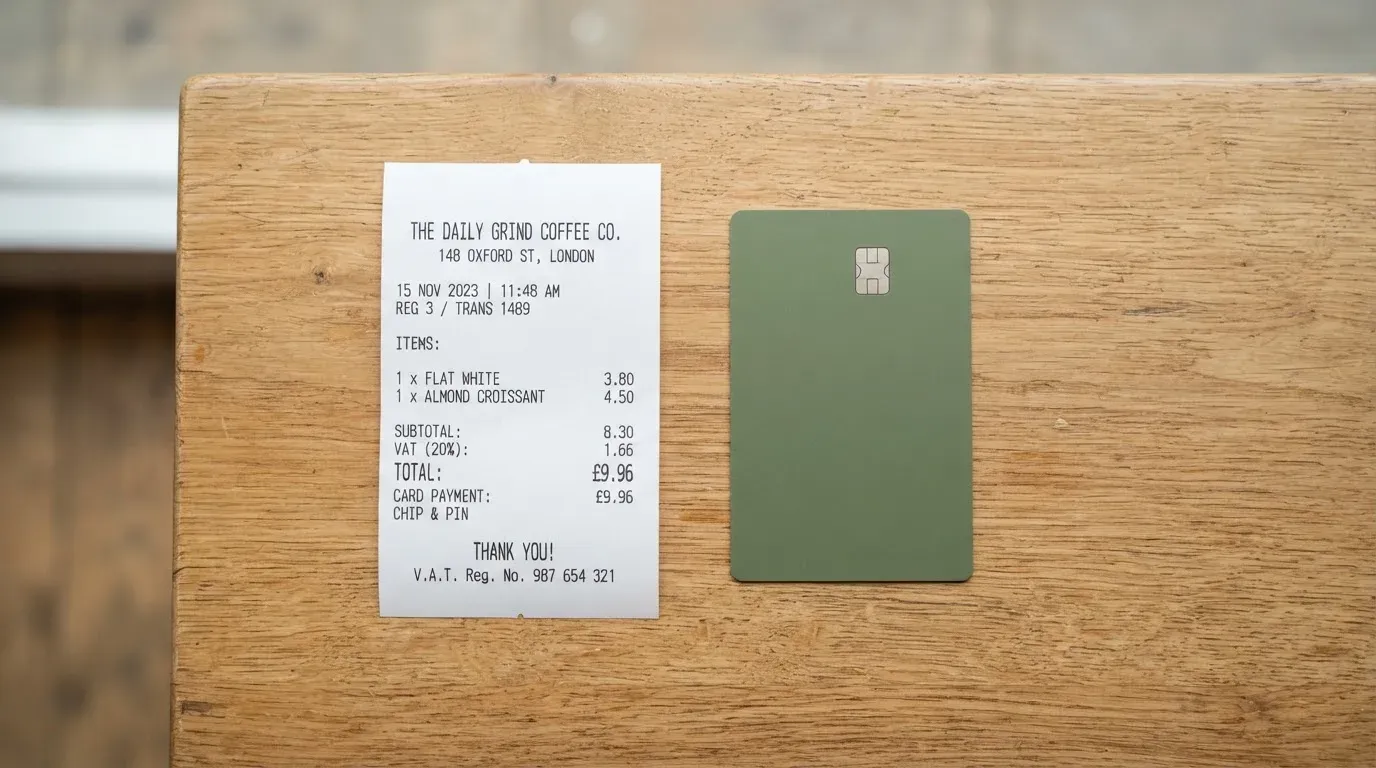
Here is the part where I have to be most careful, because the card’s own pages do not publish the amounts. Official fees are not stated. So the table below mixes what is official with what is unofficial — and the unofficial lines come from a third-party review (Kreditkartenheld, 20 July 2026, with Reisetopia and Neuebanken agreeing on the card tiers), not from Trade Republic. Confirm any figure you rely on against your own account before you commit money to it.
| Fee or limit | Amount | Official? |
|---|---|---|
| Issuance, virtual card | 0 EUR | Unofficial |
| Issuance, Classic card | 5 EUR one-time | Unofficial |
| Issuance, Mirror (metal) | 50 EUR one-time | Unofficial |
| Monthly or annual fee | none | Unofficial |
| Crypto-to-fiat conversion | 1 EUR third-party cost per trade | Official (help center) |
| Card spending fee | no card-specific fee mentioned | Official (press release) |
| Foreign-currency surcharge | none; official Visa rate used | Unofficial |
| ATM withdrawal | 100 EUR or more free worldwide at Visa ATMs | Unofficial |
| ATM withdrawal under 100 EUR | 1 EUR | Unofficial |
| ATM operator’s own fee | may still apply | Unofficial (Pagamentiditali) |
| Top up by card, Apple Pay or Google Pay | 1% of the amount | Unofficial |
| Top up by SEPA transfer | free | Unofficial |
| Daily spending limit | 1,500 EUR | Unofficial |
| Weekly spending limit | 6,000 EUR | Unofficial |
Two of these lines are official and they matter. First, spending your crypto with the card counts as a sale of that crypto — the press release says so directly, and that is a tax point, not a fee (more on that below). Second, the crypto trading commission is free but carries a 1 EUR third-party cost per trade, per the help center. Neither is a hidden charge; both are the normal way a regulated broker works.
The card page officially does promise one thing about costs: free ATM withdrawals worldwide. (The 100 EUR threshold and the 1 EUR under-threshold fee are the third-party detail.) So cash is not where this card is expensive.
Let me run three everyday payments through these numbers, because that is how the table becomes real.
A EUR 40 grocery shop in Berlin, paid with a card funded from crypto. No card-specific fee (official). Whatever crypto-to-fiat cost applies to the conversion is the main line, and the trade itself carries that 1 EUR third-party cost if it is a separate trade. The card is not adding a surcharge here.
A EUR 25 dinner in a restaurant in Lisbon, in euros, so no conversion. No FX markup (unofficial — the official Visa rate). The dinner is essentially fee-free apart from the crypto being sold to pay for it.
A EUR 300 purchase at a US online retailer, priced in dollars. Here the “no FX surcharge” claim (unofficial) matters most, and it is doing real work: the exchange rate is the official Visa rate, not a broker rate with a fat markup. This is one of the card’s quiet strengths — you are not paying a crypto-card penalty on every foreign purchase.
Where the numbers would bite you: a EUR 50 ATM withdrawal would fall under the 100 EUR free threshold and cost 1 EUR, and the ATM operator may add their own fee on top (unofficial). And the 1 EUR per crypto trade, plus the tax fact that each payment is a sale, are the running costs of using crypto as a spending balance rather than a savings one.
A word of caution about the card tiers, since it is unofficial: the sources describe three versions — virtual, Classic, and Mirror — and the Mirror differs from the Classic only by a metal casing, with the same fees and limits (Kreditkartenheld, July 2026). So you are paying 50 EUR for the metal and the feel of it, not for anything functional.
Top up: how to fund it
The headline answer is that you do not “top up” this card the way you would a prepaid card. Press release fact: customers can use crypto held with Trade Republic for card payments. The mechanism is that your crypto balance on the account is what the card spends. The coin list is not stated, so I cannot tell you which assets are spendable — check the app for what is actually enabled for you.
Beyond spending the balance, top-up options are not officially stated, and withdrawal terms are not officially stated either. From third-party sources, the unofficial picture is: a SEPA transfer is free, and topping up by card, Apple Pay or Google Pay costs 1% of the amount. That SEPA route being free is the one to prefer if you are moving ordinary euro in.
The distinction that trips people up: this is not a card you preload with a fixed fiat balance and draw down. It draws on a crypto-holding broker account. So “topping up” really means either adding funds to your Trade Republic balance by SEPA (free, unofficial) or, more to the point, holding crypto on the account for the card to convert and spend. Which coins qualify is the open question — the coin list is not disclosed.
If your mental model is “load a fixed fiat balance, spend it down, repeat, and the balance is mine,” that is closer to a prepaid card than to this one. This is a broker account you spend from.
Paying with it every day
The everyday-use experience is the card’s strongest suit, and it scores 9 for a reason. Unofficial sources describe a virtual card, a Classic card, and a Mirror metal card; Apple Pay and Google Pay support, with the card added in the app (Neuebanken, 2026). No official page describes the wallet support, so that is again unofficial — but it is the standard set for a card of this kind, and it is what you should expect.
Rewards are where the official and unofficial pictures diverge, and you should know both. Officially: a press release announces 2% Crypto Saveback on card spend, reinvested into a savings plan, up to 1,500 EUR monthly spend; the card page separately lists 1% Saveback on card payments. So there are two saveback figures in the official material — a 2% crypto-specific rate and a 1% general card rate. Unofficial detail (Neuebanken and other German reviews, 2026): the 1% goes into a savings plan of at least 50 EUR/month and is capped at 15 EUR/month, and it is not paid on transfers, ATM withdrawals, investments, top-ups, PayPal, gambling, or quasi-cash. One review says crypto-funded payments earn 2% with a 30 EUR cap since the end of 2025, which is broadly consistent with the 2% in the press release. The official caps for the 1% are not verified.
Read those two official numbers as two different things rather than a contradiction: 2% on crypto-funded card spend, 1% on card payments generally, each with its own cap. The Saveback is a nice nudge, not the reason to get the card.
On the mechanics of paying, one general fact helps explain the “card works worldwide” comment in the reviews: merchants often look up the BIN to see which institution and country issued a card, and may apply extra scrutiny if the issuer country differs from your billing address. A German-issued card paying at a US shop can look slightly foreign. That is normal for any card issued abroad, not a sign the card is unusual.
Two more practical notes, general to crypto cards rather than specific here. Card payments use 3-D Secure for online authorisations, which can add a step, and a declined authorisation can leave a hold on your funds for several days. And a gambling merchant category is often blocked on cards like this by issuer policy — so if that is on your list, do not expect it to work.
App quality and dispute handling (how you would actually claim money back if a payment went wrong) are not stated officially, so I cannot score them. Disputes are worth asking about before you rely on the card for anything large.
What can go wrong
The most important thing to know about this card is a tax point, and it is not a fee. Officially, per the press release: spending crypto with the card counts as a sale of the crypto. Each time you pay with the card, you are disposing of crypto. In most tax systems that means a taxable gain or loss is measured in your local currency at the value on the date of the transaction. This is not tax advice — I am telling you the fact the press release states so you can take it to a professional. But it means the card is a spending tool that realises gains as it goes, which is different from how a normal debit card behaves, and it should shape how much you route through it.
Then the reliability picture, which is genuinely good but not flawless. The issuer is Trade Republic Bank GmbH, Brunnenstrasse 19-21, 10119 Berlin (page footer). On Trustpilot (read 20 Oct 2026): 4.6 out of 5 from 67,608 reviews, 11% one-star, latest review 20 Oct 2026. The visible reviews are mostly positive; one simply says “Card works worldwide.” That is a large, mostly happy body of users — a real strength.
But the broader complaints about Trade Republic (not specific to the card) are about support being slow or hard to reach, high crypto spreads, and account blocks that are hard to resolve. German press reports rising BaFin complaints (date unclear). There is also a July 2026 Portuguese complaint about a crypto deposit address without a network warning — which is the kind of detail that, on a card that spends crypto, is worth internalising. The transferable lesson, general to crypto cards: send on the network you mean, because blockchain transfers are irreversible and a wrong-network deposit can be lost or need manual recovery with no guarantee. And I found no complaint specifically about the card’s crypto spending, which is reassuring for the card itself even if the parent platform has these rough edges.
Two things are simply not stated and therefore not scored: security details (the support page exists but its content is not readable here), and customer service channels, languages — including whether Russian is supported — and hours. If specific language support matters to you, ask before you rely on this card.
One more, unofficial and single-source, so weigh it as a rumour rather than a fact: a GIGA report says Trade Republic changed its Saveback terms and a user lost the 1% back. The date was not read. It is a reminder that promotional terms can change — read the current terms, not a review’s summary of them.
Because this is an EU-issued product, it also sits inside the EU’s crypto and payments regulation: MiCA for the crypto side, e-money and payment-services law for the card. Deposits held by an e-money institution are safeguarded but are not the same as bank deposits and may not sit under a deposit guarantee scheme. This card is issued by a bank, which is a stronger footing than a pure e-money card, but it is worth knowing the difference.
What to take instead
If the Trade Republic card’s gaps — the undisclosed country list, the per-trade cost, the 1.5k/6k weekly-and-daily limits, the fact that it spends from a broker balance — do not suit you, there are three other crypto cards I looked at. None of them outscore Trade Republic overall; they are here because they solve different problems.
| Card | Score | Cost model | FX model | Who it is for |
|---|---|---|---|---|
| Trade Republic | 7.2 / 10 | No monthly fee (unofficial); 1 EUR per crypto trade (official) | Official Visa rate, no surcharge (unofficial) | EU residents spending from a Trade Republic broker balance |
| International Visa Card | 6.7 / 10 | Virtual $5 once; plans Classic free, Pro $9/mo, Max $19/mo | Visa rate + 2% FX fee | USD spenders; explicit published country blocklist |
| UNi Card | 6.1 / 10 | No annual fee | No FX fee; converted at live OTC rates | Multicurrency spend, up to 3% Spend-to-Earn |
| Whop Cards | 5.2 / 10 | “No extra fees” (no amounts listed) | Not stated | US consumers in 31 states; 5% cashback at select merchants |
International Visa Card (6.7 / 10) is the interesting contrast because it publishes its restrictions. It is a U.S.-issued Platinum Visa card, virtual, paying in USD; the physical card is “Coming soon.” Its big difference is an explicit blocklist: not available to residents or legal registrants of Belarus, mainland China, North Korea, Cuba, India, Iraq, Iran, Israel, Myanmar, Nepal, Nicaragua, Russia, Syria, Turkey, Ukraine, Venezuela, Vietnam, with FATF grey-list countries reviewed case by case. Purchases are blocked in North Korea, Cuba, Iran, Russia, Syria, Ukraine, and Venezuela. The rule is by residence or registration, not citizenship. Funding is USDC or USDT into the USD account free at 1:1, plus USD, EUR, SEPA, SWIFT and FedNow. Costs: $5 virtual issuance, no maintenance fee, and a 2% FX fee on foreign currency — that 2% is the trade-off for the clarity. No cashback stated.
UNi Card (6.1 / 10) is a multicurrency card on the Mastercard network that spends from the UNi.Global balance, with no annual fee and no foreign-transaction fee, converted at live OTC rates with “no hidden exchange fees” and Spend-to-Earn up to 3%. Eligibility and funding are not stated. If your priority is no FX fee and multi-currency rather than spending a broker’s crypto balance, it is the cleaner fit.
Whop Cards (5.2 / 10) is Visa, works wherever Visa is accepted, spends from a Whop balance backed by stablecoin collateral. It is US-only — 31 states for consumers, 41 for businesses — and does not support consumers in Belarus, mainland China, Cuba, Hong Kong, India, Iran, Iraq, Israel, Myanmar, Nepal, Nicaragua, North Korea, Russia, Syria, Turkey, Ukraine, Venezuela or Vietnam. It offers 5% cashback at select merchants, currently Uber. Fees beyond “no extra fees” are not stated. For a European reader it is largely irrelevant, but it earns its place as the most generous cashback in this comparison.
The pattern worth taking away: Trade Republic wins on everyday use and reliability and on not adding an FX surcharge. The International Visa Card wins on published, predictable eligibility. UNi wins on no-FX-fee multicurrency spending. Choose based on which of those matters to you.
Who I would recommend it to
I would recommend the Trade Republic card to this person: you live in the EU, you already use Trade Republic as your broker, you want to spend crypto from that balance without a monthly fee, and you are comfortable accepting that you are spending inside a German bank’s system and that each payment is a taxable sale of crypto. If that is you, open the account, pick the tier you want (the metal is cosmetic), and turn on Apple Pay or Google Pay.
I would not recommend it to this person: you are outside the EU, or you want a card whose country list you can read before you apply. Or you want to hold your crypto in your own wallet and spend from it yourself — this card spends a broker balance, not a self-custody one, so it is the opposite of that. Or you are planning to lean on it for large international spending and the 1,500 EUR daily / 6,000 EUR weekly limits (unofficial figures) would bind you.
Or you want to be sure about the exchange rate on every purchase and cannot verify the “no FX surcharge” claim yourself — it is unofficial, and unofficial claims are the ones that change.
My honest overall: a 7.2 from a genuinely regulated issuer, with real user satisfaction behind it, held back by paperwork it does not publish and by the tax reality of spending crypto as if it were a debit balance. For its intended user, it is a good card. Just open your eyes to the two things it does not tell you.
Frequently asked questions
What is the Trade Republic card?
The Trade Republic card is a payment card that lets you spend crypto held in your Trade Republic broker account as ordinary card payments. It is issued by Trade Republic Bank GmbH in Berlin and comes in virtual, Classic and Mirror (metal) versions, the last differing only by its casing. You do not preload a fixed balance; you spend from your crypto-holding account.
Is Trade Republic a bank, and who owns it?
The card’s issuer is named as Trade Republic Bank, and the bank is Trade Republic Bank GmbH, Brunnenstrasse 19-21, 10119 Berlin. It is a Germany/EU-based institution with a German banking regulator reporting rising complaints. The licence and BIN sponsor details are not stated in the readable card text.
Who can get the card?
That is the card’s biggest unanswered question. The product is Germany/EU based, the site runs en-de and en-nl versions, and the country list, residency and citizenship rules are not disclosed in readable official pages. Practically it is a card for EU residents. If you are outside the EU, assume you are not eligible until the bank tells you otherwise.
How do I get and activate the card?
The application and activation steps are not stated in readable official pages. In practice the card is offered alongside a Trade Republic account rather than through a separate application, but treat that as an inference. Unofficial sources (Kreditkartenheld, Neuebanken, July 2026) say the virtual card is usable immediately after account opening. Identity verification (KYC) is required, as it is for any regulated EU bank.
What does the Trade Republic card cost?
Official amounts are not published. Unofficial figures: the virtual card is 0 EUR, the Classic is 5 EUR one-time, the Mirror is 50 EUR one-time, and there is no annual or monthly fee. Officially, crypto trading is commission-free but carries a 1 EUR third-party cost per trade, and card spending itself carries no card-specific fee. A replacement card costs the same as the original.
Is the Trade Republic card free to use abroad?
There is no foreign-currency surcharge according to unofficial sources — the official Visa exchange rate is used — and the card page states free ATM withdrawals worldwide. Unofficial detail: withdrawals of 100 EUR or more are free at Visa ATMs, and under 100 EUR a 1 EUR fee applies. Note the ATM operator may still charge its own fee, and foreign purchases can sometimes look “foreign” to a merchant.
How do I top up the card?
You do not preload it. You spend crypto held on your Trade Republic account directly with the card; which coins qualify is not stated. To add ordinary euro, unofficial sources say a SEPA transfer is free while topping up by card, Apple Pay or Google Pay costs 1% of the amount. Withdrawal terms are not officially stated.
Does spending with the card mean paying tax?
Possibly, and this is the thing to plan for. The press release states that crypto card spending counts as a sale of the crypto. In most systems a sale produces a taxable gain or loss measured in local currency at the value on the transaction date, so each card payment may be a separate disposal. That is a fact, not tax advice — talk to a professional about your situation.
Is the Trade Republic card safe and reliable?
The issuer is a real EU bank, Trade Republic Bank GmbH in Berlin, and Trustpilot shows 4.6 out of 5 from 67,608 reviews (11% one-star, read 20 October 2026), mostly positive, with one reviewer noting “Card works worldwide.” I found no complaint specifically about the card’s crypto spending. Broader platform complaints concern slow support, high crypto spreads and account blocks, but not the card itself.
Is the Trade Republic card worth it?
For an EU resident who already holds crypto at Trade Republic and wants to spend it without a monthly fee or an FX surcharge, yes — that is why it scores 7.2 / 10. It suits daily use best. It is less suited if you want published eligibility rules, very large spending limits, or to spend from a self-custody wallet, and you should weigh the unofficial 1,500 EUR daily and 6,000 EUR weekly limits before committing.
App and neobank card reviews – cryptocardcheck
Content created by the «cryptocardcheck» team