
The Xexon card is cheap to look at and expensive to open
 Available in US
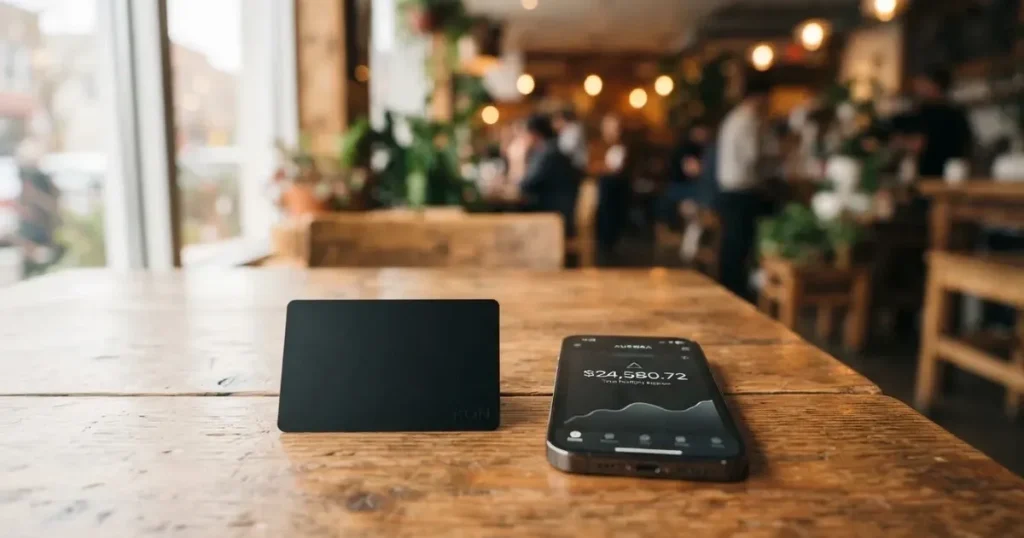
The Xexon card is a physical Platinum Visa debit card tied to an offshore US dollar account that you fund by converting BTC or USDT inside the Xexon Wallet and then loading as dollars. It is issued online, the card is shipped to you, and the whole pitch is a plain spending card for people who cannot get an ordinary bank card — or who want a dollar account held outside their home country. On paper it reads plausibly: fees are stated, limits are stated, and the account pays interest on dollar balances.
Underneath that, the picture is much thinner. The name of the card issuer is not published. The licences behind the operation are not published. The company’s own price page contradicts its card page on what the opening fee is and what the ATM fee is — and on one point the labels disagree even though the total happens to match, which tells you the numbers were never reconciled. There is no Trustpilot page, no Reddit thread, no user report of any kind that I could find, and for a financial product that is itself a finding: it is either very new or very small, and either way you would be among the first users rather than joining an established queue.
I scored it 4.8 out of 10. That is not a dismissal. It is a card that does one job at a price that stops many people before they start, sold by an entity whose financial plumbing is largely undeclared. Read the sections below in order and you will see exactly where the value sits and where the exposure sits.
The conditions described here are current as of October 28, 2026.
Verdict: 4.8 / 10, and the gap is mostly about who is behind it
| Criterion | Mark | Why |
|---|---|---|
| Who can get it | 7 / 10 | Issued online and described as available “not only in Europe but throughout Asia”; no country list and no stated exceptions |
| Cost | 1 / 10 | Account opening 450 USD, minimum deposit 150 USD, total initial 600 USD, 50 USD a year; 3 % exchange, 0.75 % card payment; labels on the pages conflict even though the total agrees |
| Top-up options | 7 / 10 | BTC and USDT (ERC20, BEP20, TRC20) into the Xexon Wallet, exchanged to USD and loaded to the card; card top-up 0.25 USD; USDT deposits 20 USDT on ERC20, 0.2 USDT on BEP20, 20 USDT on TRC20 |
| Reliability and complaints | 5 / 10 | Operated by Silver Capital Financial s.r.o. in Prague; account at JDB Bank, Laos; wallet with Fireblocks; card issuer and licences not named; no reviews found at all |
| Everyday use | 5 / 10 | Physical Platinum Visa, ATMs worldwide up to 3,000 USD a day; no virtual card, Apple Pay and Google Pay not disclosed |
| Total | 4.8 / 10 |
Who this suits: someone in Asia or Europe who wants an offshore dollar account and a Visa card attached to it, already holds crypto they are comfortable converting, and can afford to put 600 USD in before a single purchase. The interest on dollar balances is a real, if modest, sweetener for anyone actually parking money there.
Who it does not suit: anyone who needs to know, before they sign up, exactly which institution holds their money and under which licence. You cannot find that out here. It also does not suit people whose priority is cheap everyday spending — 0.75 % per payment plus 3 % on every conversion is expensive — or anyone who lives in a country where holding funds with an offshore provider is itself restricted.
Will they give you the card?
Yes, most likely, and that is the strongest thing about it: the card page says it can be issued online and is “available not only in Europe but throughout Asia”, and the offshore-account page says the account “can be opened from Europe, Asia, and more”. There is no list of eligible countries and no list of excluded ones. That cuts both ways. It means fewer artificial barriers than most comparable products, and it means you get no help working out whether your own country is one the operator actually serves — the responsibility for that check lands entirely on you.
What the pages do not tell you matters just as much. The documents required are not stated. Whether proof of address is needed is not stated. The KYC level — what they verify and how deeply — is not stated. There is an AML policy page on the site; I did not read it, so I cannot characterise its contents, and I am not going to guess at it.
One thing is stated plainly: the website is not for users under 18.
The card itself is a Visa debit in the Platinum tier, a physical card that gets shipped to you. The account is denominated in US dollars. The card’s own currency is not stated. A price-page comparison table on the site lists Visa, Mastercard and UnionPay as brands alongside it, which tells you what the card is compared against more than what it is.
How to get it
The flow is four steps, and it is the same flow as opening the account because the account and card are opened together:
- Apply online and sign up.
- Open the USD bank account and receive the card.
- Exchange crypto to USD inside the Xexon Wallet.
- Load the USD onto the card.
The card arrives at home “within a few weeks”. Xexon covers the cost of sending it. Which countries it is shipped to is not listed, so treat your own address as an open question until support confirms it.
If the card is lost or arrives damaged, the stated path is to contact support for a reissue or a suspension. What a replacement costs is not stated — worth asking before you need it.
Activation is not described as a separate step anywhere I could find; the page describes signing up and receiving the card, and that is all.
Fees: the part that decides whether this card works for you
Here is the honest version. The price page lists card issuance as free, an account opening fee of 450 USD, a minimum deposit of 150 USD, a total initial cost of 600 USD, and an annual fee of 50 USD for bank account maintenance. The card page words the same thing differently: a card issuance fee of $450 plus a bank account deposit of $150 equals $600 including shipping. The labels conflict and the totals agree. That is the detail to hold onto — the number you end up paying is the same, but the two pages do not agree on what you are paying it for, which is a small signal about how carefully the rest of the figures were checked.
| Fee or limit | What the card states |
|---|---|
| Card issuance | Free on the price page; the card page presents $450 as a card issuance fee |
| Account opening | 450 USD |
| Minimum deposit | 150 USD |
| Total initial cost | 600 USD, shipping included |
| Annual fee | 50 USD (bank account maintenance) |
| Card transaction | 0.75 % |
| Exchange fee | 3 % on the price page; the card page calls exchange fees “low” and gives no figure |
| ATM fee | 0.75 % on the price page; 1.5 % on the card page |
| Balance inquiry | Free |
| ATM limit | 3,000 USD per day |
| Payment limit | “No limit” |
| Deposit limit to bank account | No limit |
Two conflicts, both live. If you take cash out, you do not know whether you pay 0.75 % or 1.5 %. And if you convert crypto, you do not know whether the exchange fee is 3 % or something unstated. Assume the worse number until support puts it in writing.
Now three ordinary payments, with the fees that actually apply.
A coffee costing 8 USD, paid with the card. The card transaction fee of 0.75 % applies. Nothing else. Exchange fees do not touch this — the balance is already dollars.
A 200 USD online subscription paid in euros. The card transaction fee applies at 0.75 %. On top of that, the conversion from dollars to euros happens at whatever rate the Visa network gives you, and the card’s currency and any foreign-exchange markup are not stated anywhere on the public pages. This is the case where the published numbers stop covering you.
A 1,000 USD crypto-to-cash move. You pay the exchange fee — 3 % on the price page — and then the ATM fee, which is either 0.75 % or 1.5 % depending on which page you believe. With a 3,000 USD daily ATM cap, a larger withdrawal simply cannot happen in one day.
There is one product, not tiers. The single account pays 1.5 % annual interest on dollar balances, and that is the whole structure — nothing to upgrade to, nothing cheaper if you stay a year.
Top up: BTC and USDT, and the network you pick matters
Topping up is a three-step path: send BTC or USDT to the Xexon Wallet, exchange it to dollars, and load the dollars onto the card. USDT is accepted on ERC20, BEP20 and TRC20, which is three genuinely different blockchains with three different fee structures.
| Top-up item | Fee |
|---|---|
| Card loading fee | 0.25 USD |
| BTC deposit | Free |
| USDT deposit, ERC20 | 20 USDT |
| USDT deposit, BEP20 | 0.2 USDT |
| USDT deposit, TRC20 | 20 USDT |
| Exchange minimum, BTC | 0.001 |
| Exchange minimum, USDT | 20 |
The spread on that table is the practical lesson. The same asset deposited on BEP20 costs a fraction of what it costs on ERC20 or TRC20. Getting the network wrong is worse than it sounds: a transfer sent on a network the provider does not support, or to an address belonging to a different network, can be lost or need manual support recovery with no guarantee, because blockchain transfers are irreversible. And on ERC20 specifically, gas is paid in ETH — a wallet holding USDT with no ETH in it cannot send at all.
Fiat top-up is not stated. If you wanted to load dollars from a bank account rather than from crypto, the public pages do not say whether that is possible.
Getting money back out is stated, and it is not cheap either:
- BTC withdrawal costs 0.1 % plus 0.001 BTC, with a minimum of 0.0025 BTC.
- USDT withdrawal costs 0.1 % plus 20 USDT, with a minimum of 70 USDT.
What happens to a leftover balance when you close the account is not stated. That is a real question to ask before you open one, because closing an account with a stranded balance is a miserable problem to have.
Paying with it every day
The card is a physical Platinum Visa debit. It works in stores and online wherever Visa is accepted, and ATMs are available worldwide with the 3,000 USD daily cap and the disputed percentage fee.
What is missing is more revealing than what is present. There is no virtual card. Apple Pay and Google Pay support is not disclosed — and since tokenised mobile wallets are one of the everyday safeguards people actually rely on, that silence is worth noticing. A web dashboard exists at dashboard.xexon.io, but no app store listing was found. Rewards are not stated. The wallet model is not stated, which for a card whose entire function is spending crypto is a strange omission. Disputes and chargeback handling are not stated either, and that is not a small thing: a refund process ordered by the issuer is the difference between a mistake you can fix and one you cannot.
For daily use, the practical picture is a card that works like a plain Visa and gets none of the conveniences of one.
What can go wrong
Nothing is known to have gone wrong. No official incidents were found. And no reviews were found either — a search for Xexon Platinum card reviews on Trustpilot and Reddit returned nothing about Xexon at all, and there is no Trustpilot page. Read that carefully: this is not evidence of a clean record. It is evidence there is no record. For a financial product, the absence of a complaint history from a young or small operation is not reassurance.
The structural risks are clearer than the track record:
Nobody names the issuer. The operation is run by Silver Capital Financial s.r.o., a Czech company form with an address in Prague — but the registration country and the owners are not stated on the page. The bank account sits at JDB Bank in Laos. The card issuer and the licences are not stated. So the chain is: a Czech company, a bank account in Laos, a Visa-branded card from an unnamed issuer, and a wallet with Fireblocks. Any step of that chain could be where your money sits, and you cannot tell which.
Custody is undeclared. The wallet is described as being with Fireblocks, with 24/7 security operations and two-step authentication. Whether that is full custody of your funds or just infrastructure is not stated. That distinction decides whether you are trusting a custodian or holding your own keys, and it is the single most important unanswered question here. If it is custody, you carry counterparty and hack risk — the category’s history includes Mt. Gox at about US$350 million, Coincheck at about US$400 million in 2018, and the US$625 million Ronin Network loss in 2022.
Scam losses are yours. Xexon states it “cannot be held responsible for a loss of funds” if a user falls for a scam. If you are used to a bank reversing an unauthorised transfer, adjust that expectation completely.
The figures disagree with each other. Two published pages, two ATM fees, two accounts of what the opening fee is for.
Support hours are not stated. There is an FAQ, real-time chat, an email address and a contact form. Nobody says when anyone is on the other end of it.
Nothing is stated about recent company news. Nor is there any detail on how complaints are actually handled, because there are no complaints to detail.
What to take instead
If the idea of an offshore dollar card appeals to you but the specifics here are too thin, these are the three comparisons I looked at. All three score higher.
International Visa Card — 6.7 / 10. This is the one with the most clearly drawn lines. It is a U.S.-issued Platinum Visa that is virtual, pays in dollars, and has a physical version marked “Coming soon”. The account and card are not available to residents or legal registrants of Belarus, mainland China, North Korea, Cuba, India, Iraq, Iran, Israel, Myanmar, Nepal, Nicaragua, Russia, Syria, Ukraine, Turkey, Venezuela and Vietnam, with FATF grey-list countries reviewed case by case. Purchases are blocked in North Korea, Cuba, Iran, Russia, Syria, Ukraine and Venezuela. Note the basis: the rule follows residence or registration, and citizenship is not mentioned — a distinction that can matter enormously depending on your passport. Costs are far lower: 5 USD one-time for the virtual card, no maintenance fee, and plans at Classic free, Pro 9.00 USD a month and Max 19.00 USD a month. Card use in dollars is free on every plan; foreign currency costs the Visa exchange rate plus a 2 % FX fee; deposits are free. You fund it with USDC or USDT into the dollar account at 1:1, though the networks are not stated, and you can also deposit USD, EUR, SEPA, SWIFT and FedNow. No cashback is stated. Two things to weigh: the country list is long, and the physical card does not exist yet.
| International Visa Card | Xexon | UNi Card | Whop Cards | |
|---|---|---|---|---|
| Score | 6.7 / 10 | 4.8 / 10 | 6.1 / 10 | 5.2 / 10 |
| Card | U.S.-issued Platinum Visa, virtual | Physical Platinum Visa debit | Mastercard network, multicurrency | Visa |
| Who can get it | Long exclusion list by residence or registration | Europe and Asia stated, no list | Not stated | 31 US states for consumers, 41 for businesses; several unsupported countries |
| Opening cost | 5 USD virtual, no maintenance fee | 600 USD total initial | No annual fee, issuance not stated | No extra fees, no amounts listed |
| Card use | Free in USD; FX rate + 2 % | 0.75 % | No foreign transaction fee | Not stated |
| Top-up | USDC, USDT, USD, EUR, SEPA, SWIFT, FedNow | BTC, USDT | Not stated | Whop balance, stablecoin-backed |
| Rewards | None stated | Not stated | Up to 3 % spend-to-earn | 5 % cashback at select merchants, currently Uber |
UNi Card — 6.1 / 10. A multicurrency card on the Mastercard network that spends from the UNi.Global account balance. It has “no annual fee or foreign transaction fee”, converts assets at “live OTC rates”, and claims “no hidden exchange fees”. It offers spend-to-earn rewards up to 3 %. But eligibility is not stated, whether the card is physical or virtual is not stated, issuance fee is not stated and funding methods are not stated. It is a better-priced concept with the same documentation problem.
Whop Cards — 5.2 / 10. A Visa card that works anywhere Visa is accepted, spending from a Whop balance — pending balance is usable as soon as a payment arrives, while standard withdrawals use settled funds. The balance starts backed by stablecoin collateral from a linked wallet, though the coins and networks are not stated. Rewards are 5 % cashback at select merchants, currently Uber, with more planned, though the payout currency and conditions are not stated. Eligibility is spelled out in more detail than for any of the others: consumers in 31 US states, businesses in 41, and consumer exclusions for Belarus, mainland China, Cuba, Hong Kong, India, Iran, Iraq, Israel, Myanmar, Nepal, Nicaragua, North Korea, Russia, Syria, Turkey, Ukraine, Venezuela and Vietnam, with Russia and Belarus also excluded for corporate accounts. The basis — citizenship or residence — is not stated. Fees are “no extra fees” with no amounts, and the card’s physical or virtual type and currency are not stated.
Who I would recommend it to
I would recommend it to someone specific: a person in Asia or Europe who already holds BTC or USDT, needs a dollar-denominated card that is not tied to a local bank, has 600 USD to spend without needing it back quickly, and has verified with support in writing which entity issues the card and which licences apply — before sending a cent.
To everyone else I would say the cost is the first thing that ends the conversation. 450 USD to open an account, 150 USD to fund it, 50 USD a year to keep it, 0.75 % on every payment and 3 % on every conversion. That is the price of a convenience, and it should be compared against what you are actually trying to solve. If you cannot get an ordinary card, 600 USD is not an unreasonable price for a working one. If you merely prefer dollars, it is steep.
And if you move on, move on knowing why: the missing issuer and the missing licences are not small omissions. They are the questions a deposit-taking product should answer on its front page, and the answers are not there. If a provider will not tell you who holds your money, your decision has already been made for you.
Frequently asked questions
What is the Xexon card?
Xexon is a physical Platinum Visa debit card attached to an offshore US dollar account. You convert BTC or USDT into dollars inside the Xexon Wallet, load those dollars onto the account, and then spend them like an ordinary Visa card. It is aimed at people who want a dollar account held outside their home country or who cannot get a standard bank card.
How does the Xexon card work?
Four steps: apply online and sign up, open the USD bank account and receive the card, exchange crypto to USD in the Xexon Wallet, then load the dollars onto the card. The card arrives at home within a few weeks at no shipping cost. There is no virtual version, and Apple Pay and Google Pay support is not disclosed.
Is Xexon a bank?
Not as far as the public pages show. The operation is run by Silver Capital Financial s.r.o. in Prague, while the account is held at JDB Bank in Laos. The card issuer is not named and no licences are stated. What type of institution legally holds your money is the question I would want answered before funding anything.
Who owns Xexon?
The pages name Silver Capital Financial s.r.o. as the operator, with an address in Prague, which is a Czech company form. The owners and the registration country are not stated on the page. The wallet is described as being with Fireblocks. Beyond that, the ownership chain behind this operation is not published.
Does Xexon require KYC, and what documents?
What is required is not stated, and neither is whether proof of address is needed or how deep the checks go. There is an AML policy page on the site which I did not read. The one firm requirement stated is that the website is not for users under 18, so an adult applicant is a precondition.
What does the Xexon card cost to open?
The price page lists card issuance free, an account opening fee of 450 USD, a minimum deposit of 150 USD and a total initial cost of 600 USD with shipping. The card page describes the same 600 USD as a 450 USD card issuance fee plus a 150 USD account deposit. The labels disagree; the total does not. The annual fee is 50 USD.
What are the fees for spending and converting?
Card transactions cost 0.75 %. The exchange fee is listed as 3 % on the price page, while the card page calls exchange fees low without giving a figure. ATM fees are stated as both 0.75 % and 1.5 % on the two different pages, so assume the higher one. Balance inquiries are free, and deposits of any kind are described as free.
How do I top up the Xexon card?
Send BTC or USDT to the Xexon Wallet, exchange it to dollars, then load the card. Loading the card costs 0.25 USD, BTC deposits are free, and USDT deposits cost 20 USDT on ERC20, 0.2 USDT on BEP20, and 20 USDT on TRC20. Exchange minimums are 0.001 BTC and 20 USDT. Fiat top-up is not stated.
Is the Xexon card safe?
There is no track record to judge: no reviews were found on Trustpilot or Reddit and no official incidents surfaced, which means no history rather than a clean one. The wallet is described as being with Fireblocks with 24/7 security operations and two-step authentication, but the custody model is not stated. Xexon also says it cannot be held responsible for funds lost to a scam.
Where can I use the Xexon card?
Anywhere Visa is accepted, in stores and online, and at ATMs worldwide with a daily cap of 3,000 USD. Payment limits are stated as no limit, and deposits to the bank account have no limit. Country availability is described as Europe and Asia without a specific list, so check your own country with support first.
App and neobank card reviews – cryptocardcheck
Content created by the «cryptocardcheck» team