
A virtual card that spends stablecoins, priced at a 4% top-up fee
 Available in US

Nero is a virtual payment card you load with USDT or USDC and then spend like an ordinary card in shops, online, or through Apple Pay and Google Pay. That is the whole pitch, and it is a narrow one: a quick virtual card funded with USDT or USDC, with no published country list, no named issuer, and a fee that is easy to find and easy to misread. I went through the card’s own pages and its press material to see how much of that holds up. My score is 4.8 out of 10. Read on if you are weighing whether to try it, but read the sections on eligibility and cost first, because those are where the silence is loudest.
The conditions described here are current as of October 28, 2026.
Verdict: 4.8 out of 10, and the gaps matter more than the features
The card does one thing simply: you send stablecoins to it, and the balance turns into spendable fiat at the moment of payment. For someone who already holds USDT or USDC and wants a card number that works in a shop today, that is a real convenience. For everyone else, the pages do not say enough to make a decision — and several of the things you would want to know before sending money are simply absent rather than unfavourable.
| Criterion | Mark | Why |
|---|---|---|
| Who can get it | 5 / 10 | Countries are not named; the site says restricted countries exist but does not publish the list |
| Cost | 3 / 10 | 4% top-up commission; a one-time issuance fee with no amount given; FX fee not disclosed |
| Top-up options | 6 / 10 | USDT or USDC, networks not confirmed; conversion to fiat happens at payment |
| Reliability and complaints | 5 / 10 | Nero Sphere LIMITED (Hong Kong); issuer and licences not named; no complaints or reviews found |
| Everyday use | 6 / 10 | Virtual card, Apple Pay and Google Pay for contactless payments; ATM not disclosed |
| Total | 4.8 / 10 | A workable idea on a thin public disclosure |
Who this suits: you already hold USDT or USDC, you want a virtual card number today rather than a plastic one in the post, and you are comfortable treating the balance as money you could lose. Who it does not suit: anyone who needs to know in advance what a purchase will cost, anyone in a country the card will not serve, anyone who needs a bank account relationship or deposit-style protection, and anyone for whom a small, new Hong Kong company being the only named party on the page is a dealbreaker.
The single most useful thing I can tell you is that this card is young and small. Nero’s own material dates the launch to 25 June 2026 — a virtual crypto card with USDT/USDC top-up and Apple Pay and Google Pay support — and it reached me as a paid press release, not as independent reporting. When I looked for user reviews, I found nothing: no complaints, no reports, and no Trustpilot page for Nero as of 21 October. That cuts both ways. No bad stories is not the same as a good track record; it usually means the card is too new to have one.
Who they will give the card to
The card’s readable pages do not name the countries it serves, and they do not publish the list of restricted countries. The site says restricted countries exist; the list itself I could not read. I also found no statement addressing Russian or Belarusian citizens or residents, in either direction — which means you cannot infer eligibility or ineligibility from the site, and I would not infer it from anywhere else either.
That is the honest answer, and it is an uncomfortable one. Card eligibility is not a detail you can shop around: the issuer applies its own risk policy, and nationality is typically screened separately from residence because sanctions screening and issuer policy often attach to citizenship and country of birth as well as to your address. So “which country am I in” is only half the question, and on this card it is the half the site does not answer.
What the wider category tells you, though, is worth knowing before you apply. Prepaid and debit cards are generally available to adults aged 18 and over, and some issuers set higher limits. Identity checks, where they exist, are not arbitrary friction: in the EU, customer due diligence covers name, address, date of birth, nationality and identity documentation, a sanctions check, the purpose of the relationship, and whether you are a politically exposed person. In the US, the customer identification programme requires name, date of birth, address and an identification number, and electronic systems also validate proof-of-address documents against records. If due diligence cannot be completed, EU rules require the institution to decline the transaction or relationship, and to end an existing relationship where necessary — which is why accounts close or freeze while documents are chased.
So the realistic sequence is: you sign up, you are asked for identity documents, and at some point a check happens that can go either way. The card’s own pages do not describe its verification process at all. What you can check yourself, before you send anything: whether the site names a licensed entity, whether that entity appears in a regulator’s register, and whether the terms explain what happens to your balance if the programme closes. On this card, that last question has an answer I can give you — see the risks section — and you should weigh it before you fund anything.
How to get it
The signup is described as fully online: registration, top-up and card issuance, with no bank-branch visit. That is the one genuinely pleasant thing in the file. You do not queue, you do not wait for post, and you do not need to be near a particular branch.
What the card looks like once you have it: a virtual card with a standard number, expiry date and CVC, so it behaves like a card in a wallet or a checkout form. The network is not named. That omission matters more than it sounds — the network decides which terminals accept it, how online authorisation behaves, and how disputes are handled, and none of that can be inferred from the number alone.
Also worth setting expectations on two points:
- Physical delivery — the card is described as virtual only. Whether a plastic version exists or is planned is not stated.
- Verification levels — how many documents are needed, whether an upload or a live check, and whether there are different tiers for different balances: not stated.
And the timing that is actually confirmed: the card is issued within minutes of funding. That is the real milestone in the journey, not the moment you register — the card appears after money arrives, so top up once the account is open rather than assuming you can explore first and pay later.
Fees: what a Nero payment really costs
The one fee you can confirm is a 4% commission on top-up. That is the headline number, and it is a top-up fee, not a payment fee — it is charged when you load the card, not when you spend it. There is also a one-time issuance fee, but the amount is not stated, and no monthly fee is stated either.
Here is the full picture, including the blanks:

| Fee or limit | What the card says |
|---|---|
| Issuance | One-time fee, amount not stated |
| Monthly fee | Not stated |
| Conversion | Conversion to fiat happens at payment |
| FX fee | Not stated |
| ATM | Not stated |
| Top-up commission | 4% |
| Daily limits | Not stated |
| Monthly limits | Not stated |
Let me put a number on what this means for an ordinary day, using only the 4% that is confirmed. If you load $100, the commission takes $4 and $96 goes onto the card — that is the only arithmetic here that is actually derivable from the disclosure. Everything past that point depends on what the conversion rate is and whether an FX fee applies, and the card does not say. If you are outside the currency the card settles in, your real cost on top of the 4% could be considerably higher, because you cannot price a spread that has not been published.
Coffee, six dollars. You load $6, pay 24 cents in top-up commission, and whatever the conversion gives you goes on the card — then you spend most of it on one coffee. A purchase this size is a poor host for a percentage fee.
A supermarket run, eighty dollars. You pay the 4% top-up commission on the amount you load. At this level, the percentage fee is a clear addition to your costs, which is where the fee stops looking like a rounding error.
A flight, six hundred dollars. $24 in commission on the load. At this size the percentage fee starts to feel like a card service charge — the number many people expect a card to have and usually find buried in the exchange-rate spread instead.
The pattern is worth holding on to: the 4% is fixed as a proportion, so it hurts most where your balance is small, and it sits *on top of* a conversion whose rate you are not shown. If the currency your card denominates in is not the currency you shop in, you are paying the 4% plus an unknown cross-currency cost on every single purchase, and you cannot see the second number before you commit.
One more thing to weigh, from the category rather than the card: a card payment that is authorised and then declined, or a merchant who places a hold, can leave funds tied up for several days — typically up to seven. With a small balance, a hold can block the whole balance for a week.
Top up: how the money gets in
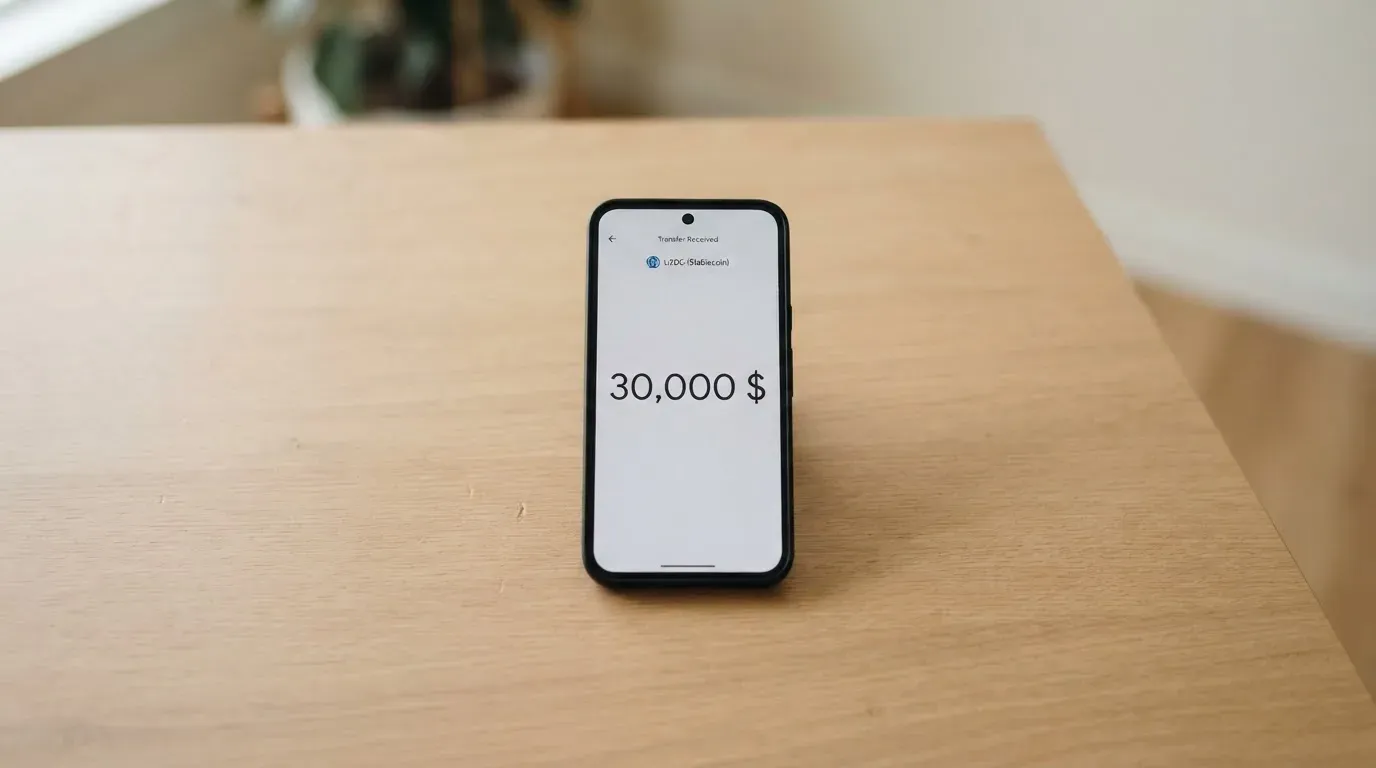
You fund the card with USDT or USDC, and the conversion to fiat happens at the time of payment rather than at the moment you deposit. The card is issued within minutes of funding.
That design is the card’s central idea and it has one important consequence: your deposit is not converted when you send it. You are holding a stablecoin-denominated balance, and the conversion rate you get is whatever applies when you spend. If the peg moves between your deposit and your purchase, the difference is yours.
Two things I could not confirm and you should establish before sending funds:
- Which networks are supported. Not confirmed on the readable pages. This is not a minor gap. USDT and USDC each exist on several chains, and the chain you send on must match what the provider supports. Circle lists USDC as natively supported on 38 networks as of 16 September 2026, and Tether describes USDT as issued on networks including Ethereum, Tron, Solana, Polygon and Avalanche. Send on the wrong one and the deposit is not lost in a technical sense — but blockchain transfers are irreversible, so it can end up needing manual support recovery, with no guarantee.
- Minimum top-up, who pays the network fee, and whether there are fiat top-up options at all. Not stated.
On the network fee itself: the on-chain cost of your deposit is charged by the blockchain, not by the card provider, so it is a separate line from the 4%. And one structural point that catches people: ERC-20 fees are paid only in ETH, so a wallet holding USDT with no ETH cannot actually send it. Tron prices fees through bandwidth and energy, often burning TRX. Either way, a top-up needs a little gas money in the native asset as well as the stablecoin itself.
What is not stated: withdrawing money back out. No withdrawal method, minimum or fee is described anywhere I could read. That asymmetry matters — this card is presented as a way to spend crypto, and the way to get money off it is not something the pages explain.
A note on the two stablecoins, since you are choosing what to send. Both are dollar-pegged and, per the BIS in July 2025, together they make up about 90% of stablecoin market capitalisation. Circle says USDC is redeemable 1:1 for USD and 100% backed by cash and cash equivalents, mostly in an SEC-registered government money market fund, with monthly reserve attestations. Tether describes USDT as built on multiple blockchains with reserves intended to back it 1-to-1. And the name is not a guarantee: TerraUSD collapsed in May 2022, and USDC temporarily lost its peg in March 2023 during the US banking crisis. One further wrinkle — Circle stopped supporting USDC on Tron in February 2024, so “USDC over TRC20” is not a native option.
Paying with it every day
Apple Pay and Google Pay are supported for in-store contactless payments, on top of the plain virtual card with its number, expiry and CVC for online checkouts. That is a genuinely practical combination: adding a virtual card to a phone wallet is what turns “a card number” into something you can use at a terminal without fumbling.
How the mobile wallets behave is worth understanding. Apple Pay replaces the card number with a device-specific Device Account Number held in the Secure Element, never on Apple servers, and each payment carries a one-time dynamic security code. So the credential on your phone is not the credential in your account, and a leak of one is not a leak of the other. It also follows that the issuer can restrict a tokenised number — blocking it on magnetic stripe, phone or web use, for example — so what your physical card can do and what your phone can do need not match.
Three things the card does not tell you about everyday use:
- Blocked merchant categories — not stated. Worth knowing because merchant category codes are how cards are restricted: MCC 7995 covers gambling, casinos, betting and lotteries, and issuers block it on specific cards by policy rather than by law, with the blocked list varying by issuer. Ask whether Nero has such a list.
- Rewards — not stated. Do not assume any.
- Disputes and chargeback handling — not stated. This is the one I would push hardest on. A chargeback is a refund ordered by the issuer to settle a dispute, with reason codes such as fraud, duplicate billing or goods not received. US debit card reversal rights come from Regulation E, prepaid-card coverage varies and should not be assumed, and if the issuer is not named anywhere on the site, you have no obvious body to complain to.
Also unstated: the app. No app is described; the service is used via the website. There is no stated mobile app to check for two-factor authentication, freeze the card, or set spending limits — the typical safeguards a card provider is expected to have.
Where it may be declined, for reasons that have nothing to do with you. A payment card number starts with a 6- or 8-digit issuer identification number identifying the issuing institution, followed by an account identifier and a check digit. Merchants can look up that prefix to see which institution and country issued the card, and apply extra scrutiny when the issuer country differs from the customer’s billing address. That is the mechanism behind the “foreign card declined” experience, and it can hit a virtual card issued in one market and used in another. Some merchants decline prepaid or foreign-issued cards precisely because the lookup reveals the card type and issuer country. Address Verification Service compares the numeric parts of the billing address you type against issuer records, is mainly offered in the US, Canada and the UK, and is generally unavailable for foreign-issued cards — which causes declines on its own. And a Hong Kong dateline on the company’s only press contact is a country that a merchant’s risk system may treat as unusual, whether or not any rule forbids it.
What can go wrong
Let me put the company first, because it is the fact everything else hangs on. The card belongs to Nero Sphere LIMITED, with a Hong Kong dateline. The press release names David Vance, Director of Growth, as the contact, and the press address is [email protected]. The issuer and the licences are not named. I want to be careful about what that means and what it does not.
It does not mean the card is unlicensed. It means you cannot check. And checking is the whole point of the regulatory layer. In the EU, MiCA — Regulation (EU) 2023/1114 — took legal effect in June 2023; its rules on asset-referenced tokens and e-money tokens applied from 30 June 2024, and the remaining provisions including crypto-asset service provider rules from 30 December 2024. Under it, e-money tokens may be issued only by a credit institution or an electronic money institution. ESMA keeps an interim register of authorised providers, white papers and non-compliant entities, and you can look a provider up there. Transitional arrangements ran until 1 July 2026, or until a provider got or was refused authorisation, whichever came first. Note the structural split: MiCA covers the crypto side — custody, exchange, transfer — while the card itself is regulated separately as a payment service, so a crypto card often depends on two licences, and here you can see neither.
What is missing is the layer that would tell you your money is held separately and protected. EMIs must safeguard customer funds, by segregating them in dedicated accounts or insuring them — but such funds are not the same as bank deposits and may not be covered by deposit guarantee schemes. A named issuer would let you check whether it is such an institution. Nero’s pages name none.
Your funds, if you have any on the card, sit with a provider you cannot audit. Two mechanisms are worth understanding. Control of crypto belongs to whoever holds the private key; a seed phrase of 12 to 24 words is an unencrypted form of the private key, and anyone who obtains it can restore the wallet and spend the funds. Transfers are typically irreversible, and a stolen key has no recovery path — the network cannot freeze or return the funds. And the record of custodial platforms is not reassuring: Mt. Gox (about US$350 million reported stolen, 2011–2014), Coincheck (about US$400 million, 2018) and Ronin Network (US$625 million, 2022). None of that is a prediction about Nero. It is a description of what holding funds with a custodian exposes you to.
Programmes end. It has happened to cards in this category more than once. Visa terminated its global agreements with FTX on 13 November 2022 and the FTX US debit card was wound down by its issuer. WaveCrest, a Visa issuer that supplied crypto card brands, was suspended by Visa in Europe in 2018, closing all WaveCrest-issued Visa programmes. The shape of a closure is consistent: a notice period, then spending and loading stop, then users are asked to withdraw remaining balances. If Nero has no withdrawal process published, the last step of that sequence has no documented route.
The stablecoin side is not censorship-proof. Tether says it disables tokens in wallets on the OFAC sanctions list and has frozen funds tied to illicit activity. Stablecoins sit inside systems that can act on your balance without your consent.
And what I could not check at all: security practices — not stated; support languages and hours — not stated; authentication, freeze and limits — not stated. Support is described as handled by staff rather than automated systems, which is better than a chatbot, but the marketing address is a press contact, not obviously a support channel.
One last, quieter risk: the card is new. Launched 25 June 2026, announced by paid press release, no independent reviews found, no Trustpilot page as of 21 October. A young card run by a Hong Kong company with no named issuer is not a scandal — it is simply early, and early means every fact above has less history behind it.
What to take instead
If you are deciding between this and something else, here is how the alternatives I looked at compare. None is a recommendation, and all three carry the same instruction: check the fee and licence disclosures yourself before funding anything.
| Nero | Cardex | CardFlow | HyperCard | |
|---|---|---|---|---|
| Score | 4.8 / 10 | 5.6 / 10 | 4.9 / 10 | 4.7 / 10 |
| Who it is for | Not stated; restricted countries exist but list unpublished | “One crypto card, 200+ countries”; no exclusions listed | Aimed at Nigeria: “Nigeria’s smartest fintech card platform” and “Nigerians and global users” | No country list on official pages; app says it works in “more than 176 countries” (acceptance, not eligibility) |
| Card | Virtual, standard number, expiry and CVC; network not named | Debit crypto card on VERVE, VISA, Mastercard and UnionPay; virtual and physical; Naira per listing | Virtual USD Mastercard, created in about 3 minutes | Prepaid; network not stated on the app page; balance in USD or EUR |
| Cost | 4% top-up; issuance fee amount not stated | Not stated | Creating a virtual card is “completely free” (site FAQ); monthly fee not stated | Not stated; app page lists no fees |
| Conversion | To fiat at payment; FX fee not stated | Real-time crypto-to-fiat at payment; site says an “AI-Powered Conversion Rate” scans global exchange rates and picks the best one; no percentage stated | Not stated | Deposit crypto, converted to USD or EUR on the card |
| Funding | USDT or USDC; networks not confirmed | USDT, USDC and BTC wallets; networks not stated | Bitcoin, USDT, ETH or Naira bank transfer; networks not stated | Crypto such as USDT, BTC, ETH in the app; networks not stated |
| Rewards | Not stated | Not stated | Not stated | Not stated |
What the comparison actually shows: nobody in this group publishes everything. Not one of these four cards gives you a full fee schedule on the pages I could read. Cardex has the most on-the-surface detail — real networks including Visa and Mastercard, and both virtual and physical — but describes its conversion pricing in marketing language with no percentage attached, which is the number you need most. CardFlow is the only one that states a card-creation cost, and it is zero, though that says nothing about what happens after. HyperCard’s app language about “more than 176 countries” describes where the card is accepted, not who may hold one; that distinction is easy to read past and it is exactly the distinction that matters on Nero too.
Nero’s honest position in this field is a narrow one: a confirmed 4% top-up fee, USDT and USDC funding, Apple Pay and Google Pay, and a virtual card issued in minutes. That is more concrete on fees than Cardex, HyperCard or CardFlow — and less concrete on almost everything else.
Who I would recommend it to
I would recommend this card in a fairly specific situation, and I would hesitate outside it.
Try it if you already hold USDT or USDC, you want a card number that works today rather than in a week, you are comfortable with Apple Pay or Google Pay as your main way of paying, and you treat the balance as money you might lose. In that situation the card does something simple and useful, and the 4% top-up fee is a price you can evaluate against what you were going to pay for the equivalent service elsewhere.
Be careful if you are outside the United States or Europe and your spending depends on the card working reliably — because the accepted-network picture for a Hong Kong-dated card is one of the practical risks here, and there is no ATM provision disclosed at all. Be careful if you are near or past a stablecoin depeg, because you are converted at payment, not at deposit. Be careful if small purchases are your pattern, where a 4% load fee costs the most.
Skip it if you need to know what a purchase will cost before you make it, or you need to dispute one afterwards — the FX fee and the dispute process are both unstated, and that combination is disqualifying for me. Skip it if you need a bank relationship, deposit protection, or a named institution you can complain to. And skip it if you need a physical card, cash withdrawals, or rewards.
My score of 4.8 out of 10 is not a verdict on whether the product works. It is mostly a verdict on how little the public pages let you verify. The 4% fee I can price; the FX spread, the eligibility rules, the licensing and the dispute process I cannot. For a card whose entire purpose is turning crypto into everyday payments, that is a thin foundation — and it is why I would put a small amount on it, watch what happens at the first conversion, and decide from that rather than from the feature list.
Frequently asked questions
What is the Nero card?
Nero is a virtual payment card funded with USDT or USDC. You send stablecoins to it, and the balance converts to fiat when you spend, rather than when you deposit. The card carries a standard number, expiry date and CVC, works with Apple Pay and Google Pay for contactless payments, and is issued within minutes of funding. It is virtual as described; a physical version is not stated.
How does the Nero card work?
You register online, open an account, top up with USDT or USDC, and receive a virtual card shortly after the funds arrive. When you pay, the stablecoin balance converts to fiat at that moment. The card cannot overdraw in the usual way because it works from a pre-loaded balance rather than a linked bank account. Conversion happens at payment, so the rate you get depends on when you spend, not when you deposit.
Is Nero a bank?
Not on the evidence available. The named company is Nero Sphere LIMITED, with a Hong Kong dateline; the press release names David Vance as Director of Growth. The issuer and the licences are not named anywhere on the pages I could read, and no regulatory registration details are given. Since a card is regulated separately from the crypto side, a genuine service would normally point to two licences, and here you can see neither.
Can I use the Nero card in my country?
I cannot tell you, and neither can the card. The readable pages do not name the countries served, and while the site says restricted countries exist, the list itself is not published. There is also no statement about Russian or Belarusian citizens or residents either way. Eligibility depends on the issuer’s policy and screening, and this card does not publish either.
How much does a Nero card cost?
The one confirmed fee is a 4% commission on top-up. There is also a one-time issuance fee, but the amount is not stated, and no monthly fee is stated. Conversion to fiat happens at payment, and the FX fee is not stated. ATM fees, daily limits and monthly limits are also not stated, so the full cost of a purchase abroad cannot be calculated from the public information.
Does the Nero card require KYC?
The card’s pages do not describe its verification process, so I cannot confirm what it requires. Category rules give a sense of the norm: EU due diligence normally covers name, address, date of birth, nationality, identity documents, a sanctions check and politically-exposed-person status, while US rules require name, date of birth, address and an identification number. If due diligence cannot be completed, EU rules require the institution to decline or end the relationship.
Is the Nero card safe to use?
There is no evidence of problems — no complaints, no user reports and no news about complaints, and no Trustpilot page as of 21 October 2026. But that reflects how new the card is: launched 25 June 2026 via a paid press release. What the pages do not state is just as important: security practices, authentication, card freeze, spending limits, dispute handling, or the name of the issuer.
Is the Nero card free?
Not quite. Creating and holding the virtual card may or may not come with a monthly charge — no monthly fee is stated — but there is a one-time issuance fee whose amount is not disclosed. The fee you can actually confirm is the 4% top-up commission, which you pay each time you load the card, including on small top-ups.
How do I add the Nero card to Apple Wallet?
Apple Pay is listed as supported, so the standard route applies: add the card in your wallet app using the card number, expiry and CVC from Nero, and confirm with your bank’s verification if prompted. The card’s pages do not describe this process themselves, and no mobile app is described — the service is used through the website. Apple Pay stores a device-specific number in the Secure Element rather than your card number, and uses a one-time code per payment.
How do I withdraw money from Nero?
The card’s public pages do not state a withdrawal method, minimum or fee — I could find nothing on it. That is worth raising before you fund the card, not after. Card programmes in this category can close, and closures typically end with a request that users withdraw remaining balances, so a card with no published way out is a gap I would want filled first.
Virtual card reviews – cryptocardcheck
Content created by the «cryptocardcheck» team