
The Bitnob virtual card does the basics and little more
 Available in US
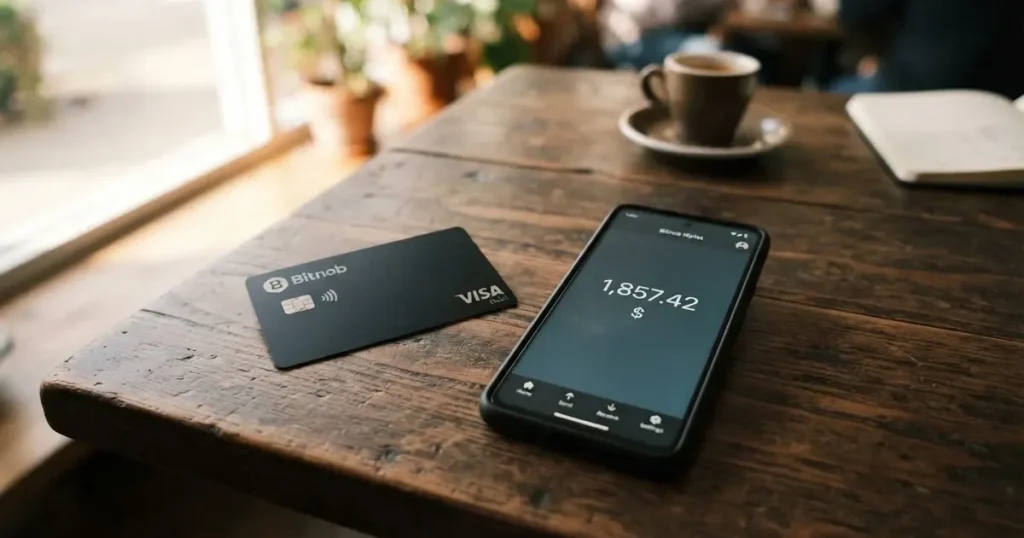
Bitnob’s virtual dollar card does one thing: it lets you spend crypto — Bitcoin, USDT or USDC held in a Bitnob wallet — at ordinary merchants as if you had a bank card. That is a genuine answer for anyone who cannot get a normal card, or who needs dollars rather than naira, zloty or reais. It is also, on the evidence I could check, a product with almost no published numbers: no fee table, no limits, no network list, no explanation of what happens if your verification fails. Those gaps matter more than the feature list does, because the people who would use this card are usually the people least able to absorb a surprise.
My score is 5.1 out of 10. That is not a verdict on crypto cards in general, and it is not a claim that Bitnob is dishonest. It is a verdict on a product I could not fully evaluate from what it publishes, wrapped in a complaints record that includes vanished funds.
The conditions described here are current as of October 28, 2026.
Verdict: 5.1 out of 10, and who it is really for
Five points are average, not bad. The card works as described, the company has been running since at least 2023, and the audience it serves is real. But the marks below show where the weight sits: a solid 6 on eligibility and funding, a middling 6 on cost because nothing is priced, and a 3 on reliability that pulls everything else down.
Who should consider it: someone based in Africa who already holds crypto, needs a virtual USD card, and wants dollars to spend online without a bank account that will take their application. Who should look elsewhere: anyone who needs a physical card, cash from an ATM, or a card that works at a wide range of merchants without surprises. Also anyone who is uncomfortable holding a balance with a company that is not a bank — which, in this case, is everyone, because the card issuer is a partner, not Bitnob.
Here is the full breakdown.
| Criterion | Mark | Why |
|---|---|---|
| Who can get it | 6 / 10 | Countries are not named on the card page; the company is Nigeria-based and has expanded to eight other African countries; 2023 press said any user with the app anywhere in the world could create a virtual card; in practice it varies by region and partner institution |
| Cost | 6 / 10 | No official amounts are published; unofficial sources say creation is free or USD 1; one Trustpilot complaint cites USD 6 for a new card; no conversion fee is named |
| Top-up options | 6 / 10 | From a Bitcoin, USDT or USDC wallet balance; networks are not disclosed; unofficial: funding up to USD 10,000 |
| Reliability and complaints | 3 / 10 | Bitnob Technologies Limited is not a bank and not a licensed card issuer; cards come from regulated partners; Trustpilot shows 2.9 out of 5 across 48 reviews, half of them one-star: missing funds, cards cancelled without notice |
| Everyday use | 4 / 10 | Virtual only; Apple Wallet and Google Pay are added manually by typing the details in; no 3-D Secure; no ATM |
| Total | 5.1 / 10 |
The last row is the number to hold on to. Everything above is a component of it.
Who will they give the card to?
They will only give it to you if you have passed verification. That is stated plainly: cards can only be issued to customers who have passed KYC. You need an image of an identity document and details that match it. If your national ID card is on their list of accepted countries, you must submit it front and back together. Passports and driving licences are not affected by that particular rule, which is a mercy if your national ID is old or partly damaged. You must be 18 or older.
The countries themselves are not specified on the card page. Bitnob describes its market as “dollar-scarce markets” without naming them. The company is Nigeria-based and has expanded to “eight other countries in Africa”, but the page does not say which eight. In 2023, press coverage said that “users located anywhere in the world who have access to the Bitnob app can create a virtual card” — which is a much broader claim than the current page makes. Availability, in practice, “varies by region and partner institution”.
So if you are outside Africa and reading this hoping the 2023 claim still holds, that is the first thing to verify for yourself before you spend an hour on anything else. The difference between “anyone with the app” and “depends on your region and which bank is behind it” is the difference between a universal product and a patchwork.
What the card page does not say: the KYC levels, what documents they accept where, and whether they need proof of address. That last one is worth noting because other providers in this category do ask. Whether verification succeeds is also not promised anywhere, and one Trustpilot user reported being denied verification after a deposit in September 2025.
The card itself: virtual only. The card page says “Visa and Mastercard USD cards”; the API documentation is more specific and says “USD-denominated virtual Visa cards”. There is no physical card, and the delivery question simply does not apply — physical cards are not currently offered. If a shop needs to see a card in your hand, or you want to survive a payment where the terminal must be handed over, this is the wrong product.
How to get it
The route is verification, then a virtual card appears in your account. In practice: register, complete KYC, pass the checks, and request the card. Cardex, one of the alternatives below, advertises quick creation; Bitnob does not publish a time, and I would not expect one.
Two things to know before you start. First, your age and your documents, covered above — there is no shortcut past the identity check, and anyone promising one is not offering you this card. Second, “how to activate Bitnob card” is a search people type, and the honest answer is that the card’s activation step is not described on the pages I read; the card is issued into the account after verification rather than posted to you.
If your national ID is on their accepted list, the front-and-back requirement is the detail most likely to cause a first-attempt failure. Photograph both sides properly, in focus, with all four corners visible. And if you are in a hurry to spend money you have already transferred in, understand the order of operations: verification comes before the card, and a deposit sent beforehand does not buy you a card if the checks fail — that is exactly what the September 2025 complaint describes.
Fees: what it really costs
Here is the honest state of Bitnob’s pricing: the cardholder fees are “defined per platform integration”, and no amounts are published on the pages I could read. I am going to say that once, plainly, and not pretend to fill the gap with a guess — anything I put in a table here would be my number, not theirs.
| Item | What Bitnob publishes |
|---|---|
| Card creation | No official amount; cardholder fees “defined per platform integration” |
| Monthly fee | Not stated |
| Conversion | “Seamless conversion at the best available rate”; no conversion fee named |
| FX / foreign currency | Not stated as a separate fee |
| ATM | Not available — API docs list “no ATM withdrawals” |
| Spending limits | No numbers published; limits are configurable per card, by amount, merchant, channel and time of day |
| Tiers | Not stated; a single product |
Some third-party reporting, which the card has not confirmed, says creation is free or costs USD 1 — The Paypers in February 2023 and cryptocards.so gave the free figure, nairacompare.ng gave USD 1 in 2026. A Trustpilot complaint from June 2025 cites USD 6 charged for a new card. Treat all three as unofficial, and treat the USD 6 figure as a signal that the price may vary by integration or have changed.
Now three everyday payments, to make the missing numbers concrete:
- An online subscription in dollars. You would convert crypto to USD and spend. The conversion happens at “the best available rate” and no conversion fee is stated — but the rate you actually get is not published anywhere, so the amount that lands in your account is a variable nobody has committed to.
- A coffee in a local currency, abroad. Bitnob publishes no FX fee at all. You are also relying on the card looking acceptable to a merchant: the card’s country of issue is visible in the card number itself, and a shop can decline a prepaid or foreign-issued card on that basis. This is not a Bitnob problem specifically, but it is a cost in the practical sense — a declined payment you have to redo another way.
- An item at a merchant in a restricted category. Merchant category restrictions exist, “within allowed categories”, and the list of allowed categories is not published. If the merchant falls outside it, the payment fails. You cannot check in advance.
The pattern: the fees are probably small, and the visibility is genuinely poor. For someone spending a small amount a month, an unstated percentage is a rounding error. For someone spending up to the unofficial limit of $10,000, it is the whole decision.
Top up: how the card gets funded
Topping up means converting crypto you already hold. You can fund the card from your Bitcoin, USDT or USDC wallet balance. That is the whole list. There is no overdraft, and there is no local-currency top-up path described on the pages I read — the card is USD-denominated, and there is no local-currency card to fall back on.
What is not stated: the networks. This is the detail to sit with before you transfer anything. USDT exists on several chains and USDC on many more, and sending on a chain the provider does not support is a well-known way to lose a deposit or spend weeks in support. Transfers are irreversible. If your stablecoin arrives on a network Bitnob does not support, it may need manual recovery, with no guarantee. Circle stopped supporting USDC on Tron in February 2024, so some obvious-looking pairings simply are not options.
There are also network costs that have nothing to do with Bitnob: on-chain fees are charged by the blockchain, not by the card provider. On Ethereum that means gas paid in ETH — so a wallet holding USDT but no ETH cannot send at all. Tron prices things differently, through bandwidth and energy, often burning TRX.
Withdrawal — getting money back out rather than spending it — is not stated. Nor is any specific top-up limit; unofficial reporting from The Paypers in February 2023 mentions funding up to USD 10,000.
One stablecoin point that matters if you hold USDC or USDT: these are not risk-free dollars. Stablecoins can and do lose their peg — TerraUSD collapsed in May 2022, and USDC briefly lost its peg in March 2023 during the US banking crisis. A card balance funded from a depegged stablecoin inherits that.
Paying with it every day
Everyday use is where this card is at its thinnest, and it is worth being concrete about why.
There is no physical card. You pay by typing the card number into a checkout, which works, but it means your card details sit in browser forms — the ordinary risk of online card entry, without the physical-card option as a fallback.
Apple Wallet and Google Pay are supported, but only by adding the card details manually. There is a catch for Apple Wallet: your Apple ID region must be the United States. If yours is not, that path is closed to you, and you are back to typing numbers into web forms.
Online payments have no 3-D Secure. Normally an issuer assesses the risk of an online transaction and either waves it through or challenges you with a one-time code or a biometric check. Bitnob’s card does not do that, which means every online payment is either approved without an extra check or declined outright. Some merchants, particularly outside the US, Canada and UK, run an address check on the billing address you type; that check is generally unavailable for foreign-issued cards, and its failure shows up as a decline.
Merchant categories are restricted, within allowed categories, and the allowed list is not published. Gambling is the classic example of a category that many issuers block by policy rather than by law — and the blocked list varies by issuer, so you cannot copy someone else’s answer.
No ATM withdrawals. Not a fee question — the option does not exist.
Rewards are not stated. An unofficial figure from cryptocards.so puts cashback at 0%. The iOS app on the US App Store shows 3.79 out of 5 from 108 ratings as I read it on 21 October 2026; I did not read the Google Play rating.
Disputes and chargeback rights are not stated. That is worth sitting with. A chargeback is a refund the issuer orders to settle a dispute, with reason codes like fraud or goods not received. In the US, debit card reversal rights come from Regulation E and credit card rights from Regulation Z, and prepaid-card coverage varies and should not be assumed. If Bitnob does not publish what applies to its card, you do not know what remedy you have when a payment goes wrong.
One more everyday detail: a declined authorisation can leave a hold on your funds for several days, sometimes up to seven. On a card that draws on one stored balance, a hold is money you cannot spend.
What can go wrong
Three things, in order of how much they should worry you.
The company is not a bank, and it is not the issuer. Bitnob Technologies Limited states plainly that “Bitnob is not a bank”. It is not a licensed card issuer either. Cards are issued by what it calls “regulated card partners” — licensed issuing banks and Visa programme managers. Its own pages do not state the jurisdiction or the specific licences. This is a common structure in this category: the brand is the front end, a partner bank holds the programme. It is not automatically a bad sign. It does mean you are in a two-party relationship where the party you deal with is not the party that holds your card programme, and that if the partner changes, your card can change with it.
Funds sit with a custodian. Money you load is custodial — it is funded from your Bitnob wallet balance. Control of crypto belongs to whoever holds the private key or seed phrase, and with a custodial wallet the provider holds the credentials, so you are trusting them completely. The seed phrase is typically 12 to 24 words and unencrypted: anyone who obtains it can restore the wallet and spend the funds. Transfers are irreversible and a stolen key has no recovery. This is not hypothetical — custodial platforms have a documented history: Mt. Gox (about US$350 million reported stolen, 2011–2014), Coincheck (about US$400 million, 2018), Ronin Network (US$625 million, 2022). Holding funds with a custodian means carrying counterparty and hack risk.
The complaints are about money disappearing. I found no official record of incidents, but the Trustpilot pattern is what you would worry about: 2.9 out of 5 from 48 reviews as I read it on 21 October 2026, half of them one-star. Themes reported by users: missing or disappearing funds from June 2025 through August 2026; cards cancelled and details changed without notice, with a USD 6 fee for new cards in June 2025; verification and withdrawal errors in September and October 2025; and, in January and July 2026, poor support and an unclear virtual card balance. A complaint is not proof. A pattern of them, on a product where the funds are custodial, is a reason to keep a small balance rather than a large one.
Against that, the standard safeguards are there: app-based two-factor authentication, an instant card freeze from the dashboard menu, and spend controls by amount, merchant, channel and time of day. It is a prepaid card, so it cannot overdraw. Help is at help.bitnob.com and a contact page, with [email protected] for data requests.
The category itself has scars worth knowing. Visa terminated its global agreements with FTX on 13 November 2022 and the FTX US debit card was wound down. WaveCrest, a Visa issuer that supplied several crypto card brands, was suspended by Visa in Europe in 2018 and all its programmes were closed. Programme closures typically follow a pattern: a notice period, then spending and loading stop, then users are asked to withdraw remaining balances. One 2026 closure reported by a secondary source had new loads ending 8 July 2026 and spending stopping 8 August 2026 — single source, unconfirmed, but the shape of it is what to plan for.
Regulation is a related question. In the EU, an electronic money institution can issue e-money and payment cards but cannot lend, and must safeguard customer funds by segregating them or insuring them — such funds are not the same as bank deposits and may not be covered by deposit guarantee schemes. MiCA, the EU’s markets-in-crypto regulation, took legal effect in June 2023; its stablecoin and asset-referenced-token rules applied from 30 June 2024 and the service-provider rules from 30 December 2024. Under MiCA, e-money tokens may be issued only by a credit institution or an EMI. The transitional period for existing providers ran until 1 July 2026 or until they received or were refused authorisation, whichever came first. A card is a payment service regulated separately from the crypto side, so a crypto card often rests on two licences. None of this tells you where Bitnob sits, because Bitnob’s pages do not say — but ESMA’s interim register of authorised providers is public if you want to check a company yourself.
What to take instead
If the shape of the card is right but the details are thin, the alternatives are worth a look. All three below are also virtual-first and all three also have thin published numbers — that is the category, not a verdict on them.
| Cardex | CardFlow | HyperCard | |
|---|---|---|---|
| Score | 5.6 / 10 | 4.9 / 10 | 4.7 / 10 |
| Who | “One crypto card, 200+ countries”; no country list or exclusions; app listing is Naira-focused | Aimed at Nigeria — “Nigeria’s smartest fintech card platform” — and “Nigerians and global users” | No country list on official pages; app says works in “more than 176 countries” (acceptance, not eligibility) |
| Card | Debit crypto card on VERVE, VISA, Mastercard and UnionPay; virtual and physical; card currency Naira per the listing | Virtual USD Mastercard, created in about 3 minutes | Prepaid; network not stated on the app page; balance in USD or EUR |
| Cost | Not stated | “Creating a virtual card is completely free”; monthly fee not stated | Not stated; app page lists no fees |
| Conversion | Real-time crypto-to-fiat at payment; an “AI-Powered Conversion Rate” claims to scan global rates and pick the best; no percentage stated | Not stated | Not stated |
| Funding | USDT, USDC and BTC wallets; networks not stated | Bitcoin, USDT, ETH or Naira bank transfer; networks not stated | Crypto such as USDT, BTC, ETH, converted to USD or EUR; networks not stated |
| Rewards | Not stated | Not stated | Not stated |
Three contrasts worth naming. Cardex is the only one of the four that offers a physical card, and the only one with four networks listed. Its “AI-Powered Conversion Rate” is a marketing claim with no percentage behind it, which is no more useful to you than an unstated fee. CardFlow publishes something Bitnob does not: a card creation price, free. But it names Nigeria as its centre of gravity, and if that is not where you are, its reach is the open question. HyperCard is the vaguest — no network, no fees, and a “176 countries” line that describes where the card is accepted rather than who can hold one; those are different questions and the answer to the second is not published.
None of them publish limits or networks either. If your deciding factor is knowing the number before you commit, that factor rules out this whole group, and the answer is further afield.
Who I would recommend it to
I would recommend this card, cautiously, to one kind of person: someone in Africa who already holds Bitcoin, USDT or USDC, has completed verification, needs a virtual USD card for online spending, and can afford to treat the balance as small. If that is you, the mechanics work and the audience fit is real.
I would not recommend it as your only card. No 3-D Secure, no physical card, no ATM, no published limits, no published fee table, and a Trustpilot record where half of 48 reviews are one-star about missing money. That combination is fine for convenience and not fine for dependency.
Before you fund it, do the three things I would do. Confirm you are eligible, since the country list is not published and the 2023 “anywhere in the world” claim is not what the current page says. Confirm which networks are supported before you transfer anything, because transfers are irreversible. And load once, small, and see how long the money takes to arrive and how support responds if something is wrong — that is the only way to get the information this page could not find for you.
If you want a card for spending and not for holding, spend small. If you want to hold, do not use this for it.
Frequently asked questions
What is Bitnob card?
Bitnob is a Nigeria-based fintech company that issues a virtual dollar card for spending. You fund it from crypto held in a Bitnob wallet — Bitcoin, USDT or USDC — and the balance converts to USD that you spend online as if you had an ordinary card. The company says it is not a bank, and the card itself is issued by regulated partner institutions. It launched the virtual dollar card on 22 February 2023.
How does the Bitnob card work?
You convert or top up crypto into a dollar balance in your Bitnob account, and the virtual card spends that balance. It behaves like a prepaid card: it draws on stored funds rather than a bank account, so it cannot overdraw and there is no overdraft. Because it is virtual, you pay by entering the card details at checkout or adding them manually to a mobile wallet.
Is Bitnob a bank?
No. Bitnob Technologies Limited states directly that it is not a bank, and its own description says it is not a licensed card issuer. It is a programme manager or front end, with cards issued by what it calls regulated card partners — licensed issuing banks and Visa programme managers. Its public pages do not state the jurisdiction or specific licences.
Who can apply for the Bitnob card?
Only customers who have passed identity verification. You need an identity document image and matching details, and you must be 18 or older. National ID cards from certain countries must be submitted front and back together; passports and driving licences are unaffected. Countries are not named on the card page, and availability varies by region and partner institution.
Does the Bitnob card require KYC?
Yes. The card states that cards can only be issued to customers who have passed verification. What it does not publish is the list of accepted documents by country, whether proof of address is needed, or what the verification levels are. One Trustpilot user reported being denied verification after a deposit in September 2025, so passing is not guaranteed.
How do I top up the Bitnob card?
You fund it from your Bitcoin, USDT or USDC wallet balance in Bitnob. There is no overdraft, and Bitnob does not publish which blockchain networks it supports for each coin — check before transferring, because sending on an unsupported network can mean a lost deposit or a long support recovery. On-chain network fees are charged by the blockchain, not by Bitnob.
How much does the Bitnob card cost?
No official amounts are published. Bitnob says conversion happens at the best available rate with no stated conversion fee, and cardholder fees are defined per platform integration. Unofficial reports say card creation is free or costs USD 1, and one Trustpilot complaint cites USD 6 for a new card. There is no ATM. Limits are configurable per card but no numbers are given.
Can I use the Bitnob card in my Apple Wallet or Google Pay?
Both are supported, but only by adding the card details manually. For Apple Wallet your Apple ID region must be the United States. The card has no 3-D Secure authentication, and merchant categories are restricted to an allowed list that Bitnob does not publish, so some payments will simply be declined.
Is the Bitnob card safe?
The standard safeguards exist — app-based two-factor authentication, an instant card freeze from the dashboard, and spend controls by amount, merchant, channel and time of day — and the card is prepaid so it cannot overdraw. But your funds are custodial, held by a company that is not a bank, so you carry counterparty risk. Trustpilot showed 2.9 out of 5 across 48 reviews when I checked, half of them one-star, with reports of missing funds.
Is the Bitnob card worth it?
It is worth it if you are Africa-based, already hold crypto, need a virtual USD card for online spending, and can keep the balance small. It is not worth it as your only card: no physical card, no ATM, no 3-D Secure, no published limits or fees, and a complaints record that includes funds going missing. Load small first and judge the provider’s support on how they handle that.
Virtual card reviews – cryptocardcheck
Content created by the «cryptocardcheck» team