
A Telegram-first Visa that spends your stablecoins, priced like a service rather than a bank
 Available in US
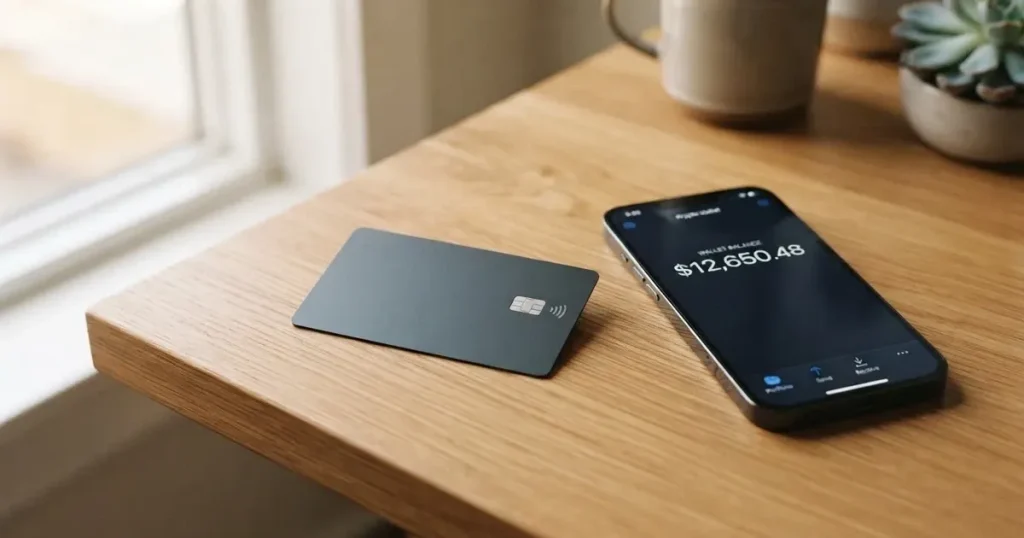
Karta is a Visa Signature you hold inside Telegram, paid for from a balance you load with USDT or USDC. It exists for people who cannot get an ordinary bank card easily: no local branch will open an account, the paperwork is a wall, or you simply move money in crypto and would rather not convert it somewhere else first. For that job it is well made. The card is issued in minutes, works at Apple Pay and Google Pay, and takes money in on eight networks. It is also not a bank, it is built by a Delaware company whose card-issuing partner is not named on its own site, and its Trustpilot score is 3.9 out of 5 from 25 reviews — a small sample, but a poor one. I scored it 7.9 out of 10.
The conditions described here are current as of October 28, 2026.
Verdict: 7.9 out of 10
Here is the whole picture at a glance, criterion by criterion, with the reasons in short.
| Criterion | Mark | Why |
|---|---|---|
| Who can get it | 9 / 10 | Works in 200+ countries and territories where Visa is accepted; availability depends on local regulations and partner coverage |
| Cost | 7 / 10 | Virtual Visa activation 5.00 USDT, physical from 100.00 USDT; crypto top-up free; card payments 1.5%; ATM 1.5% + 1 USDT |
| Top-up options | 10 / 10 | USDT or USDC on Tron (TRC-20), Ethereum, BNB Smart Chain, Polygon, Arbitrum, Optimism, Base, Solana; plus fiat via ACH, SWIFT, SEPA, PIX, SPEI |
| Reliability and complaints | 5 / 10 | Karta Finance Inc., not a bank, issuer not named; Trustpilot 3.9 out of 5 from 25 reviews, complaints about high fees; unofficially, “0% commission” and “25% cashback” are called misleading |
| Everyday use | 9 / 10 | Visa Signature virtual and physical, Apple Pay and Google Pay, ATMs worldwide |
| Total | 7.9 / 10 | A strong reach-and-convenience card with a fee structure and a thin public record to weigh against it |
The single biggest reason this score is not lower is reach: Karta says it works in 200+ countries and territories, which is a wider door than most alternatives in this category put in front of you. The single biggest reason it is not higher is the fee table and the paper trail. You pay 1.5% on card payments, 1.5% plus 1 USDT at ATMs, 1.5% plus EUR 2 for SEPA withdrawals, and you are told nothing about currency conversion, daily limits, monthly limits, or the fee for holding foreign currency. Those last omissions matter more than the fees do, because you cannot price a card whose exchange rate you are not shown.
Who it suits: you already hold USDT or USDC, you want a Visa number within an hour, you live somewhere without a usable mainstream banking relationship, and you treat the card as a spending tool rather than as a place to keep money. Who it does not suit: anyone planning to hold a balance on the card, anyone for whom 1.5% per payment matters, anyone who needs a chargeback route or a clear dispute process, and anyone who wants to know exactly which institution stands behind the card — because on its public pages, Karta does not say.
Who will they give you the card to
They will give it to you in a very wide set of places. Karta states that it works “in 200+ countries and territories where Visa is accepted”, and adds the important asterisk that availability “depends on local regulations and partner coverage”. That is two claims, and you need to hold both: the coverage is broad, and it is not uniform. Whether a specific country works is a question for Karta in the app rather than for a review page.
What the public pages do not say is how citizenship and residence are treated separately. Most issuers in this category screen nationality and country of birth as well as country of address, because sanctions rules and their own risk policy attach to both. Karta does not publish a list of excluded countries, and it does not publish a list of included ones either. If where you were born matters for your case, the only way to know is to ask.
There is one point worth raising here rather than burying later. Karta says it is used monthly by over 20,000 people. That is a small user base for a financial product, and small is not the same as unsafe — but it does mean your experience is unlikely to be an established, heavily tested one. No recent news coverage of the company is stated on the site either.
How to get it
The route is unusually short, because most of it happens inside Telegram. You start the Karta Telegram bot, you verify your identity there, and you top the account up — the top-up is what activates the virtual card. The site describes verification as a “quick verification (it takes up to 5 minutes)”.
That is the entire official flow, and it leaves real gaps. The pages do not state which documents are accepted or what the minimum age is. Nor do they describe verification levels, what each level unlocks, or why an application might be refused. Prepaid and debit cards are generally available to adults aged 18 and over, and some issuers set higher limits, but that is a general rule rather than a Karta rule.
One unofficial source, a third-party comparison site with no date shown, lists Karta’s identity checks as “ID Verification” requiring an email address, a phone number and an identity document, with proof of address and a selfie not required. Treat that as a description of practice rather than a promise, and expect the app to ask for whatever its checks need on the day.
What you get afterwards: a Visa Signature, in virtual and physical form. The card currency is not stated. The physical card is activated from 100.00 USDT, and the site does not say which countries it ships to, how long delivery takes, what delivery costs, or what a replacement costs if you lose it. Those are four things you may want to ask about before paying a hundred dollars to find out.
What it really costs: Fees and limits
The honest answer is that the fees are published and easy to read, and the limits are not published at all. So you can price a payment but not a month.
| Item | What Karta states |
|---|---|
| Visa Virtual activation | 5.00 USDT (the FAQ shows “30 USDT 5 USDT”, apparently an old price struck through) |
| Visa Physical | from 100.00 USDT |
| Virtual accounts | free |
| Monthly fee | none listed |
| Crypto top-up | free |
| Card payments | 1.5% |
| SEPA | 1.5% + EUR 2 |
| SWIFT (USD) | 1.4% + $2 |
| Send to crypto wallet | network fee only |
| ATM cash withdrawal | 1.5% + 1 USDT |
| Currency conversion (FX) fee | not stated |
| Daily and monthly limits | not stated |
Now let that sink for a second: you are not told what it costs to spend in a currency other than the card’s, and you are not told the card’s currency. If you are paid in dollars and spend in euros, or the reverse, the only thing standing between you and an unwelcome surprise is a rate you cannot see in advance. There is a third-party site claiming an FX fee and limits — a 25,000 dollar daily spend on the personal Visa Signature, unlimited daily and monthly spend on the virtual card — but it carries no date and is not confirmed by Karta. Use it to frame a question, not as a fact.
Two other figures deserve attention because they contradict the official page. The same third-party source claims ATM fees are free and ATM withdrawals are “unlimited”. Karta’s own site says the opposite on both points: 1.5% plus 1 USDT. When a card’s official page and an aggregator disagree about fees, believe the card.
Let me walk three ordinary payments through, because the fee attaches differently depending on where the money is going.
- A coffee bought with the card. The 1.5% card payment fee applies. If the coffee is priced in a currency the card does not hold, whatever conversion cost exists applies on top, and Karta does not state what that is.
- Withdrawing euros from a European ATM. The ATM fee of 1.5% plus 1 USDT applies. Add the conversion question again if the machine dispenses a currency the card does not hold, and add whatever the ATM operator charges, which is outside Karta’s control.
- Moving USDT out to your own wallet. Karta charges the network fee only — that is, the blockchain’s own cost, not a card fee. This is the one direction where the card is cheap, which makes sense: it is the direction that looks like withdrawal rather than spending.
One comparison to keep in mind while you read this table: a typical mainstream bank debit card charges you roughly nothing per purchase and shows you the conversion rate. Karta charges you 1.5% per purchase. The exchange you are making is convenience and reach against a per-transaction toll.
How to Top up
Top-up is where this card is strongest, and it is the reason to choose it over the alternatives.
Crypto: USDT or USDC, on Tron (TRC-20), Ethereum, BNB Smart Chain, Polygon, Arbitrum, Optimism, Base and Solana. Fiat rails are listed too — ACH, SWIFT, domestic wire in USD, SEPA in EUR, PIX in BRL, bank transfer in COP, SPEI in MXN — varying by country.
That network list is genuinely generous, and it matters more than it looks. The failure mode with crypto cards is sending on a chain the provider does not support, or to an address belonging to a different chain: transfers are irreversible, so the money can be gone or land in a manual recovery queue with no guarantee of a refund. Knowing up front that Tron, Ethereum, BNB Chain, Polygon, Arbitrum, Optimism, Base and Solana are all accepted removes most of that risk. One trap worth naming: Circle stopped supporting USDC on Tron in February 2024, so “USDC over TRC20” is not a native option — USDT on Tron is, and that is the pairing to use.
Costs: the crypto top-up itself is free. The minimum top-up is not stated. Spends afterwards still carry the 1.5% card payment fee, SEPA withdrawals 1.5% plus EUR 2, SWIFT in USD 1.4% plus 2 dollars, and sends to your own crypto wallet the network fee only.
Getting money back out is narrower than getting money in. Withdrawals to external crypto wallets work at network cost only. Bank withdrawals are listed as “coming soon” — so the exit route to your own bank account does not exist yet, which for many people is the single most important limitation on this card. What happens to a balance if you close the account is not stated, and you should ask that question before you fund it.
Paying with it every day
Everyday use is where Karta scores best. It is a Visa Signature, virtual and physical. It works with Apple Pay and Google Pay. It gives “global ATM cash access”.
Apple Pay is worth a word of context because people often worry about handing a card number to a phone. What Apple Pay does is replace the card number with a device-specific Device Account Number held in the Secure Element — never on Apple’s servers — and give each payment a one-time dynamic security code. So adding the card to Apple Wallet is not the same as writing your card number into an app.
On the software side, Karta works as an app inside Telegram rather than as a standalone app. App Store and Google Play listings and ratings are not stated on Karta’s own site. Again from the third-party source with no date shown: the Android app sits at 3.0 stars, with the number of ratings not given.
Rewards are advertised but not quantified. Karta claims cashback on spending — “the more they spend, the more you earn” — and referral rewards in KARAT points, where 1 KARAT equals 0.01 USDT. The cashback rate and the currency it is paid in are not stated. Two things follow from that. A third-party aggregator argues the advertised “25% cashback” claim is widely seen as misleading and that cashback is paid in an illiquid token; and either way, treat the reward as a bonus rather than as a reason, because a rate that is not published cannot be valued.
Two absences to keep in view while you use it daily. Restricted merchant categories are not stated — many issuers block gambling (MCC 7995) as policy rather than by law, and the list varies by issuer, so you cannot assume either way. And the dispute process is not stated. What happens when a shop takes the money and does not deliver, or when a transaction you did not make appears, is simply not written down on the pages I read. That is not the same as there being no process, but it is the same as having no documented one.
A note on declines that applies to any card in this category, and to yours especially: merchants can look up the BIN to see which institution and country issued the card and may apply extra scrutiny when the issuer country differs from the billing address. Some decline prepaid or foreign BINs for that reason. A declined authorisation can also leave a hold on funds for up to several days. Neither is a Karta fault; both are things that happen more often with this kind of card.
What can go wrong
The most important thing to understand here is what kind of company you are dealing with. Karta is operated by Karta Finance Inc., at 221 W 10th St, 4th Floor, Wilmington, DE 19801, USA. It says plainly that it is “not a bank” and that it is not FDIC insured. The site refers to “regulated financial and card-issuing partners” without naming the issuer, and no licences are stated.
That unnamed issuer is the thing to sit with. A card network licenses the institution that issues cards under its scheme; the crypto brand in front is often only the programme manager or the front end. Visa and Mastercard do not themselves issue crypto cards to consumers — they license issuers, and they can suspend a programme. So when you ask “who is behind this card”, the honest answer is a chain, and part of that chain is not published.
Now the record. On Trustpilot, read 2026-10-20, Karta scores 3.9 out of 5 from 25 reviews. It is a small sample, so treat it as a signal rather than a measurement — but the themes are specific and they match the fee table: some reviewers praise how quick the setup is, one says the fees are high, another says there was too little information before registration. That last complaint is fair, and it is the fault of the pages rather than of the users: limits, currency, tiers and dispute handling are all missing. A news and aggregator site, cryptocards.so, scores the Karta Virtual Visa 4.0 out of 10, flags the “0% commission” marketing as deceptive, and repeats the 3.0-star Android figure. That source is unverified.
The aggregator makes further claims worth testing rather than adopting: that the cashback is paid in an illiquid token, that non-US users face extra fees, and that there are privacy concerns. Each is checkable in the app and none is confirmed by Karta. Ask about them.
On security, Karta lists a self-custody wallet, 3-D Secure, encrypted transactions and PIN protection. It does not mention two-factor authentication or an instant card freeze, both of which are standard safeguards in this category. Self-custody has a specific meaning worth understanding: the crypto stays in your own wallet until the moment of payment, which removes the risk of a custodian failing — but it transfers key-loss risk entirely to you. A seed phrase is typically 12 to 24 words and is an unencrypted form of your private key; anyone who obtains it can restore the wallet and spend the funds, and blockchain transfers are irreversible, so the network cannot freeze or return them. Where your keys sit and who can move them is a question to raise in the app, especially since 2FA and card freeze are not mentioned and deposit insurance or safeguarding is not stated.
Two structural facts keep this in proportion. A prepaid card draws on a stored balance, and many crypto cards behave exactly that way — crypto is converted and loaded as a fiat balance, so the card cannot overdraw. That is a genuine protection against spending money you have not got. And on closure: programme closures typically mean a notice period, then loading and spending stop, then users are asked to withdraw remaining balances. A 2026 closure reported by a single secondary source, unconfirmed, ended new loads on 8 July 2026 and stopped spending on 8 August 2026. The lesson from that timeline is practical — do not leave a balance parked here, and check for closure notices.
Finally, on chargebacks and taxes. A chargeback is a refund ordered by the issuer to settle a dispute. US debit card reversal rights come from Regulation E, credit card rights from Regulation Z, and prepaid-card coverage varies and should not be assumed. Karta states none of this, and I am not going to invent it. But the tax point is worth your attention independently of Karta: the IRS treats digital assets as property, so exchanging them for goods, services or dollars generally produces a taxable gain or loss, measured in your local currency at fair market value on the date of the transaction. Every card payment funded from crypto can be a separate disposal. That is information, not advice, and it is worth a conversation with someone qualified in your own jurisdiction.
What to take instead
The three nearest alternatives are thinner and cheaper in different places, and one of them is honestly worse on almost every axis. Here is how they stack up.
| Karta | Azul Card | Telecard | OnCards | |
|---|---|---|---|---|
| My score | 7.9 / 10 | 5.3 / 10 | 6.1 / 10 | 4.6 / 10 |
| Card | Visa Signature, virtual and physical | Virtual Mastercard only | Virtual Mastercard only | Virtual Mastercard or Visa, network not fixed |
| Where | 200+ countries and territories, local rules apply | Worldwide except Russia, Belarus, North Korea, Iran, Syria, Cuba, Sudan, Venezuela, Ukraine, Crimea, Donetsk, Luhansk, Zaporizhzhia, Kherson — restrictions apply regardless of nationality | 150+ countries; terms bar users blocked or sanctioned by the US Government, including OFAC | Not stated |
| Setup cost | Virtual 5.00 USDT, physical from 100.00 USDT | $20 one-time, refunded after $2,000 in spending | Standard $5 one-time; VIP $49 setup then $19/month; $99 minimum deposit to activate, stated as not a fee | Not stated |
| Running cost | 1.5% card payments; no monthly fee listed | $5 monthly; 4% crypto top-up; $0.25 per transaction | 1.5% currency conversion on non-USD payments; 0.5 USDT gas per successful card transaction; FX and cross-border fees up to 3% each | Not stated |
| Top-up | USDT or USDC on eight networks, plus ACH, SWIFT, SEPA, PIX, SPEI and others by country | Crypto sent to the card in Telegram; coins and networks not named | USDT on Tron (TRC-20) or Ethereum (ERC-20), USDC on Ethereum (ERC-20); Polygon not supported; bank transfers coming soon | USDT BEP20 only; bank transfers not accepted |
| Physical card | Yes, from 100.00 USDT | No, may come later | No | No |
| Rewards | Cashback claimed, rate not stated; referral in KARAT points, 1 KARAT = 0.01 USDT | No cashback stated; referral pays up to 40% of fees from referrals’ transactions | Referral: Fiorini per activated friend plus cashback when friends spend; cashback rate not specified | Not stated |
| Top-up speed | Not stated | First top-up up to 10 minutes, later 1 to 5 minutes | Not stated | Not stated |
Read that table with the strongest fact first: Karta is the only one of the four with a physical card, the widest stated country reach, and eight accepted networks. That is a real advantage, and it is why I scored it highest.
Azul is the interesting compromise. Its $20 creation cost is refunded after $2,000 in spending, so it is nearly free to try, and its virtual Mastercard works anywhere Mastercard is accepted with the balance in dollars. But the running costs bite: $5 a month, 4% to top up in crypto, $0.25 a transaction. There is no physical card, and its country exclusions are explicit and apply regardless of your nationality — including, notably, a set of Ukrainian regions. If you are in any of those places, that is the whole decision.
Telecard is the one with the most confusing pricing, and its pages contradict each other: the main page says signing up is free with no monthly fee on the basic plan, while the VIP tier is $49 setup then $19 a month. It accepts USDT on Tron or Ethereum and USDC on Ethereum, but not Polygon — and the main page also lists ETH and TRX, which the help page does not. On identity checks, the site says the check is “available in most major regions” but publishes no country list, and its terms bar only people blocked or sanctioned by the US Government, including OFAC. If you want the cheapest entry, Telecom is cheaper; if you want clarity, it is not.
OnCards I would not choose on this evidence. The country position is not stated at all, the fees are described only as “simple and clear — no hidden charges” with no amounts, the network is not fixed between Mastercard and Visa, and funding is USDT BEP20 only with bank transfers refused. A page that declines to publish a price is a page that has not told you anything.
My own read: if you need reach and a physical card, Karta. If you spend enough per month that 1.5% adds up and you only ever need a virtual card, weigh Telecard’s standard plan. If you want the most explicit country list of the three, Azul is the only one that publishes exclusions you can actually check.
Who I would recommend it to
I would recommend Karta to the person who has a stablecoin balance, no usable bank card, and a tolerance for a small fee per payment. Specifically: you are somewhere without a mainstream banking relationship; you already think in USDT or USDC; you want a Visa number today rather than a branch appointment next week; you do not need to hold more on the card than you are willing to lose if something goes wrong; and you are comfortable treating a 1.5% payment fee as the price of that convenience. If you are a Telegram user topping up with multi-network USDT, this is very nearly the card built for you.
I would not recommend it to you if any of these is true. You are planning to store a salary or savings on it — bank withdrawals are “coming soon”, the issuer is not named, it is not a bank, and it is not FDIC insured. You transact heavily enough that 1.5% per payment is a real number rather than a rounding error. You cannot accept an undisclosed currency conversion cost, or you need a written dispute process, or you want a card you can point at and name the issuing bank. Or you simply want the cheapest card available — it is not that, and the third-party claim that it is free at the point of use is one of the things aggregator sites call misleading.
And the question to ask before you fund it, which I would put to the app directly: what is the card’s currency, what does it cost to pay in another currency, what are the daily and monthly limits, who is the issuing institution, and what happens to my balance if you close the card.
Frequently asked questions
What is Karta card?
Karta is a Visa Signature you manage inside Telegram, funded by loading crypto rather than by linking a bank account. You send USDT or USDC to it on one of eight supported networks, and the loaded balance becomes a card balance you spend with a Visa number, virtual or physical. The operator is Karta Finance Inc., a Delaware company that states it is not a bank and is not FDIC insured.
Is Karta a bank?
No, and Karta says so itself. It is Karta Finance Inc., not a bank, and not FDIC insured. It refers to regulated financial and card-issuing partners without naming the issuer, and publishes no licences. Treat it as a card programme manager fronting a partner, not as a deposit-taking institution you can claim your money back from.
How do I get a Karta card?
You start the Karta Telegram bot, complete the verification it describes as taking up to 5 minutes, and top up — the top-up is what activates the virtual card. A physical Visa Signature is activated from 100.00 USDT. The site does not state which documents are required, the minimum age, which countries receive physical cards, or delivery times and costs.
Does Karta require KYC?
There is a verification step, but its content is not published. Karta describes a single “quick verification (it takes up to 5 minutes)” and does not state levels, unlocks or refusal reasons. A third-party site with no date claims Karta needs an email, a phone number and an identity document, but no proof of address or selfie. Expect to provide whatever the app asks for on the day.
How much does Karta cost to use?
A virtual card costs 5.00 USDT to activate and a physical one from 100.00 USDT; virtual accounts are free and no monthly fee is listed. Crypto top-up is free, card payments cost 1.5%, ATM withdrawals 1.5% plus 1 USDT, SEPA 1.5% plus EUR 2, and SWIFT in USD 1.4% plus 2 dollars. The currency conversion fee is not stated, which is the gap worth asking about.
How do I top up a Karta card?
Send USDT or USDC on Tron (TRC-20), Ethereum, BNB Smart Chain, Polygon, Arbitrum, Optimism, Base or Solana, and the top-up itself is free. Fiat rails are also listed by country: ACH, SWIFT, domestic USD wire, SEPA, PIX, bank transfer in COP and SPEI. One trap: Circle stopped supporting USDC on Tron in 2024, so use USDT for that network.
Can I withdraw money from Karta back to my bank?
Not yet — Karta lists bank withdrawals as “coming soon”. What does work is withdrawing to your own external crypto wallet, where the charge is the blockchain network fee only. What happens to a leftover balance if you close the account is not stated, so ask before you fund it, and do not park money here.
Is Karta card safe and is it worth it?
The card lists a self-custody wallet, 3-D Secure, encrypted transactions and PIN protection, but does not mention two-factor authentication or instant card freeze, and states no deposit insurance or safeguarding. Trustpilot shows 3.9 out of 5 from 25 reviews, with complaints about fees and thin pre-registration information. Worth it for reach and speed; not worth it as a place to hold money.
Is Karta available in my country?
Karta states it works in 200+ countries and territories where Visa is accepted, but adds that availability depends on local regulations and partner coverage. It publishes no list of included or excluded countries, and does not say whether it screens citizenship separately from residence — which is how sanctions rules usually work. Ask in the app about the specific country you are in before you rely on it.
How do I add Karta to Apple Wallet or Google Pay?
Karta states compatibility with Apple Pay and Google Pay, so you add the card from the app rather than typing the number into a website. Apple Pay substitutes a device-specific number for your card number and generates a one-time code per payment, so the card number itself is not stored on Apple’s servers. Note that restricted merchant categories are not stated, so some merchants may decline it regardless of how it is set up.
Virtual card reviews – cryptocardcheck
Content created by the «cryptocardcheck» team