
The everyday card here is the strongest part; the paperwork around it is the weak part
 Available in US
If you have been reading about crypto cards and wondering which one you could actually get, what you would pay for a coffee, and who is behind the thing — the MP card is worth an hour of your attention, and this page is my attempt to save you that hour. MP is a wallet app with a payment card attached to it. You load it with USDC or USDT, and it spends like an ordinary prepaid card in shops, online, and sometimes at an ATM. The company describes itself as a financial technology company rather than a bank, and that single sentence explains most of what follows.
My score for MP is 7.1 out of 10. That is a good card for a specific person and a mediocre answer for everyone else. I will show you exactly where the number comes from, what I could not confirm, and what I would choose instead if MP is not right for you.
Conditions are current as of October 28, 2026.
Verdict: a solid everyday card for people who already hold crypto
MP scores 7.1 / 10. It does the basic thing well — paying with it is fast, virtual and physical cards sit in the same wallet, and the fees are stated plainly enough to calculate in advance. It loses marks on paperwork: the issuing bank is never named, the app’s ratings are not published where you can check them, and there is not a single user review of the product anywhere I could find. That last point deserves more weight than it sounds like it should, and I will come back to it.
Who this suits: you already hold USDT or USDC, you live outside the restricted countries, and you want one app where a virtual card for online subscriptions sits next to a physical card for the supermarket. If you want a metal card with high cashback on spending, there are better-shaped options. Who it does not suit: you are in one of the 23 countries MP refuses, you need a bank account rather than a prepaid balance, you are put off by the fact that you cannot find out which bank issued your card, or you want to spend in your own currency at close to the mid-market rate.
| Criterion | Mark | Why |
|---|---|---|
| Who can get it | 8 / 10 | 23 countries closed, including Russia and Belarus, plus several disputed territories; the rest of the world is open, decided by where the document was issued and where you live |
| Cost | 5 / 10 | Cloud Card 10 USDT, Boundless 100 USDT, $0 monthly; 0.80% per transaction, $0 crypto conversion, ATM 2% with a $1 minimum |
| Top-up options | 7 / 10 | USDC and USDT into a non-custodial MP wallet, via Binance Pay or on-chain, then onto the card; the networks are not listed |
| Reliability and complaints | 7 / 10 | MP Network Inc, licences as MSB in the US, BSP and DASP in El Salvador, TCSP in Hong Kong; issuer unnamed; Flash Card retired 30 September 2026; no reviews found |
| Everyday use | 9 / 10 | Cloud virtual and Boundless physical Visa; Apple Pay and Google Pay, plus Alipay and WeChat Pay on Cloud; ATM on Boundless |
| Total | 7.1 / 10 | Strong where you touch the card, quieter than I would like everywhere else |
The pattern in that table is worth naming plainly. Everything about *using* the card scores high. Everything about *trusting* it scores middling. If your question is “will this work at the till on Thursday,” the answer is yes. If your question is “who is legally responsible if this goes wrong,” the card’s own pages do not say, and that is a real gap rather than a quibble.
Will they give you the card?
Mostly — but there is a list, and it is long.
MP will not issue to 23 countries, described on the card’s pages as unavailable due to regulatory compliance: Afghanistan, Belarus, Central African Republic, Cuba, DR Congo, Dominican Republic, Guinea-Bissau, Haiti, Iran, Iraq, Lebanon, Libya, Mali, Myanmar, North Korea, Russia, Somalia, South Sudan, Sudan, Syria, Venezuela, Yemen and Zimbabwe. That list includes Russia and Belarus, which is the first thing many readers will want to know.
There is a second, longer list of places where you cannot finish KYC even if you live elsewhere: parts of Ukraine (Crimea, Donetsk, Luhansk, Zaporizhzhia, Kherson), Abkhazia, South Ossetia, Northern Cyprus, Somaliland, Transnistria and Nagorno-Karabakh.
How the rule works matters as much as the list. Eligibility is based mainly on two things: the place of issue of your identity document and your registered residential address. So a British citizen living in Spain with a British passport may pass, while a Spanish citizen living in Spain with a Spanish passport may also pass — the variables are the document and the address, not citizenship alone. In a separate rule, nationality is recorded and screened on its own, because sanctions checks are often applied to citizenship and country of birth as well as to where you live. Some of the countries on that first list are sanctioned, which is exactly why they appear.
One thing MP is unusually direct about: its pages state that documents cannot be switched to get around a regional restriction. That is a compliance statement, not a hint, and I would treat it as one. It also means that if you hold two passports and one is from a restricted country, the question of which you use is not yours to decide freely — and I am not going to explain how anyone might work around that, because the honest answer is that the card’s terms say you cannot.
There is one thing the public pages do not say: whether proof of address is required. It is not stated. If your address is not what your passport suggests, expect to be asked, and expect the review to take longer.
How to get it
The process is short, and the order matters more than you would expect.
KYC level one — the level that gets you a card — requires being 18 or older, giving basic personal information, presenting a government-issued ID (passport or national ID), and passing a selfie liveness check. One identity can verify only one account, so you cannot hold two wallets under the same passport. Documents must not be expired: the expiry date has to be more than three months away, and a document expiring in ten weeks will fail. Blurry, cropped, printed or photocopied documents fail too, and so does a selfie with a face mismatch or a second person in frame.
The sequence MP gives is: download the app, register, go to Assets and choose Activate Now, fund the wallet, pick a card type, and buy it. That last step is the one people miss — the card is not issued by the verification, it is bought.
There are two account tiers, and they matter more than the card names do. The Registered tier is a phone sign-up with no card and transfer caps of 1,000 USD a day and 10,000 USD in total. KYC1 is the tier that unlocks the card, with unlimited transfers and withdrawals up to 200,000 USD a day. If you only register with a phone number, you have a wallet and no card, and no amount of patience will change that.
The listed rejection reasons are worth reading as a checklist before you apply: under 18, unsupported country, poor document quality, face mismatch or another person in frame, a second account on the same identity, and a mismatch between your name, date of birth or document number across documents. Processing time is not stated on the pages I read, so plan for it to take a while.
Fees: what it really costs
This is the weakest section of the card, and the mark of 5 out of 10 is deserved. The numbers are not hidden, but they stack.
| Fee or limit | What the card says |
|---|---|
| Cloud Card purchase | 10 USDT |
| Boundless Card opening / production fee | 100 USDT |
| Monthly fee | $0 |
| Transaction fee | 0.80% of each transaction |
| Crypto-to-fiat conversion | $0 |
| FX / cross-border | Pass-through set by the card issuer, varies by country or region |
| Small-value fee | $0.15 per transaction of $1 or less |
| ATM (Boundless only) | 2%, minimum $1 |
| Declined payment | $0.80, first five a month waived |
| Reversal | $0.80 if the reversal rate reaches 15% or more |
| Refund | $0 |
| Dispute or chargeback | $35 per case |
| ATM limits | $1,500 per transaction, $1,500 per day (max 5), $15,000 per month |
| Withdrawal limits | Registered 1,000 USD/day, total 10,000 USD; KYC1 up to 200,000 USD/day |
MP’s own page summarises it as roughly 1% all-in for spending in US dollars, and 1.8% to 2.2% for spending in other currencies. Those two numbers are the ones to hold in your head, because they include the 0.80% transaction fee and the issuer’s pass-through FX.
Three everyday payments, with the fees that actually apply:
- A $4.20 coffee in New York. You pay the 0.80% transaction fee, about $0.03, and nothing else, because the billing currency is USD and no conversion is needed. Total cost roughly 1% of the amount.
- A €28 dinner in Berlin. Same 0.80% fee, about €0.22, plus whatever the issuer charges to convert dollars into euros — a pass-through rate that varies by country and region. Land somewhere between 1.8% and 2.2% all-in, or roughly €0.50 to €0.62 on that dinner.
- A $0.90 coffee. The $0.15 small-value fee applies on its own, on top of 0.80%. This is where prepaid economics stop being charming.
Now the ATM, because this is where people get surprised. The Boundless physical card charges 2% with a $1 minimum, and the limits are tight: $1,500 per transaction, $1,500 per day across a maximum of five withdrawals, $15,000 a month. ATMs are unavailable in mainland China and prohibited in Singapore. The Cloud virtual card has no ATM at all, which is worth remembering if you were planning to use a virtual card for cash.
One fee deserves its own warning: $35 per dispute or chargeback case. You can dispute a payment — that is a normal consumer right — but if you lose, you pay $35. Treat a dispute as a last resort, not a first response. I am not a lawyer and this is not legal advice; it is simply a number on a fee page.
A further detail is not stated anywhere I could find: what happens to your balance if the account is closed, and what the refund policy is on the card purchase itself. Both are the kind of thing that matters on the day you need it and cannot be checked on the day before.
Top up: loading the wallet before you spend
You do not top up the card. You top up the wallet, and then move the balance onto the card. That distinction is the single most important operational fact about MP.
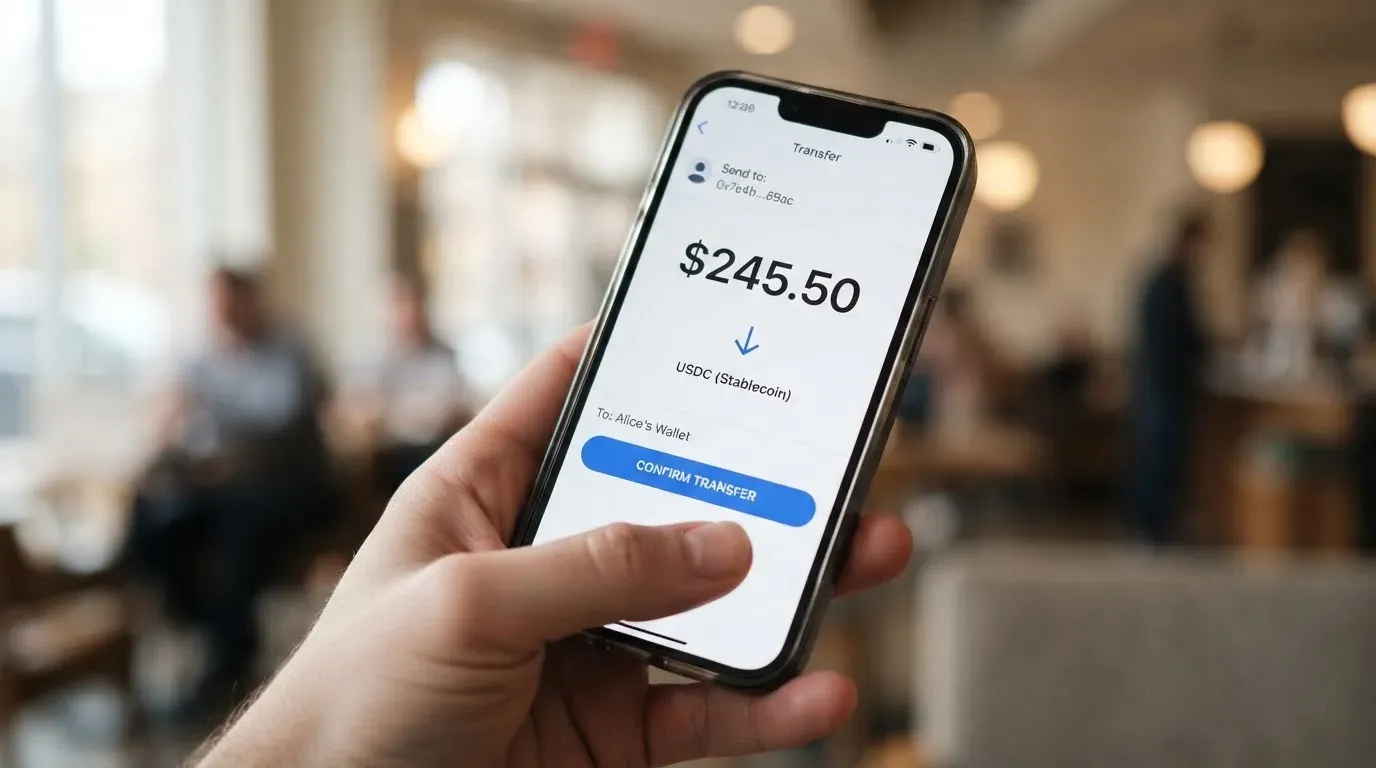
The route is: deposit USDC or USDT into MP Wallet, which the card describes as non-custodial, either through Binance Pay or on-chain, then transfer from the wallet to the card. Both assets are dollar-pegged stablecoins — the kind that aim to hold a dollar’s value, though, as the name suggests, they are not guaranteed to.
Here is the part that should make you slow down. The specific networks are not listed on the pages I read. That matters more than it sounds. If you send USDC over a network MP does not support, or to an address belonging to a different network, the transfer can be lost entirely — blockchain transfers are irreversible, and recovery is a manual support request with no guarantee. The safest habit is to copy the address from inside the MP app rather than from an exchange screen, to check the network on both sides before confirming, and to test with a small amount first. That is not clever; it is the only responsible way to handle an irreversible transfer to a destination whose supported networks the card does not publish.
Two more details. There is a minimum top-up, but the card does not state what it is. And the issuance or top-up fee is not listed on the fee page — the 10 USDT and 100 USDT figures are card purchases, separate from loading funds.
Online withdrawals cost 2.1 USDT per transaction, plus 0.1% on same-day withdrawals above 5,000 USDT. That fee sits outside the card-spending side of the ledger and matters if you are moving money back out rather than spending it.
Paying with it every day
This is the section where MP earns its 9 out of 10, and it is not close.
There are two live cards. The Cloud Card is virtual, billed in US dollars, issued in Singapore, with no ATM — up to five Cloud cards per account. The Boundless Card is a physical VISA with BIN 45659910, also billed in dollars. A third option, the Flash Card, was a virtual VISA with BIN 40433705 and has been retired, so skip any guide that still mentions it.
Mobile wallets are the practical route. The Cloud Card links with Alipay, WeChat Pay, Google Pay and Apple Pay. The Boundless card supports Apple Pay and Google Pay. If you use your phone for everything, you rarely touch the physical plastic.
Cash withdrawals exist only on Boundless, with the fees and limits in the table above.
Three things about daily use that you should know in advance rather than discover at a till. First, the billing currency is USD, so any purchase in another currency pays the issuer’s pass-through FX on top of the 0.80%. Second, some merchants decline prepaid or foreign BINs — a shop can look up the card’s first six or eight digits, see that it was issued in Singapore, and apply extra scrutiny or refuse. Third, address verification is mostly a US, Canada and UK mechanism and generally does not work for a foreign-issued card, which produces declines that look random until you know why.
Two smaller points. Blocked merchant categories are not stated, so gambling, adult content and similar codes may or may not be restricted — I would not assume either way. And the app mentions a rewards balance that cannot be used to pay reissue fees; the rate is not published, so treat any rewards as an unquantified possibility rather than a feature. The MPChat app exists on iOS and Android, and its store ratings were not obtained, so I cannot tell you what users think of it.
What can go wrong
I want to separate the things that worried me from the things that simply are unknown.
The unknown that sits at the centre: the issuing bank is not named. MP says cards are issued in Singapore and lists licences in the US, El Salvador and Hong Kong — a US MSB registration, El Salvador BSP and DASP, Hong Kong TCSP, per a help-centre statement dated 13 August 2026 — but the institutions that issue the cards are not identified, and neither are the issuing authorities behind those licences. You are therefore being asked to trust a chain of entities whose final link is unnamed.
Also unknown: reviews. I searched for MPChat reviews on Trustpilot and Reddit and found no page for this product at all. That is not the same as bad news — plenty of small products have no review footprint — but it means you have no crowd-sourced signal, no pattern of other people’s complaints, and nothing to check against. You are early.
What has actually happened: the Flash Card was permanently retired on 30 September 2026, with issued cards converted to Cloud Cards and balances moved to Total Assets. If you held a Flash Card, that happened to you already. Programme closures follow a pattern — a notice period, then loading and spending stop, then you are asked to withdraw what is left — so read the retirement notice carefully if you ever receive one.
Then there are the structural risks anyone running a crypto wallet carries. Control of crypto belongs to whoever holds the private key; with a custodial wallet the provider holds it and you must trust them completely, and MP describes its wallet as non-custodial, which is the better position but makes you solely responsible for key loss, phishing and malware that swaps copied addresses. Custodial platforms have failed before — Mt. Gox at roughly $350 million, Coincheck at roughly $400 million, Ronin Network at $625 million — and stablecoins can depeg, as TerraUSD did in May 2022 and USDC briefly did in March 2023. Tether also states that it disables tokens in wallets on the OFAC sanctions list and has frozen funds tied to illicit activity.
One genuine reassurance: with a self-custody-linked wallet the funds stay yours until the moment of payment. What MP does not confirm on the pages I read: two-factor authentication, and the in-app freeze and block function. Spending limits are managed in the app. Those are the controls I would want switched on before I loaded real money, so check them yourself once you are inside.
Support is in-app, on X, by email at [email protected], and through a Help Centre at help.mp.net in English, Simplified and Traditional Chinese. Hours are not stated, which is a real inconvenience if you are locked out at a weekend hour.
What to take instead
Three cards I would look at before signing up, and why each might suit you better.
MetaMask Card — 7.1 / 10. The closest match to MP on paper, and it is more transparent in the places that matter. It is a Mastercard, and the issuer (Monovate) and card provider (Crypto Life) are named. You get a virtual card instantly and can pre-order a metal one in the app afterwards; one card per user. The virtual card is free with no annual or maintenance fee; the metal card is $199 a year. Fees are described as minimal per transaction with no additional MetaMask fees and no foreign transaction fee, using the Mastercard rate. It spends straight from your connected wallet on Linea, Base, Monad and Solana, across tokens including mUSD, wETH, EURe, GBPe, USDC and USDT. Cashback is paid in mUSD: 1% on Virtual, and a headline 3% on Metal limited by the footnote to the first $10,000 spent before it drops to 1%, plus a $FLY multiplier through the Blackbird dining app. Sign-up is open in 45 listed countries and territories — Andorra, Argentina, Brazil, Canada, Mexico, Germany, France, Spain, Uruguay among them — with other regions on a waitlist and proof of residency required. The catch: ineligible regions limit sign-ups, not spending, and US and UK sign-ups are temporarily closed.
KAST — 6.1 / 10. The cheapest way to spend crypto in dollars, if you read the fee table and it holds. Stablecoin top-up is 0%, USD card spend is 0%, transaction fee is 0%, Apple and Google Pay are 0%. The 0.5% to 1.75% FX fee applies only on non-USD spending, plus $0.10 on non-USD transactions under $25 and $0.50 on a declined payment. You can hold up to ten cards: Visa Platinum Standard, Visa Infinite metal Premium, Visa Infinite gold-plated Private, plus Pengu, Solana and Bitcoin designs. Membership is annual and upfront — Standard 0 USD, Premium 1,000 USD, Private 10,000 USD — with a $40 delivery fee on the Standard physical card, $2 for an extra virtual card in some regions, and a $1 monthly inactivity fee after twelve months. Cashback is in dollars: 1.5% on the first 2,000 USD a month at Standard, 2% on the first 10,000 at Premium, 3% on the first 40,000 at Private. Funding is USDT, USDC, PYUSD or RLUSD on Ethereum, Solana, Polygon, Arbitrum or TRON — though the terms still say acceptable tokens are “currently USDT and USDC”, which conflicts with the app listing the other two, so check before you rely on it. Eligibility is the part to read twice: living in a supported country is not enough if your ID is from a restricted region, dual citizens with a supported-country ID may pass, a VPN does not bypass it, and you can create an account in an unsupported country but KYC stays locked.
TokenPocket — 5.8 / 10. The weakest of the three, and worth knowing mainly as a comparison. It offers a Mastercard debit card for Australia, Canada, Hong Kong, Japan, Taiwan, New Zealand, Singapore, South Korea and the UK among others, and Visa debit for much of Europe — Germany, France, Spain, Switzerland and the rest of that list — with the Americas described as planned for Q2 2025. The Fiat24 cards it runs on are virtual, with balances in EUR24 and USD24 on Arbitrum. The 1% fee on depositing crypto is described as refunded later through rewards and reduced transaction fees, and there is no cashback stated. One identity can verify only one account, so treat the dual-Singapore angle as unavailable.
| MP | MetaMask Card | KAST | TokenPocket | |
|---|---|---|---|---|
| Score | 7.1 / 10 | 7.1 / 10 | 6.1 / 10 | 5.8 / 10 |
| Network | Visa (Cloud virtual, Boundless physical) | Mastercard | Visa | Mastercard / Visa |
| Issuer named | No | Yes (Monovate) | Not stated | Not stated |
| Card cost | 10 USDT virtual, 100 USDT physical | Free virtual, $199/year metal | Membership tier; Standard 0 USD | Small portion of an NFT fee |
| Transaction fee | 0.80% | Minimal, amount not stated | 0% on USD spend | Not stated |
| Cashback | Not stated, rate not published | 1% virtual, 3% headline on Metal | 1.5% / 2% / 3% by tier | None stated |
Who I would recommend it to
I would recommend MP to three kinds of person. First, you hold USDT or USDC already and want one app that holds both a virtual card for subscriptions and a physical card for real life, without thinking about which app does what. Second, you are somewhere the mainstream cards are awkward — and by “awkward” I mean the ordinary reasons people end up looking at crypto cards, not the country-list reasons above. Third, you want Alipay and WeChat Pay in the same wallet as your card.
I would not recommend it if any of these are true. You are in one of the 23 countries MP will not serve, or in a region where KYC cannot be completed. You need to know which bank issued your card and cannot accept that the card does not say. You spend mainly in a currency other than the dollar, where you would be paying 1.8% to 2.2% all-in. You make small purchases regularly, where the $0.15 sub-dollar fee is punitive. You want cashback you can count on, or you want metal. You want to plan your taxes around a card that converts crypto into a taxable disposal on every purchase — I am not giving tax advice here, only noting that the treatment of digital assets as property means each payment may be a separate event to report.
One last thing, and it is the thing I would tell a friend. Before you load money, open the app and check three things I could not: that two-factor authentication is on, that the freeze button works, and what the issuer is called. If the app cannot answer those three, my score would drop, and it would drop fast.
Frequently asked questions
What is the MP card?
The MP card is a prepaid payment card attached to the MPChat crypto wallet. You load it with USDC or USDT, and it spends that stored balance like an ordinary card — online, in shops, and at an ATM if you hold the physical Boundless version. It is not a bank account and the company describes itself as a financial technology company. The card comes in a virtual Cloud version and a physical Boundless Visa.
Is MP a bank, and who owns it?
No, MP is not a bank. It is MP Network Inc, registered at 8 The Green, Suite B, Dover, DE 19901, USA, and it describes itself as a financial technology company rather than a bank. The help centre lists a US MSB registration, El Salvador BSP and DASP licences, and a Hong Kong TCSP, in a statement dated 13 August 2026. The bank that actually issues the cards is not named on the public pages.
Does MP card require KYC, and what does it involve?
Yes. KYC level one requires being 18 or older, basic personal information, a government-issued passport or national ID, and a selfie liveness check. Documents must have an expiry date more than three months away. One identity can verify one account only. The card pages do not state whether proof of address is required. Without KYC1 you have a wallet but no card.
Can I get the MP card in my country?
You can, unless you are in one of the 23 countries MP lists as unavailable due to regulatory compliance, which includes Russia and Belarus. Eligibility turns mainly on where your identity document was issued and your registered residential address. KYC also cannot be completed in parts of Ukraine, Abkhazia, South Ossetia, Northern Cyprus, Somaliland, Transnistria or Nagorno-Karabakh. Check the list for your own situation before you download anything.
How do I top up the MP card, and which networks work?
You deposit USDC or USDT into the MP Wallet, which the card calls non-custodial, either via Binance Pay or on-chain, then transfer the balance to the card. The card’s public pages do not list the supported networks, which is the detail to be careful about: a transfer sent on the wrong network can be lost, since blockchain transfers are irreversible. Copy the address from inside the app and test with a small amount first.
What does it cost to spend with the MP card?
The transaction fee is 0.80% of each purchase and crypto-to-fiat conversion is $0. The Cloud virtual card costs 10 USDT and the Boundless physical card 100 USDT, with no monthly fee. MP’s own summary is roughly 1% all-in for US dollar spending and 1.8% to 2.2% for non-dollar spending, because currency conversion is a pass-through set by the issuer. A $0.15 fee also applies on any transaction of $1 or less.
Can I use the MP card at an ATM and in Apple Pay?
Yes on the Boundless physical card, no on the Cloud virtual one. ATM withdrawals cost 2% with a $1 minimum, capped at $1,500 per transaction, $1,500 per day across five withdrawals, and $15,000 a month; ATMs are unavailable in mainland China and prohibited in Singapore. For mobile wallets, Boundless works with Apple Pay and Google Pay, and the Cloud card additionally links Alipay and WeChat Pay.
Is the MP card safe, and can I trust it?
There are real strengths and real gaps. The wallet is described as non-custodial and card funds as backed within a regulated trust framework, which is the better position. Against that, the issuing bank is never named, two-factor authentication and the in-app freeze were not confirmed on the pages I read, and a search for Trustpilot and Reddit reviews found no page for this product at all — so you have no crowd-sourced track record to lean on. Check the security settings yourself before loading money.
Is MP card free?
Not entirely. The monthly fee is $0, but the Cloud Card costs 10 USDT and the Boundless Card has a card opening and production fee of 100 USDT. On top of that sit a 0.80% transaction fee, a $0.15 fee on sub-dollar purchases, $0.80 for a declined payment with the first five a month waived, and $35 per dispute case. Replacing a Boundless card costs $5 the first time and $10 each time after, with replacements at least 31 days apart.
What happened to the MP Flash Card?
The Flash Card was permanently retired on 30 September 2026, as the card’s own pages record. Cards already issued were converted to Cloud Cards and balances moved to Total Assets. If you read an older guide that treats Flash as a current option with a 10 USDT monthly fee, it is out of date. Retirements like this normally follow a pattern of notice, then stopping of loading and spending, then a request to withdraw remaining balances.
Wallet card reviews – cryptocardcheck
Content created by the «cryptocardcheck» team