
A card you load with USDT and spend like any other, but with an unnamed issuer and a half-filled legal page
 Available in US
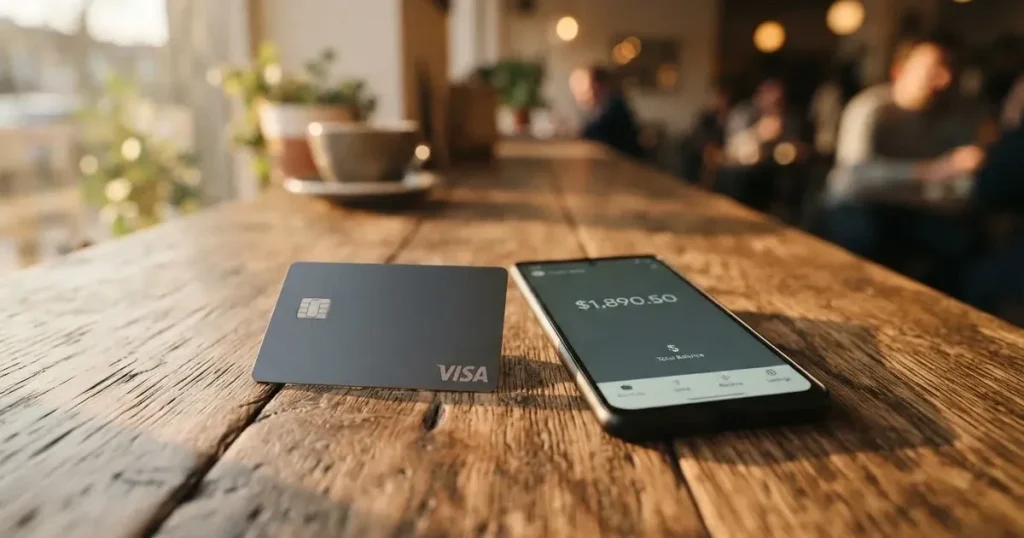
OkiCard is not a bank, and it does not pretend to be one. It is a prepaid card you fund yourself with USDT, convert to a dollar or euro balance, and then spend wherever ordinary cards are accepted — including through Apple Pay and Google Pay. The pitch is simple and, on paper, appealing to a specific person: someone who already holds crypto, cannot or will not complete a bank’s identity checks, and wants a card number that works in shops this week rather than a card application that has been pending for a month.
That pitch is served well enough on the mechanics. Virtual card in under a minute, no identity verification below the stated limits, four networks accepted for deposits, no monthly fee. What I cannot shake after reading the card’s public pages is a different kind of problem: the pages that would tell you who you are actually trusting are the pages that are blank. No legal entity is named, the governing law in the Terms is an unfilled placeholder, and the issuer is described only as an unnamed regulated entity. The card says it is non-custodial and encrypted; it does not say who holds the money on the day you go to sleep.
My score is 6.0 out of 10. That is not a verdict of “avoid” — it is a verdict of “usable if you accept that you cannot check the counterparty.” If your money is in a bank deposit, this is not for you. If it is in a self-custodied wallet and you are already taking on that kind of risk, a $15 virtual card that spends in 60 seconds is a reasonable tool.
The conditions described here are current as of October 28, 2026.
| Criterion | Mark | Why |
|---|---|---|
| Who can get it | 8 / 10 | “150+ countries” (some pages say “200+”); no geo-blocking based on your passport; sanctioned jurisdictions are closed |
| Cost | 5 / 10 | Issuance $0, monthly $0, starting $15 for the virtual card; 3% load fee; first deposit 100 USDT |
| Top-up options | 8 / 10 | USDT on BSC, Ethereum, Tron and Solana; USDC, BTC and other coins marked “soon” |
| Reliability and complaints | 3 / 10 | Legal entity not named, governing law left as “an unnamed jurisdiction”, issuer unnamed; no reviews found to check |
| Everyday use | 6 / 10 | Virtual card in 60 seconds, Apple Pay and Google Pay; physical card mentioned without conditions; ATM not disclosed |
| Total | 6.0 / 10 | Strong on access and funding, weak on telling you who is behind it |
The audience note under all of this: users wanting a no-KYC card funded in USDT. If that sentence describes you, keep reading. If it describes someone you know, pass them this page — the sections below are ordered so you can stop when the answer stops mattering to you.
Will they give you the card
Yes, to almost anyone, which is the point and also the risk. The card states “150+ countries” and no geo-blocking based on your passport — some pages say “200+”, so treat the reach as approximate rather than a published list. There is no country table to check yourself against, no list of excluded countries, no document requirements attached to the countries that do allow it.
What you do have to do is confirm one thing yourself: that you are not in a sanctioned jurisdiction. That is your side of the bargain, stated in the card’s own terms. Sanctioned jurisdictions are closed, and the card does not publish which ones it means. If your country appears on any sanctions list you know of, the honest answer is that you should not be applying. I am not going to describe how anyone could get around this, and neither should the card’s marketing.
Two things worth separating as you read that. “No geo-blocking based on your passport” is a statement about not filtering applicants by passport nationality — it is not a promise that your card will work smoothly everywhere, or that merchants will welcome it. Cards issued under one country’s programme routinely look “foreign” to merchants in another, because the first six or eight digits of a card number identify the issuing institution and country, and any shop can look that up. That is why a card that exists can still be declined at the till.
The second thing: the age rule is 18 or the legal age in your country, and there is no country table to check what that means for you. Both points come from the same page as the country count.
How to get it
There is no application form in the usual sense. Orders go through a Telegram bot, @okicard_bot, with no e-mail address and no password to set — the bot is the entire account. If that appeals to you, you can be spending in under a minute. If you would rather not have a payment account living inside a chat app, that is a fair reason to stop here.
What you get on that path is a virtual card, in under 60 seconds. The page also mentions a physical card, but says nothing about it: no conditions, no delivery time, no cost. Treat the physical card as advertised rather than documented.
The card network is not specified. The card states “Visa/Mastercard” without committing to one, and the currency is USD or EUR, pegged. If you have a strong preference about which network runs your card — some merchant categories and some subscription services behave differently on one than the other — you will not find that answer in the card’s pages.
On verification: no KYC within the allowed tier, and the FAQ puts it more concretely as no verification below $10,000 of limits. That is the only tier described. Higher tiers exist in the bot, but the card does not describe what they require, and it does not state the reasons a user might be rejected. Daily spending is capped at $10,000; monthly limits exist but are not given; the higher tier limits are visible in the bot rather than published.
What you need to bring: a Telegram account, some USDT, and a decision about which tier you are on. What you will not be asked for, at that tier, is a passport.
What it really costs: Fees, limits and the small print
The headline is genuinely good: $0 issuance, $0 monthly, and a starting price of $15 for the virtual card. There is one wrinkle — the FAQ mentions a one-time issuance fee while the pricing page shows issuance at $0, so the card’s own pages disagree with each other. Assume you will pay something on the way in and check what the bot actually charges before you send funds. The first deposit is 100 USDT.
The 3% load fee is the real recurring cost, and it is charged on the way in, not on the way out. The transaction fee in USD is listed at 0%, and the card says “no hidden exchange spreads”. Both of those are good news on their face. The FX fee is not stated — and since the card lets you hold either USD or EUR and you will be spending across many currencies, the absence of that number is a gap, not a saving.
| Fee or limit | Value |
|---|---|
| Issuance | $0 |
| Monthly fee | $0 |
| Starting price, virtual card | $15 |
| Load fee | 3% |
| Transaction fee (USD) | 0% |
| FX fee | Not stated |
| ATM | Not stated |
| Daily spending limit | $10,000 |
| Monthly limit | Exists, not given |
| Minimum initial deposit | 100 USDT |
Three everyday payments, so this stops being abstract.
A $30 supermarket shop in a non-dollar country. The 30% version of this problem is FX, and the card does not quote you an FX fee. Add the 0% USD transaction fee and you are looking at whatever the card does to a dollar balance in a euro shop — and that number is exactly the one the card leaves blank. If you spend regularly outside the dollar, this is the fee line to resolve with support before you rely on the card.
A $3 streaming subscription billed monthly. 3% of a $3 load is 9 cents — irrelevant. The larger question is the decline rate: a subscription service that runs an address-verification check on a foreign or prepaid BIN can decline a payment for reasons that have nothing to do with you. On a $3 charge, a retry costs nothing; on a $120 one, a retry costs a delivery fee.
A $200 purchase from a shop that declines prepaid cards. Some merchants decline prepaid or foreign BINs precisely because the lookup shows the card type and issuer country. If it happens, you pay for the delivery yourself.
Also worth knowing before you commit: it is a single paid card, and “tier limits” exist inside the bot without being described in public.
How to Top up the card
This is the strongest part of the product, and it is why the top-up score is as high as it is. You send USDT to a generated address, and the card converts it to fiat balance at the moment of spending. Four networks are supported: BSC (BEP-20), Ethereum (ERC-20), Tron (TRC-20) and Solana (SPL).
USDC is marked “soon”. BTC and altcoins are “coming soon”. If you are holding anything other than USDT today, the phrase you care about is the second one — and it is a promise, not a product.
Network fees are the part that varies. Deposits on BSC and Solana carry zero network fee. ERC-20 is low but congestion-dependent. TRC-20 pays the standard network fee. The suggested weekly volume is $300 to $1000, which tells you the scale this is designed for. The minimum first deposit is 100 USDT, and the load fee is the 3% from the cost section.
One practical warning that belongs here: send on the network the card supports, to the address the card generated. Blockchain transfers are irreversible. A deposit on the wrong network, or to an address belonging to another network, can be lost or need manual recovery through support — with no guarantee. On ERC-20, remember that gas is paid only in ETH, so a wallet holding USDT with no ETH cannot send at all.
On getting money back out: withdrawal limits exist, the process is not described, and the balance on closure is not addressed. Loaded funds are non-refundable except where the law requires otherwise. For a prepaid card that is normal in principle; for one whose issuer is not named, it is a clause you are accepting without knowing who is on the other side of it.
Paying with it every day
Apple Pay and Google Pay both work: the virtual card can be tokenised and added for contactless payments, which is the most practical thing about it. In practice, once the number is in your phone wallet, where you can use it is wherever cards are accepted, subject to how the merchant treats a prepaid foreign BIN.
There is no app. There is the Telegram bot, which the card presents as an advantage — “no heavy apps” — and if you are the kind of user who prefers that, it is a real one. If you want spending categories, notifications or a proper statements screen, you will not find them here. App-store ratings are not applicable, which follows from the absence of an app.
Two everyday details the card does not answer. Blocked merchant categories are not stated — so you cannot tell in advance whether gambling, adult content or ticketing will work. And rewards are not stated: there is no cashback mentioned anywhere, so plan as if there is none.
Disputes follow the ordinary card-network rules, with no separate chargeback process layered on top. Once a card is generated, issuance fees are non-refundable. Standard chargeback rights generally come from the card’s issuing country and scheme rather than from the brand, and prepaid coverage in particular is patchy — worth confirming what your protection actually is before you rely on it for a large purchase.
What can go wrong
The uncomfortable section. If the mechanics are the best part of OkiCard, the paperwork is the worst, and I would rather say so plainly than hedge.
Nobody will tell you who they are. The legal entity is not named. The Terms and Conditions carry a governing law field that reads “an unnamed jurisdiction” — an unfilled placeholder on a live legal page. The issuer is described only as an unnamed regulated issuing entity. You are being asked to fund a prepaid card, and the entity standing behind the balance is not disclosed on the pages a reader is directed to.
There is no track record to inspect. I found no official incidents and no user reports — and I found no review page either, no Trustpilot presence for OkiCard. Absence of complaints is not evidence of safety when there is nothing there to review. Card schemes themselves can end a programme: Visa terminated its global agreements with FTX on 13 November 2022 and the FTX US debit card was wound down by its issuer; WaveCrest, an issuer that supplied several crypto card brands, was suspended by Visa in Europe in 2018, closing all its Visa programmes. Closures follow a pattern — a notice period, then spending and loading stop, then you’re asked to withdraw what is left. That is the scenario the missing entity name makes hard to plan for.
The security claims are claims. The page says “AES-256 Encrypted”, “No Database Logs”, and describes itself as “Non-Custodial”, prepaid only. Freeze controls and spending controls are not stated. Non-custodial is the good one for you: it means funds stay in your wallet until the moment of payment, and nobody can move them. It also means nobody can reverse a mistake or recover a stolen balance — crypto transfers are irreversible by design, and there is no built-in help for that.
Support is a footer link. There is a “Support” link and no channel, no address, no hours, no language list. Ordering goes through the bot. If a deposit lands wrong, or a payment is wrongly declined, or the card stops working, the person who can explain it to you has no published address.
Everything at once. The Terms page carries an effective date of 2 March 2026, and I found no other dated events — no launch, no change log, no published update history. For a product that handles money, a single dated legal page is a thin trail.
Two smaller flags. Stablecoins are not censorship-proof — Tether says it disables tokens in wallets on the OFAC sanctions list and has frozen funds tied to illicit activity — and if your balance ends up frozen on the issuer side, the balances behind it are the same kind of asset.
What to take instead
If your reason for being here is “no ordinary bank card will have me”, then these are the honest comparison points — and all three sit lower on my scale than OkiCard does.
Cardex scores 5.6 / 10. It advertises “One crypto card, 200+ countries” with no country list and no stated exclusions; its app-store listing is Naira-focused, paying in Naira. It runs on VERVE, VISA, Mastercard and UnionPay, with both virtual and physical cards, and converts crypto to fiat in real time at the moment of payment — the site describes an “AI-Powered Conversion Rate” that scans global exchange rates and picks the best one when you spend, though no fee percentage is published. Funding is by USDT, USDC and BTC wallets, networks not stated. Cost and rewards are not stated.
CardFlow scores 4.9 / 10. It aims at Nigeria — “Nigeria’s smartest fintech card platform” — and at “Nigerians and global users”, with no country list or exclusions stated. A virtual USD Mastercard, created in about 3 minutes. Creating a virtual card is free per its FAQ; monthly fee, conversion fees and rewards are all not stated. Funding by Bitcoin, USDT, ETH or a Naira bank transfer, networks not stated.
HyperCard scores 4.7 / 10. Official pages state no country list; its app-store page says the card works in “more than 176 countries” — note that is acceptance, not eligibility, and the two are different questions. A prepaid card, network not stated on the app-store page, balance in USD or EUR. Cost and fees are not stated on the pages I could read. Funding by depositing crypto such as USDT, BTC or ETH in the app, converted to USD or EUR on the card, networks not stated. No rewards mentioned.
| Alternative | Score | Card | Funding stated | What’s missing |
|---|---|---|---|---|
| OkiCard | 6.0 / 10 | Virtual ($15) + physical, network unspecified | USDT on BSC, ETH, Tron, Solana | Entity, issuer, FX fee, ATM |
| Cardex | 5.6 / 10 | Virtual + physical, VERVE/VISA/Mastercard/UnionPay | USDT, USDC, BTC | Networks, cost, fee % |
| CardFlow | 4.9 / 10 | Virtual USD Mastercard | BTC, USDT, ETH, Naira transfer | Networks, monthly fee, fees |
| HyperCard | 4.7 / 10 | Prepaid, network unspecified | USDT, BTC, ETH in app | Networks, cost, fees |
The pattern across all four is the same and it is worth naming: none of these products publish the things you would use to compare them. If none of them gives you a fee you can calculate on and an entity you can look up, you are choosing on the strength of a landing page. For me, that tips the balance toward the option whose mechanics are most transparent, and away from the ones that are less.
Who I would recommend it to
I’d recommend OkiCard to a person who has USDT in a wallet they control, no access to a normal bank card, and a high tolerance for the fact that they cannot verify who issued the card. Concretely: someone paying for software, hosting, travel bookings or online services where a virtual number and a phone wallet are the whole job, and who would rather hold USDT than sit through a banking onboarding flow.
I would not recommend it as a first crypto card, or as a place to keep more than you can afford to lose on a bad day, or as a card to run your rent and utilities through. And I would not recommend it at all if you were hoping for an EMI-style safeguard — funds segregated in dedicated accounts or insured — because nothing on these pages says you get one, and prepaid balances are not bank deposits in any case.
Two habits I’d build in from day one. Put only what you need for the week on the card, since loaded funds are non-refundable except where law requires otherwise. And pick your network deliberately — BSC or Solana cost nothing to deposit into, and the wrong network cannot be undone.
I also want to be honest about what I did and did not do here. Everything above is from the card’s own public pages and, where marked, from what I could find elsewhere; I have not used the card, and I could not find independent user reports to weigh against the marketing. Given the missing legal entity, that absence is itself the reason to keep small.
Frequently asked questions
What is OkiCard?
OkiCard is a prepaid payment card you fund yourself with USDT rather than through a bank account. You send stablecoin to a generated address, it is converted into a dollar or euro balance, and you spend that balance wherever cards are accepted. There is no credit, no overdraft and no bank relationship. It positions itself for people who want a card funded in USDT without completing identity verification.
How does OkiCard actually work?
The mechanics are conventional prepaid-card mechanics with a crypto front end. Four networks are supported for USDT deposits: BSC, Ethereum, Tron and Solana. The deposit is converted to fiat at the moment of spending, not when you load it, and the card currency is USD or EUR. The card can be tokenised into Apple Pay and Google Pay, so most day-to-day spending happens from your phone.
Is OkiCard a bank?
No, and that distinction matters. No legal entity is named on the card’s pages, the governing law in the Terms is left as an unfilled “an unnamed jurisdiction” placeholder, and the issuer is described only as an unnamed regulated issuing entity. So there is no deposit guarantee, no named institution to complain to, and no published safeguarding arrangement behind your balance.
Who owns OkiCard, and where is it based?
The card’s public pages do not say, and that is the finding rather than a gap in my reading. No company name, no jurisdiction, no issuer. The Terms page carries an effective date of 2 March 2026 and nothing else dated. If who is behind the product is a condition for you, this is where the answer should be and isn’t.
Does OkiCard require KYC?
Not at the tier the card describes. There is no verification below $10,000 of limits, with daily spending capped at $10,000. Higher tiers exist inside the Telegram bot but are not described publicly, and the card does not state rejection reasons. Users must confirm they are not in a sanctioned jurisdiction, and sanctioned jurisdictions are closed.
How much does OkiCard cost to get and to keep?
The pricing page shows $0 issuance and $0 monthly, with a starting price of $15 for the virtual card — but the FAQ separately mentions a one-time issuance fee, so the card’s pages contradict each other and you should confirm what the bot charges. The recurring cost is a 3% fee to load. USD transaction fees are listed at 0%, while the FX fee and ATM costs are not stated.
How do I top up the card, and what will it cost me?
You send USDT to an address the card generates for you. Loads carry a 3% fee and a minimum first deposit of 100 USDT. On network cost: BSC and Solana are zero-fee, ERC-20 is low but congestion-dependent, and TRC-20 pays the standard network fee, which is charged by the blockchain rather than the card. USDC is marked “soon”; BTC and altcoins “coming soon”.
Can I use it with Apple Pay or Google Pay?
Yes — that is one of the card’s clearer strengths. Both Apple Pay and Google Pay can hold the virtual card, and the card states it can be tokenised and added for contactless payments. What is not stated is which card network runs underneath, since the page only says “Visa/Mastercard”, nor which merchant categories are blocked.
Is OkiCard safe to use?
That depends on a question I can’t answer for you: whether the unnamed issuer and unnamed legal entity are acceptable. The card claims AES-256 encryption, no database logs and a non-custodial model where funds stay in your wallet until you spend — good properties, but self-custody also means no recovery from a mistake. I found no independent user reviews to weigh against the marketing, which is itself information.
Is OkiCard worth it?
For a self-custodied user spending USDT on everyday purchases, the free monthly fee and 60-second virtual card are a fair trade for the 3% load fee. For anyone wanting a dependable everyday card, the unnamed issuer, unpublished FX fee and undisclosed ATM terms make it thin. If the alternatives also leave gaps, compare all of them and keep your balance small.
Virtual card reviews – cryptocardcheck
Content created by the «cryptocardcheck» team