
The card with no monthly fee, no cashback ceiling — and no physical fallback
 Available in US

The Phemex card is a virtual Mastercard that spends straight from the balance you hold on the Phemex exchange, converting USDT or USDC at the moment of payment. There is no card to hold in your hand, no monthly fee, no annual fee, and no ATM. In exchange you get something fairly rare in this category: a cashback rate that is not capped, and a card that costs nothing to hold. What you give up is a great deal of everyday convenience — no cash withdrawals, a narrow eligibility area, and money that sits inside a custodial exchange account rather than in your own wallet.
The conditions described here are current as of October 28, 2026.
Verdict: 5.9 out of 10
The Phemex card scores 5.9 / 10 overall. That is a middling result, and the shape of it matters more than the number. This is a card that is genuinely cheap and does one thing well — spending crypto without you having to convert it by hand — but it lives inside a single exchange’s account, it is restricted to one region, and it exists only on a screen.
Who it suits, plainly: residents of the European Economic Area who already keep a balance on Phemex, pay online or in shops that accept Mastercard, and want a small cashback in USDT without paying anything to hold the card. Who it does not suit: anyone who needs physical cash, anyone outside the EEA, anyone who is uneasy about leaving funds on an exchange, and anyone who expects their money to be protected the way bank deposits are.
| Criterion | Mark | Why |
|---|---|---|
| Who can get it | 5 / 10 | Only residents of the EEA, 30 countries listed |
| Cost | 8 / 10 | Issuance, annual fee and closure are free, no monthly charge; conversion spread with no percentage stated; cashback VIP 1%, Standard 0.25% |
| Top-up options | 6 / 10 | Spends the Spot Account balance in USDT and USDC, auto-converted at payment; networks not applicable |
| Reliability and complaints | 4 / 10 | Programme manager IMMERSVE LIMITED (New Zealand), licensed by Mastercard; Trustpilot for the exchange 2.0/5 across 277 reviews, blocked withdrawals; custodial balance |
| Everyday use | 6 / 10 | Virtual Mastercard, Apple Pay and Google Pay; no ATM |
The two ends of this table tell the story. Cost is the strongest column because there is very little to pay and very little to earn — no fee on the card, but also cashback of 0.25% on the Standard tier, which is a rounding error on a normal monthly spend. Reliability is the weakest, and that is where I would want you to look hardest before committing money, because it is not really about the card at all. It is about who holds your balance and how that company has behaved when customers needed help.
If you are in the EEA and your spending is mostly online, this card is worth an afternoon of setup. If you are anywhere else, or you need a card in your wallet as a backup, it is not the tool for you.
Will they give you the card?
Yes, but only in one region, and the exact border of that region is slightly muddled in the card’s own paperwork.
The card is available exclusively to users residing in the European Economic Area. Thirty countries are listed: Austria, Belgium, Bulgaria, Croatia, Cyprus, Czech Republic, Denmark, Estonia, Finland, France, Germany, Greece, Hungary, Ireland, Italy, Latvia, Lithuania, Luxembourg, Malta, Netherlands, Poland, Portugal, Romania, Slovakia, Slovenia, Spain, Sweden, Iceland, Liechtenstein, Norway.
Note the test: residence, not citizenship. Someone living in France with another passport qualifies on the same basis as a French citizen. Someone in the UK, in Switzerland, or in the US does not, regardless of nationality.
There is also a conflict inside the official pages worth knowing about. The list of thirty countries above includes Croatia, Ireland and Romania, but the cardholder terms define the EEA as excluding those three. So the marketing list and the legal definition disagree. In practice this matters if you live in one of those three countries: the card’s public pages say yes and its terms say no. That is a question to put to support in writing before you rely on the card, not after your first payment is declined.
How to get it
The application is a single identity check plus an address check, done inside the Phemex Wallet app. You must be 18 or older, resident in the EU/EEA, and using the Phemex Wallet.
The steps are: open the Card page, complete KYC, verify your residential address, enter your mobile number, agree to the Terms of Use, Privacy Policy and Cardholder Terms, then submit.
Address verification is handled in one of two ways, and which one you get depends on where you live. Residents of twelve countries — Austria, Belgium, Denmark, Finland, France, Germany, Italy, Netherlands, Norway, Poland, Spain, Sweden — type their address in. Residents of the other EEA countries upload proof of address dated within the last 3 months: a bank document, a utility bill, or a government document.
That distinction is the single most useful thing on this page if you are applying. If you are in the first group, you will not be hunting for PDFs. If you are in the second, have a bank statement or utility bill from the last three months ready before you start, because a document with an older date is a rejected document.
On verification level, this is one identity verification plus address verification, and nothing further. The stated reasons for rejection are: incomplete KYC, an unsupported region, failed address verification, a failed risk or compliance review, and inconsistent information between what you typed and what your documents say. Processing time is not stated.
What arrives, if it arrives, is a virtual Mastercard debit card — one per user, denominated in USD, issued immediately on approval. There is no physical card, and there is no physical version to choose. If you cancel or your card is terminated, no replacement is issued; if a replacement is raised because your concerns no longer apply, one may be possible.
What it really costs: Fees, conversion and limits
Here is the honest cost picture, and the first thing to understand is that the headline numbers are the easy part. The Phemex card has no issuance fee, no annual fee, no account closure fee and no monthly charges at all. There is a single fee tier and no paid upgrades, so there is nothing to buy your way into.

The costs that do exist are the ones the card’s pages do not put a number on.
When you pay, crypto in your account is converted automatically. That conversion carries a spread applied at the time of the transaction, and the card does not state what that spread is. For purchases in a currency other than USD, the card applies the card network’s baseline rate plus a possible Phemex conversion spread, again with no percentage given. Both the spreads and the markups are non-refundable.
This is the part to sit with. You cannot compute your cost per payment from the published information, because the two variables that determine it are unstated. If you make large or frequent purchases in a non-USD currency, that unknown is not a rounding detail. Ask support what the spread actually is before you commit your normal spending to the card.
| Item | What the card says |
|---|---|
| Card issuance | Free |
| Annual fee | Free |
| Account closure fee | Free |
| Monthly charge | None |
| Crypto auto-conversion | A spread at transaction time, no percentage stated |
| FX on non-USD transactions | Card network baseline rate plus a possible Phemex conversion spread, no percentage stated; spreads and markups non-refundable |
| ATM | Not stated — the card is virtual only, no ATM terms |
| Cashback | VIP 1%, Standard 0.25%; no monthly cap |
| Currency | USD base settlement currency; spending power based on USDT and USDC balances converted to the base currency |
Limits are adjustable downward, so you can lower them but not raise them past the defaults: 5,000 USD per transaction, 5,000 USD daily, 30,000 USD monthly, 100,000 USD annual.
Two of those defaults deserve a second look. The per-transaction and daily limits are the same number, which means a single large purchase eats your entire daily allowance. And a 30,000 USD monthly ceiling is generous compared to most crypto cards but modest compared to a normal bank card — worth knowing before you book anything expensive.
Three ordinary payments, and what happens to each
A 40 USD coffee in Paris. You tap, the card converts whatever USDT and USDC your balance needs at a spread the card does not publish, and your bank statement shows 40 USD. You are not choosing an exchange rate at that moment — the card is. The euro cost to you is the network rate plus whatever Phemex adds, and you will not know the second half of that number in advance.
A 15 USD monthly subscription in USD. This is the cleanest case the card has, because a USD purchase on a USD card skips the FX layer entirely. The only cost is the conversion spread on the crypto that funded it, plus your cashback, which on the Standard tier is 0.25% — fifteen cents back, credited on the 10th of the following month.
A 300 USD purchase on a site that declines foreign prepaid cards. The card can be declined here for reasons that have nothing to do with your balance. Merchant category codes are the usual culprit: gambling is one code many issuers block by policy, and the card’s pages do not list which categories are blocked for spending. A decline can also leave a hold on your funds that stays for several days, typically up to 7.
How to Top up the card
There is no top-up in the usual sense, and that is the concept to unlearn first. The Phemex card does not hold a balance you load. It draws on the Spot Account balance you already have on the exchange, in USDT and USDC, and converts automatically at the point of sale.
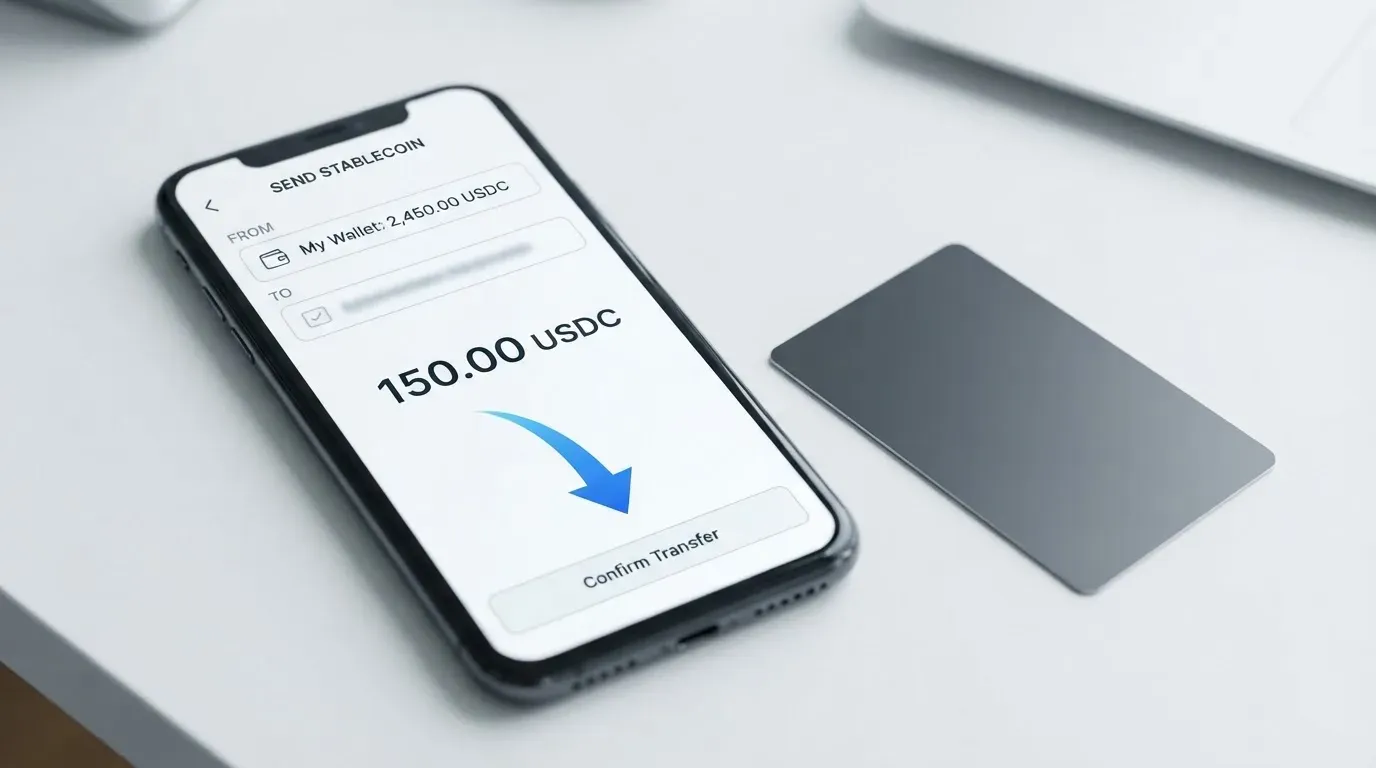
Practically, that means two things. You move funds onto Phemex through the exchange’s own Transfer and Deposit functions before you spend, and you choose how the card reaches for your money: each coin can be switched on or off, and prioritised. If you hold both USDT and USDC, you decide which one funds the purchase first.
Networks are not applicable here, which is the one genuine convenience of this design compared with other crypto cards. You are not choosing between a transfer on one blockchain and the same token on another. On the other hand, the card’s own pages do not state any fee or minimum for top-ups, only that Transfer and Deposit buttons exist.
If you cancel the card, remaining funds are refunded to your Phemex Wallet after final transactions and fees are settled. The programme itself may be terminated by the operator on 60 days’ written notice — which is worth reading twice, because it means your ability to spend this balance depends on a company decision you would not control.
Paying with it every day
Apple Pay and Google Pay are both supported, and between them they cover most of the phone-based spending people actually want to do. Details live in the Phemex app and on the web card page, which works in Chrome, Safari and Firefox.
The cashback is the part that distinguishes this card. It is paid in USDT, and the rate follows your Phemex user tier: 1% for VIP, 0.25% for Standard, with promotions reaching up to 3% for VIP. There is no monthly cap. Credit arrives in your Spot Account on the 10th of the following month, UTC, and only completed eligible purchases count, determined by merchant category code. If a purchase is refunded, the cashback is reduced proportionally — and the same proportional reduction applies when a fiat refund comes back through.
Not everything earns cashback. Excluded categories include Financial/Investment, Cash-like and Crypto-related, Gambling, Government Services, Education, Insurance, Business Services, and Professional Services. That is a long list and it covers a lot of ordinary life: your insurance premium, your government fees, your education costs, and anything you pay at a betting site will not return anything.
On disputes and chargebacks, the deadlines are worth knowing before you need them. For an unauthorised transaction, notify within 13 months of the debit. For a merchant dispute, a written confirmation is needed within 120 days of the transaction. For a merchant-initiated amount dispute, 8 weeks.
Three weeks of goods and two months of paperwork — those are short windows, and they are shorter than the window a bank gives you.
What can go wrong
This is where I would slow down and read carefully, because the weak column in the verdict table is about the company holding the money rather than the card spending it.
The balance is custodial. Your funds sit in the Phemex Spot Account, which means Phemex holds the credentials. You trust them completely with the money you are spending. This is the structural difference between a custodial card and a self-custody one, and it is not a technicality: with self-custody the funds stay in your own wallet until the moment of payment, but with custody there is a counterparty standing between you and the balance. Custodial platforms have a documented history of failure — Mt. Gox at around US$350 million reported stolen between 2011 and 2014, Coincheck at around US$400 million in 2018, and the Ronin Network at US$625 million in 2022. Those are not the same as saying Phemex is in trouble. They are the reason to size this card’s balance to what you would be comfortable losing.
The safeguard language is thin. The terms say customer funds are safeguarded “in accordance with applicable law”, and there is no deposit protection scheme. Funds safeguarded under e-money rules are held separately and are not the same as bank deposits; they are not covered by a deposit guarantee scheme. If you are used to the protection that comes with a bank, this is a step down, not sideways.
Liability for a lost card is capped at “€50 / £35”. For a virtual card that number is largely theoretical, but it is the figure the terms chose.
Freezes work one way. You can freeze the card yourself in the app with “Freeze Card”, and there is a 4-digit PIN which may be required at physical stores. But an issuer-risk freeze cannot be undone by you. If the programme manager’s risk system decides to stop the card, your unfreeze button does nothing.
The company behind it is not the brand you know. The programme manager is IMMERSVE LIMITED, registered in New Zealand (registration No. 9429050083725, FSP1003031), and the card is issued under a Mastercard International licence. The issuer is named inconsistently in the terms: the definitions list IMMERSVE LIMITED as “Card Issuer”. If you are trying to work out who is actually responsible for your money, the honest answer is that the paperwork does not settle it cleanly.
The track record on the exchange side is poor. Reading Trustpilot reviews on 21 October 2026, the exchange scores 2.0 out of 5 from 277 reviews, of which 31 came in the last 12 months. The recurring themes are withdrawals blocked or locked (recorded across January to September 2026), repeated KYC re-verification (July 2026), slow or bot-like support (2026), and disputed liquidations. One reviewer on 1 July 2026 describes a card deposit followed by a KYC re-check. These are exchange reviews rather than card-specific ones, and I want to be precise about that — but the card spends the exchange’s balance, so the exchange’s reliability is the card’s reliability. No card-specific incidents were found.
There was a security incident. A 2025 incident interrupted deposits and withdrawals, and a card rollout began on 14 September (the year is given as 2025 by BeInCrypto, with EEA expansion gradual). Whether that history disturbs you is your call, but you are entitled to know it happened.
Support promises are aggressive. Live Chat and Zendesk tickets are offered, with a stated response within 2 minutes, email at [email protected], and complaints answered within 10 Business Days. Given that Trustpilot reviewers describe slow or bot support, treat the two-minute figure as a target rather than an expectation.
One small piece of good news: the complaint-handling structure itself is stated, with deadlines and escalation windows written down. What is missing is any evidence of how well it works.
What to take instead
Three other cards came up in this review. None of them is unambiguously better — they trade against each other on very different axes — and the honest comparison is that Phemex wins on being free and simple, and loses on eligibility, cashback rate and the fact that it exists only virtually.
| Card | Score | Cost | Cashback | Notes |
|---|---|---|---|---|
| Phemex | 5.9 / 10 | No issuance, annual, monthly or closure fee | USDT, Standard 0.25%, VIP 1%, no cap | EEA residents only, virtual only |
| Young Card | 5.7 / 10 | Not stated officially | YNG tokens by Club tier: Essential 0.1%, Gold 1.8%, Platinum 3.6% (Bronze and Silver not stated) | Not stated officially |
| MSX | 6.4 / 10 | Not stated | Not stated | Not stated |
| Bybit Card | 6.0 / 10 | Virtual issuance free “until further notice”; physical varies by region; no annual fees | From 2026-10-05, crypto-funded transactions only | Explicitly not for EEA customers |
Bybit Card is the most fully specified of the alternatives and the one worth real study, because it publishes its numbers where Phemex does not. Its crypto conversion fee is 0.9% over the One-Click Sell rate in Australia, Asia Pacific, Georgia, Kazakhstan, Brazil and Mexico, and 0.5% in Argentina, with Peru not supported. Its FX fee is 2% on top of the network rate in Australia, Asia Pacific, Georgia and Mexico, 2% “International Fee” on purchases outside Kazakhstan in the AIFC region, 7% in Argentina, 1.5% in Brazil and 1% in Peru. Its cashback ladder is far richer than Phemex’s: from 5 October 2026 at 10:00 UTC, only crypto-funded transactions earn, with tiers running Base 2.00% up to Infinite 10% and monthly caps from 5 USD to 600 USD. That top tier beats Phemex’s 1% several times over.
But note two catches. Bybit’s cards page states the product is not meant for European Economic Area customers and that EEA participation is strictly prohibited — so it is not an alternative for the audience this card targets. And its cashback ladder has monthly caps that Phemex’s does not, so the two are not comparable without knowing your spend.
Young Card pays cashback in YNG tokens rather than USDT, which is a different proposition: you are taking platform-token risk on top of everything else. MSX scored highest of the four at 6.4 / 10, but the pages I could read do not state its fees, its funding model, or its eligibility, and I am not going to fill those gaps with guesses.
If you want cashback at a materially higher rate and you live outside the EEA, Bybit is the more interesting of the two. If you live in the EEA and want no fees and no caps, Phemex is the more interesting of the two. They are not really rivals.
Who I would recommend it to
I would recommend the Phemex card to someone who ticks most of these boxes: you live in the EEA outside Croatia, Ireland or Romania, you are 18 or older, you already use Phemex as an exchange, your monthly card spending stays comfortably inside 30,000 USD, you pay mainly online or by phone in USD, and you treat whatever balance you leave there as money you could lose. You should also be the kind of person who reads the withdrawal section of an exchange’s terms before loading it, because on this card that section is doing a lot of work.
I would not recommend it to anyone who needs physical cash, anyone whose spending regularly exceeds the daily 5,000 USD cap, anyone who wants cashback they can plan around — 0.25% on Standard will not move the needle — or anyone who needs to know exactly what a payment will cost before they make it. On that last point: the card does not state its conversion spread or its FX markup, and I would not build a monthly budget around a number the provider has not published.
For the specific person who came here because an ordinary bank card is hard to get: this card is worth a try if you are in the EEA, and the setup is genuinely quick. But it is not an escape hatch. It is a virtual Mastercard attached to an exchange account, the money is not deposit-protected, and the exchange’s own review score is 2.0 out of 5.
Frequently asked questions
What is the Phemex card?
It is a virtual Mastercard debit card that spends directly from your balance on the Phemex exchange. Instead of holding funds in a bank account, your USDT and USDC in the Spot Account are converted automatically when you pay, and the purchase goes through as an ordinary Mastercard transaction. You get the card number inside the app — there is no physical version — and you can add it to Apple Pay or Google Pay.
Is Phemex a bank?
No, and this matters more than it sounds. The card programme manager is IMMERSVE LIMITED, a New Zealand company (registration No. 9429050083725, FSP1003031), and the card is issued under a Mastercard International licence. Phemex itself is a crypto exchange. Safeguarding is described as “in accordance with applicable law” with no deposit protection scheme, so your funds are not covered the way bank deposits are.
Who can get the Phemex card?
Residents of the European Economic Area, and only residents — the test is where you live, not your passport. Thirty countries are listed, including the EU member states plus Iceland, Liechtenstein and Norway. Note that the card’s own pages disagree: the country list includes Croatia, Ireland and Romania while the cardholder terms exclude them. Residents outside the EEA cannot apply at all.
How much does the Phemex card cost to hold?
Nothing, which is the card’s strongest point. There is no issuance fee, no annual fee, no account closure fee and no monthly charge, and there is a single fee tier with no paid upgrades. What you pay is at the point of sale: a spread applied when crypto is converted, and for non-USD purchases the card network rate plus a possible Phemex conversion spread. Neither percentage is published, and both are non-refundable.
How much can I spend with the Phemex card?
The defaults are 5,000 USD per transaction, 5,000 USD per day, 30,000 USD per month and 100,000 USD per year. You can lower any of these in the app but not raise them. Because the per-transaction and daily figures are the same, a single large purchase uses up your whole daily allowance — something to plan around before you travel or book anything.
How do I top up the Phemex card?
You do not, in the usual sense. The card draws on the USDT and USDC already in your Phemex Spot Account and converts at the point of sale, so you fund it by moving money onto the exchange through its Transfer and Deposit functions. You can switch each coin on or off and set a priority order. Networks are not applicable here, and the card’s pages state no fee or minimum for top-ups.
Does the Phemex card work with Apple Pay?
Yes. Apple Pay and Google Pay are both supported, and you can add the virtual card to your phone wallet from the app or the web card page, which runs in Chrome, Safari and Firefox. Because Apple Pay replaces your card number with a device-specific number and each payment uses a one-time security code, adding it to the wallet is generally safer than typing the card number into websites.
Is the Phemex card safe?
It is a custodial product, so the honest answer is that safety depends on the exchange. Your funds sit in the Phemex Spot Account, there is no deposit protection scheme, and the exchange’s Trustpilot score is 2.0 out of 5 from 277 reviews, with blocked withdrawals and repeated KYC re-checks among the recurring themes. You do get a self-service card freeze, a 4-digit PIN, adjustable limits and security verification — but an issuer-side freeze cannot be lifted by you.
Why was my Phemex card payment declined?
The usual suspects are merchant category codes — gambling is a common one for issuers to block — and a merchant that declines foreign or prepaid BINs, because the card lookup reveals the issuer country and card type. A 2025 security incident at the exchange also interrupted deposits and withdrawals, and address verification requires a document from within the last 3 months in some countries. A declined payment can also leave a hold on your funds for up to 7 days.
Is the Phemex card worth it?
For an EEA resident who already holds a balance on Phemex and spends mainly in USD online, yes — it is free, immediate, and pays cashback with no monthly cap. Against that, Standard-tier cashback is 0.25%, there is no ATM or physical card, the eligible area is narrow, and the conversion spread is not published. If your spending is large, frequent, or in a non-USD currency, the unknown spread is the number to ask about before you start.
Exchange card reviews – cryptocardcheck
Content created by the «cryptocardcheck» team