
Non-custodial crypto card with a 2% currency mark-up and an unpublished country list
 Available in US
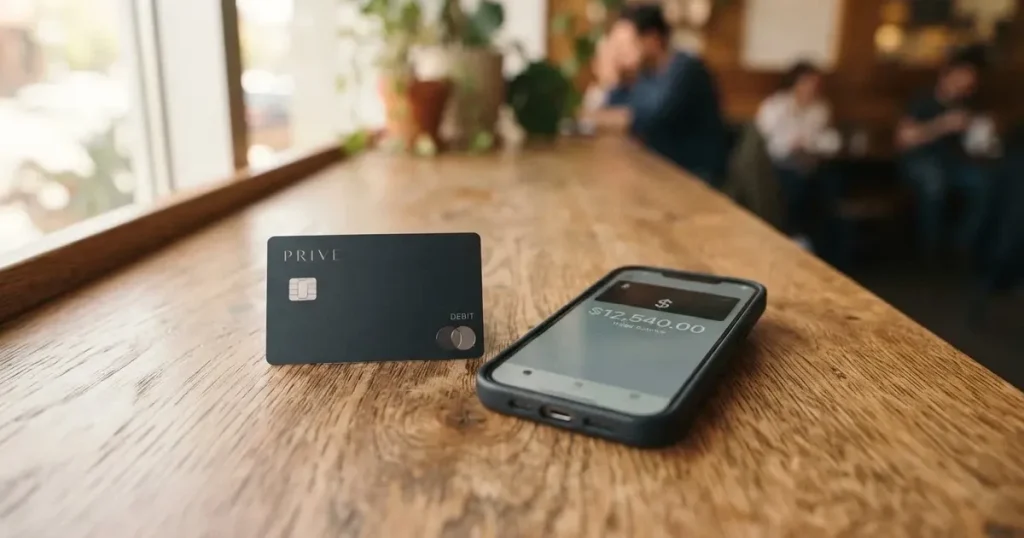
The Prive card is a Visa Platinum that spends a balance you have already loaded, which means the crypto stays in your own wallet until you top up. That is the good part, and it is genuinely unusual. The parts I could not pin down are the ones that decide whether you should bother: the site publishes no country list, the card currency is not stated on the fee schedule, and the issuer behind the “licensed card programme partners” is never named. My score is 5.1 out of 10 — mid-table, because what is documented is fine and what is undocumented is load-bearing.
Conditions are current as of October 28, 2026.
The verdict at a glance
Who this suits: you already hold USDC or USDT in a wallet you control, you spend most of it near home rather than across many currencies, and you are comfortable verifying your identity to an unnamed programme manager. Who it does not suit: anyone whose income arrives in a currency the fee schedule does not list, anyone who needs to know exactly which institution is liable for their money, or anyone who plans to lean on Apple Pay or Google Pay — the public pages do not support that expectation.
| Criterion | Mark | Why |
|---|---|---|
| Who can get it | 5 / 10 | No country list published; off-ramps to bank accounts in 80+ countries; the site terms are written for Hong Kong residents while sources disagree on Hong Kong itself; unofficial reports mention invitation-only early access |
| Cost | 3 / 10 | Metal card $99.00, virtual $10.00 (shown discounted to $5.00), top-up 0.50% plus $0.05 network fee, FX mark-up 2.00%, ATM 1.00% |
| Top-up options | 7 / 10 | USDC, USDT, EURC and PYUSD from a non-custodial wallet, plus fiat through FPS, ACH and SEPA; the networks themselves are not named |
| Reliability and complaints | 5 / 10 | Prive Technologies Limited, “not a bank”; issuer and FCA number not named; complaints about post-update login failures and slow support; App Store 4.3 from 20 ratings |
| Everyday use | 7 / 10 | Virtual and premium metal card, ATM at 1.00% mark-up, a Google Pay terms page exists; unofficial sources say Apple Pay and Google Pay are not supported |
| Total | 5.1 / 10 | Strong custody model, thin disclosure |
That total is not a verdict on the engineering. It is a verdict on what I can confirm. A card that cannot tell you its issuer, its card currency or its country list asks you to take on more trust than a 2% mark-up justifies.
Will they give you the card?
Here is the honest answer: I cannot tell you from Prive’s own pages, and that is the finding rather than an obstacle to it.
The site shows no country list. What it does show is that off-ramps reach bank accounts “in 80+ countries” — that is about where you can send money out, not about where you can sign up. Those are different questions and the distinction matters enormously if you are trying to work out whether you are eligible.
The site’s terms claim the content is intended exclusively for Hong Kong residents. Other records state it is not available in Hong Kong. Both cannot be right, and the card’s availability remains unclear. Early access is by invitation, though this is not confirmed by the operator.
So you have three statements and one company. What I would do: check whether the app lets you register at all, and treat a successful registration as the only real evidence of eligibility that exists. Everything before that is inference.
Behind the eligibility question sits a less visible one, which is age and verification. The terms set 18 or the age of majority. Membership is “subject to application and verification” at Prive’s discretion, and identity checking runs through Sumsub and Bridge — the help centre carries eight articles on KYC without the documents themselves being shown. Unofficial sources say email, phone and an identity document are required, and that proof of address and a selfie are not. That is the kind of detail that materially changes how long an application takes, and it comes from a source the card has not confirmed.
How to get it
The documented path is short: install the app, onboard and verify, order the virtual card, then request the metal card from inside the app. That ordering is worth noting — the virtual card is the fast one and needs no shipping, so you can be spending before any plastic exists.
What is not documented is the part that would tell you whether to expect a yes or a no. Verification tiers set your card limits, but the tier names, what each tier unlocks, how long review takes and why an application can be refused are all not stated. An unofficial catalogue lists a single level called “ID Verification” and mentions complaints about slow KYC review. One level, if true, is a smaller problem than a ladder you cannot see.
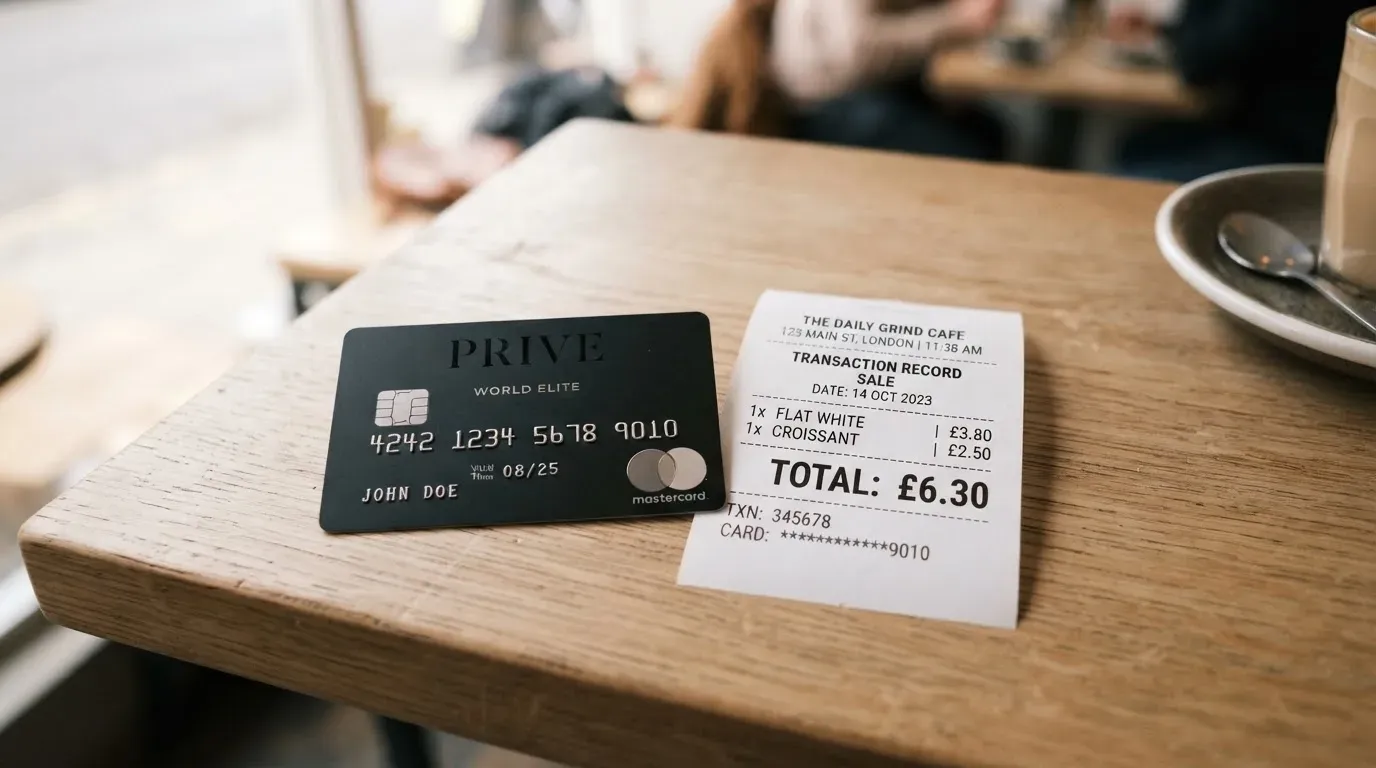
The card itself is a Visa Platinum, available virtual or as “premium metal”. The card currency is not stated on the schedule, though the cash balances you can hold are GBP, USD, EUR, NGN, KES, MXN and BRL — that is a fairly wide spread of currencies for an operator whose terms name one residency. Metal shipping is $60.00, bundled into the $99; where and how fast it travels is not stated, and replacement of a lost, stolen or damaged metal card costs $99.00 again.
Fees and what a payment actually costs
Here is the full schedule, effective 12 April 2026, which is also the date from which changes can be made with 15 days’ notice.
| Item | Fee or limit |
|---|---|
| Metal card | $99.00 ($39.00 card fee + $60.00 shipping) |
| Virtual card | $10.00, shown discounted 50% to $5.00 |
| Monthly fee | none listed |
| Card closure | free |
| Top-up | 0.50% ($0.50 min, $999,999 max) plus $0.05 network fee for USDT/USDC |
| FX mark-up | 2.00% |
| Domestic transactions | no extra fee |
| ATM withdrawal mark-up | 1.00%; free allowance not stated |
| Declined authorisation | $0.50, and only if your decline rate exceeds 5% over 10+ attempts |
| Per-transaction limit | “up to $100,000 per transaction”; overall limits depend on your verification tier |
| Daily and monthly limits | not stated |
Two of those lines deserve more than a glance. The per-transaction figure of up to $100,000 is a ceiling, not a promise — what you can actually move depends on your tier, and the daily and monthly numbers are simply not published. And the $0.50 declined-payment fee is unusual in how narrowly it is drafted: it applies only when your decline rate goes above 5% across more than ten attempts, which means ordinary declined payments are not billed, and a run of them eventually is.
Now the part people actually care about: three ordinary payments.
A coffee in your own currency, say $4.00, at a shop that accepts your card currency without conversion. The top-up fee of 0.50% is already behind you — you paid it when the balance loaded — and domestic transactions carry no extra fee. So the card’s cut of that coffee is zero, and what you paid was the loading cost.
The same coffee in a currency you are not holding. Now the 2.00% FX mark-up applies on top of whatever spread the network and the merchant’s own pricing add. On $4.00, 2% is eight cents, which sounds trivial. On a month of spending abroad it is not, and the 2% is the part Prive itself publishes — the rest depends on the Visa programme partner and the merchant, and neither is named.
A cash withdrawal at an ATM. Here you pay the 1.00% mark-up, plus whatever the ATM operator charges in its own currency. No free allowance is stated, so I would assume every withdrawal is charged rather than hunting for a threshold.
If you want to load with crypto, the arithmetic stacks: 0.50% plus a $0.05 network fee on the way in, then 2.00% if the spend currency differs. For someone spending steadily in one currency, the recurring cost is close to the loading fee alone. For someone converting constantly, the 2% dominates everything else on this page.
How to top it up
The funding model is the strongest thing about this card. You hold USDC, USDT, EURC or PYUSD in a non-custodial wallet, and top-ups from wallet balance are instant. That means the crypto is yours until the moment you send it, and the card never holds it in the sense of taking custody.
Fiat is the second route: FPS, ACH and SEPA, in GBP, USD, EUR, NGN, KES, MXN and BRL. Fiat top-up fees are not stated — and that is not the same as free. The minimum top-up is not stated either, apart from the $0.50 fee minimum.
One thing to fix in your head before you send anything: the networks are not named. The card says which coins it accepts, not which chain to send them on, and for USDT that is the whole ballgame. USDT lives on Ethereum, Tron, Solana, Polygon, Avalanche and others; Circle lists USDC as natively supported on 38 networks. A transfer sent on a network Prive does not support can be lost, or need manual support recovery with no guarantee — blockchain transfers are irreversible, and there is no customer service that can reverse one. Circle also stopped supporting USDC on Tron in February 2024, so “USDC over TRC20” is not a native option. Read the app’s on-screen instructions at the moment you transfer, and check them again each time, because the answer is what the app says rather than what this page says.
Withdrawing works the other way: 0.00% withdrawal fee with a $0.01 minimum, plus the $0.05 network fee for USDT and USDC, out to local bank accounts in 80+ countries. That is a low withdrawal fee compared with the loading fee. If you close the account, outstanding balances become due, and there is an account-closure disclosure page to read before you do.
Paying with it every day
The metal card is Visa Platinum, which means it will work wherever Visa is accepted — with the usual caveat that a prepaid or foreign-issued card can be declined by a merchant who looks at the BIN and decides it looks foreign. That is not a quirk of Prive; it is how card acceptance works for any card issued outside the merchant’s home market.
On mobile wallets the picture is genuinely unclear, and I would not decide anything on it. Prive’s site has a Google Pay terms page, which is at least a page. Apple Pay is not stated anywhere. An unofficial 2026 catalogue says both are “not supported”, which directly contradicts the Google Pay terms page. Read that as: the page exists, the capability is unconfirmed, and it could go either way depending on when you check.
Blocked merchant categories are not stated either. So the usual suspects — gambling, which carries MCC 7995 and is blocked by many issuers, and other categories issuers frequently restrict — are a genuine unknown rather than an assumed yes.
The rewards programme earns points on top-ups, payments, withdrawals and referrals, and the points are usable only inside the app. No cashback is stated. A points programme you can spend only in one app is worth roughly what that app’s own goods are worth to you, which for many people is close to nothing.
On the app itself: iOS shows 4.3 out of 5 from 20 ratings, read on 2026-10-21. A Google Play listing exists under life.prive but I could not read its rating. Twenty ratings is a very small sample — enough to say nobody is rioting, not enough to say anything is reliable.
What can go wrong
The structural risk here is not the crypto. It is the paperwork.
Prive Technologies Limited states plainly that it is “not a bank”. Card services go through unnamed “licensed card programme partners”, identity checking runs through Sumsub and Bridge, the terms are governed by Hong Kong law, and no FCA authorisation number is stated. The issuer is not named. That means the entity you would complain to if a payment went wrong is not identified in anything I could read — and it also means the scheme that Visa Platinum normally implies, deposit-style protection, is not in place. FSCS protection does not apply. You should assume no compensation scheme covers you here.
That is a real difference from a bank card, and it is not a reason on its own to walk away. It is a reason to keep the balance you keep on the card small enough that its loss would be an inconvenience rather than a hole.
On custody, the good news is genuine: the model is non-custodial, “Your Wallet. Your Keys.”, fiat balances sit with “regulated partners”, and the app offers biometric login, 2FA and real-time fraud detection. But the flip side of self-custody is that you own the failure modes too — a lost seed phrase, a phishing page, or clipboard malware that silently swaps a copied address is not reimbursable by anyone. Crypto transfers are irreversible and a stolen key has no recovery path.
On enforcement, the published record is thin rather than bad. I found no official incident reports. A user report via a 2026 catalogue summary mentions login failures after an update, slow and vague support, and payment links that require the payer to register and clear KYC. Searching Reddit and Trustpilot for complaints turned up only unrelated shopping sites with a similar name; there is no Trustpilot page for Prive Money. So the complaint pattern is consistent and small, not absent.
One more: disputes. The terms point to arbitration in Hong Kong under HKIAC, and the card chargeback process and its time frames are not published — the Card Agreement page currently shows that content is not yet available. If you are ever in a dispute with a merchant, you are reading a page that has not been written.
What to take instead
Three cards I looked at directly, all of which publish more of what Prive leaves blank. Scores are mine on the same scale, for the same reason: they measure how well the public pages answer the questions you’d actually ask.
MetaMask Card (7.1 / 10). Mastercard, virtual card issued instantly with the Metal card pre-orderable in-app after approval, one card per user, issuer Monovate, card provider Crypto Life. The virtual card is free with no annual or maintenance fee; Metal is $199/year. Fees are described as a “minimal fee for each transaction” with no additional MetaMask fees and no foreign transaction fee, though the amount sits behind a linked table. Sign-up is open in 45 listed countries or territories, with proof of residency required, and US and UK sign-ups were temporarily closed. Rewards are the strongest in this group: 1% cashback in mUSD on Virtual, 3% headline on Metal limited by footnote to the first $10,000 spent then 1%. If you want disclosure rather than discounts, this is the one.
KAST (6.1 / 10). Visa, virtual and physical, up to 10 cards per user, from a Standard tier at no annual fee to a Private tier at 10,000 USD/year billed annually upfront. Stablecoin top-up 0%, card spend in USD 0%, transaction fee 0%, non-USD FX 0.5%–1.75% depending on your country and card programme. It also has the clearest residence policy of the three: the country list appears at KYC, and the terms distinguish living in a supported country from holding an ID from a restricted region — dual citizens with a supported ID may pass, and a VPN does not bypass it. Cashback runs 1.5% to 3% by tier, capped by monthly spend.
TokenPocket (5.8 / 10). Visa debit for European countries and territories, Mastercard debit for Australia, Canada, Hong Kong, Japan, Taiwan, New Zealand, Singapore, South Korea and the UK, with the Americas planned. It runs on Arbitrum with balances in EUR24 and USD24, and Fiat24 cards are virtual. Fees are a 1% charge on depositing cryptocurrency, described as later refunded through rewards or reduced transaction fees; everything else is stated as no additional fees. That refund promise is the part to read twice.
My own ranking for a reader in your position: if your crypto is in a self-custody wallet and you want the card to keep it there, MetaMask spends directly from the connected wallet on Linea, Base, Monad and Solana — no loading step at all, which also means no loading fee. KAST wins if you want tiered limits and cashback in dollars and will pay an annual fee for them. Prive wins if you want cash balances in NGN, KES, MXN or BRL, which none of the three offers.
Who I would recommend it to
I would recommend the Prive card to a specific person, and it is narrow: someone who already holds USDC or USDT in their own wallet, spends nearly all of it in one currency, keeps a small balance loaded at a time, and has read the terms rather than skimmed them. For that person it is a reasonable card with a genuinely good custody model and a 2% mark-up that only bites when they cross currencies.
I would not recommend it to someone who needs certainty about who is liable for their money, whose spending spans several currencies, or who plans to use a phone wallet as their main tap-to-pay. In each of those cases the gap is not in the product but in the disclosure, and you should assume you are filling that gap yourself.
And I would not recommend it to anyone hoping it replaces a bank account. It is not a bank, it says so, and the protection scheme you might expect does not apply.
Frequently asked questions
What is Prive card?
Prive is a Visa Platinum payment card that spends a balance you load in advance, rather than pulling funds from a bank account at each payment. You load it from a wallet you control or from fiat rails, and the card behaves like a prepaid card. It is run by Prive Technologies Limited, which states it is “not a bank”, with card services provided through unnamed licensed card programme partners.
How does Prive card work?
You convert or transfer crypto into a cash balance, and the card spends only that balance, so it cannot overdraw. Crypto arrives from your own non-custodial wallet instantly, or in fiat through FPS, ACH or SEPA. Spending a crypto-backed balance, or receiving crypto in payment for it, may be a taxable event where digital assets are treated as property — check the position where you live.
Is Prive a bank?
No, and the card says so directly. Prive Technologies Limited describes itself as “not a bank” and delivers card services through unnamed licensed card programme partners. Terms are governed by Hong Kong law and no FCA authorisation number is stated, so the FSCS protection that comes with a UK bank deposit does not apply here.
Who owns Prive?
Prive is operated by Prive Technologies Limited, with identity checking handled through Sumsub and Bridge. The card’s fee schedule became effective 12 April 2026. The issuer behind the card programme is not publicly named.
Is Prive card available in my country?
The site publishes no country list; it only says off-ramps reach bank accounts in 80+ countries. The terms state the content is intended exclusively for Hong Kong residents, while other records state the card is not available in Hong Kong. Early access is by invitation. Try registering — that is the only real test.
How do I get a Prive card?
Install the app, complete onboarding and identity verification, order the virtual card, and then request the metal card from within the app. You must be 18 or the age of majority. Verification tiers determine your limits, but the tier names and unlocks are not published, so do not expect to know your ceiling before you are approved.
Does Prive card require KYC?
Yes. Membership is “subject to application and verification” at Prive’s discretion, and identity checks run through Sumsub and Bridge; the help centre has eight KYC articles. Unofficial sources say email, phone and an identity document are needed but proof of address and a selfie are not — worth confirming yourself, since it decides how long approval takes.
What are Prive card fees?
The metal card is $99.00, including $60.00 shipping; the virtual card is $10.00, shown discounted to $5.00. Top-ups cost 0.50% plus $0.05 network fee for USDT and USDC, the FX mark-up is 2.00%, ATM withdrawals carry 1.00%, and no monthly fee is listed. Card closure is free. The schedule took effect on 12 April 2026.
Is Prive card safe?
The custody design is the safest thing about it: the card is non-custodial, so your crypto stays in your wallet until you load, and the app offers biometric login, 2FA and fraud detection. But there is no deposit guarantee, the issuer is unnamed, and the chargeback process is not published. Keep the loaded balance small, because self-custody also means lost keys are unrecoverable.
Can I add Prive card to Apple Wallet?
I would not plan around it. Prive’s site has a Google Pay terms page, but Apple Pay is not mentioned at all, and an unofficial 2026 source says both wallets are unsupported — directly contradicting that Google Pay page. Treat mobile wallet support as unconfirmed and check in the app before you rely on tapping to pay.
Wallet card reviews – cryptocardcheck
Content created by the «cryptocardcheck» team