
A free Visa, no account fees, and a savings angle — but the small print is thinner than the marketing
 Available in US

Rebind is a Paris-built app that offers a free Visa card funded from a euro balance, with a savings feature that pays variable yield and the option to spend the balance anywhere Visa is accepted. The marketing leans on the idea that euro savers can keep their money in euros, earn yield, and pay with a normal card on top. The actual public information is thinner than that pitch, and a lot of what people say online comes from third-party trackers rather than the company itself. I went through the official pages, the legal language, and the unofficial summaries, and this is what I found useful, where the gaps are, and who I think the card is genuinely built for.
The card earns 5.8 out of 10 in my scoring. That is not a verdict against the concept, but it reflects how much is missing from the public material. If you want a crypto card where every fee, every limit, and every supported country is spelled out, Rebind is not yet that product. If you mainly want a free euro card, a yield angle, and you live somewhere the card actually operates, the picture is more interesting.
The conditions described below are current as of October 28, 2026.
Verdict
The headline: Rebind is free to open, free to hold, and free to spend in any currency as far as the company’s own pages say, with variable yield on top. That is genuinely unusual. The drawback is the lack of detail about the issuer, the limits, the supported top-up routes, and the precise cost when you spend in a currency other than euros. When the official pages do not say, I have used unofficial sources and flagged them; where even those do not say, I have said so.

| Criterion | Mark | Why |
|---|---|---|
| Who can get it | 5 / 10 | Works in 40+ countries inside and outside the eurozone per the official page, but the full list is on a separate guide that is not on the main flow; one third-party tracker says the operational footprint is EU, EEA and UK |
| Cost | 8 / 10 | No account fees, no transfer fees, no foreign exchange fees and no minimums on the company’s own pages; buying and selling assets carries an unspecified “small fee” and unofficial sources cite a 1.5% markup on non-EUR, non-GBP spending |
| Top-up options | 4 / 10 | Official pages talk only about IBAN top-ups; the crypto side is not documented publicly, and the unofficial read is that ETH and USDC are supported through Gnosis Pay infrastructure |
| Reliability and complaints | 5 / 10 | Rebind SAS is a tech company without a banking licence; euros are issued as e-money by Monerium, a licensed EU EMI; the card-issuing partner is not named; there is no deposit insurance; user reports describe cashback tied to a GNO token holding and delays withdrawing from yield contracts |
| Everyday use | 6 / 10 | The card is a free Visa, virtual and physical per unofficial sources, ATM withdrawals appear free per the same source, and Apple Pay and Google Pay are not supported |
| Total | 5.8 / 10 |
Who the card suits: euro savers who want yield on a euro balance and a Visa on top, and who do not need a fully transparent fee table or a wallet add-to-pay experience. Who it does not suit: people who need a published list of supported countries, who want to add the card to Apple Pay or Google Pay, who rely on a public ATM fee schedule, or who want the issuer and card programme named on the front page.
Who Rebind will give the card to
Rebind says on its public pages that the service works in 40+ countries, both inside and outside the eurozone, and that the full list lives on a linked guides page. I did not pull that guides page for this review, which means the exact list of supported countries is not confirmed here. One third-party tracker (cryptocards.so) puts the operational footprint at the European Union, the European Economic Area, and the United Kingdom, but that is unofficial and is not how Rebind itself describes the reach. If your country matters to you, the guides page on Rebind’s own site is the place to check before you sign up.
What the company does not say publicly is the underlying eligibility test beyond the country rule. The signup line is simply “Free to open. Only takes 5 min.” Documents, address proof, age and any tiered checks are not stated on the pages I read. That is an unusual level of silence for a card product, and it is worth treating as a gap rather than as confirmation that anything goes.
On the unofficial side, the same tracker says signup requires an email, a phone number and an ID document, and that proof of address and a selfie are not required. Treat that as a third-party report rather than as a confirmed fact, but it is the most concrete picture of the onboarding flow I could find.
One thing to keep in mind: even if your country is on the list, your ability to use the card in practice will also depend on the card network’s rules and on the issuing partner’s risk policy. A card that works in 40+ countries on paper can still be declined at checkout if the merchant’s bank treats the issuer country or the card type as risky. That is a category-wide pattern rather than a Rebind-specific issue, and I come back to it in the daily-use section.
How to get it
The official flow is short: sign up in the app, get the card in the app. There is no separate website application, and the company does not publish a step-by-step KYC list. If the unofficial description is right, the real flow is email, phone, ID document, no proof of address and no selfie, and the whole thing takes 5 minutes. I would not treat the lack of proof of address as a green flag: the company can still request additional documents at any point, and the EU’s anti-money-laundering rules do require address verification in many cases.
The card is described as a free Visa. The official pages do not say whether the card you receive is virtual, physical, or both, and the delivery time for a physical card is not stated either. The unofficial tracker says both virtual and physical are available. The euro balance is issued as e-money by Monerium, an EU-licensed electronic money institution, and the card is described by Rebind as issued through a “licensed, MiCA-compliant card-issuing partner” that the company does not name on the page I read. The partner logos on the public site include Stripe, Visa, Privy and Gnosis Pay, but the company does not say which of these is actually issuing the card.
What that means in practice: there are at least three regulated entities between your money and your spend, and only one of them is named on the public pages. That is not unusual for a programme-manager model, but if you like to read every licence number before you sign up, Rebind does not currently make that easy.
What it really costs
The cost story is the strongest part of the offering, on paper. The official pages say there are no account fees, no transfer fees, no foreign exchange fees, and no minimums. The card itself is described as free. Buying and selling assets inside the app carries what the company calls a “small fee”, without a number attached, and the spread on any conversion is not stated either.
The unofficial read is more granular. The same third-party tracker says the ATM fee is free, and that there are no daily, monthly or ATM limits listed. It also says there is a reported 1.5% markup on spending in a currency that is not EUR or GBP. I have not seen that 1.5% on Rebind’s own pages, so I would treat it as a real-world pattern reported by users and trackers rather than as a published fee.
| Fee or limit | What the official page says | What unofficial sources say |
|---|---|---|
| Card issuance | Free | Free, virtual and physical |
| Monthly or annual fee | None | None |
| Account or maintenance fee | None | None |
| Foreign exchange fee | None | None on EUR/GBP, reported ~1.5% elsewhere |
| Conversion / spread | “Small fee” (amount not stated) | Not listed |
| ATM fee | Not stated | Free |
| Daily / monthly spend limits | Not stated | Not listed (which is not the same as confirmed absent) |
| ATM withdrawal limits | Not stated | Not listed |
Three everyday payments to make this concrete. None of these is a worst case, and all of them assume the official page is the source of truth unless I say otherwise.
- Coffee in Berlin, paid in euros. You tap the card, the merchant receives euros, your euro balance is debited in euros, and no FX fee applies because the transaction is in the same currency as the balance. If the conversion spread is 0, your cost is the price of the coffee. If the spread is non-zero but undisclosed, your cost is the price of the coffee plus whatever the company means by “small fee”.
- Lunch in London, paid in pounds. The card is in pounds, your balance is in euros. The official page says there is no foreign exchange fee, so on paper the only cost is the spread. The unofficial source says GBP is treated like EUR, which would mean no markup in London either. If you trust the official line, the cost is the spread only.
- A flight booked in US dollars from a German card. Same situation but the currency is not in the EUR/GBP pair that the unofficial source treats as fee-free. The reported 1.5% markup would apply on top of the network rate. If the official “no FX fee” is the truth, that 1.5% is a spread rather than a fee, and you would only see it in the exchange rate the merchant is charged.
The honest read: the headline “no account fees, no FX fees” is supported by what the company publishes. The cost you cannot see until you actually transact is the spread, the “small fee” on buying and selling assets, and the markup on non-EUR, non-GBP spending that third-party users report. None of those is large in absolute terms, but if you want a card where every basis point is published, this is not it.
Top up
The official top-up story is built around an IBAN. You transfer euros from a bank account to the IBAN linked to your Rebind account, and the page says the transfer is instant, 24/7, and free, with no minimums. Savings start from one euro, which is also the practical floor for a meaningful top-up.
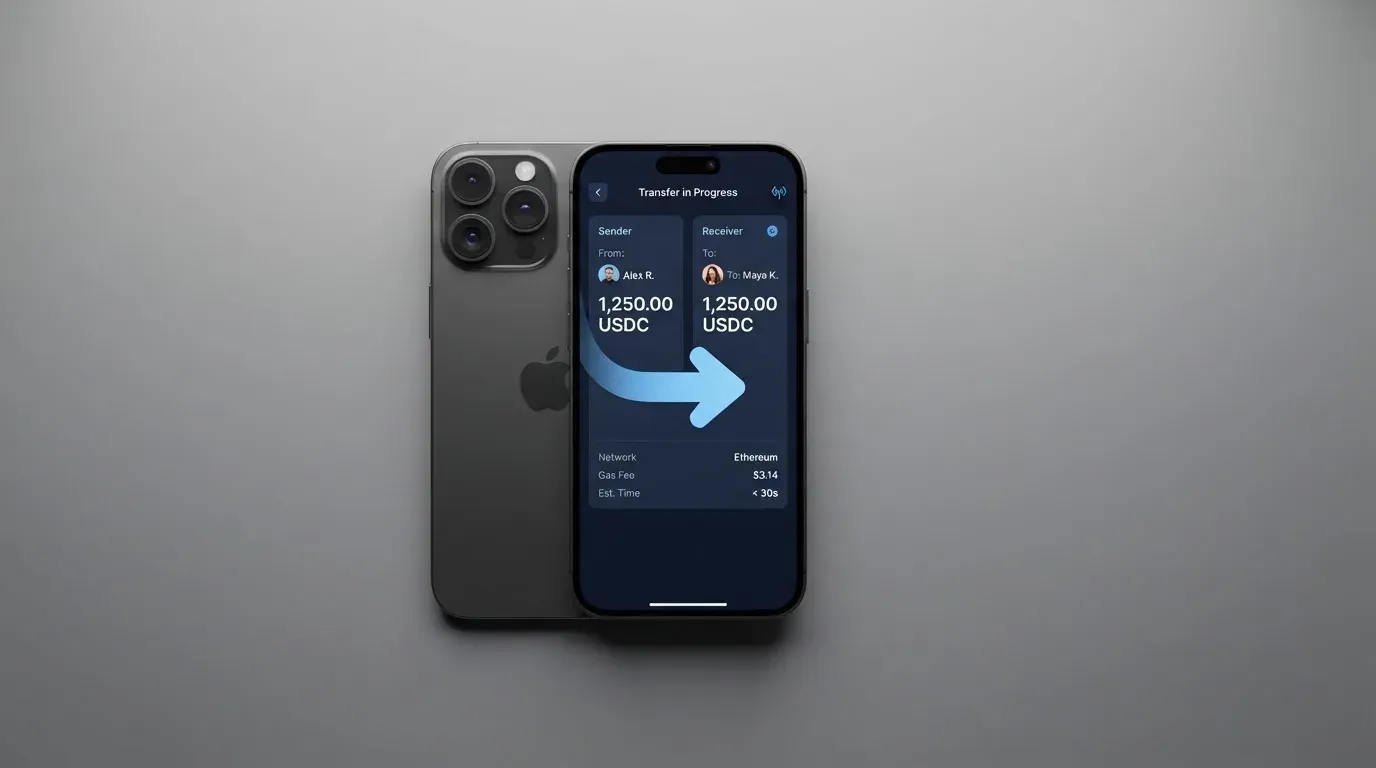
The crypto side is the part the official pages do not document. The unofficial read is that Rebind supports ETH and USDC, and that the underlying infrastructure is the same one Gnosis Pay uses. That would put deposits on a chain familiar to people who already use self-custody wallets, but it would also mean a normal set of on-chain constraints: you need the right network, you need a small amount of the network’s native token to pay gas, and a transfer sent on the wrong network is not recoverable through customer support.
A few things to weigh before you commit money.
- The IBAN route is the documented one. If you have a euro bank account and you want a predictable, fee-free top-up, the IBAN is the path the company stands behind.
- The crypto route, if you want to use it, runs through unofficial channels. The company does not publish supported networks or minimums, and it does not say what happens if you send a coin or a network it does not support.
- Withdrawals from the savings feature are described as “available at any time” with no lock-ups, but the withdrawal process and any fee are not explained. User reports describe multi-day delays when pulling money out of the yield contracts, which matters more than the headline “no lock-up” suggests.
- On-chain deposits cost gas, which is paid to the network rather than to Rebind. That is a category fact, not a Rebind fee, but it shows up in the cost of a small top-up.
The most likely reason the company is quiet about the crypto top-up is that it does not want to be treated as a crypto custodian. Rebind’s own pages say the company does not custody assets, and that stablecoin balances are owned and held by the user. That is a meaningful statement of intent, but it does shift more of the operational risk onto you, because if you send the wrong coin to the wrong address, no one at Rebind is in a position to reverse it for you.
Paying with it every day
In normal merchant situations the card behaves like a free Visa debit card: tap to pay, insert to pay, or pay online. The official pages do not mention Apple Pay or Google Pay, and the unofficial read is that neither is supported. One App Store reviewer also reports that adding the virtual card to a mobile wallet requires manual card entry, which is the same as saying there is no tokenised provisioning flow.
The practical consequence is that the card is a card, not a phone wallet. If you are used to paying by phone, you will need to fall back to the physical card or to the virtual card details entered manually into a checkout form. That is workable, but it is a step behind what most of the better-known crypto cards offer today.
Cashback is the other place where the official and unofficial pictures diverge. The official page talks about yield, not cashback: it advertises up to 5% on euros, paid every second, with the explicit caveat that the rate is variable and not guaranteed. Unofficial user reports describe a cashback feature that is tied to holding the GNO token and that is subject to weekly caps, plus a 15% performance fee on the yield. None of that appears on the public pages I read, and the aggregator scores themselves disagree across the English, Russian, French and Chinese versions of the same site, which is its own warning sign.
Things that the official pages do not mention, but that you should expect to matter: which merchant category codes are blocked, whether there is a daily or per-transaction limit, how disputes are handled, and what happens if a chargeback is needed. The company has a support site linked in the footer, but the dispute and chargeback process is not described on the pages I read. Given that the card runs through an unnamed issuing partner, the actual answer to those questions will be set by that partner rather than by Rebind.
The savings layer is the differentiator. The same euro balance earns variable yield, and the marketing is built around the idea of being paid to hold the balance you would have had sitting in a regular bank account anyway. The yield is variable because it comes from third-party DeFi protocols, which means the rate you see today is not a rate the company can guarantee tomorrow. The savings are described as available at any time, but user reports describe a delay between requesting a withdrawal and seeing the money back in the spendable balance, which is a meaningful gap between marketing and practice.
What can go wrong
A few things to weigh honestly before you put real money in.
The company is not a bank, and it does not pretend to be. Rebind SAS is a French technology company, and the public pages are explicit that it does not hold a banking licence. The euro balance is e-money issued by Monerium, an EU-licensed electronic money institution, and the card is issued through a “licensed, MiCA-compliant card-issuing partner” that the company does not name. E-money balances are not bank deposits and are not covered by the French deposit guarantee scheme or any equivalent, which means if Monerium or the issuing partner failed, you would be an unsecured creditor rather than a depositor with a guaranteed claim.
The card-issuing partner is not named on the public pages. The site carries logos for Stripe, Visa, Privy and Gnosis Pay, but does not say which of these is the actual issuer. Programme closures are a real category risk: Visa terminated FTX’s global agreements in November 2022, and the WaveCrest suspension in 2018 closed every WaveCrest-issued Visa programme overnight. A programme closure typically gives a notice period, then stops loading and spending, then asks users to withdraw the remaining balance. None of that is a Rebind-specific prediction, but the unnamed issuer is what would make a closure operationally painful, because you would not know in advance who to talk to.
The crypto layer has its own risk. The company says it does not custody assets and that the user holds the stablecoins, which is the safer arrangement from a counterparty point of view but pushes operational risk onto you. A transfer on the wrong network, to the wrong address, or in a token that the platform does not actually support, is not something the support team can reverse.
The reported features that are not on the front page are also a risk signal. The cashback tied to GNO holdings, the weekly caps, the 15% performance fee, the reported 1.5% markup outside EUR and GBP, the multi-day withdrawal delays: each of these is a small thing on its own, but together they describe a product where the marketing is more generous than the disclosure. I did not find a Trustpilot page or a Reddit thread dedicated to Rebind, and the only third-party reviews I could find were on a single aggregator that gives the English page an 8.3 and the Russian, French and Chinese pages a 6.2, which is itself a reason to read the positive reviews with one eye open.
The regulatory frame is real but it is also a moving target. Rebind’s pages reference MiCA, the EU’s markets-in-crypto-assets regulation, which has applied in stages from June 2023 through December 2024. Under MiCA, e-money tokens can be issued only by a credit institution or an electronic money institution, which is why a card like this depends on at least one licensed entity behind the brand. A transitional period runs until 1 July 2026, which is also a date worth keeping in mind: any provider that does not have a MiCA authorisation by then has to wind down its crypto-asset service.
Finally, the things the company does not say are themselves a risk. The signup line is “takes 5 min”, the fees page is “no account fees, no FX fees, no minimums”, and the issuer is “our licensed partner”. Each of those is true and also incomplete. A reader who wants more will not find more on the public site.
What to take instead
Rebind sits in a small group of euro-friendly crypto cards that try to combine a euro balance, yield, and a normal card experience. None of the three alternatives below is a direct substitute, and each scores differently on the same axes I used for Rebind.
| Card | Score | Card type | Where it works | Cost | Funding | Rewards |
|---|---|---|---|---|---|---|
| Rebind | 5.8 / 10 | Visa, virtual and physical (unofficial) | 40+ countries per the official page; EU/EEA/UK per unofficial trackers | No account or FX fees on the official page; “small fee” on asset trades; 1.5% markup on non-EUR/GBP per unofficial reports | IBAN officially; ETH and USDC per unofficial sources | Up to 5% variable yield on EUR per the official page; cashback tied to GNO per unofficial reports |
| TokenPocket | 5.8 / 10 | Mastercard and Visa debit depending on country | Specific European and Asia-Pacific country lists; Americas “planned” | NFT creation fee partly paid by user; otherwise “no additional fees”; 1% crypto deposit fee (refundable via rewards) | Crypto from the TokenPocket wallet on Arbitrum; specific coins not listed | No cashback stated |
| MetaMask | 7.1 / 10 | Mastercard; virtual and Metal | 45 countries with proof of residency, others waitlist | Virtual free; Metal US$199/year; minimal per-transaction fee; no MetaMask fees; no foreign transaction fee | Direct from a connected wallet on Linea, Base, Monad, Solana; nine named tokens | Cashback in mUSD: Virtual 1%, Metal 3% on the first US$10,000 then 1%; dining bonus on top |
| KAST | 6.1 / 10 | Visa Platinum, Infinite metal, Infinite gold-plated, plus branded designs | Residence-based country list shown at KYC; not published in advance | Standard free; Premium US$1,000/year; Private US$10,000/year; extra virtual card US$2; inactivity fee US$1/month after 12 months | USDT, USDC, PYUSD and RLUSD on Ethereum, Solana, Polygon, Arbitrum, Tron (app lists current networks) | USD cashback 1.5%–3% by tier with monthly caps; KAST Points on Premium and Private |
A few notes on the table. The MetaMask card scores higher partly because the card-issuance, fees, and supported tokens are documented on the public pages, and partly because the cashback is published in plain numbers. The KAST card is the most expensive in annual fees but is the most explicit about its top-up tokens and networks, and is the only one in this group that supports both Apple Pay and Google Pay. TokenPocket sits at a similar score to Rebind because the published fees and supported regions are limited.
Who I would recommend it to
I would recommend Rebind to a fairly specific reader. You live in the EU, the EEA or the UK, you have a euro bank account, and you are happy to top up the card by IBAN rather than by sending crypto from a self-custody wallet. You want a free Visa, you do not care about adding the card to Apple Pay or Google Pay, and you are comfortable with the idea that the variable yield is variable and that there is no deposit insurance. You are also comfortable with the fact that the card-issuing partner is not named on the public pages, and that the third-party user reports describe features that the company itself does not advertise.
I would not recommend Rebind to a reader who needs every fee, every limit and every supported country spelled out in advance, who relies on a phone wallet for daily payments, who needs a confirmed ATM schedule, who wants a named card issuer on the front page, or who plans to fund the card primarily with crypto. For any of those, one of the alternatives above is a better fit.
The honest summary is that Rebind’s marketing and Rebind’s public documentation do not fully match. The marketing is confident and the cost story is genuinely strong. The public documentation stops where the harder questions start. If you can live inside what is documented, the card is a reasonable tool. If you cannot, you should wait for the company to publish more before you put real money in.
Frequently asked questions
What is the Rebind card?
The Rebind card is a free Visa card linked to a euro balance inside a Paris-built app, with a savings feature that pays variable yield from third-party DeFi protocols. The card is the spending side of the same account, and the euro balance is issued as e-money by Monerium, an EU-licensed electronic money institution.
Is Rebind a bank?
No. Rebind SAS is a French technology company without a banking licence, as stated on the company’s own pages. The euro balance is e-money issued by Monerium, and the card is issued through an unnamed licensed partner. E-money balances are not bank deposits and are not covered by the French deposit guarantee scheme or any equivalent.
Who owns Rebind?
Rebind is built by Rebind SAS, a Paris-based company. The pages I read do not give a more detailed ownership structure, and they do not name the card-issuing partner. The site carries logos for Stripe, Visa, Privy and Gnosis Pay without saying which of these is the actual issuer of the card.
Is the Rebind card available in my country?
Officially, the card works in 40+ countries inside and outside the eurozone, with the full list on a separate guides page that I did not pull for this review. The unofficial read is that the operational footprint is the EU, the EEA and the UK, but that is a third-party report rather than a published fact. If your country matters, the guides page on Rebind’s own site is the place to check.
Does the Rebind card require KYC?
The official pages do not describe the documents required, beyond saying that signup takes 5 minutes. The unofficial read is that the company asks for an email, a phone number and an ID document, and that proof of address and a selfie are not required. Either way, the company can request additional documents later, and EU anti-money-laundering rules apply to the underlying regulated entities.
How do I top up the Rebind card?
The documented top-up is an IBAN transfer from a euro bank account, advertised as instant, 24/7 and free, with no minimum. The crypto top-up is not documented on the official pages, and the unofficial read is that ETH and USDC are supported through Gnosis Pay infrastructure, with the usual on-chain constraints around network choice and gas.
Is the Rebind card free?
The card is described as free on the official pages, with no account fees, no transfer fees, no foreign exchange fees and no minimums. Buying and selling assets inside the app carries an unspecified “small fee”, the conversion spread is not stated, and user reports describe a 1.5% markup on spending in a currency other than EUR or GBP. The headline is accurate, but it is not the whole picture.
Can I add the Rebind card to Apple Pay or Google Pay?
The official pages do not mention Apple Pay or Google Pay, and the unofficial read is that neither wallet is supported. One App Store reviewer also reports that adding the virtual card to a mobile wallet requires manual card entry rather than tokenised provisioning, so the card behaves as a card rather than as a phone wallet.
How do I withdraw money from Rebind?
The official pages describe the savings as available at any time, with no lock-ups, but the withdrawal process and any fee are not explained. User reports describe multi-day delays when pulling money out of the yield contracts, which is a meaningful gap between the headline and the practice and worth testing with a small amount before you commit a large balance.
Is the Rebind card worth it?
For a euro saver in the EU, the EEA or the UK who wants a free Visa, a euro balance, and a variable yield on top, and who is comfortable with the gaps in the public documentation, the card is worth trying with a small balance. For a reader who needs full fee disclosure, named issuers, phone wallet support, or a published list of supported countries, the alternatives in the previous section are a better fit.
Wallet card reviews – cryptocardcheck
Content created by the «cryptocardcheck» team