
Roqqu scores 4.5 out of 10 — the crypto is easy to spend, the paperwork is not
 Available in US
The Roqqu card is one of those products where the visible part is polished and the invisible part is missing. You can see the card designs, you can read that it spends crypto directly online and in-store, you can see App Store and Google Play badges. What you cannot find on the public pages is the price of the card, the conversion fee, the currency fee, the ATM fee, the daily limit, the countries you can sign up from, or which institution actually issues the card. That absence is not a small documentation gap. It is the main thing you are judging, because your money sits on the other side of it.
The conditions described here are current as of October 28, 2026.
I want to be clear about what I did. I read the terms and conditions, the card page and the help pages, and I looked at user reports on Trustpilot. I did not apply, I did not hold funds, and I did not pay with the card. Everything below is what the card’s own public material says, plus a picture of what users complain about. Where the card’s public pages do not say something, I say so rather than filling the gap with a plausible-sounding number.
Verdict: 4.5 out of 10, and the score breaks down into six parts
Here is the card’s score out of 10, criterion by criterion, with my reasoning written out so you can disagree with it:
| Criterion | Mark | Why |
|---|---|---|
| Who can get it | 5 / 10 | Countries are named only as “supported markets”; access depends on where you live and where Roqqu operates, and that list is not published |
| Cost | 5 / 10 | Card fees are not disclosed, and the fees page does not contain them |
| Top-up options | 5 / 10 | “Spend your crypto directly” with direct conversion, but no coins or networks named |
| Reliability and complaints | 4 / 10 | Roqqu Nigeria Limited is named in the terms; issuer and licences are not; complaints about blocked accounts and held assets; Trustpilot 3.6 out of 5 from 104 reviews |
| Everyday use | 3 / 10 | A virtual card with customisable designs; Apple Pay, Google Pay, plastic and ATM all undisclosed |
| Total | 4.5 / 10 | The weakest part is everyday use, the strongest is eligibility, and nothing reaches above the middle |
Who this suits: someone who already uses Roqqu as an exchange, holds stablecoins there, and wants to spend that balance online or in-store without manually selling it first. The product describes itself exactly that way — spend your crypto directly, with direct conversions — and the audience is Roqqu exchange users spending stablecoins online. If that is you, the convenience is real.
Who this does not suit: anyone whose first question is “what does this cost me”. If you are choosing a crypto card for the first time and you want to know the conversion fee, the monthly fee, whether Apple Pay works, or whether you can use it in your country, this card will not tell you today, on its public pages. That is not a small complaint. A card whose price you cannot discover before you sign up is a card whose cost you learn by paying it.
There is also the shape of the company underneath it, which I come back to below: Roqqu Nigeria Limited in the terms, Roqqu Technologies in the site footer, and no issuing institution or licence named anywhere I could read. For a product whose whole pitch is spending your balance, that is the thing I would want answered before I moved anything of size.
Will they give you the card?
The card’s page names no countries. That is the honest answer and I want to give it to you plainly: the public pages do not list a single eligible country. The wording is “supported markets”, and the terms say that access depends on where you live and the countries Roqqu operates in, with eligibility reassessed on an ongoing basis. So the gatekeeper is the company’s own discretion, applied continuously, not a published checklist you can read once and satisfy.
If you are outside those unnamed markets, the practical answer is that you cannot tell from the outside whether you qualify. You can read the terms all evening and still not know. And because eligibility is reassessed on an ongoing basis rather than checked at signup, even a successful registration is not a guarantee that the account stays open. That ongoing reassessment is the same mechanism that produces the locked-account complaints I describe later — which is not an accusation of any specific case, just the structural reason to keep your balance elsewhere.
What I would check first, if I were you: not the marketing page but the terms. Section 3 of the terms is where the residence and operating-country language lives, and Section 5 is where identity documents are described. Those two sections tell you more about whether the card is realistically for you than the card designs do.
How to get it
The registration path is the ordinary regulated one. The terms say that registering means providing your legal name, a government ID and your date of birth, and that you must be 18 or at the legal age in your country. That is identity verification in the standard sense — the kind of check that anti-money-laundering rules require of regulated businesses, including ongoing monitoring and reporting of suspicious activity. There is no route around it and I am not going to invent one; if you do not want your identity tied to a financial platform, this is not the product for you and no amount of cleverness changes that.
One thing worth knowing: the card’s own FAQ page has a KYC answer that is not displayed on the page I saw. So the card’s FAQ cannot be your source for what KYC means here — the terms are the only place it is actually written down.
The card itself is described as “Virtual Flexibility”, a virtual card with customisable designs. The card network is not stated, and the FAQ answers are not displayed, so I cannot tell you the network from the current pages. An earlier check described it as a prepaid Visa; I would treat that as historical rather than current, since the present pages do not confirm it. Whether a physical card exists is also not stated. Delivery is not stated either — no shipping time, no countries shipped to, nothing.
And then there is the tier system, which the terms mention but never define. Limits depend on your verification level and your tier, and higher limits may require enhanced due diligence. No tiers are listed, no timings, no thresholds. So the honest description of onboarding is: you submit documents, you get assigned a level you cannot see, and your limits will be whatever that level permits.
Fees and what a payment really costs
Here is the section that decides the score for me. The card links to a fees page, and that page does not list the card’s fees. That is the finding, not a summary of a table I could not find. Issuance is not stated. Monthly fee is not stated. Conversion fee is not stated. Currency and FX fee is not stated. ATM fee is not stated. Daily and monthly limits are not stated — only that limits depend on verification level and tier. Tiers are not stated. Currencies are not stated.
| Fee or limit | What the card states |
|---|---|
| Issuance fee | not stated |
| Monthly fee | not stated |
| Crypto conversion fee | not stated |
| Currency / FX fee | not stated |
| ATM withdrawal fee | not stated |
| Daily transaction limit | not stated — depends on verification level and tier |
| Monthly transaction limit | not stated — depends on verification level and tier |
| Supported currencies | not stated |
| Card tiers and their limits | not stated |
So let me walk through three everyday payments with the table in front of us, because “what will I pay” is the question you are actually asking, and I want to show you how much of it I cannot answer.
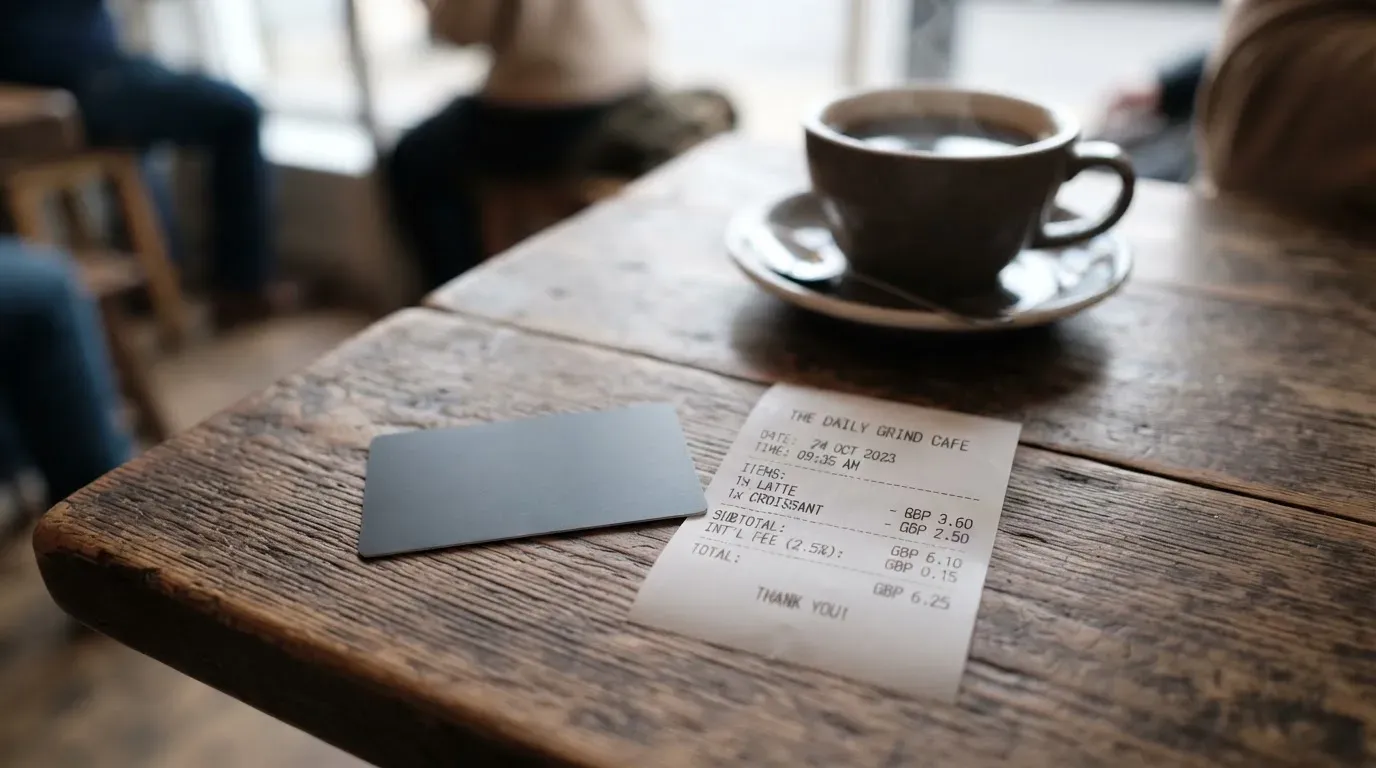
Buying coffee. You tap, the amount is small, and the cost of that tap is at minimum the conversion of whatever you hold into whatever currency the merchant charges. I cannot tell you what that conversion costs, because the conversion fee is not stated. I can tell you where it does *not* come from: on-chain network fees for a deposit are charged by the blockchain, not by the card provider. So the conversion side of your coffee is entirely the provider’s number, and that number is not published.
A subscription, say a streaming plan in another currency. Now two unknowns stack: the conversion, and whatever happens when the merchant’s currency is not the currency your balance is in. The currency fee is not stated, and so is the list of currencies you can hold or be charged in. There is also a category question here that has nothing to do with Roqqu: a merchant category code classifies a business by what it sells, and a four-digit code for gambling exists specifically so issuers can block it on particular cards by policy rather than by law. Which categories Roqqu blocks, and how it handles foreign-issued cards at merchants that check the card’s issuing country, is not stated. I would not want to learn that at a checkout.
Withdrawing cash. The ATM fee is not stated and the ATM situation is not stated — whether the card works in machines at all is not something the pages answer. The daily limit is not stated either, so even if you find a working machine, the ceiling on what comes out is unknown until you are inside an account with an assigned tier.
Three payments, and the honest answer for all three is the same: you cannot compute the cost. I have not estimated it and I am not going to give you a rule of thumb from other cards. What I can do is tell you exactly which four numbers to ask for in writing before you move money — issuance, monthly, conversion, and FX — and which two limits to ask about, daily and monthly. If the answers do not arrive, that is information too.
How to top it up
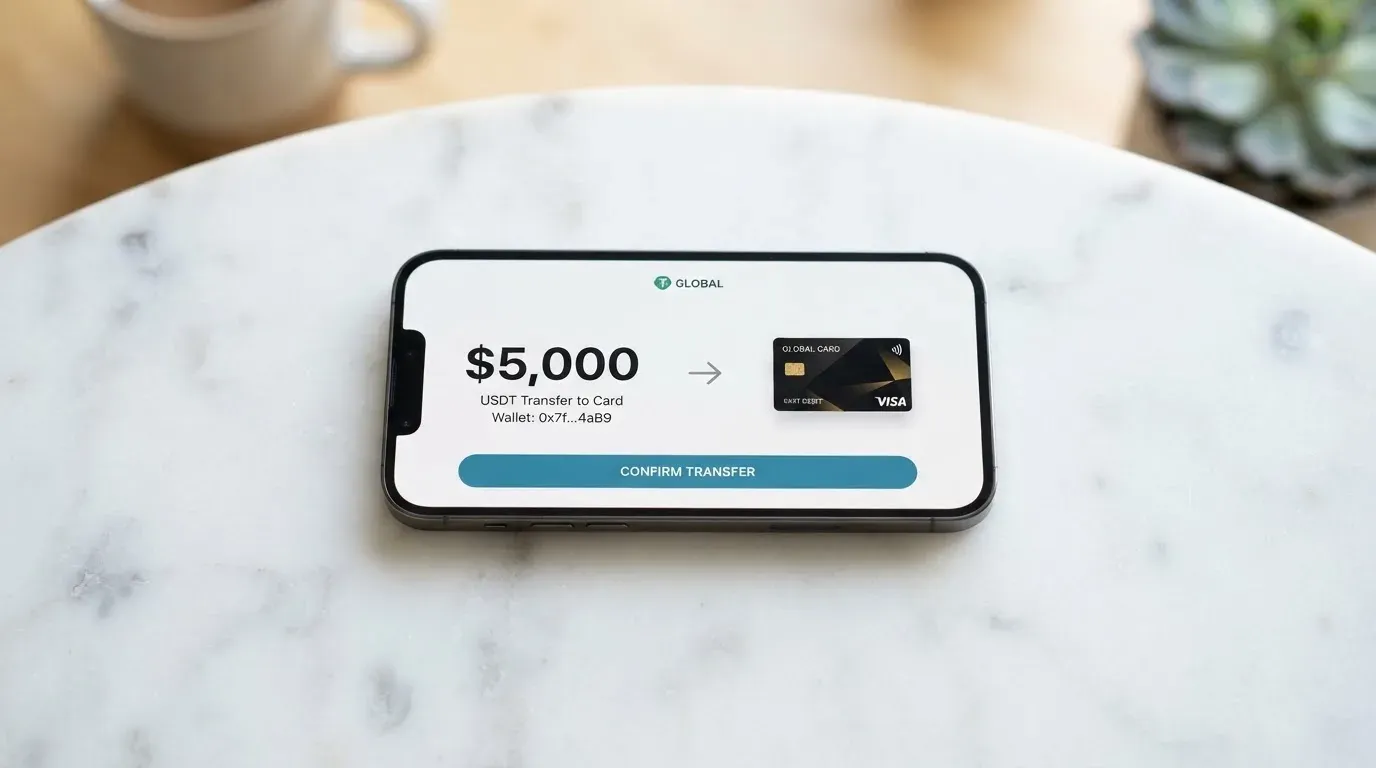
The card’s own words are the best description available: spend your crypto directly online or in-store, with “Direct Conversions”. Coins and networks are not listed. An earlier check described stablecoins in a Roqqu wallet, converted in real time at each purchase. So the model the card describes is: your crypto sits with Roqqu, and each purchase converts it at the moment you pay.
That model has one thing in its favour and one thing against it. In its favour: it is the reason the card exists. Nothing about the conversion is your problem as a separate step. Against it: the top-up mechanics themselves are not stated. How you fund the wallet, which networks you can transfer on, minimums, arrival times — none of it is on the page.
And this is where a mistake gets expensive rather than merely annoying. Blockchain transfers are irreversible. If you send funds on a network the provider does not support, or to an address belonging to a different network, the funds can be lost, or recovering them can require manual support work with no guarantee of success. There is no chargeback for a crypto transfer, because there is no transaction in the card scheme to reverse.
One specific trap worth knowing, since people hit it constantly: on Ethereum, the ERC-20 standard means gas is paid only in ETH, so a wallet holding USDT and no ETH cannot send at all. The Tron network prices differently, using bandwidth and energy, often burning TRX. And “USDC over TRC20” is not a native option — Circle stopped supporting USDC on Tron in February 2024. So before your first transfer, confirm the network from Roqqu’s side rather than from the interface of whatever wallet you are sending from. Terms also state that digital asset transactions cannot be reversed once broadcast.
As for cashing out, the card’s pages do not state a withdrawal method. The terms reference reversibility of digital asset transactions, which is about transfers, not about getting money out. If you need to reach your own bank account, ask before you fund.
Paying with it every day
The card as described is virtual, with customisable designs. That is the whole of the daily-use description. Whether you can add it to Apple Pay or Google Pay is not stated. Whether a plastic card exists is not stated. Whether it works at ATMs is not stated. Whether online payments at foreign merchants go through smoothly is not stated.
I want to explain why that last one matters, because it is the category’s problem and not Roqqu’s alone. Every card number starts with a six- or eight-digit issuer identification number that identifies the institution that issued it. Merchants can look that number up and see which institution and country issued the card, and some apply extra scrutiny when the issuer country differs from the billing address. This is precisely why a card issued in one country can look foreign to a shop in another. Some merchants decline prepaid cards for the same reason: the lookup reveals the card type and the issuer country.
There is a second mechanism in the same family. Address Verification Service compares the numeric parts of the billing address a buyer typed — street number, postcode — against issuer records. It is mainly offered in the US, Canada and the UK, and it is generally unavailable for foreign-issued cards, which can cause declines. So a perfectly valid card with funds in it can fail a checkout for a reason that has nothing to do with you.
Two more things that are simply true of this category, so you can anticipate them. A declined authorisation can leave a hold on your funds for several days, typically up to seven — money you did spend, or did not spend, temporarily unavailable. And if you add the card to a mobile wallet, the phone stores a device-specific number rather than your card number, with a fresh security code for each payment; the issuer can restrict that tokenised number, blocking it on magnetic stripe, phone or website use as it sees fit.
On the app: the page carries App Store and Play Store badges and shows “4.25 Stores” with no explanation of the figure. The store ratings and review counts were not readable to me, so I will not put a number in your head that I did not verify.
What can go wrong
I looked for official incidents first, because that is the difference between a documented problem and a rumour. I found none. No regulator action, no published incident, no dated card-related event in the news. That is worth stating plainly, because it is easy to read a low score as an accusation.
What I did find is user reports, and these are unofficial, not confirmed by the card. Trustpilot shows 3.6 out of 5 across 104 reviews, of which two fall in the last twelve months, as read on 2026-10-21. The same page also displays “4.0 Trust Pilot / 300”, so the figures differ between what is shown and what is counted. Themes reported by users: deposits and withdrawals going missing, dated October 2023 and October 2025; slow support, November 2023 and February 2026; locked accounts and assets held, November 2023 and June 2024; and identity-verification problems, December 2023 and January 2025. Card-specific complaints I did not find — the complaints are about the platform, and that distinction matters, because it means the card inherits the platform’s reputation without adding its own track record.
Now the company underneath. The terms name Roqqu Nigeria Limited. The site footer names Roqqu Technologies. The relationship between the two is not explained. The issuing institution and its licences are not named on the page. For context on why the issuer matters: a card programme involves a network that routes messages and sets rules, an issuer licensed to issue under that network’s licence, and often a crypto brand that is simply the programme manager in front. Visa and Mastercard do not themselves issue crypto cards to consumers — they license issuers, and they can suspend a programme. In November 2022 Visa said it had terminated its global agreements with FTX, and the FTX US debit card was wound down by its issuer. In 2018 Visa suspended WaveCrest in Europe, closing all WaveCrest-issued Visa programmes. So the issuer’s standing is not a footnote; it is the thing that decides whether your card still works next year.
Programme closures follow a pattern: a notice period, then loading and spending stop, then users are asked to withdraw remaining balances. There are also sector-wide reasons to check a provider’s registration rather than take its word: ESMA keeps an interim register of authorised crypto-asset service providers and white papers, and users can look a provider up there.
On the security side, the page states cold storage, two-factor authentication, email and SMS transaction notifications, “ISO 27001 certified”, and an NDPR audit dated 2024. Those are the standard safeguards plus a named audit, and I would rather say that than dismiss it. What is not stated is the custody model for card funds specifically — who holds your balance, and under what arrangement. That is the question I would ask.
Support: the page states 24/7 support, with legal notices to [email protected]. That is a contact route, not a resolution time, and slow support is one of the recurring user themes.
On disputes: Roqqu is a platform, not a counterparty — its terms say user disputes are resolved directly, and chargebacks appear only in a fraud context, with a formal process at the complaint-handling page. Read that carefully if you are thinking about a purchase gone wrong. A chargeback is a refund ordered by the card issuer, with reason codes such as fraud, duplicate billing or goods not received; whether that path applies to a given problem on this card is not something these pages promise you.
Two risks from the crypto side specifically. First, stablecoins are not actually stable — TerraUSD collapsed in May 2022, and USDC temporarily lost its peg in March 2023 during the US banking crisis. If the balance behind the card is a stablecoin, its value on the day you spend is not guaranteed to be a dollar. Second, stablecoins are not censorship-proof: Tether says it disables tokens in wallets on the OFAC sanctions list and has frozen funds tied to illicit activity. That is a feature from an anti-crime perspective and a risk to the holder’s access, and both are true at once.
And a tax point, offered as a fact rather than advice: in the US the IRS treats digital assets as property, so exchanging them for goods or services generally produces a taxable gain or loss, measured in local currency at fair market value on the date of the transaction. Each card payment funded from crypto may therefore be a separate disposal. What that means for you depends on where you live — and that is a question for a professional in your own country, not for me.
What to take instead
I only compare what I could verify. Young Card, MSX and Bybit Card come out of the same review process, and their scores are higher: Young Card 5.7, Bybit Card 6.0, MSX 6.4. Higher is not the same as safe, and neither of the first two tells me much on the pages I could read.
MSX scores 6.4 / 10. I could not find official statements on who qualifies, what the card is, its cost, its fees or its funding. That is a thin basis, and I am not going to fill it in with assumptions.
Young Card scores 5.7 / 10. Country eligibility, card details, cost, fees and card funding are not stated on the pages I could read. One thing is stated, and it is a genuine differentiator: cashback paid in YNG tokens at a rate set by Club tier — Essential 0.1%, Gold 1.8%, Platinum 3.6%, with Bronze and Silver not stated. If you are in that ecosystem and willing to be paid in a token, that is a concrete answer to “what do I get back”, which is more than Roqqu offers today.
Bybit Card scores 6.0 / 10, and it is the only one of the three where the numbers are actually published — which makes it the useful comparison, because it shows what a card that discloses its fees looks like.
| Bybit Card | What is stated |
|---|---|
| Card type | Virtual and physical; a virtual card must be obtained first; physical not available in Peru; rolled out in phases |
| Networks | Argentina Mastercard prepaid; AIFC, Georgia, Kazakhstan, Australia, Mexico “Mastercard credit card”; Brazil and Peru Visa prepaid; Asia Pacific Visa credit |
| Card currency | USD for AIFC, Georgia, Kazakhstan, Australia, Asia Pacific; ARS Argentina; MXN Mexico; BRL Brazil; PEN or USD Peru |
| Validity | 3 years (AIFC, Georgia, Kazakhstan, Asia Pacific, Australia), 6 years Argentina, 5 years Brazil, Mexico, Peru |
| Virtual issuance | None in all regions “until further notice” |
| Physical issuance | Australia 29.99 USD; Argentina 5 USD/USDT; Georgia 29,99 USDT; Kazakhstan (AIFC) 29,99 USDT; Asia Pacific 5 USDT; Brazil and Mexico none; VIPs in several regions pay none |
| Crypto conversion fee | 0.9% over the One-Click Sell rate (Australia, Asia Pacific, Georgia, Kazakhstan, Brazil, Mexico); 0.5% Argentina; Peru not supported |
| FX fee | 2% on top of the network rate (Australia, Asia Pacific, Georgia, Mexico); 2% “International Fee” for Kazakhstan (AIFC) on purchases outside Kazakhstan even in USD; 7% Argentina; 1.5% Brazil; 1% Peru |
Bybit’s region list is also explicit: Argentina, AIFC (Kazakhstan), Georgia, Kazakhstan, Australia, Mexico, Brazil, Peru, Asia Pacific. The application asks for your country of residence, and if the country is not supported Bybit says it will register your interest. The cards page states the product is not meant for European Economic Area customers and that all EEA customer participation is strictly prohibited. Separately, Bybit’s fiat-service restricted list — deposits, withdrawals and One-Click Buy, not the card itself — includes Belarus, the Russian Federation, Serbia, China and the United States, and says Russian users can only make RUB transactions in fiat. No card-specific statement on Russian or Belarusian citizens was found, and no citizenship-versus-residence rule: nationality is screened separately from residence because sanctions screening and issuer risk policy apply to citizenship and country of birth as well as address. The card currency depends on the country of your Advanced Identity Verification.
Two Bybit details are worth your attention because they are structural rather than cosmetic. The card has no balance of its own — it draws on the Funding Account and the Flexible Easy Earn balance, fiat first, and if fiat is insufficient crypto is sold at the One-Click Sell rate plus the card’s conversion fee. Supported coins are BTC, ETH, XRP, USDT, USDC and GRAM, with a default priority of USDT, USDC, GRAM, BTC, ETH, XRP that you can reorder in the Card Dashboard. And from 5 October 2026 at 10:00 UTC, only crypto-funded transactions earn points or cashback; fiat-funded spending does not. The tiers run from Base at 2.00% with a 5 USD monthly cap up to Infinite at 10% with a 600 USD cap, and points stay pending four calendar days.
So the choice is not really “which card is better”. It is “which card will tell me the price”. Bybit publishes its fees, its regions, its networks and its limits; Roqqu publishes its card designs. If your problem is that you cannot get an ordinary bank card, Bybit’s long unsupported-region list may put it out of reach anyway, and the FX fee of 2% to 7% depending on region is a real number you should weigh. But you can weigh it. With Roqqu, you weigh nothing.
Who I would recommend it to
If you already hold a Roqqu balance, mostly stablecoins, and you spend it online in the same market you signed up in, then this is a reasonable convenience tool and the direct-conversion model is the right shape for that job. You are not betting on fees you have never seen, because your alternative is manually selling before every purchase, which costs you time and usually a worse rate anyway.
If you are in any of these groups, I would look elsewhere first:
- Anyone choosing a card for the first time who needs to know the cost before committing. The fee list does not exist on the public pages.
- Anyone outside the unnamed “supported markets”, particularly if you need certainty rather than a maybe. You cannot check, and eligibility is reassessed on an ongoing basis.
- Anyone who wants cash, Apple Pay, Google Pay or a physical card. None of these is confirmed.
- Anyone who needs to take money out to a bank account. The withdrawal method is not stated.
- Anyone whose balance is large relative to their spending. The combination of unnamed custody arrangements, unnamed issuer, and reports of locked accounts with assets held is not a position I would hold deliberately.
- Anyone in the EEA. Whether Roqqu can serve you is exactly the kind of question this card’s pages do not answer, and the region’s licensing regime is specific enough that you should not guess.
Before you fund anything, I would get answers in writing to six things: which countries are supported, which entity issues the card and under which licence, the issuance fee, the monthly fee, the conversion fee, and the FX fee — plus the daily and monthly limits and the withdrawal route. Eight, really. If the support that is supposedly available 24/7 does not answer those, the absence is the answer.
Frequently asked questions
What is the Roqqu card?
The Roqqu card is a virtual payment card tied to a Roqqu account holding crypto. The card’s page describes it as “Virtual Flexibility”, with customisable designs, and says you can spend your crypto directly online or in-store through what it calls direct conversions. Coins and networks are not listed on the current pages, and an earlier check described stablecoins in a Roqqu wallet converted at each purchase.
How does the Roqqu card work?
You hold crypto in a Roqqu wallet, then pay with the virtual card. At the moment of purchase the balance is converted and the merchant is charged in fiat, so the card behaves like a prepaid card drawing on a stored balance rather than a debit card pulling from a bank account. The conversion rate you pay is the part that is not published — the conversion fee is not stated.
Is Roqqu a bank?
No. Roqqu describes itself as a platform rather than a counterparty, and its terms name Roqqu Nigeria Limited while the site footer names Roqqu Technologies, with the relationship unexplained. The issuing institution and its licences are not named on the page I could read. Card programmes are normally run by a licensed issuer under a network licence, with the crypto brand as programme manager.
Who owns Roqqu?
That is genuinely unclear from the public pages. The terms name Roqqu Nigeria Limited; the site footer names Roqqu Technologies; neither document explains how the two relate, and no parent or ownership structure is described. The nearest thing to a clue is the name itself, which suggests a Nigerian base — but that is inference from a company name, not a statement from the company.
Which countries can I get the Roqqu card in?
The card’s public pages name no countries at all. The wording is “supported markets”, and the terms say access depends on where you live and the countries Roqqu operates in, with eligibility reassessed on an ongoing basis. So you cannot check eligibility from outside, and even a successful signup is not a guarantee of continued access. This is the single largest practical unknown on the card.
How do I apply, and does it need KYC?
You register with your legal name, a government ID and your date of birth, and you must be 18 or the legal age in your country. That is standard identity verification under anti-money-laundering rules, which also bring ongoing monitoring and suspicious-activity reporting. The card’s FAQ has a KYC answer that is not displayed on the page, so the terms are your only real source. Limits then depend on a verification level and tier that are never spelled out.
How much does the Roqqu card cost?
I cannot tell you, and that is the finding rather than a gap in my checking. The card links to a fees page that does not list the card’s fees. Issuance, monthly fee, conversion fee, FX fee and ATM fee are all not stated, and neither are daily or monthly limits. One related detail: on-chain network fees for a deposit are charged by the blockchain, not by the card provider, so that cost is not the provider’s — but the conversion cost on every purchase is.
How do I top up the Roqqu card?
Top-up mechanics are not stated on the public pages. The card’s model is to hold crypto in a Roqqu wallet and let each purchase convert it, rather than topping a card balance directly. What you must confirm before your first transfer is which networks are supported, because blockchain transfers are irreversible: sending on an unsupported network, or to an address of another network, can lose the funds or require manual recovery with no guarantee.
Is the Roqqu card safe?
That depends on what you mean. The page states cold storage, two-factor authentication, email and SMS transaction notifications, “ISO 27001 certified” and an NDPR audit dated 2024 — but the custody arrangement for card funds is not stated. Unofficially, Trustpilot shows 3.6 out of 5 from 104 reviews, with themes of missing deposits and withdrawals, slow support, locked accounts and held assets, and identity-verification problems. I found no official incidents.
Can I add the Roqqu card to Apple Wallet or Google Pay?
I could not confirm that you can. The current pages do not state whether the card works with Apple Pay or Google Pay, whether a physical card exists, or whether it works at ATMs — and an earlier check described a prepaid Visa, which the present pages do not confirm. By contrast, a mobile wallet stores a device-specific number rather than your card number and uses a fresh security code per payment, so support matters; ask before you rely on it.
Exchange card reviews – cryptocardcheck
Content created by the «cryptocardcheck» team