
Solflare card review — paused since 28 July 2026, money stays in your own wallet
 Available in US
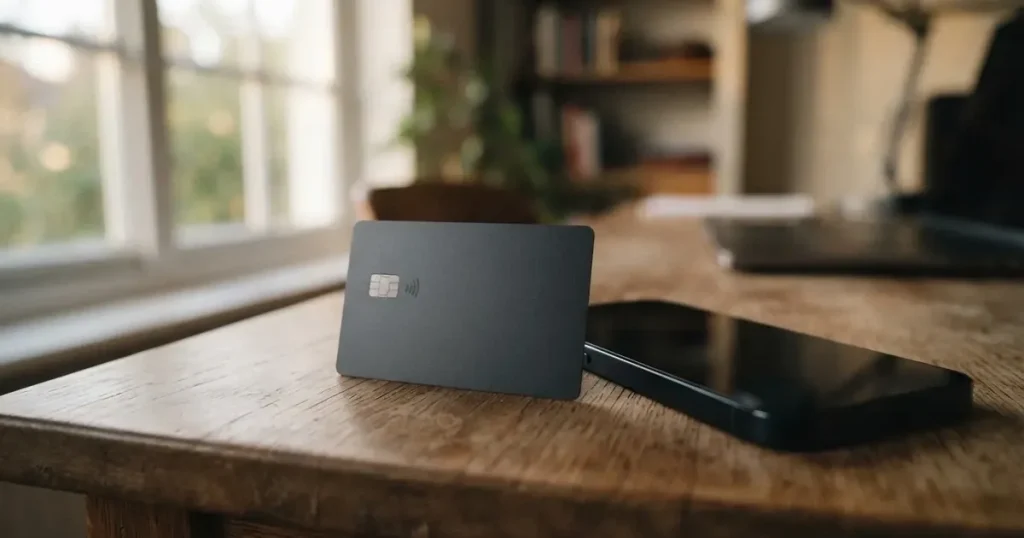
If you are weighing Solflare as a way to spend crypto day to day, the first thing you need to know is that the card programme is not running. Cards were paused on 28 July 2026, the issuer that ran them wound down, and as of the check behind this page there is still no relaunch. Nothing else in this review matters as much as that. Everything below is written for a reader who has their own situation and is trying to work out what to do with it — whether you hold the card, whether you only hold the wallet, or whether you were simply considering Solflare as a candidate.
The conditions described here are current as of October 28, 2026.
My score for this card is 3.2 out of 10. That is not a rounding of a middling mark. It is a card that does not currently exist for new applicants, whose fees the official pages never published, and whose issuer disappeared in a single weekend.
Verdict: 3.2 out of 10
Solflare is a self-custody wallet with a Solana connection, and the card was meant to be the part that let you spend from it in an ordinary shop. On paper the fit was good: money stays in your own wallet until the moment you pay, so there is no custodian to trust with your balance. But the programme is paused, no successor issuer has been named, and the marketing pages still show a “Get Solflare Card” button with no notice about the pause. If you are one of the wallet holders waiting for the relaunch, this page is for you — it sets out what was promised, what is confirmed, and what you can check yourself.
| Criterion | Mark | Why |
|---|---|---|
| Who can get it | 0 / 10 | Issuance is closed: cards are paused during a transition to a new issuer, and no relaunch is confirmed |
| Cost | 7 / 10 | Not disclosed officially; unofficial: the annual fee is free, a 1% service fee, 0.7% FX, 2% at the ATM, and sources disagree |
| Top-up options | 4 / 10 | The card draws USDC straight from the Solana wallet; no other coins or networks |
| Reliability and complaints | 2 / 10 | Cards were paused on 28 July 2026 after the issuer Kulipa closed down; no new partner named, and the funds stay in a self-custody wallet |
| Everyday use | 3 / 10 | The card is not issued right now; Google Pay works, Apple Pay is “coming soon”; unofficial: the virtual card is instant, the physical one optional, the ATM 2% |
| Total | 3.2 / 10 | The programme is paused, so most of what you would judge a card on is currently unavailable |
Who this suits once it returns: someone who already keeps USDC in a Solana self-custody wallet and wants the card to spend directly from it, with no pre-loaded balance to manage. Who it does not suit now: anyone who needs a card next week. If your problem is that an ordinary bank card is hard to get where you live, a paused crypto card is not an answer this year — the alternatives below are the place to look.
What happened to the programme
The short version: the card did not fail on the crypto side. The wallet, staking and swaps kept working. What stopped was the card, because the institution that issued it ceased to exist.
On 28 July 2026 Solflare paused both virtual and physical cards after its issuer, Kulipa, wound down. A Solflare co-founder cited solvency issues at Kulipa. At the time, a replacement card was promised “in August” 2026, along with Apple Pay and Google Pay, higher limits and cash back. As of a roadmap published in late August 2026 the relaunch was still a future item, and by 20 October 2026 no relaunch could be found. The issuer is named as Kulipa by third-party reporting; the official pages still do not name the card issuer at all.
One thing that catches people out. The Solflare website still describes the self-custody Mastercard that deducts USDC from the wallet at checkout, at “100M+ merchants”. There is no pause notice on those pages. So if you land on solflare.com from a search result, the page will read like a live offer. That is a marketing artefact, not a sign the programme is open.
Who the card was for, officially: cards were offered in the EEA, the UK and “other countries”, decided case by case, with eligibility checked by requesting a card in the mobile app. There is no country list, and the pages do not state whether the test is residence or citizenship — worth knowing if you are in a place where the answer is not obvious. Verification in the app was instant; the documents, proof of address and age requirements are not stated. The wallet app is on iOS and Android; a third-party page gives the App Store rating as 4.8 out of 5 from 9.6K ratings, verified on 6 October 2026. The Play Store listing was not read.
The payments side, as far as it went: Google Pay worked, and Apple Pay was “coming soon” and tied to the card relaunch. The pause notice said cash back returns with the relaunched card; the rate and the payout currency are not stated. There were no tiers — it was a single product with virtual and physical options. Existing cards do not carry over to a replacement. Details on delivery times and the price of a physical card are not stated officially, though third-party pages say the virtual card was instant in the app and the physical one optional, with no shipping time or fee published.
If you already have the card
Here is the reassuring part, and it is worth reading carefully. Solflare’s own notice says there is nothing you need to do, because there is no card balance to worry about in the first place. No card balance exists. Your funds stay in your own self-custodial wallet, and the card only ever drew from it. When the cards stopped working on 28 July 2026, your money did not go with them. Subscriptions that auto-renew through the card stopped, and open Borrow positions remain accessible in the Cards tab.
So there is no queue of claims to join and no balance to withdraw. That is a genuine structural difference from a custodial card, where the provider holds your funds and a closure means waiting for administrators. Your coins are in a wallet whose keys you control; the issuer’s failure does not reach into it.
What you should do:
- Confirm your wallet is yours. Check that you hold the keys or seed phrase for the wallet the card drew from. If a third party ever held them, the self-custody protection does not apply to you.
- Stop expecting anything from the card. Existing cards do not carry over to a replacement, and the promised higher limits and cash back come back only “with the relaunched card”, which has not been confirmed.
- Watch subscriptions. Auto-renewals tied to the card stopped on 28 July 2026. Move any that matter to another payment method so you do not find out at the next billing cycle.
- Keep an eye on the roadmap. The relaunch has been promised since late July and not delivered. Treat any date as a promise, not a plan.
A few things that are not stated officially and that people ask about anyway: the ATM fee and the transaction limits. Third-party sources disagree — one says an ATM fee of 2%, another lists free ATM withdrawals, and the same page tells you to confirm in the app. On limits, one site shows daily, monthly and ATM limits as unlimited, another says no limits were published. Since the card does not run, none of this can be verified from the card side right now.
| Cost or fee | What the card’s own pages say | What third-party pages say, and do they agree? |
|---|---|---|
| Annual fee | not stated | Free, per one October 2026 page |
| Card price | not stated | “TBD”, confirm in the app |
| Service fee | not stated | 1% |
| FX fee | not stated | 0.7% in one fee table; 0.40%–0.70% for the UK and EEA in the same page’s text; 1% in another page from the same site; a Solflare help article described as a fixed 1%; 0.55% from cryptocards.so — sources disagree |
| ATM fee | not stated | 2% on one review; free at withdrawals on another site; the same review says confirm in the app — sources disagree |
| Gas or network fee | not stated | Charged by the blockchain for your own deposit, not by the card provider |
Top-ups were never a step here: the card spends USDC directly from the Solana wallet. The coin and the network are fixed — one coin, one chain — which is simple, but it also means no fallback if USDC or Solana misbehaves on the day you need to pay.
What can go wrong
The obvious risk already materialised, and it is the reason for the score. An issuer wound down, and with it went the card. This is not an exotic scenario: Visa terminated its global agreements with FTX on 13 November 2022 and the FTX US debit card was wound down by its issuer, and WaveCrest, a Visa issuer that supplied several crypto card brands, was suspended by Visa in Europe in 2018, closing all WaveCrest-issued Visa programmes. Visa and Mastercard do not issue crypto cards themselves; they license issuers, and a licence is revocable. A crypto card is usually a front end over someone else’s balance, and that someone else can disappear.
Second, the information itself is thin and partly contradictory. The official pages do not publish fees, and the third-party figures I found disagree with each other on the FX rate and the ATM fee. If you cannot establish what a card costs from the card company, that is a bad sign whatever the number turns out to be.
Third, self-custody cuts both ways. Keeping your own keys means no custodian can lose your funds — but it also means no custodian can recover them. A seed phrase is typically 12 to 24 words in an unencrypted form of the private key; anyone who obtains it can restore the wallet and spend the funds. Crypto transfers are typically irreversible, and a stolen private key has no built-in recovery, because the network cannot freeze or return the funds. You also carry the risk of phishing and of clipboard-hijacking malware that swaps an address you thought you copied.
Fourth, the company behind the card is thin on the page. The site footer names Solrise Finance Ltd, Tortola, British Virgin Islands, and marketing may be handled by an affiliate, Blockadopt d.o.o., Zagreb, Croatia. Licences are not stated. The card issuer is not named on the official pages. Third-party reporting names Kulipa as the wound-down issuer; no new partner has been named. For context, the EU’s MiCA regime allows e-money tokens to be issued only by a credit institution or an electronic money institution, the transitional period for existing providers ran until 1 July 2026 or until they received or were refused an authorisation, and a card itself is regulated separately from the crypto side — so a crypto card often depends on two licences. None of that tells you where Solflare stands; it tells you what to ask.
Fifth, the everyday friction that every crypto card carries. Merchants can look up the card’s BIN and see which institution and country issued it, and some apply extra scrutiny or decline the card when the issuer country differs from your billing address — which is why a card issued in one country can look foreign in another. Address verification, which compares parts of the billing address you type against issuer records, is mainly offered in the US, Canada and the UK and is generally unavailable for foreign-issued cards, which can cause declines. Gambling merchants carry MCC 7995, and many issuers block it on specific cards by policy rather than by law. A declined authorisation can leave a hold on your funds for several days. Apple Pay replaces the card number with a device-specific number in the Secure Element, never on Apple’s servers, and each payment uses a one-time code — but the issuer can restrict that tokenised number, for example blocking it on magnetic-stripe, phone or website use.
On complaints, be careful what you read. The Trustpilot listing for solflare.com is given as 3.9 out of 5 from 66 reviews, per one third-party article, with a date not stated and the live page not read by me; roughly 45% of those reviews are called critical, citing lost funds, failed transactions and suspicious token approvals. Those are wallet complaints, not card complaints, and I found no card-specific complaints. On disputes, nothing is stated; the help centre has a single card article, about the pause. Support is described as a “24/7 human support team” reachable by message in the app — that is the official description, and I have not tested it. In the EU, if customer due diligence cannot be completed, rules require the institution to refrain from the transaction or relationship, which is why accounts get closed or frozen pending documents; expect that friction wherever you go, and expect to re-enrol if a replacement card ever appears, since one third-party view is that a fresh KYC round is likely for it.
What to take instead
If you need a card now, the honest advice is that a paused crypto card cannot serve you, so here are the three alternatives in this review, with their own scores, and what each actually commits to. None of them is a promise; they are options to check against your own country and your own situation.
| Alternative | Score | Card and cost | Funding and rewards |
|---|---|---|---|
| Young Card | 5.7 / 10 | Eligibility, card type and cost not stated | Funding not stated for the card; cash back in YNG tokens by club tier: Essential 0.1%, Gold 1.8%, Platinum 3.6% (Bronze and Silver not stated) |
| Cardex | 5.6 / 10 | Debit card on VERVE, VISA, Mastercard and UnionPay, virtual and physical, card currency Naira per the listing; cost not stated; real-time crypto-to-fiat conversion at payment, no fee percentage stated | USDT, USDC and BTC wallets, networks not stated; rewards not stated |
| International Visa Card | 6.7 / 10 | U.S.-issued Platinum Visa, virtual, pays in USD; physical “coming soon”; issuance $5 one-time, no maintenance fee; plans Classic free, Pro $9.00/month, Max $19.00/month | USDC or USDT into the USD account, free at 1:1; USD card use free on all plans; foreign currency at “Visa exchange rate + 2% FX fee”; no cash back stated |
A few notes as you read that table, because the blank cells are the point. The International Visa Card is the only one of the three with a published price and an explicit list of who cannot have one: not available to residents or legal registrants of Belarus, mainland China, North Korea, Cuba, India, Iraq, Iran, Israel, Myanmar, Nepal, Nicaragua, Russia, Syria, Turkey, Ukraine, Venezuela or Vietnam, with FATF grey-list countries reviewed case by case, and purchases blocked in North Korea, Cuba, Iran, Russia, Syria, Ukraine and Venezuela. The rule is by residence or registration, not citizenship — which matters if you hold one citizenship and live in another. Cardex markets itself to 200+ countries with no country list and no exclusions, but its app listing is Nira-focused and its card currency is Naira. Young Card’s most distinctive feature is that its cash back is paid in tokens, which is a risk in itself: you are being paid in something that can fall while you spend it.
Whichever you are considering, run the same checks I ran on Solflare. Look for a named issuer in the terms, not just a brand. Look for a published fee table with a stated FX rate, because a card that will not tell you its FX cost will cost you anyway. Check whether the money sits with a company or with you: custodial platforms have a record of failure — Mt. Gox, about US$350 million reported stolen between 2011 and 2014; Coincheck, about US$400 million in 2018; Ronin Network, US$625 million in 2022 — while a self-custody card leaves you carrying the key risk yourself. And check whether your coin and network are supported at all, because a deposit on an unsupported network can be lost or need manual recovery with no guarantee. One last detail that catches people: if you ever try to send USDC over Tron, Circle stopped supporting USDC on Tron in February 2024, so “USDC over TRC20” is not a native option.
Who I would recommend it to
In the state it is in, I would recommend it to nobody as a way to get a card today. The pause is open-ended, the replacement issuer has not been named, and the promised August relaunch did not happen. That is the whole recommendation, and it is not a hedge.
Where it goes from there depends on you. If you already hold USDC in a Solana self-custody wallet and were waiting for this card, you are the audience this page is written for. Your money is safe in the sense that matters most — it never left a wallet you control, and Solflare’s own notice says there is nothing you need to do. Stay self-custodial, move your subscriptions off the dead card, and judge the relaunch on what is actually published when it arrives: a named issuer, a real fee table, and a working card in your own country. If you are simply looking for a crypto card and have no Solflare wallet, there is no reason to wait for this one; the three alternatives above are live candidates and one of them has published prices. And if you hold the wallet but never wanted the card, nothing here touches your wallet, staking or swaps — that side of Solflare was unaffected.
One line for anyone reading this later and wondering whether the pause is a scandal: it is an operational failure with a clean financial outcome for holders. The issuer failed; the funds did not. That is what the structure of a self-custody card is for, and it is why I score the card at 3.2 rather than zero.
Frequently asked questions
What is the Solflare card?
It was a self-custody Mastercard that deducted USDC directly from your Solana wallet at the checkout, usable at what the site described as “100M+ merchants”. It was a single product with a virtual and a physical option rather than a set of tiers. It is currently paused and is not being issued to new applicants, so today the honest answer is that it is a card on hold, not a working payment method.
How does the Solflare card work?
At the moment of purchase the card draws USDC straight from your own wallet, so there is no pre-loading step and no card balance to top up. Only USDC on Solana is supported — no other coin and no other network. Google Pay worked; Apple Pay was described as “coming soon” and tied to the relaunch, and cash back was promised to return with the relaunched card at a rate that is not stated.
Is Solflare a bank?
No — the site footer names Solrise Finance Ltd, Tortola, British Virgin Islands, with marketing possibly handled by an affiliate, Blockadopt d.o.o., Zagreb, Croatia. Licences are not stated on the official pages, and the card issuer is not named there either; third-party reporting names Kulipa, which wound down. Under EU rules, e-money tokens may be issued only by a credit institution or an electronic money institution, and a card is regulated separately from the crypto side.
Can I still get a card, and is it available in my country?
No. Cards were paused on 28 July 2026 after the issuer closed down, and no relaunch had been confirmed by 20 October 2026. Before the pause, cards were offered in the EEA, the UK and “other countries” case by case, with no country list published and residence versus citizenship not stated. Eligibility was checked by requesting a card in the app.
Does the Solflare card require KYC?
Yes, verification was instant in the app, and third-party reporting expects a fresh KYC round if a replacement card appears. The documents, proof of address and age requirements are not stated on the official pages. In the EU, due diligence covers name, address, date of birth, nationality, identity documents, a sanctions check and a politically-exposed-person check, and if it cannot be completed the institution must hold off or end the relationship.
What happens to my money while the card is paused?
Nothing happens to it, which is the point. The card had no balance of its own; your funds stayed in your self-custodial wallet, and Solflare’s notice says there is nothing you need to do. Existing cards stopped working on 28 July 2026, subscriptions that auto-renewed through the card stopped, and open Borrow positions stay accessible in the Cards tab. Your wallet, staking and swaps were unaffected.
Is the Solflare card free?
Officially, the fees are not stated at all. Unofficial October 2026 reporting puts the annual fee at free, with a 1% service fee, an FX fee quoted variously as 0.7%, 0.40%–0.70%, 1% or 0.55% depending on the source, and an ATM fee of 2% on one page while another lists free withdrawals. The sources disagree, and the card’s own pages do not settle it.
Is the Solflare card safe?
Your funds are, in the structural sense: they stay in a wallet you control, so an issuer failure cannot reach them, and that is how I score reliability at 2 out of 10 while the programme is paused. The wider system is less comfortable. Self-custody means a lost seed phrase, typically 12 to 24 words, means lost funds with no recovery, because transfers are irreversible. Trustpilot shows solflare.com at 3.9 out of 5 from 66 reviews per one third-party article, roughly 45% critical, though those are wallet complaints, not card ones.
Can I use it in Apple Wallet or Google Pay?
Google Pay worked before the pause. Apple Pay was listed as “coming soon” and explicitly tied to the card relaunch, so with no relaunch confirmed there is nothing to add. The pause notice promised that Apple Pay and Google Pay would both return with the replacement card, together with higher limits and cash back, promised “in August” 2026 — a date that passed without the relaunch.
Is the Solflare card worth it, and is Solflare worth it?
For a card today, no: it is paused with no successor issuer named, so it is not worth planning around. For the wallet, that is a separate question and nothing here says otherwise — self-custody on Solana worked through the episode. The waiting game only pays off if the relaunch arrives with a named issuer, a published fee table and live cards in your country, and until then a live alternative is the more sensible place to look.
Wallet card reviews – cryptocardcheck
Content created by the «cryptocardcheck» team