
A Visa card you fill from your own wallet, and the one thing you cannot get back
 Available in US
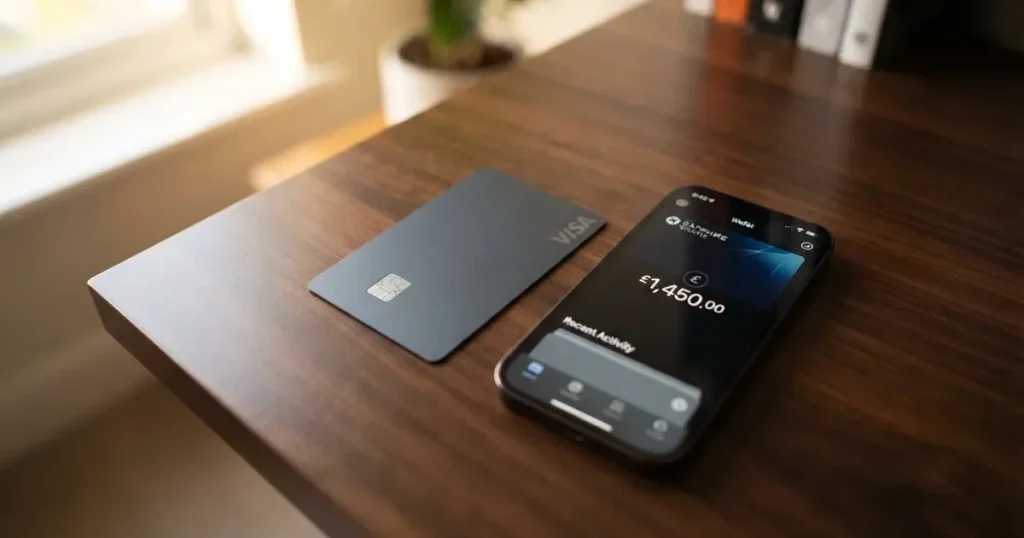
Spritz is a Visa Signature card that you load with crypto from a wallet you control, and then spend like an ordinary prepaid card online, in stores, and through Apple Pay or Google Pay. Spending and account maintenance carry no fees, the top-up options are very wide, and eligibility is decided by where you live rather than by your citizenship. The catch is a single hard rule that shapes everything else: money loaded onto the card cannot be returned or transferred out. You spend it or you lose it. If that trade suits how you already hold money, this card works well. If you need a fallback, or a way to move a balance back to self-custody, look elsewhere.
The conditions described here are current as of October 28, 2026.
The verdict: 7.4 out of 10, and it is aimed at a specific person
Spritz scores 7.4 / 10 overall. That number is not a rounding of vague impressions; it comes from six criteria, each marked separately, and the marks tell you where the card is strong and where it merely survives. The strongest mark is top-up options (9/10) and the weakest is reliability and complaints (6/10). If your priorities are the opposite — if you want a card you can drain back into crypto, or you read reviews before you read fee tables — this ranking tells you in advance that you are looking at the wrong product.
| Criterion | Mark | Why |
|---|---|---|
| Who can get it | 7 / 10 | Residence-based, not citizenship: “many international countries and territories”; unofficial counts say 42 countries including the US across 30 states |
| Cost | 8 / 10 | No fees on spending or account upkeep; loading is 1% base with a $2 minimum, USDC on Arbitrum, Avalanche, Base, Optimism, Polygon and Solana at +0%, USDT on Tron at +1.5%; issuance and FX fees not disclosed |
| Top-up options | 9 / 10 | From your own wallet: 50,000+ tokens across 5 chains, with USDC and USDT on Tron, USDC on Arbitrum, Avalanche, Base, Optimism, Polygon, Solana, plus Bitcoin, DASH, XRP and Sui |
| Reliability and complaints | 6 / 10 | Spritz Finance, issuer not officially named (unofficial: Rain); loaded funds cannot be withdrawn; unofficial ratings include Trustpilot 4.0 out of 5 from 319 reviews and App Store 3.2 out of 5 from 11 ratings |
| Everyday use | 7 / 10 | Apple Pay and Google Pay supported; virtual and physical card; unofficial reporting says the physical card is a limited release for the US with an ATM on the physical card |
| Total | 7.4 / 10 |
Who this suits: someone already holding self-custodied crypto, comfortable selecting a network and paying gas, who wants a Visa number to spend from without selling into a banking system that will not open an account for them. The card exists precisely because the ordinary route is blocked. Who it does not suit: someone treating the card balance as a temporary parking space, anyone who needs ATM cash as a standard feature, and anyone who wants card rewards beyond a Visa Signature benefit list.
Who you need to be before Spritz will talk to you
Eligibility runs on residence, not citizenship. Spritz’s own words: “Spritz works off of your residence versus your citizenship.” The blog says it works in “many international countries and territories”, and the actual list is a table in the help centre. That distinction matters in both directions: a citizenship that would be rejected elsewhere does not disqualify you if you live in a listed place, and a listed citizenship does not help you if you live somewhere unlisted. Nigeria needs conditional approval rather than an automatic yes, and countries not on the list are unsupported. Before you spend an evening on an application, find your country in that help-centre table — it is the only eligibility test that counts.
Unofficial sources put the availability at 42 countries including the US across 30 states, and list Belarus, Cuba, Iran, North Korea, Russia, Syria and Venezuela as restricted (CryptoCardHub, August 2026). Neither the country count nor the restricted list is confirmed by Spritz’s own pages, so treat both as orientation rather than as fact.
Getting the card: identity checks first, card activation second
You must be at least 18, and you need a verified account. That means uploading ID; if the automated check stalls, manual verification through support is possible. Once the account is live, card activation happens in the app at app.spritz.finance/card, which the company says takes “in minutes”. The card you are applying for is “The premium Spritz Card”, a Visa with Visa Signature benefits, available in virtual and physical types in the API documentation, and funds on it are denominated and stored in USD.
What exactly gets collected is not fully published on the card’s public pages. Unofficial descriptions (CryptoCardHub, August 2026) list a government photo ID, phone number, legal name, date of birth, ID number, address and a live face check, and note that a partner may add citizenship, passport or address checks of its own. Two things the card’s own pages do not state: there are no KYC tiers — no simplified or premium verification level — and neither the processing time beyond “in minutes” nor the reasons an application might be rejected is published. There is also no stated policy on how to delete an account, which is worth asking about directly if that matters to you.
The physical card is where the gap between official and unofficial is widest. Spritz does not publish delivery times, a delivery price, or a replacement fee, and none of that is not stated. Unofficial reporting (CryptoCardHub, August 2026) describes the physical card as a limited release with a 3,000-card Alpha allocation for US customers and no published price. Plan on the virtual card as the thing you will actually use this month.
What it really costs: Fees
The headline is genuinely good, and then the fine print starts. Spending on the card and maintaining the account carry no fees. What costs money is loading the card, and the load fee depends on which network and token you send. There is no FX fee disclosed, no issuance fee disclosed, and no ATM fee disclosed. Unofficial reporting states an annual and monthly fee of $0, and says there is no Spritz fee on card purchases though exchange rates apply abroad — meaning that if you spend in a currency other than the one your balance is in, someone is converting it, and the card does not say at what rate or with what markup.

| Fee or limit | What the card’s public pages say |
|---|---|
| Spending on the card | No fee |
| Account maintenance | No fee |
| Issuance fee | not stated |
| Card load fee | 1% base (0.5% base + 0.5% virtual card load), $2 minimum |
| USDC on Arbitrum, Avalanche, Base, Optimism, Polygon, Solana | +0% on top of the base |
| Other tokens on those networks | +0.5% |
| Ethereum, all tokens | +0.5% |
| Sui: USDC | +1% |
| Sui: SUI | +2% |
| BSC | +1% |
| XRP | +1.5% |
| Tron: USDC | +0.5% |
| Tron: USDT | +1.5% |
| Bitcoin | +1.5%, minimum $5 |
| DASH | +1.25% |
| FX fee | not stated |
| ATM fee | not stated officially; unofficial: the physical card works at supported Visa ATMs, no fee figures |
| Daily limit | $10,000 |
| Maximum card balance | $10,000 (US, Canada and all other supported countries) |
| Card load maximum | $5,000 per load (unofficial, and it conflicts with the official table) |
| Tiers | One card described: “premium Spritz Card”, Visa Signature. No paid tiers |
| Currency | All funds added to the card are denominated and stored in USD |
Read the second table row by row before your first load, because the cheapest path is specific. The base is 0.5% plus 0.5% for loading a virtual card, with a $2 floor. Sending USDC over Arbitrum, Avalanche, Base, Optimism, Polygon or Solana adds nothing to that. Sending USDT over Tron adds 1.5%, and a card that is denominated in USD that you are funding with a Tron-based dollar token is the most expensive common route. Bitcoin is worse: 1.5% with a $5 minimum.
Two everyday payments show what that means. Buying a $30 lunch with USDC taken from your Arbitrum balance costs $0.30 in loading fee, if you loaded it in one go; split into six small loads, the same $30 costs $12 in minimums. And a $200 purchase while travelling, with the balance held in USD and the terminal charging you in euros, costs $0 on Spritz’s side plus whatever conversion the network applies — a figure the card does not publish, which is exactly why you should treat the travel exchange rate as unknown rather than as free.
One thing in your favour, if you are reading this early: the blog says loading fees are waived for the first 30 days after launch. That window is a launch promotion, not a standing rate, and it is the moment to learn the mechanics with small amounts.
How to top up: your wallet, the right network, and a fee table worth reading twice
Topping up happens from your own wallet, and this is the card’s strongest dimension — 9 out of 10. Spritz says 50,000+ tokens across 5 chains are supported. The help article names Bitcoin, DASH, and USDT and USDC on Tron, and the fee table lists Arbitrum, Avalanche, Base, Optimism, Polygon, Solana, Ethereum, Sui, BSC, Ripple, Tron, Bitcoin and DASH. Crypto is converted to USD through a quote and credited into a program balance.
The mechanics matter more than the breadth. Network fees, called gas, are paid by you and are separate from Spritz’s own fees — the help centre keeps them distinct, which is honest and also a reminder that a cheap load on a cheap network can still cost real money in gas. The minimum load amount is not stated. Fiat top-up is not stated either; there is a separate on-ramp with a 1% flat charge, which is not the same thing as funding the card from crypto.
Get one detail right and you avoid the most expensive mistake available here: send the asset on the network you intend. Circle stopped supporting USDC on Tron in February 2024, so “USDC over TRC20” is not a native option. Blockchain transfers are irreversible, so a deposit sent on an unsupported network, or to an address belonging to another network, can be lost outright or need manual support recovery with no guarantee of success.
And then the rule that decides whether this card is usable for you at all: “Once funds are on your Spritz Card we cannot return or transfer them.” They must be spent. A bank off-ramp exists, but only for crypto sent through Off-Ramp — not for the card balance. What happens to a leftover balance when you close the account is not stated. Load what you are willing to lose track of, and treat the card as a spending wallet rather than a store of value.
Paying with it every day
Day to day, this behaves like a normal Visa. Apple Pay and Google Pay are supported for online, in-store and mobile payments, and both a virtual and a physical card exist, with the unofficial picture being that the physical card is a limited release in the US and that the ATM function sits on the physical card rather than the virtual one. Refunds should process back to the card within 7 business days, after which the support chat is the route — there is no separate chargeback process described. Unofficial reporting says merchant refunds can in practice take up to 30 business days, which is a gap you should plan around if a large purchase goes wrong.
Rewards are the thinnest part of everyday use. Cashback is not stated officially; what is official is the Visa Signature benefit set — lounge access, travel insurance and purchase protection. Unofficial reporting describes a promotion called “Shopping Sprees”: 5% on airlines, hotels, restaurants and travel agencies inside a 3-day window, capped at $20 per merchant and $40 per spree, up to $80 a month, paid as withdrawable Spritz Credits. Treat that as a promo rather than a plan.
The app is a web app at app.spritz.finance plus an iOS app, and the official store pages were not readable when I checked. Unofficial ratings disagree slightly: App Store 3.2 out of 5 from 11 ratings as of 2026-10-21, and 3.4 out of 5 from 10 ratings in August 2026 per CryptoCardHub. Small samples, and worth your own look before you rely on an app for balance tracking.
Two things you will not find published, and both explain real declines. Which merchant categories are blocked is not stated, and the help article notes declines can come from merchant restrictions or from 3-D Secure. To understand why: a merchant category code is the four-digit classification a business is assigned when it starts accepting cards, gambling being the category issuers most often block by policy rather than by law, and the blocked list differs by issuer. So a decline is usually policy, not a malfunction, and the blocklist on this card is unpublished.
What can go wrong
The biggest documented risk is that loaded funds cannot be withdrawn to crypto. That is not a bug report; it is the stated design. On top of that, unofficial user and news reporting (CryptoCardHub, August 2026) lists further drawbacks: Spritz Points are not yet redeemable, cashback is limited, and the physical card is a limited release. Official incidents published by the company: none.
The corporate picture is thinner than the marketing suggests. The company is Spritz Finance. The issuing institution is not officially named. Unofficial reporting describes a Visa Signature card powered by Rain, issued through licensed partners by jurisdiction, with the institution itself unnamed. That matters more than it might seem, because a card’s survival depends on the issuer’s licence rather than on the brand’s app — Visa can suspend a programme, and has done so before. In November 2022 Visa terminated its global agreements with FTX and the FTX US debit card programme was wound down by its issuer.
Card controls are ordinary and sensible: the card can be active, frozen, not activated or cancelled, with cancellation being permanent, and PIN and card details are end-to-end encrypted. What is not stated is how custody and safeguarding work — who holds the balance, and in what kind of account. For a card funded from self-custody, that is the question to ask before loading a large sum. If the balance is safeguarded the way e-money rules require elsewhere — segregated accounts or insurance — it is not the same as a bank deposit and may not sit under a deposit guarantee scheme.
Reviews are mixed rather than bad. Unofficial user reporting gives Trustpilot 4.0 out of 5 from 319 reviews in the text, against 3.8 out of 5 from 253 in the rating box. The recurring themes: no withdrawal of card balance to crypto, Points not redeemable, and a limited physical card.
Support reaches you at [email protected], through a support chat, and through a “Book a call” form; hours are not stated. One more piece of context: the blog announces the card is “now available internationally”, without a date shown on the page I read — a sign of a young product rather than a settled one.
What to take instead
I compared Spritz with three cards that solve overlapping problems, and the honest summary is that Spritz wins on breadth of top-up and loses on exit.
| Spritz | MetaMask | KAST | TokenPocket | |
|---|---|---|---|---|
| Score | 7.4 | 7.1 | 6.1 | 5.8 |
| Network | Visa Signature | Mastercard | Visa Platinum / Infinite | Visa or Mastercard debit |
| Card cost | Not stated for issuance; no maintenance fee | Virtual free, no annual fee; Metal $199/year | Standard 0 USD, Premium 1,000 USD/year, Private 10,000 USD/year | NFT creation fee partly covered, user pays “a small portion” |
| Load fee | 1% base, $2 minimum, varies by network | “Minimal fee for each transaction”, amount not stated | Stablecoin top-up 0% | 1% on crypto deposit, refunded later via rewards |
| Spend fee | None stated | No additional MetaMask fees; no foreign transaction fee, Mastercard rate used | USD spend 0%; non-USD FX 0.5%–1.75%; declined transaction 0.50 USD | No additional fees stated |
| Cash back | Not stated officially; 5% promo capped at $80/month unofficial | Virtual 1%, Metal headline 3% limited to the first $10,000 spent then 1% | Standard 1.5% on first $2,000/month, Premium 2% on first $10,000/month, Private 3% on first $40,000/month | None; the 1% is refunded via rewards later |
| Card balance recoverable | No | Spends from connected wallet | Spends from own balance, each purchase deducted immediately | Balances in EUR24 and USD24 |
Three comparisons deserve spelling out.
MetaMask is the closest rival on score. It signs up in 45 listed countries and territories with proof of residency, issues a virtual Mastercard instantly and lets you pre-order a metal card afterwards, one card per user, with Monovate as issuer. It spends directly from your connected wallet across Linea, Base, Monad and Solana, and it pays real cash back: 1% on the virtual card. Its catch is the eligibility friction — US and UK sign-ups were temporarily closed per its FAQ, and ineligible regions limit spending rather than sign-ups.
KAST is the one with the most generous published fee schedule — stablecoin top-up 0%, USD spend 0%, Apple and Google Pay 0% — but it charges membership for its better tiers, up to 10,000 USD a year for Private, and its KYC is unusually strict: only the account holder’s own ID counts, a VPN does not help if you live in an unsupported country, and holding an ID from a restricted region can disqualify you even from a supported country.
TokenPocket is the weakest of the four on this evidence, mostly because the critical numbers are missing: no physical card mentioned, no specific coins or networks listed, and a 1% deposit fee that is promised back later rather than refunded now.
Who I would recommend it to
I would recommend Spritz to someone in this position: you hold crypto in a self-custody wallet, USDC on a cheap network such as Base or Arbitrum is your everyday working asset, you have no workable route to an ordinary bank card, and you are looking for a spending instrument rather than a place to keep value. You load small amounts, you spend them down, and you treat the card as a wallet with a Visa number on it.
I would not recommend it to someone who plans to load once and withdraw later, who needs cash from ATMs as a routine feature, who lives in a country that is not in the help-centre table, or who wants published cashback rates and a named issuing bank. The fee table rewards the informed user — Base or Arbitrum USDC costs you 1% and Tron USDT costs you 1% base plus 1.5% fee — but the no-withdrawal rule punishes anyone who loads ahead of their spending.
Two questions to ask before your first load, in this order: what happens to my balance if I stop using the card, and who is the issuing institution. Neither has a published answer. Ask [email protected] and keep the reply.
Frequently asked questions
What is the Spritz card?
Spritz is a Visa Signature payment card you load with crypto from a wallet you control. Crypto is converted to USD and held as a card balance, which you then spend online, in stores, and through Apple Pay or Google Pay. Spending and account upkeep carry no fees. The defining constraint is that money loaded onto the card cannot be returned or transferred out — it must be spent.
How does the Spritz card work?
You sign up, verify your identity, and activate a virtual or physical card in the app at app.spritz.finance/card, which the company says takes “in minutes”. You then send crypto from your own wallet; Spritz converts it to USD through a quote and credits a program balance. All funds added to the card are denominated and stored in USD. Spending draws down that stored balance, which is why the card cannot overdraw.
Is Spritz a bank, and who owns it?
No — Spritz is not a bank, and it does not describe itself as one. The company behind the card is Spritz Finance, and the issuing institution is not officially named. Unofficial reporting describes a Visa Signature card powered by Rain, issued through licensed partners by jurisdiction, with the institution itself unnamed. The card works off your residence rather than your citizenship.
Who can apply for the Spritz card?
Anyone aged 18 or over who lives in a listed country or territory and can complete identity verification. The blog says “many international countries and territories”, with the actual list shown as a table in the help centre. Nigeria needs conditional approval, and unlisted countries are unsupported. Unofficial sources count 42 countries including the US across 30 states. Verification means an ID upload, with manual verification available through support.
Does the Spritz card require KYC, and how long does approval take?
Yes. A verified account is required, meaning an ID upload and, per unofficial descriptions, a live face check and details including legal name, date of birth, ID number and address. The card publishes no KYC tiers, no stated processing time beyond “in minutes” for activation, and no stated rejection reasons. If the automated check stalls, manual verification through support is the documented fallback.
What does it cost to load and spend?
Spending and account maintenance are free. Loading costs 1% base — 0.5% base plus 0.5% for loading a virtual card — with a $2 minimum. USDC on Arbitrum, Avalanche, Base, Optimism, Polygon or Solana adds 0%; Tron USDT adds 1.5%; Bitcoin adds 1.5% with a $5 minimum. Issuance, FX and ATM fees are not stated on the card’s public pages.
Can I withdraw money from the Spritz card?
No. The card states: “Once funds are on your Spritz Card we cannot return or transfer them.” A bank off-ramp exists, but only for crypto sent through Off-Ramp, not for the card balance. What happens to a leftover balance if you close the account is not stated. Unofficial user reviews list the inability to withdraw loaded funds as the most common complaint.
Is the Spritz card safe, and is it a bank?
Safety is not one question but three. Card controls are ordinary: active, frozen, not activated or cancelled status, with cancellation permanent, and PIN and card details end-to-end encrypted. What is not stated is how the balance is safeguarded — segregated accounts or insurance are not described, and safeguarded funds are not the same as bank deposits. The issuer is unnamed officially, which is the gap I would raise with support before loading a large sum.
Can I add the Spritz card to Apple Wallet?
Apple Pay is supported, for online, in-store and mobile payments, as is Google Pay. Apple Pay replaces the card number with a device-specific number stored in the Secure Element, and each payment uses a one-time dynamic security code. One caveat worth knowing: some merchants decline prepaid or foreign BINs because the card lookup reveals the card type and issuer country, which is a common reason for declines that are not your fault.
Is the Spritz card worth it?
Worth it if you already hold self-custodied crypto, want a Visa number without a traditional bank account, and can pick a cheap network — USDC on Base or Arbitrum keeps loading at 1%. Not worth it if you expect to load and later withdraw, need ATM cash as a standard feature, live outside the listed countries, or want published cashback rates; cashback is not stated officially and the Visa Signature benefits are lounge access, travel insurance and purchase protection. My overall mark is 7.4 out of 10.
Wallet card reviews – cryptocardcheck
Content created by the «cryptocardcheck» team