
A free virtual Visa from a crypto wallet, with country rules that decide everything
 Available in US

Tangem Pay is a Visa payment card that spends a balance you load yourself, most often from USDC on the Polygon network, rather than pulling money from a bank account each time you tap. It is aimed squarely at one group: people who already keep funds in a self-custody crypto wallet and want an ordinary-looking card to spend from it, without a bank’s approval process standing in the way. If that is you, the card makes real sense, and the free Basic tier costs you nothing to hold.
If instead you want a normal everyday bank card and are considering this as a substitute, read the eligibility section first. Availability is residence-based and the card’s own readable pages do not publish the country list. That single fact shapes everything else: you cannot tell from the marketing page whether your address qualifies, and third-party listings of “available” countries are not confirmed by the card itself. My score is 6.9 out of 10.
The conditions described here are current as of October 28, 2026.
Verdict: 6.9 out of 10, and the country rule matters more than the card
The card works, the free tier is genuinely free, and there is no monthly fee to escape on Basic. What holds it back is not the product but the perimeter: a residency-based eligibility check with no published list, a company stack where Tangem states plainly that it is not regulated as a financial services provider, and reports of declines and KYC lockouts from people who had already been issued a card. If you are in a covered country and hold stablecoins, this is a reasonable tool. If you are anywhere else, or you need an ATM today, I would not build a routine around it.
| Criterion | Mark | Why |
|---|---|---|
| Who can get it | 7 / 10 | Residence-based, available in the US (not all states) and selected countries in LATAM, APAC, MEA and Africa; the country list is not published; UK and EU planned for 2026 |
| Cost | 7 / 10 | Basic $0/month, Plus $29.99/month; $0 transaction fee, FX at Visa exchange rate + 1.5%; ATM 4% on Basic; plastic delivery $14.53 to $82.10 |
| Top-up options | 6 / 10 | Native USDC on Polygon from any wallet or an in-app swap, plus bank top-up via ACH/FedWire in some regions |
| Reliability and complaints | 7 / 10 | Card issued by Third National, programme run by Rain, service delivered by Paera LLC; Tangem is not regulated as a financial services provider; reports of fuel-station declines and KYC blocks |
| Everyday use | 7 / 10 | Basic is virtual, Plus is plastic; card can be added to Apple Pay and Google Pay; ATM 4% on Basic and 2% on Plus; unofficially, withdrawals are not yet available and plastic cards are not widely issued |
| Total | 6.9 / 10 | Free and simple where it works; gated by residence and by a young, multi-company stack |
So who does this suit? Someone who already holds USDC, sits in a supported country, wants a virtual Visa for subscriptions and online spending, and does not need cash. That person gets a free card, 1% cashback capped at $100 a month, and no monthly fee. Who it does not suit: anyone in the UK or EU today, anyone who needs banknotes regularly, anyone who wants a card in their home currency, and anyone unwilling to sit through a residence-based eligibility check.
Will they give you the card
The eligibility rule is stated by the card as residence-based: “Eligibility is determined based on your country and region of residence,” and the app shows you the outcome during onboarding. Availability is described as the United States, excluding some states, plus selected countries in Latin America, the Asia-Pacific region, the Middle East and Africa. The United Kingdom and the EU are described as planned for 2026.
Here is the part that will frustrate you. The card’s readable public pages do not publish the full country list; what they say is that the card works at “Visa-accepting merchants in over 150 countries.” That is a statement about where the card is accepted, not about who can hold one. I want to be plain about this rather than filling the gap: where I say “not stated”, that means the card’s public pages do not say it. I will not guess.
Third-party sites do publish lists. Reported as available: Argentina, Australia, Bahamas, Barbados, Belize, Bolivia, Brazil, Chile, Colombia, Costa Rica, Dominican Republic, Ecuador, El Salvador, Guatemala, Guyana, Honduras, Hong Kong, Jamaica, Japan, Mexico, New Zealand, Nicaragua, Panama, Paraguay, Peru, Philippines, Singapore, South Africa, Trinidad and Tobago, United Arab Emirates and Uruguay — 31 in total. Reported as restricted: the United Kingdom, Andorra and EU states. Treat those as unofficial indications only; the card has not confirmed them, and the app is the authority on your own address.
One practical check before you invest any time: if you need the plastic card, note that shipping is excluded for roughly 20 countries, including Russia and China, North Korea and Palestine, per Tangem’s own statement as reported in press coverage. So a country can be “supported” for the virtual card and still be excluded from physical delivery.
How to get it
You apply inside the Tangem app, and there is an identity check in the middle of it. The check is done by Sumsub: government ID plus face verification, run after the app confirms your country of residence. Which documents are accepted, whether proof of address is needed, and what age threshold applies are all not stated on the pages I read.
What you get is a Visa card, in three tiers with different card products behind them: Basic is Visa Platinum, Plus is Visa Signature, and Prestige, marked as coming, is Visa Infinite. Basic is virtual, Plus is a plastic card, and Prestige is described as virtual, plastic and metal. The card currency is not stated on the card page; what the fees material says is that the card is USD-denominated.
Two details worth knowing up front. The identity check applies to the Pay account only, not to your wallet, so verifying for the card does not turn the wallet into a custodial account. And your transaction limits will depend on your “risk profile, verification level, and account history” — the levels themselves are not named, which means the ceiling you get may not be the ceiling on the table.
If you are asking what the first card costs: the first physical card issuing fee is $0 on Basic and $0 for the first card on Plus. An additional virtual card is $5, a replacement is $1, and delivery is $14.53 to $82.10 depending on the address, shown in the app when you order. How long delivery takes is not stated. Officially the live format is a virtual card, and third-party reporting adds that most cards issue within minutes with manual review taking up to 48 hours — unofficial, and it is also reported that the first physical batch was capped at 5,000 cards.
Fees: what it really costs to use Tangem Pay
The headline is good and the details are ordinary. Basic costs $0 per month and Plus costs $29.99 per month. Prestige is shown as $999 for the year. A card payment itself carries a $0 transaction fee, and an on-chain withdrawal is $0. The costs land on the edges: currency conversion, foreign exchange, cash withdrawal, delivery, and disputes.
| Fee or limit | Value |
|---|---|
| Basic monthly plan | $0 |
| Plus monthly plan | $29.99/month |
| Prestige | $999/year (shown as a single yearly payment; “coming soon”) |
| First physical card issuing fee | $0 (Basic), $0 for the first card (Plus) |
| Additional virtual card | $5 |
| Replacement card | $1 |
| Physical card delivery | $14.53 to $82.10 depending on address |
| Card payment transaction fee | $0 |
| Non-USD transaction (FX) | Visa exchange rate + 1.5% |
| USDC to USD conversion | 1:1 |
| On-chain withdrawal | $0 |
| Bank top-up via ACH | $1 (Basic), $0 (Plus) |
| Bank top-up via FedWire | $10 (Basic) per one listing, $11 (Basic, Plus) in the offramp row of the same fees material; $0 (Plus) |
| Bank withdrawal (offramp) | $1 ACH / $11 FedWire (Basic, Plus) |
| ATM fee | 4% (Basic), 2% (Plus), 1% (Prestige) |
| Dispute fee | $30 |
| Daily POS spend limit per card | $10,000 (Basic), $50,000 (Plus) |
| Annual limit per card | $10,000,000 |
| Transactions per day / month | 100 / 1000 |
| Cards per user | 3 (Basic), 5 (Plus), 10 (Prestige) |
| ATM withdrawals | maximum 3 per 24 hours, $250 per time |
| Free ATM allowance | not stated |
| Monthly spend limit | not stated |
Two things in that table I would not gloss over. The FedWire figure appears twice in the card’s own material at $10 and $11 for the Basic top-up, and I am reproducing both as written rather than picking one. And a $30 dispute fee is real money when the amount you are disputing is small, which is exactly the case where you would most want to complain.
Now the everyday version. Buying something priced in dollars on a US site: you pay the price, plus $0 in transaction fees, plus $0 for the USDC conversion, so you spend the balance and nothing more. Buying in euros or yen: the Visa exchange rate applies, plus 1.5%, and that is the number to budget with rather than the rate you saw on your morning. Pulling cash from a machine: 4% of the amount on Basic, 2% on Plus, with a cap of three withdrawals in 24 hours and $250 at a time, and there is no stated free allowance, so I would treat every withdrawal as fully charged.
Top up: how the balance gets there
The card is funded with stablecoins or directly from your bank account, and it spends only the balance you have loaded. The specific mechanics: funding is native USDC on the Polygon network, from any wallet that supports it, or an in-app swap. The app page does not name coins or networks beyond that; the fees material is what makes Polygon explicit. Polygon gas is paid by you to the network, so a top-up costs something even though the card’s own fee is $0.
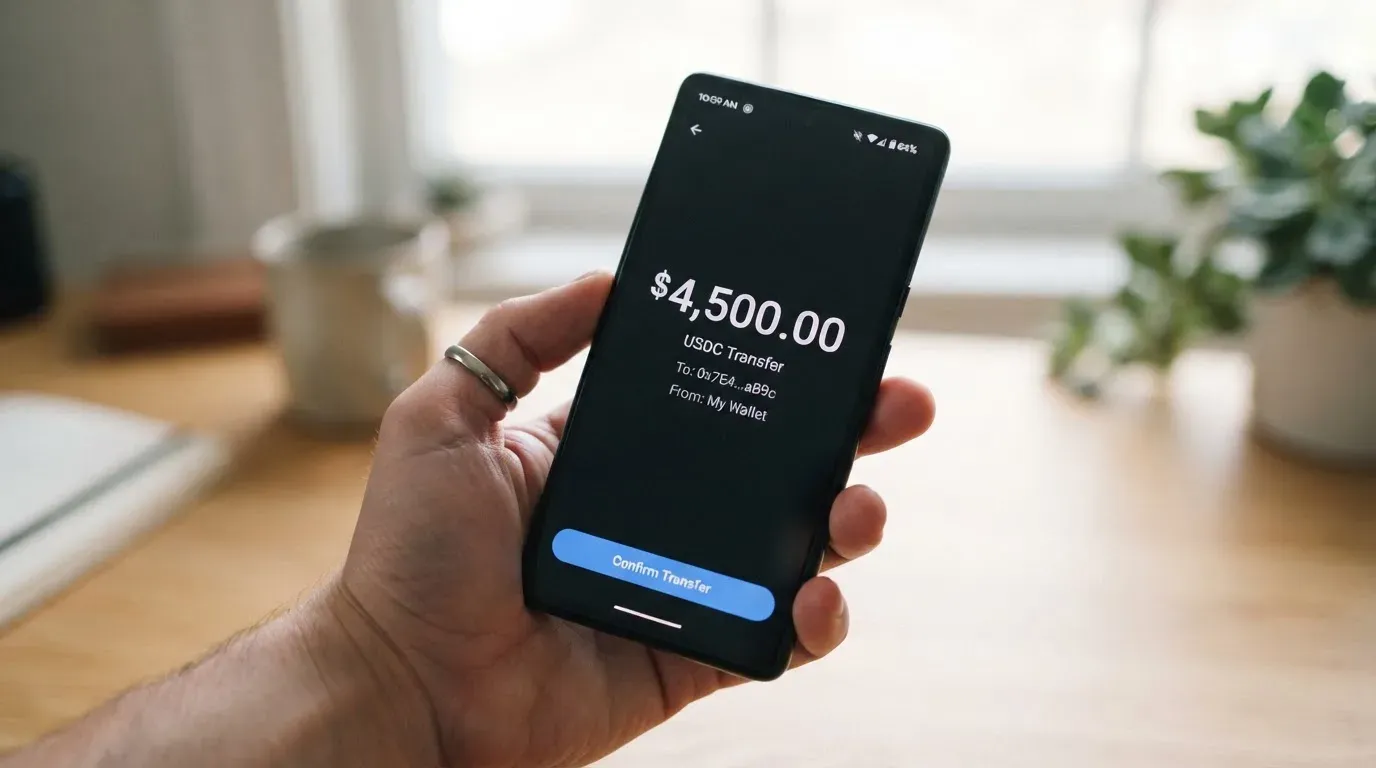
Where a bank route exists, the onramp goes through ACH or FedWire: $1 ACH on Basic and $0 on Plus, FedWire $0 on Plus. Availability varies by jurisdiction, which in practice means you should check your own region rather than assume. The minimum top-up is not stated.
One network warning, and it is not a Tangem-specific one. Blockchain transfers are irreversible. Send USDC on a network the provider does not support, or to an address belonging to a different network, and the funds can be lost or need manual recovery with no guarantee attached. Check the network twice before you confirm. It is also worth remembering that stablecoins can lose their peg — TerraUSD collapsed in May 2022, USDC briefly lost its peg in March 2023 during the US banking crisis — so “1:1 to USD” describes the intended conversion, not a guarantee about the asset you hold.
Getting money back out works two ways: on-chain withdrawal at $0, or a bank offramp at $1 via ACH and $11 via FedWire. Whatever is left stays in the account you control, in a smart contract. How you close an account is not stated.
Paying with it every day
Add the card to Apple Pay or Google Pay using the card details in the app, and it behaves like any other tokenised card number on your phone. For the virtual Basic card, that is the normal way to pay, since there may be no plastic. You need Tangem app version 5.35 or later, on iOS 16.4+ or Android. The app’s store listing shows 4.9/5 from 25K ratings as of my check, though that rating covers the whole Tangem Wallet app rather than Pay alone.
Where it is not accepted matters more. Blocked merchant categories include gambling, online casinos and liquor stores, though the full list was not readable. In practice, that means some subscriptions and some ordinary shops simply decline the card. Merchant category codes are the mechanism: a four-digit code assigned to a business, with 7995 covering gambling, which issuers block by policy rather than by law, and the blocked list differs from issuer to issuer.
Rewards are simple on Basic: 1% cashback with a monthly cap of $100. Plus pays 2% capped at $300; Prestige, when it arrives, is shown at 4% capped at $1,000. Boosted rates of 5%, 10% and 15% on the first $500 are marked coming soon. What currency the cashback is paid in is not stated.
Two behaviours are worth preparing for rather than discovering at the till. First, a decline can leave a hold on your money that stays for several days, typically up to seven — the reason a fuel pump that pre-authorises a large amount can leave your balance looking short afterwards. Second, some shops decline foreign-issued cards because the card’s issuing country is visible in its first digits, and address verification, which compares the numeric parts of the billing address you type with the issuer’s records, is mostly a US, Canada and UK system and often unavailable for foreign cards. Neither is a fault of yours, and both are common to this whole category.
What can go wrong
The stack behind the card has more names than you would expect, and it is worth holding in your head. The Visa card is issued by Third National, with the programme managed by Rain, described as a Visa Principal Member. The service is delivered by Paera LLC, which is responsible for onboarding, KYC and AML. Tangem AG is the wallet maker. The main card page still names Rain as issuer. Licences are not stated for the group.
On the security side, the design is genuinely different from a custodial card. The account is non-custodial: your USDC “sits in a smart contract you control”, and Tangem states in its own footer that it “does not hold, custody, or control users’ assets” and “is not regulated as a financial services provider”. Identity data goes to Sumsub, not to Tangem. Transaction monitoring is by Elliptic. If you freeze the card, it disconnects from Visa and your on-chain balance is unaffected. Whether the funds are insured is not stated — and in a model where the balance is yours, insurance may not be the concept that applies.
What that means practically: you carry the risk of key loss, phishing, and clipboard-hijacking malware that silently swaps a copied address. Crypto transfers are irreversible by design, and the network cannot freeze or return funds for you. Self-custody is the point of this card, but it moves the burden onto you.
Then the practical complaints. A user report gathered by a secondary aggregator that summarises Reddit — unverified — describes declines at fuel pumps, hotels and restaurants tied to pre-authorisation holds, KYC lockouts after the card had already been issued, and activation problems where support asked for a video. Trustpilot shows Tangem overall at about 4/5 from 876 reviews, which is the wallet brand rather than Pay; there is no Tangem Pay-specific Trustpilot page. Add to that the unofficially reported ATM situation: higher tiers advertise ATM pricing, but one source reports withdrawals are not actually available at Basic in practice, and that physical cards are not generally issued yet. I would plan around virtual spending and not build cash access into your week.
Finally, the structural risk nobody can price for you: card programmes close. Visa terminated its global agreements with FTX on 13 November 2022 and the FTX US debit card was wound down. WaveCrest, a Visa issuer that supplied several crypto card brands, was suspended by Visa in Europe in 2018, closing all its programmes. A closure typically means a notice period, then loading and spending stop, then you are asked to withdraw what remains. One reported 2026 closure had new loads ending 8 July 2026 and spending stopping 8 August 2026 — a single unconfirmed source, and a reminder that this is a young product.
What to take instead
I compared this against three other cards that spend from a crypto balance. Here is the honest picture, with the caveat that scores are not money: they reflect how each card fares on the same criteria.
| Card | Score | Cost | Key trade-off |
|---|---|---|---|
| Tangem Pay | 6.9 / 10 | Basic $0/month, Plus $29.99/month | Free virtual Visa, but residence-gated with no published country list |
| MetaMask | 7.1 / 10 | Virtual free, Metal $199/year | Highest score here; Mastercard, spending straight from the connected wallet, but sign-up open only in 45 listed countries and US/UK sign-ups temporarily closed |
| KAST | 6.1 / 10 | Standard $0/year, Premium $1,000/year, Private $10,000/year upfront | Broadest fee transparency, including 0% FX inside 0.5%–1.75% by region, but high tiers are priced for heavy spenders |
| TokenPocket | 5.8 / 10 | NFT creation fee partly covered, small portion paid by user; “no additional fees” | 1% fee on crypto deposits, later refunded via rewards; regional card split across Visa and Mastercard |
MetaMask scores highest, and the reason is structural rather than cosmetic: it spends directly from the connected wallet with no separate pre-loaded balance, with no foreign transaction fee, cashback paid in mUSD, and networks including Linea, Base, Monad and Solana. What it costs you is access — a waitlist outside 45 listed countries, proof of residency, and one card per user.
KAST is the one to look at if fee clarity is your priority. Stablecoin top-up 0%, USD spend 0%, transaction fee 0%, Apple and Google Pay 0%, and an FX fee of 0.5% to 1.75% depending on where you live, where you spend and which card programme. It publishes 1.5% cashback on the first $2,000 a month as standard. It also has the most restrictive eligibility wording I found: if your country is not on the list at KYC, KAST is not available there, and holding only an ID from a restricted region can disqualify you even when you live in a supported country.
TokenPocket is the weakest fit. The 1% deposit fee, partly refunded later through rewards, is a real haircut, and the card split across Visa and Mastercard by region makes it harder to reason about. I would not start here.
Who I would recommend it to
I would recommend Tangem Pay to a Tangem Wallet owner who wants a free virtual Visa and lives somewhere the app says is eligible. That person gets a genuinely free card, spends from stablecoins they already hold, can add it to a phone wallet in minutes, and keeps their funds in a smart contract they control rather than with a custodian. For online spending and subscriptions, that is a coherent, cheap setup.
I would not recommend it as your only card. The country rule is unpublished, the ATM story is weak and unofficially broken at Basic, plastic is not yet widely issued, and the issuer chain is young enough that programme closures are a real category of risk rather than a theoretical one. If you need cash, a local currency, or certainty about next year’s availability, a conventional card from a bank you already deal with is the more reliable instrument — and if your bank will not give you one, this card’s residency gate is exactly the constraint that will stop you.
The decision rule I would use: check the app first, because it is the only authority on your address. If it says eligible and you spend online, take the free Basic tier and ignore every paid tier until you have a reason. If it says ineligible, no amount of reading this page changes that.
Frequently asked questions
What is the Tangem Pay card?
It is a Visa payment card that spends a balance you load yourself, most often USDC held on the Polygon network, rather than charging a linked bank account. Basic is a free virtual Visa Platinum card. You add it to Apple Pay or Google Pay using card details in the app, and it behaves like an ordinary tokenised card. Your USDC sits in a smart contract you control, not with Tangem.
How does Tangem Pay work in practice?
You top up, then spend only what is loaded, so the card cannot overdraw. A dollar-priced purchase costs the price plus a $0 transaction fee, with USDC converting to USD 1:1. Non-dollar purchases add the Visa exchange rate plus 1.5%. ATM withdrawals cost 4% on Basic, capped at three per day and $250 a time. The app must be version 5.35 or later.
Is Tangem Pay a bank, and who actually issues the card?
No, Tangem is not a bank, and it states in its own footer that it is not regulated as a financial services provider. The Visa card is issued by Third National, the programme is managed by Rain, described as a Visa Principal Member, and Paera LLC delivers the service, including onboarding, KYC and AML. Tangem AG is the wallet maker behind the app.
Who can get the card?
Eligibility is based on your country and region of residence, and the app tells you the result during onboarding. Availability covers the US minus some states, plus selected countries in Latin America, Asia-Pacific, the Middle East and Africa; the UK and EU are planned for 2026. The card’s public pages do not publish the full country list, and third-party lists are unofficial.
Does Tangem Pay require KYC?
Yes. After the app confirms your country of residence, Sumsub runs a government ID and face verification. It applies to the Pay account only, not to your wallet. Your transaction limits then depend on your risk profile, verification level and account history, and those levels are not named publicly. Which documents qualify is not stated.
What does it cost to use?
Basic is $0 a month and Plus is $29.99 a month. Card payments carry a $0 transaction fee and on-chain withdrawal is $0. The costs that bite are non-USD transactions at the Visa exchange rate plus 1.5%, ATM at 4% on Basic, plastic delivery from $14.53 to $82.10, an additional virtual card at $5, a replacement at $1, and a $30 dispute fee. Basic pays 1% cashback capped at $100 a month.
How do I top up, and can I get the money back out?
Top up with native USDC on the Polygon network from any wallet that supports it, or swap inside the app; Polygon gas is paid by you to the network. Where available, bank top-up runs through ACH at $1 on Basic and $0 on Plus, or FedWire at $0 on Plus, with availability varying by jurisdiction. Withdrawals work the same two ways: on-chain at $0, or to a bank at $1 ACH and $11 FedWire.
Is it safe, and what happens if I freeze the card?
The balance is non-custodial: your USDC sits in a smart contract you control, and Tangem says it neither holds nor controls users’ assets. Freezing the card disconnects it from Visa and leaves your on-chain balance untouched, and identity data goes to Sumsub rather than Tangem. The trade-off is that key loss, phishing and bad transfers are yours to manage — blockchain sends cannot be reversed.
Why is my payment declined at a petrol station or hotel?
Two usual reasons, both common to crypto cards. The merchant places a pre-authorisation hold, often a large one, and it can sit on your balance for several days, up to seven. Second, the card’s issuing country is visible in its first digits, so some merchants treat it as foreign, and address verification systems are mostly US, Canada and UK. User reports through a secondary aggregator, unverified, describe exactly these declines.
What should I check before I commit?
Open the app and confirm your country is eligible, because that list is not published anywhere else. Then decide whether you need cash: ATM withdrawal is 4% on Basic and is reported as not actually available in practice at Basic. If you want plastic, check whether your address is inside the roughly 20 countries excluded from shipping. And if your spending is dollar-based online, the free Basic tier is the whole product.
Wallet card reviews – cryptocardcheck
Content created by the «cryptocardcheck» team