
Three virtual cards, one quiet company: TapX in detail
 Available in US
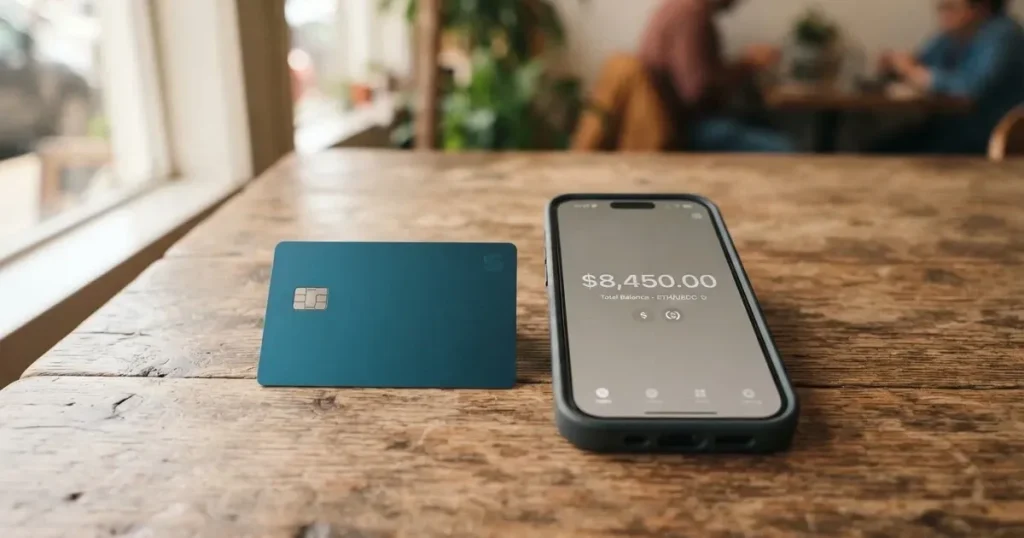
TapX sells three virtual cards that you pay for up front in USDT and then load with crypto: a Visa Universe card at 199.00 USDT, a Mastercard Business card at 50.00 USDT and a Visa E-commerce card at 30.00 USDT. The idea is simple — hold USDT, get a card number, pay for the online services you would otherwise have to fund with a bank transfer. The execution raises more questions than it settles. The public pages never name a legal entity, an issuing bank or a licence; the country list is not published; the only top-up route described is USDT; and there is no physical card at all.
My score for it is 5.1 out of 10. That is not a dismissal. For a specific person — someone already sitting on a USDT balance who needs to pay for software, hosting or ad platforms and has no ordinary card in reach — this card does a real job, and it does it fast: Universe and Business are issued within 2 minutes after verification. For everyone else, the cost of entry is high, the fees are not fully published, and the absence of any named company behind it is the kind of thing you have to weigh before you load money, not after.
The conditions described here are current as of October 28, 2026.
How the card scored, criterion by criterion
| Criterion | Mark | Why |
|---|---|---|
| Who can get it | 8 / 10 | Countries are not listed; the page says every card is crypto-friendly and “works globally”. No country restrictions are named, and nothing is said about citizens or residents of any particular country. |
| Cost | 2 / 10 | Issuance is 199.00 USDT (Universe), 50.00 USDT (Business) or 30.00 USDT (E-commerce), each with a 10.00 USDT initial top-up; top-up fees are 3.0 % and 3.5 %, authorization 0.50 USD, and there is no monthly fee. |
| Top-up options | 5 / 10 | The starting top-up is in USDT; no other methods are named on the page. Unofficial starting data mentions USDT, USDC, ETH and BTC, but the networks are not disclosed and none of that is confirmed by the card’s own pages. |
| Reliability and complaints | 4 / 10 | No legal entity, issuer or licences are named. Unofficial: the domain was recently registered with hidden WHOIS, no confirmed complaints were found, and no Trustpilot reviews surfaced. |
| Everyday use | 7 / 10 | Three virtual cards; Universe and Business work with Apple Pay and Google Pay; there is no plastic. Unofficial: an ATM fee is mentioned as free, but the sources disagree. |
| Total | 5.1 / 10 | Good for one narrow job, thin on everything a card is normally judged on. |
The strongest line in that table is the first one, and the weakest is the second. Anyone can apply, apparently, from anywhere — which sounds like freedom until you notice that nobody has said who is on the other end of the application. And the price of getting in is genuinely steep: you pay for the card before you have proved you can use it, and then you pay again, at 3.0 % to 3.5 %, to put money into it.
Who gets the card
The page states that countries are not specified and that every card is crypto-friendly and “works globally”. There is no country list, no exclusion list, and no statement about Russian or Belarusian citizens or residents specifically. If that is your situation, the card’s own pages simply do not address it, and you should treat that silence as an unanswered question rather than a green light.
Eligibility otherwise follows from the verification tiers, because the card you buy determines how much checking you get. There is no separate list of who qualifies — no stated minimum age, no stated proof-of-address requirement. Under EU rules, prepaid and debit cards are generally available to adults at 18 and over, and some issuers set higher limits; the card does not say where it sits on that scale.
Two questions live here that I cannot answer for you from the public material. Who is legally responsible for the card, and what happens to your balance if that entity stops operating. I will come back to both in the risk section. For now, the practical reading: the onboarding is open, and the absence of restrictions is not the same as a statement that you are welcome.
Getting the card
The path is short. You choose one of the three cards, complete verification at the level that card requires, and pay the card price plus a 10.00 USDT initial top-up. Universe and Business are issued within 2 minutes after verification.
What each card asks for:
- Visa Universe, 199.00 USDT — phone number, international passport, and a face photo.
- Mastercard Business, 50.00 USDT — phone number and international passport.
- Visa E-commerce, 30.00 USDT — phone number only.
So the verification depth is priced into the card. The cheapest card asks the least of you and is the one aimed at online services; the most expensive card asks for a passport and a photograph of your face. There are three levels of checking in total, tied to which card you buy: phone only, phone plus passport, phone plus passport plus face photo.
What is not stated is as telling as what is. There is no proof of address in the list. There is no stated age requirement. And the page gives no reasons for rejection — no list of what trips a decline, no appeal route, no timeframe for a decision if a check stalls. If you have ever been refused by a financial institution and are trying to work out whether this is a fresh start or a repeat of the same experience, that absence is the thing to ask about before you pay.
On activation and account removal, the pages are quiet in the same way: nothing describes a separate activation step beyond issuance, and nothing describes deleting an account. If keeping a clean exit matters to you — because you may be opening something you intend to close — that is an unanswered question, not a reassurance.
Fees: what a TapX payment really costs
Here is the honest version. You pay for the card before you spend anything on it, you pay to load it, and several of the smaller charges only appear once you start spending.

| Fee or limit | Universe (Visa) | Business (Mastercard) | E-commerce (Visa) |
|---|---|---|---|
| Issuance | 199.00 USDT | 50.00 USDT | 30.00 USDT |
| Required initial top-up | 10.00 USDT | 10.00 USDT | 10.00 USDT |
| Monthly fee | none | none | none |
| Top-up fee | 3.0 % | 3.5 % | 3.5 % |
| Authorization fee | 0.50 USD | 0.50 USD | 0.10 USD under 1 USD, free above |
| Apple Pay commission | not stated | 0.20 % | not stated |
| 3DS fee | not stated | not stated | 0.03 USD |
| High-decline penalty (declines over 10 %) | not stated | not stated | 0.80 USD |
| FX fee | not stated | not stated | not stated |
| ATM fee | not stated | not stated | not stated |
| Monthly limit | 1,000,000.00 USD | 500,000.00 USD | No limits |
| Per-transaction limit | 80,000.00 USD | 500,000.00 USD | 20,000.00 USD |
| Daily limit | 1,000,000.00 USD | 500,000.00 USD | No limits |
Fees and limits are stated in US dollars; the card currency is given as USD and prices are collected in USDT. Multi-currency support is not stated, and neither is the FX fee — which is the line I would most want to see answered, because anyone spending outside a dollar zone will hit currency conversion, and no rate, no spread and no fee is published.
The three cards are separate products rather than tiers of one: they differ in verification, fees, limits and wallet support. Universe is the expensive one with the largest monthly and daily ceilings and a per-transaction limit well below Business’s. Business is the cheap one with a very high per-transaction cap. E-commerce is the cheap one with no monthly or daily limit at all, but a 20,000.00 USD ceiling per transaction.
Now, three ordinary payments, to show which fees bite.
A 40.00 USD subscription on Universe. You spent 199.00 USDT to get here and 10.00 USDT to load, so this is the fourth payment you make in the first month and the first that costs only 0.50 USD in authorization. Top it up and the loader takes 3.0 %. There is no monthly fee, so there is no floor to clear — and no FX fee is published, which matters if the service bills in anything other than dollars.
A 25.00 USD card-not-present purchase on E-commerce. Authorization is 0.10 USD below 1 USD and free above, so at 25.00 USD you pay nothing for authorization. But if the merchant declines the payment and your decline rate climbs past 10 %, there is a 0.80 USD penalty, and a 3DS check costs 0.03 USD. On a small recurring charge those two numbers are small; on a card you use for many small online payments in a month, they are the kind of thing that adds up quietly.
Anything at all on Apple Pay with Business. The 0.20 % Apple Pay commission sits on top of the 3.5 % top-up fee. Pay 500.00 USD through a phone wallet and you have paid 17.50 USD to load and 1.00 USD to the wallet.
A word on what is not in that table. ATM fees are not stated; an unofficial source mentions an ATM with no commission, but the sources conflict, so do not plan around free cash withdrawals. Blocked merchant categories are not stated either — and in this category that is not a small omission, because gambling sits under a merchant category code that many issuers block by policy rather than by law, and the blocked list differs from issuer to issuer.
Top up: how the money gets in
The initial top-up is in USDT. No other funding method is listed on the page. Unofficial starting data refers to USDT, USDC, ETH and BTC through the dashboard, but the networks are not disclosed and the card’s own pages do not confirm it.
The top-up fee is 3.0 % to 3.5 % depending on the card. The stated minimum is the 10.00 USDT initial top-up. Who pays the blockchain network fee is not stated, and no fiat top-up route is described. Withdrawal is not stated.
That network question is the one I would not gloss over. On-chain network fees are charged by the blockchain, not by the card provider — so on Ethereum that means gas paid in ETH, which is why a wallet holding USDT but no ETH cannot send. Tron prices its fees through bandwidth and energy, often burning TRX. USDT has been issued on networks including Ethereum, Tron, Solana, Polygon and Avalanche; USDC, which Circle lists as natively supported on 38 networks as of 16 September 2026, stopped being supported on Tron in February 2024, so “USDC over TRC20” is not a native option.
And the mistake people make is irreversible. Blockchain transfers cannot be undone. A deposit sent on a network the provider does not support, or to an address belonging to another network, can be lost or need manual recovery with no guarantee attached. Before your first transfer, get the network and address from the dashboard rather than from memory or from a support reply, and check them twice. The fact that the page does not name the networks is what makes this hard, not easy.
Paying with it day to day
The card lives in your phone. Universe and Business work with Apple Pay and Google Pay, and the page describes every card as “ready for Apple Pay & Google Pay”. The E-commerce card is marketed for online services, with Google, OpenAI, ChatGPT, Microsoft, Meta, Shopify, AWS, Telegram and TikTok named. There is no physical card — no plastic, no metal — so every payment is a tokenised mobile-wallet payment or a card number typed into a checkout page.
Apple Pay replaces the card number with a device-specific account number stored in the Secure Element on the device, never on Apple’s servers, and each payment carries a one-time dynamic security code. That is a genuine advantage over typing a card number into a website. It is also worth knowing that an issuer can restrict a tokenised number — blocking it on magnetic-stripe, phone or website use — so support for the wallet does not mean support everywhere.
The Business card supports 3-D Secure payments. What that buys you is an identity check on online payments, where the issuer assesses risk and either approves without friction or challenges you with a one-time code or biometrics. Visa’s brand is Visa Secure, Mastercard’s is Identity Check. Other security controls are not stated: no mention of app-based two-factor authentication, instant card freeze, or spending limits as a safety feature.
Around the payment itself, a few category realities apply. Address verification compares the numeric parts of the billing address you type against issuer records; it is mainly offered in the US, Canada and the UK and is generally unavailable for foreign-issued cards, which can cause declines. Some merchants decline prepaid or foreign-issued cards outright because the issuer’s BIN lookup reveals the card type and issuing country. A declined authorization may leave a hold on your funds for several days, typically up to seven.
What is not described is any rewards programme. The page claims “favorable conditions for commissions and conversion” for Universe, which is a promise about pricing rather than a cashback scheme — and given that no FX fee or conversion rate is published, it is not a claim you can check. The interface is a dashboard on the web plus a Telegram bot; native apps and their ratings are not stated. Disputes and chargeback handling are not stated either, which matters more than it sounds: a chargeback is a refund ordered by the issuer to settle a dispute, with reason codes for fraud, duplicate billing or goods not received, and prepaid-card coverage varies by jurisdiction and should not be assumed.
What can go wrong
The largest risk here is structural rather than technical. The only company information on the pages is a copyright line reading “© Copyright TapxCard, 2026”. No legal entity, no issuer, no licences. That is the first thing I would ask about, because a card is a regulated product and the regulation attaches to a named institution somewhere.
That is not a rhetorical point. Visa and Mastercard do not issue crypto cards to consumers themselves; they license issuers, and they can suspend a programme. In November 2022 Visa said it had “terminated its global agreements with FTX”, and the FTX US debit card programme was wound down by its issuer. WaveCrest, a Visa issuer that supplied crypto card brands, was suspended by Visa in Europe in 2018, closing all WaveCrest-issued Visa programmes. Closures tend to follow a shape: a notice period, then spending and loading stop, then users are asked to withdraw remaining balances.
The pattern that makes this worth taking seriously is that a crypto card usually rests on two licences, not one. The card itself is a payment service under e-money and payment-services law, while MiCA covers the crypto side — custody, exchange, transfer — so a provider can be perfectly sound on one side and unlicensed on the other. In the EU, an electronic money institution may issue e-money, payment cards and e-wallets but cannot lend, and must safeguard customer funds in dedicated accounts or by insuring them; those funds are not the same as bank deposits and may not sit under a deposit guarantee scheme. MiCA itself took legal effect in June 2023, its token rules applied from 30 June 2024 and its crypto-asset service provider rules from 30 December 2024, with a transitional period running only until 1 July 2026 or until a provider receives or is refused authorisation, whichever comes first. ESMA maintains an interim register of authorised providers that you can check, and because a CASP authorised in one member state can serve the EU, that register is the place to look. None of this is advice about what TapX should be; it is the checklist I would run the name through once it exists.
Then the money itself. Control of crypto belongs to whoever holds the private key. A seed phrase — typically 12 to 24 words — is an unencrypted key, and anyone who obtains it can restore the wallet and spend the balance. Transfers are typically irreversible, and a stolen key has no recovery: the network cannot freeze or return funds. Custodial platforms have a real record of failure — Mt. Gox at about US$350 million reported stolen across 2011–2014, Coincheck at about US$400 million in 2018, Ronin Network at US$625 million in 2022 — and if TapX holds your balance, you carry that counterparty and hack risk. With a self-custody-linked card the funds stay in your wallet until the moment of payment, but then key loss, phishing and clipboard-hijacking malware that swaps a copied address are yours alone. Which model TapX uses is not stated.
Stablecoins are not, despite the name, necessarily stable. Tether’s USDT and Circle’s USDC are dollar-pegged and the BIS put about 90 % of stablecoin market capitalisation in these two as of July 2025, but USDC temporarily lost its peg in March 2023 during the US banking crisis, and TerraUSD collapsed in May 2022. Tether also says it disables tokens in wallets on the OFAC sanctions list and has frozen funds tied to illicit activity, so these tokens are not censorship-proof.
On reputation, the search came back thin rather than damning. No official incidents were found. Searches for reviews on Trustpilot and Reddit returned no pages about this brand, and there is no Trustpilot page for TapxCard, which means there is no recurring complaint pattern either — the absence of complaints here is mostly the absence of a public footprint. Unofficial, from an aggregator summarising a 2026 news item: Scamadviser flagged the domain as recently registered with hidden WHOIS, with no confirmed scam reports. That is not evidence of anything, but a domain registered recently and concealed is a fact you can weigh rather than a rumour.
Support is the quietest area of all. No channels are listed; the page links to a Telegram bot, Instagram, X and Facebook. When a payment is declined and a hold sits on your funds for days, or when a transfer goes to the wrong network, “no channels listed” is the answer you will be reading.
One more thing, because it is easy to forget and expensive to skip: in the US the IRS treats digital assets as property, so exchanging them for goods, services or dollars generally produces a taxable gain or loss, measured in local currency at fair market value on the transaction date. Each card payment funded from crypto may be a separate disposal. I am not offering tax advice — I am saying that the cost of this card is not fully visible in its own fee table, and that part of it is yours to work out.
What to take instead
Three alternatives came up in the same category, and all three score within a point of TapX. That is worth saying plainly: at 4.7 to 5.6 out of 10, this whole corner of the market is thin, and TapX sitting in the middle of it is not an accident of my scoring.
| TapX | Cardex | CardFlow | HyperCard | |
|---|---|---|---|---|
| Score | 5.1 / 10 | 5.6 / 10 | 4.9 / 10 | 4.7 / 10 |
| Card | Three virtual cards; no plastic | Debit crypto card on VERVE, VISA, Mastercard and UnionPay; virtual and physical per the App Store listing | Virtual USD Mastercard, created in about 3 minutes | Prepaid “HyperCard”; network not stated |
| Cost | 199.00 / 50.00 / 30.00 USDT issuance, no monthly fee | Not stated | “Creating a virtual card is completely free”; monthly fee not stated | Not stated; the App Store page lists no fees |
| Who it targets | Anyone paying for online services from a USDT balance | “One crypto card, 200+ countries”; App Store listing is Naira-focused, pay in Naira | “Nigeria’s smartest fintech card platform”; “Nigerians and global users” | No country list on official pages; App Store says the card works in “more than 176 countries” — acceptance, not eligibility |
| Top-up | USDT; other methods not listed | USDT, USDC and BTC wallets; networks not stated | Bitcoin, USDT, ETH or Naira bank transfer; networks not stated | Deposit crypto such as USDT, BTC, ETH in the app, converted to USD or EUR; networks not stated |
| Conversion | Fees stated; FX fee not stated | Real-time crypto-to-fiat conversion at the moment of payment, with an “AI-Powered Conversion Rate” that scans global exchange rates and picks the best one; no fee percentage stated | Not stated | Balance in USD or EUR |
Cardex is the closest on shape and the only one that says anything about physical cards, which TapX does not offer at all. CardFlow is the one to look at if the 199.00 USDT entry point is what stops you — it says creating a virtual card is completely free. HyperCard is the least specified of the four: no network, no fees, no country list.
What none of the four publishes well is the same thing TapX does not publish: the legal entity behind the card, the issuer, the licence, the FX fee and the withdrawal route. If your decision turns on any of those, you are choosing between four thin options, and the honest move is to ask each of them the same questions before you load money — not to pick the one with the friendliest app.
Who I would recommend it to
I would recommend TapX to someone in a narrow spot: you already hold USDT, you pay for online services in dollars, a card number in your phone wallet is all you need, and the 199.00 USDT plus 3.0 % is a cost you have already decided is worth paying to convert a balance you hold anyway. If you fit that description, the two-minute issuance is a real advantage over a bank process that takes days, and the fact that you can pay for hosting, model subscriptions or ad platforms without a bank account is the whole point.
I would not recommend it as a primary everyday card, and I would think hard before making it the only card you have. There is no physical card, so a declined payment and a dead phone is an evening with no way to pay. The FX fee is not published, which makes any non-dollar spending unforecastable. Withdrawal is not stated, which makes the exit unforecastable. There is no named company, no issuer and no licence, and the only corporate detail on the page is a copyright line. Support has no listed channels. And you pay 3.0 % to 3.5 % every time you load — a cost that only makes sense if you load infrequently and deliberately, not weekly.
Before you commit, my own checklist would be short. Who is the legal entity and who issued the card. What the FX fee is. How you get money back out. Which networks you can deposit on. What happens to your balance if the programme ends. And whether the register your regulator keeps names them. If the answers are unclear on the last one especially, the fee table stops being the interesting part of the decision.
Frequently asked questions
What is the TapX card?
TapX is a set of three virtual payment cards — Visa Universe, Mastercard Business and Visa E-commerce — sold for a one-off price in USDT and then loaded with crypto. Universe costs 199.00 USDT, Business 50.00 USDT and E-commerce 30.00 USDT, and each requires a 10.00 USDT initial top-up. There is no physical or metal card; the cards are used through Apple Pay, Google Pay or a typed card number. No monthly fee is charged on any of the three.
How does the TapX card work?
You choose a card, complete the verification that card requires, and pay the price plus the initial top-up. The money sits as a balance and the card spends it; if you top up in a stablecoin it is converted to spendable dollars, with conversion terms that the page describes only as “favorable” for Universe. Universe and Business are issued within 2 minutes after verification. Limits apply: Universe 1,000,000.00 USD monthly and daily with 80,000.00 USD per transaction, Business 500,000.00 USD across the board, E-commerce no monthly or daily limit but 20,000.00 USD per transaction.
Is TapX a bank?
Not on the evidence available. The public pages show only a copyright line, “© Copyright TapxCard, 2026”, with no legal entity, no issuer and no licences named. A card programme normally sits with a licensed institution — an EMI or a bank — which the card brand may merely manage. That named institution is exactly what you would want to see before you load money, and the pages do not give it to you.
Can I use TapX card in my country?
The card’s own pages do not say. Countries are not specified, there is no country list and no exclusions; the page says every card is crypto-friendly and “works globally”. Nothing is stated about citizens or residents of any particular country. Where you can spend it and where you can open it are two different questions, and only the first is vaguely answered.
How do I get the TapX card?
Pick one of the three cards, verify at its level, and pay. The E-commerce card needs a phone number only; Business needs a phone number and an international passport; Universe needs a phone number, an international passport and a face photo. Proof of address and an age requirement are not stated, nor are the grounds on which an application might be refused. There is also no stated procedure for deleting an account later.
Does TapX card require KYC?
Yes, and the depth depends on which card you buy — there are three verification levels tied to the three products. What that checking means in law is not described on the card’s pages. In general, KYC rules require regulated businesses to verify customers and assess risk as part of anti-money-laundering law, with ongoing monitoring, and EU due diligence normally covers name, address, date of birth, nationality, a sanctions check and politically-exposed-person status.
How do I top up the TapX card?
The stated method is USDT, with a top-up fee of 3.0 % on Universe and 3.5 % on Business and E-commerce; the minimum is the 10.00 USDT initial top-up. Other methods are not listed officially, though unofficial starting data mentions USDT, USDC, ETH and BTC through the dashboard without naming networks. Check the deposit network in the dashboard before you send, because blockchain transfers are irreversible and a wrong network can mean lost funds.
What are the fees on the TapX card?
Issuance is 199.00 USDT, 50.00 USDT or 30.00 USDT depending on the card, plus a 10.00 USDT first top-up. Top-up is 3.0 % or 3.5 %, authorization is 0.50 USD on Universe and Business, and on E-commerce it is 0.10 USD under 1 USD and free above. E-commerce adds a 0.03 USD 3DS fee and an 0.80 USD penalty if declines exceed 10 %. Business adds a 0.20 % Apple Pay commission. There is no monthly fee; the FX fee and ATM fee are not stated.
How do I add the TapX card to Apple Wallet?
Universe and Business are described as ready for Apple Pay and Google Pay, and the Business card carries a 0.20 % Apple Pay commission. The pages do not set out a step-by-step for adding the card, and they do not describe the mobile apps or their ratings — the interface is described as a web dashboard plus a Telegram bot. Note that an issuer can restrict a tokenised card number to certain channels, so wallet support does not guarantee acceptance everywhere.
Is TapX card safe, and how do I withdraw money?
Safety is the open question here, because the pages name no entity, issuer or licence, and no support channels — only links to a Telegram bot, Instagram, X and Facebook. Withdrawal is not stated at all, which is the first thing I would ask before topping up. Visa and Mastercard do not issue crypto cards to consumers directly; they license issuers and can suspend a programme, and past crypto card programmes have been wound down.
Is the TapX card worth it?
For one specific person, yes: if you hold USDT, you pay for online services in dollars, and 199.00 USDT plus a 3.0 % load is cheaper and faster than the alternative you have. For everyday spending, no — there is no physical card, the FX fee is not published, withdrawal is unstated, and loading costs 3.0 % to 3.5 % every time. My own score is 5.1 out of 10, and I would want the legal entity, the FX fee and the withdrawal route in writing before committing.
Virtual card reviews – cryptocardcheck
Content created by the «cryptocardcheck» team