
The 6.1/10 virtual Mastercard that lives inside Telegram
 Available in US
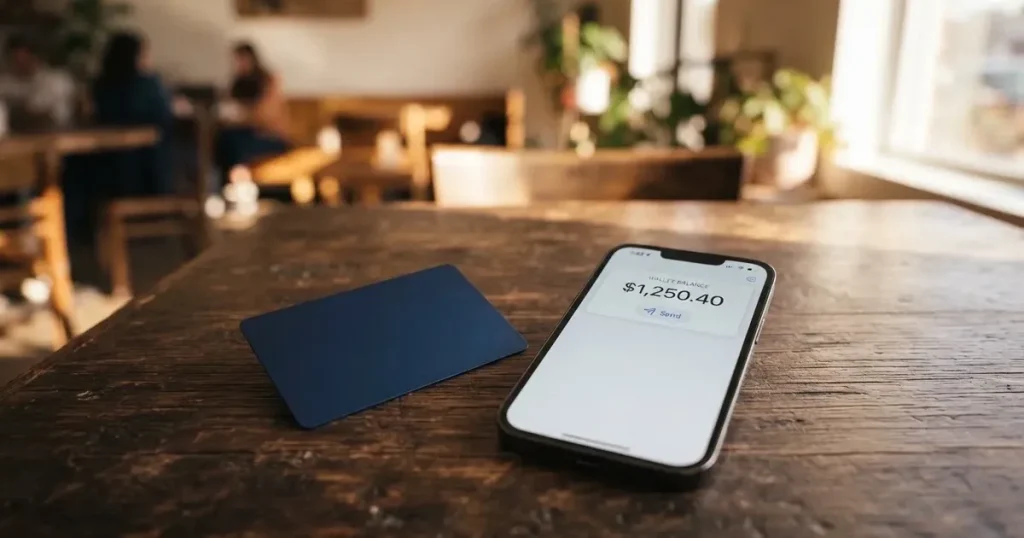
Telecard is not a bank and does not pretend to be one. What it is: a virtual Mastercard, delivered instantly inside a Telegram bot, that you fund with USDT or USDC and spend like an ordinary prepaid card anywhere Mastercard is accepted — over 150 countries, the card’s terms say. There is no plastic, no ATM, no delivery waiting for a parcel. There is an app, a card number, and a chain to transfer crypto into.
I score it 6.1 out of 10. That is not a dismissal and not an endorsement. It is a card that does a small set of things cheaply and quickly, inside a structure where the interesting details are the ones the public pages leave out. Read on, because where the silence sits matters more than where the fees are printed.
Who this suits: someone already living on USDT who needs a card number today — for a subscription, an online merchant that refuses crypto, or a country where opening a normal account has become awkward. Who it does not suit: anyone who wants a bank account, a debit card with a dispute process they can rely on, or physical cash access. Those are different products, and this one is honest about not being them.
The conditions described here are current as of October 28, 2026.
| Criterion | Mark | Why |
|---|---|---|
| Who can get it | 8 / 10 | Works in over 150 countries where Mastercard is accepted; terms exclude only users under US sanctions, including OFAC |
| Cost | 6 / 10 | Standard $5 once, VIP $49 plus $19/month; 1.5% conversion on non-USD payments, 0.5 USDT gas per transaction, $99 minimum deposit held in the wallet |
| Top-up options | 7 / 10 | USDT on Tron (TRC-20) and Ethereum (ERC-20), USDC on Ethereum (ERC-20); 0% deposit fee; bank transfers “coming soon” |
| Reliability and complaints | 3 / 10 | Legal entity, jurisdiction, issuer and licences unnamed, “not a bank”; custodial balance; no reviews found |
| Everyday use | 6 / 10 | Instant virtual Mastercard, Apple Pay and Google Pay; no plastic, no ATM; issued inside a Telegram bot |
| Total | 6.1 / 10 | A quick, cheap virtual card wrapped in an unusually thin layer of published information |
That 3 for reliability is the one to sit with. It is not a complaint about a bad experience — no bad experience is documented. It is a score for what I could and could not verify.
Will they give you the card?
Broadly yes, and the breadth is the card’s strongest feature. The site says the card is usable in over 150 countries wherever Mastercard is accepted, and the terms name exactly one category of excluded user: those “blocked or sanctioned by the United States Government, including OFAC”. So the door is wide open, with a US-sanctions lock on it.
What you will not find is a country list. The card says identity verification is “available in most major regions” but does not publish which regions those are, and it publishes neither a supported nor an excluded country list. If your question is “can I use Telecard in my country”, the honest answer from the card’s own pages is: probably, unless you are under US sanctions, but nobody has told you in writing. That is a gap you close by asking [email protected] before you move money, not by reading a list that does not exist.
Two background points worth keeping in mind here. Sanctions screening is usually applied to citizenship and country of birth as well as to where you live, so a card that accepts you as a resident of one place may still screen you on your passport. And an identity check that is “available in most major regions” is not the same as an identity check that is available where you are — the tier you land in decides which plan you can join, which is the next section.
How to get it
The card is issued from inside a Telegram bot, and there are two plans. The difference that matters most is not the price, it is whether you have to hand over documents.
Standard plan. KYC is required. That means a government ID, a selfie holding that ID, and proof of address dated within three months. Review takes 24–48 hours and the result arrives via Telegram; the card activates after approval. If you are declined, the pages do not say why — rejection reasons are not stated.
VIP plan. No KYC at all. This is the fastest and least demanding route, and it is plainly the point of the tier.
| Plan | KYC | Cost | Card | Limits |
|---|---|---|---|---|
| Standard | Required: ID, selfie with ID, proof of address within 3 months | $5 one-time | Instant virtual Mastercard | $500 daily, $5,000 monthly |
| VIP | None | $49 setup then $19/month | Instant virtual Mastercard | $500 daily, $5,000 monthly, higher limits on request by email |
Two wrinkles you will want to resolve yourself. First, the main page says verification “takes up to 5 minutes” while the help page says 24–48 hours; the help page is the one I would plan around, because the five-minute figure cannot describe a manual document review. Second, the card does not state an age requirement. Prepaid and debit cards are generally available to adults, 18 and over, and some issuers set higher limits, but Telecard is silent — another thing to raise in a message before you start.
If you are asking how to get going, the whole flow is: find the bot, choose a plan, complete the checks the plan requires, receive the card in the app, and add money. There is no plastic to wait for and no delivery to track; the card is virtual only, and a VIP replacement card costs $15. My practical advice about the 24–48 hours is only that if you need a card number today, the VIP path is the one built for that.
Fees and what a payment actually costs
The headline prices are friendly. The per-payment layer is where a $5 card quietly becomes a $5 card plus a slice of every purchase, and you should see the whole shape before you decide.
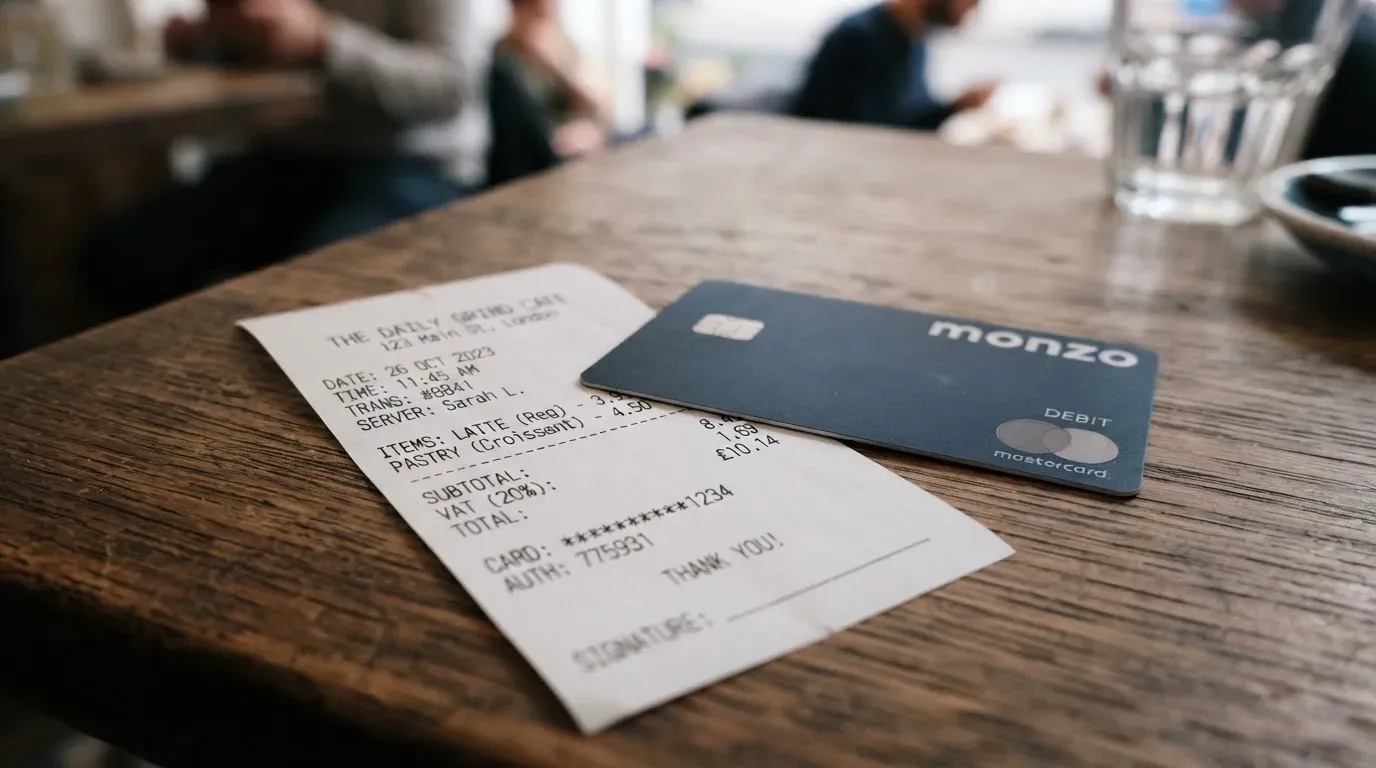
Here is everything the card publishes as a cost or a limit:
| Item | Amount |
|---|---|
| Standard plan | $5 one-time |
| VIP plan | $49 setup, then $19/month |
| VIP card reissuance | $15 |
| Currency conversion | 1.5% (non-USD payments only) |
| Gas fee | 0.5 USDT per successful card transaction |
| FX and cross-border fees | “up to 3% each” |
| Deposit fee | 0% (advertised) |
| Minimum deposit to activate | $99 — stated as “NOT a fee”; the money stays in your wallet |
| Daily limit | $500 |
| Monthly limit | $5,000 |
| ATM | not stated |
The card currency is USD, so paying in dollars costs no conversion. Paying in anything else carries the 1.5% conversion fee. The main page says signing up is free and there is no monthly fee on the basic plan, which is consistent with the $5 one-time figure.
Let me run three ordinary payments through that table, because the point of a fee list is what it does to a specific purchase.
A $20 coffee in euros. Non-USD payment, so the 1.5% conversion fee applies — $0.30. Plus 0.5 USDT gas on the successful card transaction. The “up to 3%” FX and cross-border lines are the ones with no fixed ceiling, so treat them as possible rather than certain, and read them as a range the card publishes without promising you won’t hit them.
A $49 software subscription in dollars. No conversion fee at all, since the payment is in USD. Just the 0.5 USDT gas. This is the shape of payment the card is cheapest for, and it is worth saying plainly: the card is at its best on dollar-denominated online spending.
A $200 purchase on a card you topped up with $99 and $150. You spend $200 of balance; conversion and gas apply as above if it is not a USD payment. Limits are not the issue at this size — $200 is well inside the $500 daily and $5,000 monthly.
One clarification that saves real money: the $99 minimum deposit is not a charge. It is a threshold to activate the card, and the balance stays in your wallet. But it is still money you must have before the card works at all, which is a form of commitment even when it is not a fee.
How to top up
Topping up is where this card is clearest and best, and it is the reason people like it. You send crypto to the card’s address, and you spend from the resulting balance.
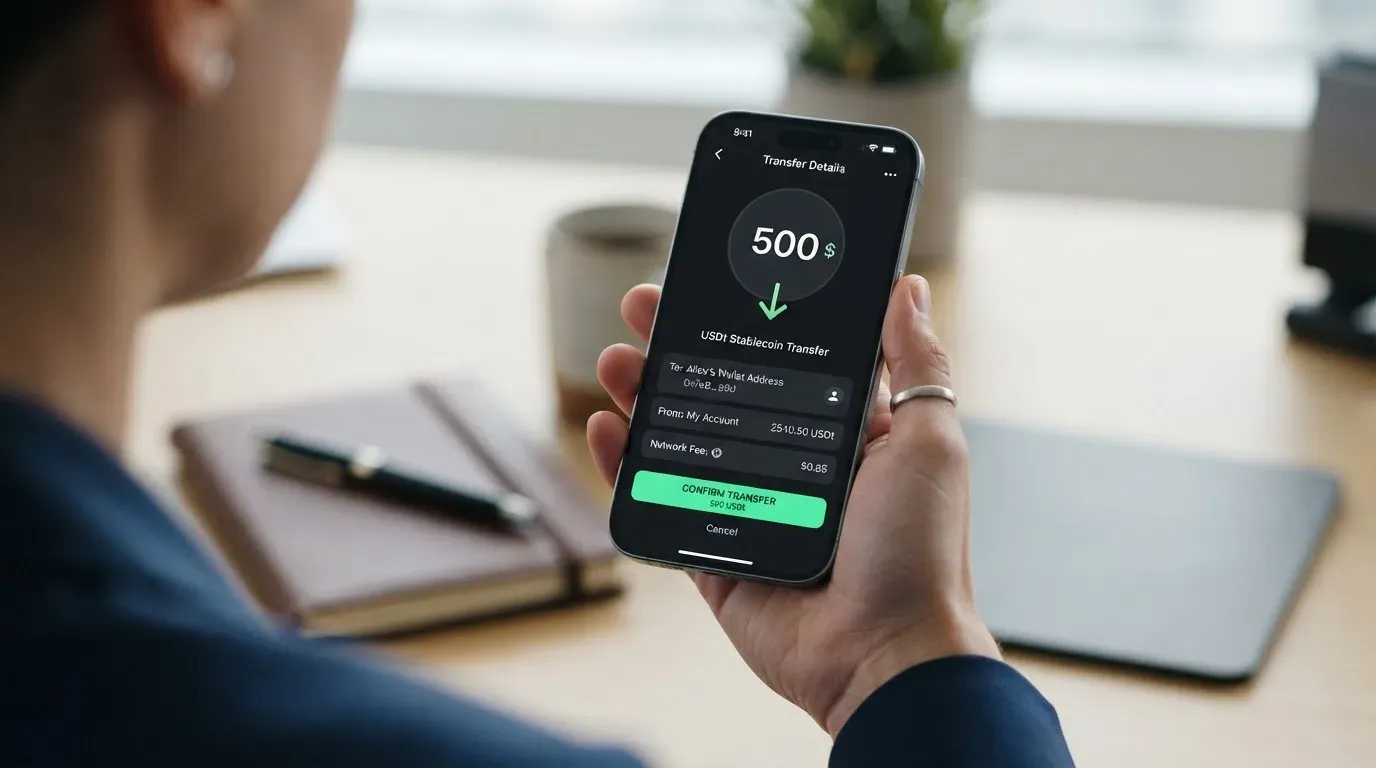
- USDT on Tron (TRC-20) — supported
- USDT on Ethereum (ERC-20) — supported
- USDC on Ethereum (ERC-20) — supported
- Polygon — not supported
- Bank transfers — “coming soon”
The main page additionally lists ETH and TRX, which the help page does not. Treat the two as unconfirmed against each other: the intersection of what both pages promise is USDT on Tron, USDT on Ethereum, and USDC on Ethereum, and that is the conservative set to plan around. The deposit fee is advertised as 0%, and who pays the network fee for deposits is not stated.
Getting this wrong is the single most expensive mistake available on this card, so it is worth a sentence of warning that is not circumvention of anything: pick the network the card supports and match the address to that network exactly. Blockchain transfers are irreversible. A deposit sent on an unsupported network, or to an address belonging to a different network, can be lost or need manual support recovery with no guarantee. The card itself warns at category level that transfers cannot be reversed. If you want to be careful, a small first deposit proves the route before you move size.
Getting money back out is a withdrawal button in the app, to an external crypto wallet on Tron or Ethereum, usually within minutes. Network fees: Tron about 0.5–2 USDT, Ethereum 5–50+ USDT. The main page lists a withdrawal gas fee of 0.5 USDT. Once confirmed it is irreversible. Bank withdrawals are “coming soon”, and what happens to a leftover balance if you close the account is not stated. Note the asymmetry — the cheap network to send in on is also the cheap one to take out on; Ethereum withdrawals can cost more than the balance you are moving.
Paying with it every day
In the app you get an in-app wallet inside the Telegram bot, and the card works with Apple Pay and Google Pay — which, for a card that exists only as a number, is most of the practical convenience story. Tokenised mobile wallet numbers keep the card number off the device in any meaningful sense: Apple Pay replaces it with a device-specific number stored in the Secure Element, never on Apple’s servers, and each payment carries a one-time code. Some issuers still let themselves restrict a tokenised number to particular channels, so if a merchant declines the phone pay, try the raw card number before assuming the card is dead.
Two things about normal payments are simply not stated, and I would rather say so than invent an answer. First, blocked merchant categories — gambling and similar codes are blocked by many issuers as policy, but Telecard publishes no list, so there is no way to know from the outside whether a given category will be declined for you. Second, store ratings for the app are not stated, so the usual public signal about a Telegram product’s quality simply does not exist here.
There is a referral programme: you get Fiorini for each friend who activates, and cashback when friends spend. One USDT is 100 Fiorini. The cashback rate is not specified, so I cannot tell you what it pays out to. The rewards exist; their value is a matter of arithmetic you will have to do yourself.
If a payment goes wrong, the terms offer binding arbitration with no class actions, and the first point of contact is [email protected]. The refund policy is not addressed. That is a real limitation for anyone whose protection depends on disputing a charge, and it belongs in your decision, not buried.
What can go wrong
This is the section where I would slow down, because the risks here are structural rather than anecdotal.
Nobody has said anything about the company. Telecard describes itself as “a financial technology company, not a bank and not insured by the FDIC”, and as a Mastercard partner. The legal entity, the jurisdiction, the card issuer and the licences are not named in the terms. Ask yourself the question you would ask of any counterparty holding your money: *who is the counterparty?* Here the answer is on the public pages nowhere. That is the single largest gap I found, and it is why reliability scored 3.
Your money is custodial. Funds sit in the Telecard account and can be withdrawn to external wallets — which sounds reassuring until you notice what it means: the credentials are held by the provider, not by you, so you must trust them completely. The risks that follow are counterparty risk and hack risk, and those are not hypothetical categories. Mt. Gox lost roughly $350 million reported stolen between 2011 and 2014, Coincheck about $400 million in 2018, and Ronin Network $625 million in 2022. None of that happened to Telecard. All of it happened to custodians, which is the point.
Reversibility is one-way. Crypto transfers cannot be undone. Neither can a confirmed withdrawal. A card that leans on both is a card where mistakes are final.
Sanctions reach into the crypto itself. The card excludes users under US sanctions including OFAC. That is not only a sign-up rule: Tether says it disables tokens in wallets on the OFAC list and has frozen funds tied to illicit activity. Stablecoins are not censorship-proof, and neither, therefore, is a balance held in one.
Two-Factor and freeze are not stated. The standard safeguards — app-based 2FA, instant card freeze, spending limits — are the ordinary protections on a card like this, and Telecard’s pages describe none of them. I am not claiming they are absent; I am telling you that nothing public says they exist, and that you should ask.
There is no track record to lean on. I found no Trustpilot page for Telecard, no recurring-complaint data, and nothing on Trustpilot or Reddit naming the brand. Searches for reviews returned nothing. An absence of complaints and an absence of history look identical from outside, and you should read this section as the latter.
Programmes end. Visa and Mastercard do not issue crypto cards to consumers themselves; they license issuers, and they can suspend a programme. Visa terminated its agreements with FTX on 13 November 2022 and the FTX US debit card was wound down; WaveCrest, a Visa issuer that supplied crypto card brands, was suspended in Europe in 2018, closing all WaveCrest-issued Visa programmes. When a programme closes, the pattern is a notice period, then spending and loading stop, then you are asked to withdraw what is left. One 2026 closure reported by a secondary source had new loads ending 8 July 2026 and spending stopping 8 August 2026 — a single unconfirmed source, but the shape of it is the shape you should expect.
And a small, ordinary point that catches people out constantly: a declined authorisation can leave a hold on your funds for several days, typically up to seven. It is not lost, but it is not spendable.
Support, for what it is worth: in-app chat via Telegram @telecardcryptobot, a Help Center at telecard.ai/help, and [email protected], which answers general mail in 24–48 hours and prioritises urgent cases such as a blocked card.
What to take instead
There is no single better card here — the alternatives are thinner in some places and fatter in others. What they mostly share is one thing Telecard does not offer: a published company behind them, or at least a country list you can read.
| Card | Score | Who | Card and fees | Top-up |
|---|---|---|---|---|
| Telecard | 6.1 / 10 | 150+ countries; excludes US-sanctioned users | Virtual Mastercard; $5 once or $49 + $19/month; 1.5% conversion on non-USD; 0.5 USDT gas | USDT on Tron and Ethereum, USDC on Ethereum; deposit fee 0% |
| Azul Card | 5.3 / 10 | Worldwide except Russia, Belarus, North Korea, Iran, Syria, Cuba, Sudan, Venezuela, Ukraine and the Crimea, Donetsk, Luhansk, Zaporizhzhia and Kherson regions — restrictions apply regardless of nationality | Virtual only; $20 creation, refunded after $2,000 spending, then $5/month; crypto top-up 4%; $0.25 per transaction; FX fee not stated | Crypto sent to the card in Telegram; coins and networks not named; first top-up up to 10 minutes |
| Ape Wallet | 5.5 / 10 | No country list; works “wherever Visa is accepted”; Russian focus | Virtual Visa, service card and Apple/Google Pay card; issuance price not stated (promo codes change it); fee and total shown before confirming | Wallet balance in USDT |
| OnCards | 4.6 / 10 | Not stated | Virtual Mastercard or Visa “directly in your Telegram”; fees not stated, only “no hidden charges” | USDT BEP20; bank transfers not accepted |
Two contrasts are worth your attention. Azul publishes an explicit exclusion list — long, specific, and applied regardless of nationality — which is more information than Telecard gives, even if it is narrower ground. It also costs more per transaction (4% on top-up, $0.25 per purchase) and asks for $20 up front, refunded only after $2,000 of spending. OnCards is simpler and cheaper on paper but tells you almost nothing: no country list, no fee amounts, and a BEP20-only funding route that is a different network from Telecard’s. Ape Wallet shows fees before you confirm an operation, which is a real transparency win, but its price changes with promo codes and it is oriented towards Russian users, with SBP payments and Russian-passport KYC.
Choose on the axis you actually care about: Telecard if you want the cheapest USDT funding on the networks most people already use; Azul if you need to read your country’s rules before you commit; OnCards if you want the fewest moving parts and accept knowing less.
Who I would recommend it to
I would recommend Telecard to a specific person, and I would not recommend it to everyone. Here is the shape of that person: you already hold USDT or USDC, you are used to picking a network, and you need a card number for online spending within a day. You live somewhere opening a bank card is slow, expensive or impossible, you are not under US sanctions, and you accept that this is a custodial product from a company whose legal identity and licence you cannot read. For you, $5, an instant virtual Mastercard, Apple Pay, and 0% deposit fees are a genuinely good deal.
I would steer everyone else elsewhere, and I want to be specific about who.
- If you want a bank account or a card with a dispute process, this is the wrong product. The terms point at binding arbitration with no class actions, and the refund policy is not addressed.
- If you need cash or a physical card, there is no ATM and no plastic. There is nothing to wait for and nothing to hold.
- If you are sending and receiving larger amounts, the $500 daily and $5,000 monthly limits are the ceiling on both plans, and VIP’s higher limits require an email request. Ethereum withdrawal fees of 5–50+ USDT can exceed a small balance.
- If you cannot tolerate an unnamed counterparty, stop here. That is a reasonable position, not a paranoid one.
- If you want to check a provider against a public register, that check is available for EU crypto-asset service providers on ESMA’s interim register, and a card is a payment service regulated separately again — often two licences, and here you are told neither.
The honest summary: this is a fast, cheap, single-purpose tool that does its one job well and tells you very little about itself. Use it for what it is.
Frequently asked questions
What is Telecard card?
Telecard is a prepaid virtual Mastercard issued through a Telegram bot. You fund it with USDT or USDC, and it spends from that balance wherever Mastercard is accepted. There is no physical card, no ATM and no bank account behind it — the company describes itself as a fintech, “not a bank and not insured by the FDIC”.
Is Telecard a bank?
No, and it says so itself. It describes itself as a financial technology company that is not a bank and not FDIC-insured. Its Mastercard partnership does not make it an issuing bank; networks license issuers, they do not issue consumer cards themselves. Your balance is custodial, held at Telecard, and it is not a bank deposit.
Who owns Telecard?
That I could not establish. The terms name a Mastercard partner and describe the company as a fintech, but they do not name the legal entity, the jurisdiction, the issuer or any licence. I found no Trustpilot page and no reviews naming the brand. Before you fund it, ask [email protected] who the entity is — and read the answer critically.
Does Telecard require KYC?
It depends on the plan. Standard requires a government ID, a selfie holding it, and proof of address dated within three months, with review in 24–48 hours and the result sent via Telegram. VIP requires no KYC at all. Note that the main page claims verification “takes up to 5 minutes”, which contradicts the help page — plan around the longer figure.
How much does a Telecard card cost?
Standard is $5 one-time. VIP is $49 to set up and then $19 per month, with card reissuance at $15. A $99 minimum deposit activates the card and stays in your wallet — it is explicitly not a fee. On top of that, non-USD payments carry a 1.5% conversion fee and each successful card transaction costs 0.5 USDT gas.
Which cryptocurrencies and networks can I use?
USDT on Tron (TRC-20) and on Ethereum (ERC-20), and USDC on Ethereum (ERC-20). Polygon is not supported. The main page additionally lists ETH and TRX, which the help page omits. Getting the network or the address wrong on a deposit is irreversible, so send a small test amount before sending size.
Is the card free to sign up for?
Mostly. The main page says signing up is free and that the basic plan carries no monthly fee, which matches the $5 one-time Standard charge. Deposit fees are advertised as 0%. But you still need $99 in the wallet to activate the card — it is not a fee, it is a threshold, and it is a real commitment of money.
Can I use it with Apple Pay or Google Pay?
Yes, both are supported, which is where most of the day-to-day convenience of a number-only card comes from. The tokenised number stays in the phone’s Secure Element rather than on Apple’s servers, and each payment uses a one-time code. Blocked merchant categories are not published, so I cannot tell you which shops will decline it.
How do I withdraw my money?
There is a withdrawal button in the app that sends to an external crypto wallet on Tron or Ethereum, usually within minutes. Network fees are roughly 0.5–2 USDT on Tron and 5–50+ USDT on Ethereum, and the main page lists a 0.5 USDT withdrawal gas fee. Transfers are irreversible. Bank withdrawals are “coming soon”, and the balance on account closure is not stated.
Is Telecard safe to use?
Safe from fraud, yes — it uses Mastercard’s own rails. Safe from counterparty risk, I cannot tell you: the money is custodial and the entity holding it is unnamed. Consider that the app does not state 2FA, a freeze switch or spending limits, and that a declined authorisation can hold funds for up to seven days. Not a recommendation either way — a reason to fund it lightly until you know more.
Virtual card reviews – cryptocardcheck
Content created by the «cryptocardcheck» team