
A virtual card that opens without papers and charges 5% three times over
 Available in US

ValidVCC sells exactly one thing: a virtual Visa or Mastercard number that you create yourself after sending crypto to a wallet on its platform. There is no application to fill in, no identity document, no address proof and no phone number — the sign-up asks for an email and a password, and the footer puts it plainly: “No KYC. No banks. No waiting.” In return, the card draws on a balance the platform holds for you, and the public pages name no legal entity, no registration, no card issuer and no licence.
That trade is the whole review. If you are one of the people the card is actually built for — someone who cannot or will not open an ordinary bank account, who pays online in crypto, and who treats a spending card as a convenience rather than as a place to keep money — the fit is genuine and hard to dismiss. If you are comparing cards on cost, on whether a merchant will accept them, or on who stands behind them when something goes wrong, this is a weak card, and the 5% charges plus the absent paperwork are the reasons.
My score for it is 5.2 out of 10. That is not a rounding of a better or worse number — it is the average of a card that is unusually easy to obtain and unusually transparent about its own fees with one that is unusually unexplained about the people behind it.
Scorecard
| Criterion | Mark | Why |
|---|---|---|
| Who can get it | 9 / 10 | Cards accepted in 195 countries, no exclusions listed; no documents, just email and password |
| Cost | 2 / 10 | 5% on issuance, 5% on top-up, 5% on withdrawing the balance; a one-off activation fee may apply. Elite VIP waives issuance, but asks for a 50 USD minimum deposit |
| Top-up options | 9 / 10 | BTC, ETH, USDT (TRC20), SOL, TRX, DOGE, LTC, USDC; credited within 5–10 minutes of confirmation |
| Reliability and complaints | 3 / 10 | Legal entity, registration, issuer and licence all unnamed; the balance sits on the platform’s wallet; no Trustpilot reviews, and no page found |
| Everyday use | 3 / 10 | Virtual Visa or Mastercard only, in under 60 seconds, with no app; Apple Pay, Google Pay and ATM withdrawals not disclosed |
| Total | 5.2 / 10 | Strong on access and funding, weak on cost, transparency and everyday convenience |
Conditions described below are current as of October 28, 2026.
Will they give you the card
Yes — with no checks at all, which is the single most striking thing about this offer. The card states that cards are accepted in “195 countries” and lists no country exclusions; the stated starting data is worldwide, age 18 and over. There is no residency test, no nationality test, no proof of address, no selfie, no bank statement. Your email address is your entire relationship with the company before money moves.
For the reader who has been turned down by a bank, or who lives somewhere that a bank will not open an account for a remote worker, or who simply refuses to hand over documents to a stranger, that is not a small detail. It is the product.
Two things follow from it, though, and you should hold both at once. The first is that you are entering an arrangement with an entity whose name you cannot find. The second is that the age rule is the ordinary one: prepaid and debit cards are generally available to adults (18+), and some issuers set higher limits — but the page itself does not state an age, so the 18+ figure comes from how this category of card normally works rather than from ValidVCC.
If you were expecting to be asked for anything, you were not. There are also no KYC levels to climb, because none exist here — not a light tier and a fuller one, none at all.
How to get it
The sequence on the card’s own pages is three steps. Sign up with an email address. Deposit crypto, minimum USD 50. Create the card. That is the entire application, and the card is issued in under 60 seconds — but issued virtually. There is no plastic in the post, no delivery address to type, no waiting for an envelope. If you were picturing a physical card in your wallet, that picture is not what you get.
The card is a virtual Visa or Mastercard, and you choose which. The currency of the card is not stated, which matters more than it sounds: a card that settles in a currency you do not hold, or that converts at a rate the platform sets, changes what a purchase actually costs you. Since the site does not say, you would be finding that out at the till.
Replacement is also not stated. If the number is lost, leaked, or worn out in the sense a virtual number can be — compromised in a database you have no control over — the card does not tell you what happens next, or how long it takes.
Fees and what a payment actually costs
Here is where the numbers stop being flattering. Card issuance costs 5%, once per card. Depositing costs 5%, once. Withdrawing an unused balance costs 5%. And the dashboard may show a one-time account activation fee on top of that. The monthly fee is not stated, the foreign-exchange fee is not stated, and ATM terms are not stated — but the ones that are stated are all the same number, and they apply at each of three separate moments.
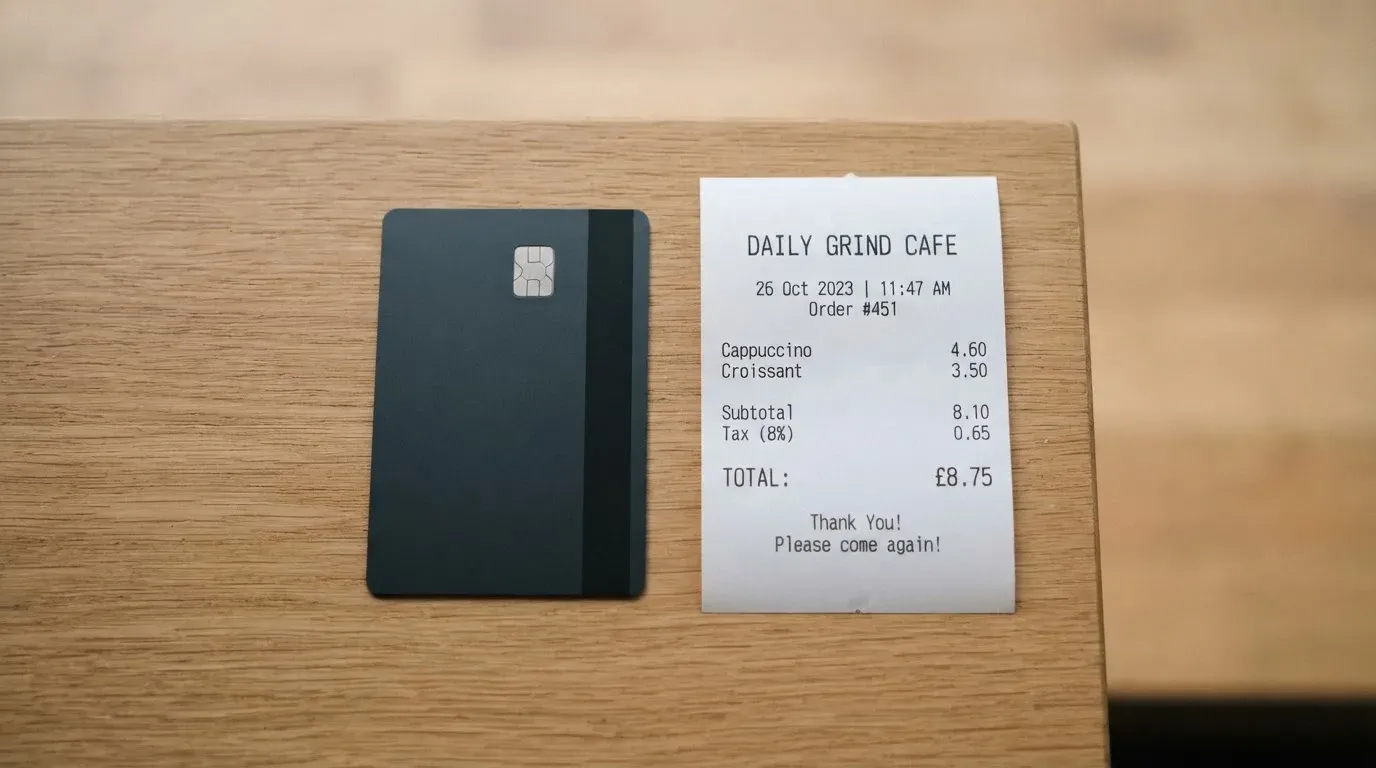
The 5% on top-up is the one that will surprise you, because it is charged before you have spent anything. If you deposit 200 USDT, 10 USDT of it is the fee. Then issuance takes 5% of what remains. So the effective cost of getting a card funded with 200 USD is 10 USD plus 5% of 190, which is 9.50 — you start about 19.50 USD down before a single purchase. On a small balance those percentages are the whole transaction.
| Fee or limit | What ValidVCC states |
|---|---|
| Card issuance | 5% once per card; zero for Elite VIP |
| Deposit (top-up) | 5% once |
| Withdrawal of unused balance | 5%, minimum withdrawal USD 5, processed in 1–3 days |
| Account activation | A one-time fee may apply, shown in the dashboard |
| Monthly fee | Not stated |
| Conversion fee | Not stated |
| Foreign-exchange fee | Not stated |
| ATM withdrawal | Not stated |
| Spending limits | Not stated |
| Minimum deposit | USD 50 |
Now three ordinary payments, so the percentages stop being abstract.
Paying 30 USD for a month of subscriptions. Issuance does not apply again. Your top-up of, say, 40 USD cost you 2 USD in deposit fees. If the balance is denominated in dollars and spent as dollars, the 5% withdrawal fee never touches you because there is nothing left to withdraw. What you actually feel is that 2 USD.
Paying 300 USD for something bigger. If you topped up 320 USD to cover it, the deposit fee took 16 USD. On a single 5% issuance charge, if you created a fresh card for that payment, that is another 15 USD on top — 31 USD of cost on a 300 USD purchase, roughly 10% gone before the shop sees anything. This is where the “create a new card per payment” pattern that some crypto card users favour stops being clever and starts being expensive, and where the Elite VIP tier exists.
Paying in a currency that is not your balance’s. This is the case where the missing numbers hurt most. Neither the conversion fee nor the foreign-exchange fee is stated, so the true cost of a cross-currency purchase is unknown until it happens, and the only honest advice is to assume there is a spread in there and to size your balance so that a surprise does not leave you short.
What the Elite VIP tier changes
There are two tiers on the site. The standard one is the one described above. The second is called Elite VIP, and it asks for a 300 USD or larger deposit. In exchange it lists zero issuance fees, zero transaction fees and “unlimited card creation”. So the expensive-in-the-small, cheap-in-the-large pattern is explicit and deliberate: if you will genuinely create many cards and move meaningful sums, the tier erases the worst of the fee schedule; if you just want one card for the occasional payment, the percentage charges are you.
Top up
This is the strongest part of the card, and the reason the top-up score sits where it does. Deposits go to a wallet on the platform and can be sent in BTC, ETH, USDT (TRC20), SOL, TRX, DOGE, LTC or USDC — the site’s own FAQ words one of them slightly differently, calling it “USDC ERC20”. Funds are credited “within 5–10 minutes of confirmation”, which is fast enough to be genuinely useful and slow enough to be believable.
The deposit fee is 5%, minimum USD 50, and two things are not stated that you will want to know: who pays the network fee for the transfer, and whether a fiat top-up exists at all. If there is no card or bank rail in, then crypto is not the convenient option here, it is the only option.
Because the tokens sit on different networks, the network you choose matters enormously and permanently. On Ethereum, fees are paid in ETH — so a wallet holding USDT with no ETH in it cannot send. On Tron, fees are paid through bandwidth and energy and often burn TRX. And a transfer sent on a network the provider does not support, or to an address belonging to another network, can be lost outright or need manual support recovery with no guarantee of outcome, because blockchain transfers are irreversible by design. There is no undo button here.
Two further wrinkles worth knowing. Circle stopped supporting USDC on Tron in February 2024, so “USDC over TRC20” is not a native option even though the site’s list may read as if it is. And Tether states that it disables tokens in wallets on the OFAC sanctions list and has frozen funds tied to illicit activity — meaning a stablecoin balance is not censorship-proof, and freezing can come from the token issuer rather than from the card.
Paying with it every day
Everyday use is where the card is thinnest, and it earns the 3 out of 10 for it. There is no mobile app — only a web dashboard — and no Apple Pay or Google Pay support is disclosed. For most people in most markets, that is not a detail, it is the deal-breaker: adding a card to a phone wallet is how card payments actually happen now, and this card does not say you can.
What it does say is useful and worth knowing. The site lists Google Ads, Meta, Amazon, Netflix, Spotify, Stripe merchants and PayPal as usable, which tells you the card is aimed squarely at subscriptions, advertising and digital services rather than at a shop’s card terminal. What it does not say is just as important: blocked categories are not stated. In this category, an issuer can block whole classes of spending by policy — gambling is the classic example, carried under the four-digit merchant category code that classifies a business by what it sells — and the blocked list varies from issuer to issuer. Nobody here has published one.
There is no cashback or rewards mentioned, and no dispute process described: if a payment is taken and the goods never arrive, the card does not set out how you would argue it, which window you have, or who would decide. ATM withdrawals are not addressed at all.
Two things can still surprise you at the till even where the card is accepted. Address verification, which compares the numeric parts of the billing address you type against the issuer’s records, is mainly offered in the United States, Canada and the United Kingdom and is generally unavailable for foreign-issued cards — so a decline there has nothing to do with you. And a merchant can look up the card’s issuing institution and country from the number itself and decide to be careful, because the issuer country differs from where you say you live. That is the structural reason a crypto card can read as foreign at an ordinary shop.
Also worth carrying in your head: a declined payment can leave a hold on your funds that stays for several days, sometimes up to seven, so a failed attempt is not always simply neutral.
What can go wrong
I could not find a single official incident involving this card. A search for reviews turned up no ValidVCC reviews at all — no Trustpilot page exists for ValidVCC. Similar sellers in this space show complaints about non-delivery, but those are different brands and I am not folding their record into this one.
That absence cuts both ways, and I want to be honest about why. A young product with a small user base has not accumulated complaints; a failing product with a large user base has. So “no complaints” here means “no history either way”, and it is not evidence of a good track record.
The larger risks are structural, and they come from things the card does not say.
You do not know who you are dealing with. The legal name, registration, card issuer and licence are all not stated. Under the card system, that information is not optional decoration: the card network routes messages and sets the rules, the issuer is a licensed bank or e-money institution holding the programme, and the brand you see is often only a programme manager or front end. Here, none of those three layers is named. Visa and Mastercard themselves do not issue crypto cards to consumers — they license issuers, and they can suspend a programme. They terminated their global agreements with FTX on 13 November 2022 and the FTX US debit card was wound down by its issuer. WaveCrest, a Visa issuer that supplied several crypto card brands, was suspended by Visa in Europe in 2018 and all its Visa programmes were closed. A provider that does not name its issuer is a provider whose programme can be closed without much warning from you.
Your balance is on someone else’s wallet. The funds sit in a platform wallet, which is custody in effect even if the word is not used. Control of crypto belongs to whoever holds the private key or seed phrase, and a seed phrase is typically 12 to 24 words in an unencrypted form — anyone who obtains it can restore the wallet and spend the money. Transfers are irreversible and a stolen key has no built-in recovery, because the network cannot freeze or return funds. This is not hypothetical for the category: Mt. Gox lost roughly 350 million US dollars as reported between 2011 and 2014, Coincheck about 400 million in 2018, and the Ronin Network 625 million in 2022. Whatever you put here, treat it as money you are lending to an unnamed company.
The standard safeguards are not described. Two-factor authentication and instant card freeze are not stated, and the deposit-withdrawal flow runs through a web dashboard rather than an app. So the usual controls you would rely on — freeze the card, confirm a payment, cap spending — cannot be assumed from what is written.
Support exists, in channels that are hard to weigh. There is 24/7 support by WhatsApp, Telegram and email at [email protected], and the languages are not stated. If your money is on a platform wallet, “no official incident” is partly a statement about how complaints are handled, not just about how things have gone.
Regulation cuts both ways here. Under the EU’s markets-in-crypto regulation, e-money tokens may be issued only by a credit institution or an electronic money institution; a card is regulated separately from the crypto side, so a crypto card often depends on two separate licences. The transitional period for providers operating under national law ran until 1 July 2026 or until a MiCA authorisation, whichever came first. ESMA maintains an interim public register of authorised providers that you can check. In the United States, FinCEN guidance treats administrators and exchangers of convertible virtual currency as money transmitters, while people simply buying goods with their own crypto are not. None of this tells you whether ValidVCC holds the right permissions — that is what the missing company details leave you unable to check.
Charges compound quietly. A declined authorisation can hold funds for days. An irreversible transfer to the wrong network can be gone. These are small, ordinary events that combine badly with a balance held in one place.
What to take instead
I want to be careful here, because none of these is a clean answer either — they trade the same problems around. I am listing the ones I could actually read pages for.
| Score | Card | Who it aims at | Stated costs | |
|---|---|---|---|---|
| ValidVCC | 5.2 | Virtual Visa or Mastercard, worldwide | Anyone, no KYC | 5% issuance, 5% top-up, 5% withdrawal; Elite VIP waives issuance |
| Cardex | 5.6 | Debit card on VERVE, Visa, Mastercard and UnionPay; virtual and physical | “One crypto card, 200+ countries”; App Store listing is Naira-focused | Not stated; conversion at payment time, no percentage published |
| CardFlow | 4.9 | Virtual USD Mastercard, about 3 minutes | Nigeria, and “Nigerians and global users” | Creating a virtual card is “completely free” |
| HyperCard | 4.7 | Prepaid card, balance in USD or EUR | App Store says works in “more than 176 countries” | Not stated; the App Store page lists no fees |
Cardex scores marginally higher than this card, 5.6, and its distinguishing feature is a conversion model rather than a fee model: crypto converts to fiat at the moment of payment, and the site describes an “AI-Powered Conversion Rate” that scans global exchange rates and picks the best one. No fee percentage is published, so you are trading a known 5% for an unknown rate method — which may suit you better or worse, but at least you can see the claim. It also offers physical as well as virtual cards and four networks, and it is the only one of the four with a stated geographic reach beyond a country-specific market. Against it: the App Store listing is Naira-focused.
CardFlow is the one to look at if your problem is a small, cheap, single-use virtual dollar card. It is aimed at Nigeria, creates a virtual USD Mastercard in about 3 minutes, and says creating a virtual card is “completely free”. You can fund it with Bitcoin, USDT, ETH or a Naira bank transfer. For a reader outside that market, both the framing and the Naira rail narrow it.
HyperCard is the quietest of the three. You deposit crypto such as USDT, BTC or ETH in the app and it converts to USD or EUR on the card. The App Store says it works in “more than 176 countries”, though that is acceptance rather than eligibility — the official pages give no country list. Networks are not stated, fees are not stated, and the App Store page lists none.
What none of the four does is tell you its issuer. That is the common thread, and it is the one thing I would want answered before I loaded any of them with money I could not afford to lose.
Who I would recommend it to
I would recommend ValidVCC to someone specific, and I would not recommend it to most people.
Recommend it if: you cannot open a bank account and a normal card, or you are choosing not to; you are comfortable leaving a balance on an unnamed platform rather than in your own wallet; you pay for digital services — ads, subscriptions, platform fees — and you can name the vendors you want; you will make one or two payments rather than dozens, or you are prepared to put real sums in and use the Elite VIP tier, where the 5% issuance charge disappears.
Be careful if: you need a physical card; you need to tap to pay on your phone, since Apple Pay and Google Pay are not disclosed; you want to hold a balance for weeks; you need chargeback protection and a stated dispute process; you are moving money you would miss; or you are in a country where the rules on virtual assets and their cards are enforced, and you need the provider to be someone you can identify and check.
The honest summary is this: the access is real and the fees are known, and what is missing is the name behind it. That combination suits a user who has already priced their own risk and is spending, not storing. It does not suit anyone treating the card as ordinary banking with the paperwork skipped.
Frequently asked questions
What is the ValidVCC card?
ValidVCC is a virtual payment card — Visa or Mastercard — issued through a crypto platform rather than a bank. You create it yourself after depositing crypto, and it spends from a balance the platform holds for you. It is essentially a prepaid card funded in crypto, with no physical version offered. The card’s stated reach is 195 countries with no exclusions listed, and the minimum deposit is 50 USD.
Does ValidVCC require KYC or identity documents?
No. The card states plainly that no identity documents, no proof of address and no phone number are required — only an email address and a password. Its footer reads “No KYC. No banks. No waiting.” There are no KYC levels at all, because none are required. That is the main reason people use services like this, and the reason regulated institutions treat them differently.
Is ValidVCC a bank, and who owns it?
That is the central unanswered question. The legal name, registration, card issuer and licence are all not stated on the public pages. Normally a crypto card has three layers — a network, a licensed issuer, and a brand that manages the programme — and here none of them is named. You are therefore not able to check the provider against any licence register or file a complaint against a legal entity.
How much does ValidVCC cost?
Card issuance is 5% once per card, depositing is 5% once, and withdrawing an unused balance is 5%. A one-time account activation fee may also appear in the dashboard. Monthly fees, conversion fees and foreign-exchange fees are not stated, which means a cross-currency purchase has an unknown cost. The Elite VIP tier, at a 300 USD or larger deposit, lists zero issuance fees, zero transaction fees and unlimited card creation.
How do I top up the ValidVCC card?
You send crypto to a wallet on the platform: BTC, ETH, USDT (TRC20), SOL, TRX, DOGE, LTC or USDC, credited within 5–10 minutes of confirmation. The deposit fee is 5% and the minimum is 50 USD. Choose your network carefully — Ethereum fees are paid in ETH, Tron fees in TRX — and a transfer on the wrong network can be lost, because blockchain transfers cannot be reversed.
Can I add the ValidVCC card to Apple Wallet or Google Pay?
Not on the available information. Apple Pay and Google Pay support are not stated, and the service has no mobile app at all — only a web dashboard. Since tokenised mobile wallets are now the normal way most people pay, this is the single biggest practical limitation of the card and should be settled before you rely on it.
Is the ValidVCC card safe?
Safety here is not a simple question, because the usual answers are unavailable. Your balance sits in a platform wallet, so the provider holds the credentials and transfers out of it cannot be reversed. Two-factor authentication and instant card freeze are not stated. I found no Trustpilot page and no reviews at all — which means no track record in either direction, not a clean record. Treat the balance as money you are lending.
Can I use the card in my country?
The card says cards are accepted in 195 countries and lists no exclusions, with worldwide availability and an 18+ starting age. So acceptance is not the constraint. The constraints are practical and local: which networks your usual merchants run, whether your own rules permit using crypto-funded cards, and whether the payment you need is one of the digital services the site lists, such as Google Ads, Meta, Amazon, Netflix, Spotify and PayPal.
Is the ValidVCC card free?
No. Creating a card costs 5% of the balance once, depositing costs 5%, and withdrawing the remainder costs 5%. Free card creation does exist in this category, but it is CardFlow’s offer, not ValidVCC’s — its FAQ says creating a virtual card there is “completely free”. On ValidVCC, the free route is the Elite VIP tier, and that comes with a 300 USD or larger deposit.
Can I withdraw money from ValidVCC?
Yes — unused balance can be withdrawn to USDT on TRC20 “any time”. The fee is 5%, the minimum is 5 USD, and processing takes 1–3 days. Note that this is a withdrawal of funds left over, not a bank transfer, and the same 5% applies that applied on the way in.
Virtual card reviews – cryptocardcheck
Content created by the «cryptocardcheck» team