
A crypto-funded Visa for people ordinary banks won't touch
 Available in US
The Winity Exclusive card is a Visa debit product aimed at people who find it hard to get an ordinary bank account. You fund it with crypto, mostly stablecoins, and spend in USD wherever Visa is taken. The promise is straightforward: if you can move USDT or USDC from your own wallet, you can have a working card in many countries where traditional banking is either unavailable, slow or refused.
I went through the card’s public pages, terms, fee tables, the apps and a thin but real pile of user feedback. This review is my read of it: who it suits, what it really costs, what it does well, and where it should make you pause. If you only have a minute, the verdict table gives the short version; the rest of the page walks you through how I got there.
Conditions are current as of October 28, 2026.
Verdict
The Exclusive line lands at 7.6 out of 10. That is a good score for this category, and it comes from a clear split: where Winity is strong, it is genuinely useful; where it is weak, the problem is information, not product.
The card scores highest on reach and on the cost of funding. Eligibility is broad (the FAQ says 187+ countries, the site footer says 180+), which is far wider than most bank-grade debit cards. The funding model is unusually cheap if you stay in USDT or USDC: deposit conversion is 0% on those two, and the same 0% applies to WCO, while other assets carry a 5% conversion fee. There is no cashback, but there are Winity Points (1 point per USD 10 spent on Exclusive), which is a small sweetener rather than a reason to switch.
Where the score drops is reliability and disclosure. Winity is run by Winity Life and WTY Technology Hong Kong Limited, neither presented as a bank. The card is “issued by licensed partners” but those partners are not named. The Visa programme is real, the Google Pay integration is real, but the company behind the brand is thin on regulatory details, and there is not enough public feedback to balance that out. The 3.7 Trustpilot score comes from a single review, which is not a sample.
In plain terms: the Winity Exclusive card works well if you already hold USDT or USDC, you need a Visa you can fund from your own wallet, and you do not need a full bank account. It is a less obvious choice if you want a card from a heavily regulated bank, want cashback, expect Apple Pay on day one, or live in a country Winity does not serve. The score table below breaks the number down.
| Criterion | Score | Why it got that mark |
|---|---|---|
| Who can get it | 9 / 10 | Available in 180+ countries (or 187+ in the FAQ); restricted countries are excluded but not listed. |
| Cost | 7 / 10 | Physical card USD 20/year, first 6 months free; USDT/USDC top-ups 0%, other assets 5%; small-payment fee USD 0.10 under USD 25; virtual issuance and FX fees not disclosed. |
| Top-up options | 9 / 10 | USDT and USDC at 0%; ETH, SOL, POL, TRX, WCO and BNB at 5% across Ethereum, Solana, Tron, Polygon, BNB Chain and W Chain. |
| Reliability and complaints | 5 / 10 | Winity Life and WTY Technology Hong Kong Limited are not banks; card partners unnamed; Trustpilot 3.7 from one review, no complaint themes. |
| Everyday use | 8 / 10 | Virtual and physical Visa in USD, Google Pay ready, USD 3 ATM fee on the physical card; Apple Pay not mentioned. |
| Total | 7.6 / 10 | A useful, low-friction crypto-funded Visa for the unbanked, held back by thin disclosure and limited public feedback. |
If you are a USDT or USDC holder who needs a working payment card across many countries, this is one of the more interesting options in the category. If you are a casual card shopper in a country with normal banking, the gap between this and a regular debit card is small, and a regular card has a regulator you can call.
Who can get the Winity Exclusive card
The headline numbers are 180+ in the site footer and 187+ in the FAQ. Both are big. For a Visa debit product to be available in that many jurisdictions is unusual; most bank-grade cards cap well below. The catch is that “available” here means “the card programme accepts applications from residents of supported, non-restricted countries.” Winity does not publish the restricted list, so the only way to know for sure is to start the sign-up and see.
Eligibility is tied to residence, not citizenship. The terms refer to living in a supported country; nothing in the public materials asks about the passport you hold. That matters in two directions. If you are a citizen of a restricted country but live in an allowed one, you may still be able to apply. If you hold a passport from an allowed country but live in a restricted one, the application is likely to fail at KYC.
You must be 18 or older. Identity is checked with a passport, driving licence or national ID. The manual review path takes 1 to 2 business days; the automatic path usually finishes in minutes. There is no stated requirement for proof of address, which is itself a sign of how lean the onboarding is designed to be. Whether that is a feature or a worry depends on what you compare it to.
In short: if you live in a country Winity serves, you are 18+, and you can pass an ID check, the door is open. If you do not know whether your country is on the list, the only certain answer comes from trying.
How to sign up
The flow is the same one you find across this category: download the Winity app, create an account, complete KYC, top up the balance, and the card is issued. Nothing in the public materials points to a sign-up via the website without the app, so plan on installing it.
Identity verification asks for a passport, driving licence or national ID. If the system can read the document and match the selfie, approval is usually minutes. If the case is routed to manual review, you are looking at 1 to 2 business days. There are no published KYC tiers, no silver/gold/platinum onboarding levels; you pass once and you are in. The reasons the system can reject an application are not listed, so the safest assumption is that mismatched data, an unsupported country, or a document that fails the automatic checks will be the usual causes.
The card is issued only after KYC succeeds. That is the right order, but it also means you cannot preload the balance and then “fail later”; nothing on the card side happens until the identity check is done.
Two card products sit on the Exclusive line: the Exclusive Virtual and the Exclusive Physical, with a higher-end Executive Metal sitting above. All are Visa. All settle in USD. The virtual one is the entry point; the physical one is the card you carry.
Physical card shipping may carry a charge, but the country list, delivery times and replacement cost are not stated. If timing matters, treat that as “ask before you order.”
What the Winity Exclusive card really costs
Cost is where this card is interesting and where the disclosure thins out. The published numbers are friendly; the unstated ones are the ones that will catch you if you do not look.
The headline: the Exclusive Physical costs USD 20 a year, with the first 6 months waived on new activations. Free physical issuance is described as “limited,” which is the kind of word that means “while the current promo runs.” The Exclusive Virtual is presented as the no-fee starting point, but the issuance cost of the virtual is not stated, so the only safe assumption is that some charge exists somewhere in the flow. The physical card also requires you to spend USD 25 on the virtual card, which is a soft commitment rather than a fee.
Funding the card is the cheapest part. USDT and USDC convert at 0%. WCO and other non-stable assets convert at 5%. That is the most important fee on the page, because it sits on every deposit. You also pay the blockchain’s own network fee (gas, bandwidth) for the transfer itself, and that is paid by you, not by Winity.
The card adds a small-payment fee: USD 0.10 on any transaction under USD 25. The rest of the spend fee is described as “shown in app,” which is the standard way of saying “look in the app before you pay.” The FX fee is not stated, and that is the one I would push hardest on if you plan to spend outside USD. If the card is funded in USD and the merchant charges in EUR, the conversion path is part of the cost, and it is not on the public price list.
ATM withdrawals are physical-card only. The fee is USD 3 per withdrawal; a PIN change costs USD 5. There is no free allowance, and there is no monthly cap on the number of withdrawals. PIN changes are the kind of fee that sounds small until you realise it is more than the ATM fee itself; do not change your PIN through the app unless you need to.
You need a USD 25 minimum balance for card transactions. The virtual card is deactivated if it has not received USD 25 within 14 days of activation. That is not a fee, but it is a trap if you set the card up and forget to top it up.
The limits (daily, monthly, per transaction) are not published. They vary by user, tier and jurisdiction, which is the standard phrasing, and it is also the standard reason to check in the app before you plan a large payment.
| Fee or limit | Amount | Notes |
|---|---|---|
| Physical card annual fee | USD 20 | First 6 months waived on new activations; free issuance “limited”. |
| Virtual card issuance | Not stated | Treated as the free entry; cost hidden if it exists. |
| Spend requirement for physical | USD 25 on the virtual | Soft commitment, not a fee. |
| Deposit conversion — USDT, USDC | 0% | |
| Deposit conversion — WCO and other assets | 5% | Applies to non-stable assets. |
| Small-payment fee | USD 0.10 | Transactions under USD 25. |
| Other spend fee | Shown in app | Not in the public price list. |
| FX fee | Not stated | Material if you spend outside USD. |
| ATM withdrawal | USD 3 per withdrawal | Physical card only, Visa ATMs. |
| PIN change | USD 5 | Higher than the ATM fee itself. |
| Minimum balance for card use | USD 25 | Virtual deactivated if not topped up within 14 days. |
| Daily/monthly limits | Not published | Vary by user, tier and jurisdiction. |
| Statement request | USD 5 |
Two everyday scenarios to make this concrete:
- Buying lunch for USD 8 with USDT. You top up USDT (0% conversion) and pay USD 8. The fee is USD 0.10 because the amount is under USD 25, so the effective price is USD 8.10 plus whatever gas the USDT transfer cost on the network you used. Below the USD 0.10 floor, the percentage fee would be a bigger number; here, the dollar amount is the cap.
- Booking a USD 600 flight. No small-payment fee applies. The conversion fee is 0% on USDT. What you do not know from the public page is whether there is a foreign transaction fee if the airline charges in EUR. If there is one, it is not on the table I just showed you. That is the cost gap on this card, and the only way to close it is to check inside the app before you tap “pay.”
The Winity Exclusive sits above the Executive Metal on the same product family, and below a small loyalty ladder (Silver, Gold, Platinum; Platinum kicks in at USD 5,000+ of spend). Mobile data bundles are also bundled in (Exclusive gives 1 GB after USD 5,000 spend, Executive 3 GB a year), which is a niche perk rather than a reason to choose it.
How to top up the Winity Exclusive card
Top-up is where this card is most clearly designed for a crypto-native user. The list of accepted assets is long for a card product, and the cheap path is obvious: stay in USDT or USDC.
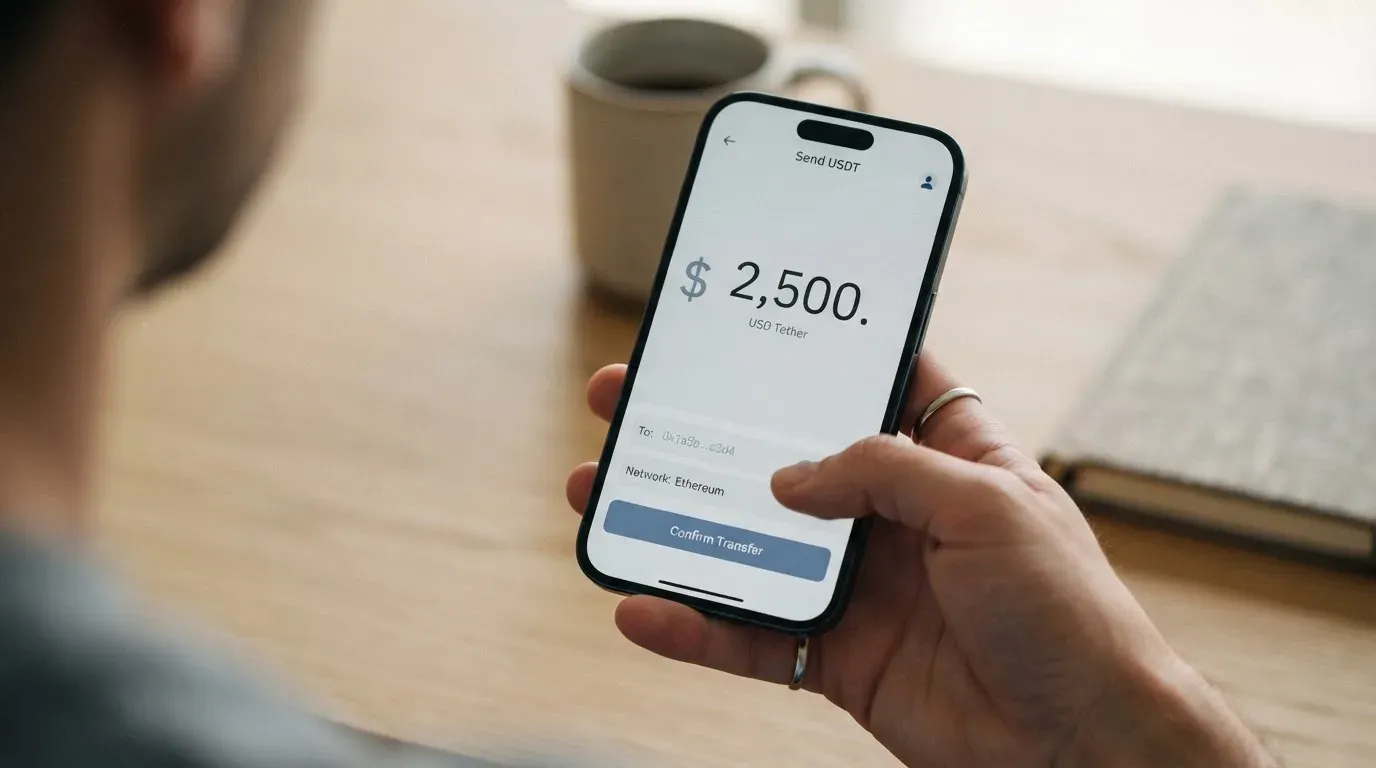
You can fund the card with USDT, USDC (both at 0% conversion), or with ETH, SOL, POL, TRX, WCO and BNB (at 5% conversion). The networks supported are Ethereum, Solana, Tron, Polygon, BNB Chain and W Chain. Anything you send is converted to USD and held in a partner custody wallet before it lands on the card; the card itself does not hold crypto.
The mechanics look like this in practice. In the app, you pick the asset and network, copy the deposit address, and send from your own wallet. You pay the blockchain’s network fee in the native token of that chain (ETH on Ethereum, TRX on Tron, and so on). If you only hold USDT and no ETH, you cannot move it on Ethereum, because gas must be paid in ETH; this is a property of the network, not of Winity.
The minimum balance is USD 25. If you activate the virtual card and do not send at least USD 25 within 14 days, the card is deactivated. That is the same number as the soft spend requirement for the physical card, and it is small enough to satisfy on the first top-up.
There is no fiat top-up. You cannot load the card from a bank account in the app; the funding path is crypto in, USD out, card balance. If you want to fund from a bank transfer, this card is not built for that.
Cash out goes the other way. Crypto withdrawals are not supported in the app. If you want to take money off the card, the route is the physical card at a Visa ATM (USD 3 per withdrawal). The single refund path is for the most recent deposit: you can request a refund review on that one deposit, and you must do it immediately, with no card transactions after the deposit in question. A paper statement costs USD 5.
Two things on the funding path that are easy to miss:
- Network choice matters. Send USDT over TRC20 (Tron) and you pay TRX in fees; send the same USDT over ERC20 (Ethereum) and you pay ETH in fees, often much more. Winity supports both via the networks above, so the choice is yours, and so is the bill.
- USDC on Tron is not native. Circle stopped supporting USDC on Tron in February 2024, so a “USDC over TRC20” deposit is not a real path. USDC is supported on the other networks; USDT remains the answer if you want to move cheap on Tron.
Paying with the Winity Exclusive card every day
In daily use, the Exclusive line behaves like a standard prepaid Visa. The balance is in USD, the card settles in USD, and you can pay wherever Visa is taken. The two practical differences from a bank card are: the balance is prepaid (so it cannot overdraw), and the FX path is in the app’s hands.
The Exclusive Virtual is Google Pay ready. Apple Pay is not mentioned in the public materials, and that is the most common single complaint you would expect from a mobile-first user. If Apple Pay is the only way you pay, the virtual card is half a feature until that changes. The physical card is the one you tap at a terminal; the standard magstripe/chip/contactless experience.
There is no cashback. Winity Points run at 1 point per USD 10 spent on the Exclusive card, with a redemption portal that the public pages describe as “coming soon.” That is a real but small upside; it is not a reason to switch from a card that pays 1-5% back. The Executive rate is not specified, which fits the pattern of “ask in the app” rather than “ask the website.”
Blocked merchant categories are not stated, and that is a real gap if you care about which MCCs the issuer declines by policy. Gambling (MCC 7995), for example, is the category most often restricted, but Winity does not publish a list. If you plan to use the card at a specific kind of merchant, the only certain check is a small test transaction.
A few things worth knowing about how the card behaves at the till:
- Holds can last up to 7 days. A declined or pending authorisation can leave a hold on funds for several days; that is a property of card networks, not of Winity.
- AVS is mainly US/CA/UK. Address Verification Service compares the billing address you type with the issuer’s records and is generally unavailable for foreign-issued cards, which can cause declines on US sites even when the card is valid.
- 3-D Secure is biometric, OTP-free. The card uses biometrics through 3-D Secure rather than a one-time code, which is a smoother flow if your device supports it.
The iOS and Android apps exist, but app store ratings were not found in the materials I worked from. If ratings matter to you, that is a check worth doing before you commit.
Disputes go through support: report an unauthorised transaction, block the card, Winity reviews and escalates to Visa, with a USD 100 chargeback fee per case. The public terms say there is no guaranteed recovery, that decisions are “final and binding,” and that unresolved cases after 60 days go to arbitration in Hong Kong. None of this is unusual for a card programme run outside the EU/US banking mainstream, but it is worth reading before you dispute a USD 30 charge, because the fee alone is more than the charge.
What can go wrong with the Winity Exclusive card
This is the section I would not skip. The product is reasonable; the company around it is thin.
Winity Life and WTY Technology Hong Kong Limited are the names on the public materials. Neither is presented as a bank. The card is issued by “licensed partners” that are not named. Services are issued in Hong Kong, the terms are governed by Hong Kong law, and disputes that do not resolve in 60 days go to HKIAC arbitration. No registration number is given for the parent companies, and the public materials do not point to a banking, e-money or CASP licence that Winity itself holds.
The custody model is the standard one for this category: assets you deposit are held in a partner custody wallet before they reach the card. That is a counterparty you do not choose, and one you cannot exit. There is no public statement on how customer funds are safeguarded. In the EU, an electronic money institution must segregate customer funds or insure them; in a Hong Kong setup, the equivalent is whatever the local regime requires, and that is not detailed on the Winity page.
The security features that are there are reasonable. 3-D Secure is OTP-free and uses biometrics. There is an instant freeze in the app, a PIN on the physical card, and optional biometrics on the app itself. Custody of the deposit sits with a partner rather than with the user, so a hack or insolvency at that partner is a risk the user bears.
Support is reachable at [email protected] and through the in-app Support tab. 24/7 member service is claimed for members; email replies are typically within 24 hours. There is no phone number on the public page. If you need to call someone, that is a gap.
Public feedback is thin. The Trustpilot profile for winity.life was claimed in October 2025, has a TrustScore of 3.7 (labelled 3.5 stars) from a single review, a 5-star rating dated 26 December 2025, and no complaint themes. One review is not a sample, and there is no user-generated content elsewhere in the search I ran. No official incidents and no programme news have shown up in the public record.
There is one closing pattern I would note, because it has hit this category before. Visa and Mastercard do not issue crypto cards themselves; they license issuers and can suspend a programme. WaveCrest had its European Visa licence suspended in 2018, which closed every WaveCrest-issued card at once. FTX had its Visa agreements terminated in November 2022, and the FTX US debit card was wound down by its issuer. A programme closure typically gives a notice period, then stops loading, then stops spending, and asks users to withdraw their balance. The risk that a programme shuts down is small in any given year, but it is not zero, and it is not visible to the user until it happens.
If you keep a meaningful balance on the card, treat it like any prepaid card: do not park more than you can afford to lose access to for a notice period, and have a backup card from a different programme.
What to take instead of the Winity Exclusive card
Three products that come up in the same category are Cardex, CardFlow and HyperCard. I have given each a short read against the same score scale; the numbers come from their own public pages and are useful for comparison, not as endorsements.
Cardex (5.6 / 10). Cardex markets “one crypto card, 200+ countries” with no country list and no exclusions. The card is a debit product on the VERVE, Visa, Mastercard and UnionPay networks, with virtual and physical options. The app store listing is Naira-focused, which suggests the primary market is Nigeria. There is no published fee schedule. The site describes an “AI-Powered Conversion Rate” that picks the best exchange rate at the moment of spend, which is a marketing phrase more than a fee structure. Funding is in USDT, USDC and BTC, with no stated networks. Cardex is a reasonable alternative if you are in its target market, but the lack of a fee page is a real gap.
CardFlow (4.9 / 10). CardFlow describes itself as “Nigeria’s smartest fintech card platform,” aimed at Nigerians and global users. The product is a virtual USD Mastercard created in about 3 minutes, with creation listed as free. There is no published monthly fee and no published transaction fee. Funding is in Bitcoin, USDT, ETH or Naira bank transfer; networks are not stated. CardFlow is the most entry-level of the three and the least documented, which pulls its score down.
HyperCard (4.7 / 10). HyperCard is a prepaid card with USD or EUR balances. The official pages do not list a country list; the app store says the card works in “more than 176 countries,” which is acceptance, not eligibility. The card network is not stated on the app store page, and there is no fee list. Funding is in USDT, BTC and ETH, converted to USD or EUR. HyperCard is the most generic of the three; it does the basic job and is hard to evaluate beyond that.
In a single line: Winity is the better-documented of the four, with a clearer fee structure and a broader funding list, and a Visa brand that the others do not all share.
Who I would recommend the Winity Exclusive card to
The honest answer is: a specific kind of user, in a specific kind of situation.
If you hold USDT or USDC in your own wallet, live in a country ordinary banks will not serve, and need a Visa you can fund from crypto, the Winity Exclusive card is a strong fit. The 0% conversion on USDT and USDC, the 0% on WCO, the USD 25 minimums, and the prepaid model all add up to a card that does what it says on the tin. The Google Pay integration on the virtual card is a real convenience, and the physical card’s USD 3 ATM fee is at the cheaper end of the category.
If you live in a country with normal banking, want cashback, expect Apple Pay on day one, or want a card from a regulated bank with a regulator you can call, the Winity Exclusive is a less obvious choice. A regular debit card from a licensed bank in your country will give you deposit protection, a complaints path, a phone number, and likely Apple Pay and Google Pay. The price for those things is the bank account you already have.
I would not park more on the card than I could move through in a month, because the disclosure around custody partners and safeguarding is thin. I would not treat it as a savings account. I would keep a backup card from a different programme, the same way a sensible traveller keeps a second payment method in case the first one is declined or shut down.
Used that way, the Exclusive line is a useful tool. Used as a primary bank account, it is not what it is built to be.
Frequently asked questions
What is the Winity Exclusive card?
The Winity Exclusive card is a Visa debit product issued under the Winity brand, available as a virtual and a physical card. It is funded with crypto (USDT, USDC and other assets) and spent in USD wherever Visa is taken.
How does the Winity Exclusive card work?
You deposit crypto into a partner custody wallet, the platform converts it to USD (at 0% for USDT and USDC, 5% for other assets), and the resulting balance is what the card spends. The card cannot overdraw because it is prepaid.
Is Winity Exclusive a bank?
No. Winity describes itself as a technology provider and programme manager, not a bank. The cards are issued by licensed partners that are not named in the public materials.
Who owns Winity Exclusive?
The brand is run by Winity Life and WTY Technology Hong Kong Limited. No registration number is given for either company in the public materials, and the cards are issued by unnamed licensed partners based in Hong Kong.
Is the Winity Exclusive card available in my country?
Winity says 180+ countries in the footer and 187+ in the FAQ, with restricted countries excluded. The list of restricted countries is not published, so the only way to know is to start the sign-up and see.
How do I get the Winity Exclusive card?
Download the Winity app, create an account, pass KYC with a passport, driving licence or national ID, top up the balance, and the card is issued. Automatic KYC usually finishes in minutes; manual review takes 1 to 2 business days.
How do I top up the Winity Exclusive card?
In the app, pick the asset and the network, copy the deposit address, and send from your own wallet. USDT and USDC convert at 0%; ETH, SOL, POL, TRX, WCO and BNB convert at 5%. You pay the blockchain’s own network fee in the native token of the network you use.
Can I add the Winity Exclusive card to Apple Pay?
The public materials do not mention Apple Pay. Google Pay is supported on the Exclusive Virtual. If Apple Pay is the only way you pay, the card is half a feature for you until that changes.
Is the Winity Exclusive card safe?
It uses biometrics-based 3-D Secure, instant card freeze, PIN and optional app biometrics. Assets are held in a partner custody wallet before they reach the card, and the public materials do not state how customer funds are safeguarded, which is a real gap.
How do I withdraw money from the Winity Exclusive card?
Crypto withdrawals are not supported in the app. The cash path is the physical card at a Visa ATM, at USD 3 per withdrawal. Refund reviews are only for the most recent deposit and must be requested immediately, with no card transactions after the deposit in question.
Virtual card reviews – cryptocardcheck
Content created by the «cryptocardcheck» team