
Thin on published detail
 Available in US
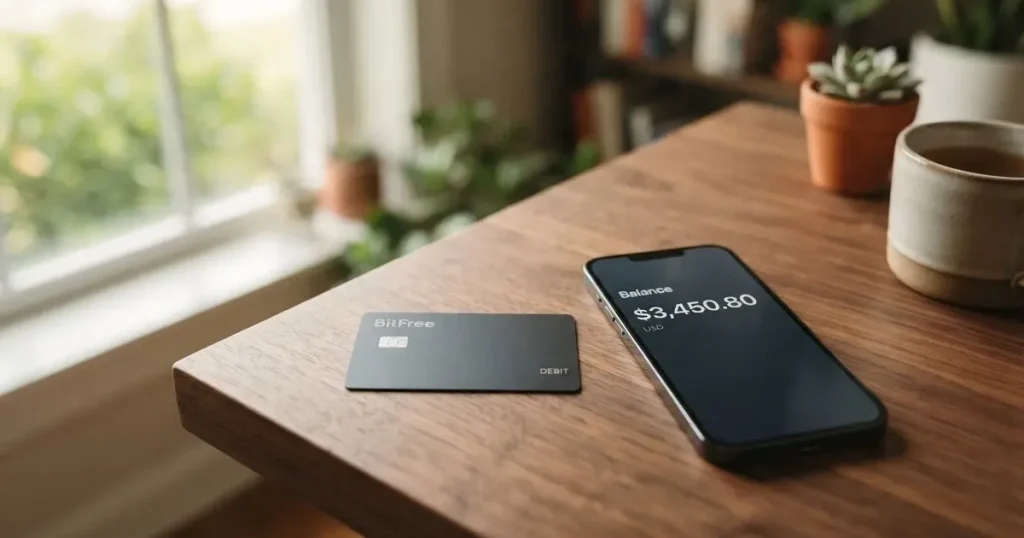
The BitFree card is a virtual, prepaid payment card that you hold in your phone and load from a crypto balance. That is the whole product, and on the evidence of its own public pages, that is also the whole story. The card is issued by a licensed partner whose name the app store listings never give, the fees are never listed, the limits are never listed, and the coins and networks you would load it with are never named. What is stated plainly is where it works — supported App Store regions except mainland China, Hong Kong, Macau and the United States — and that supported digital assets may be used only for prepaid card top-up requests, which is the language of a top-up-only card, not a debit card tied to a bank account.
My score for it is 5.2 out of 10. That is not a verdict of fraud; it is a verdict of thinness. What BitFree publishes about itself is consistent and unremarkable, and nothing I read looked wrong. It is simply that the questions you would want answered before loading money into a card — what does a payment cost, what is my daily limit, which stablecoin on which chain do I send, who is my issuer — come back “not stated.” For a card whose entire purpose is to spend crypto balance in ordinary shops, those are the four questions that matter.
Whether that is disqualifying depends entirely on why you are looking at a crypto card at all. If you already hold crypto on an exchange and want to turn it into a card number for subscriptions and everyday spending, a card like this can be exactly the tool, and the fact that the balance is prepaid means it cannot overdraw. If you are choosing a main everyday card, or you are in a place where you need predictable statement lines and a support number that works in your language, this is thin material and you should keep reading before you commit anything. I scored it the way I score any card I review: mostly on what it actually does, with a little weight on what it chooses to tell you.
The conditions described on the card’s public pages are current as of October 28, 2026.
The score in full
Here is the breakdown, one line per criterion, with the reason I gave for each mark.
| Criterion | Mark | Why |
|---|---|---|
| Who can get it | 7 / 10 | Available in supported App Store regions, excluding mainland China, and not available in Hong Kong, Macau or the US |
| Cost | 5 / 10 | Fees are not disclosed; conversion is done by the partner and the reference rate is visible before you confirm a top-up |
| Top-up options | 4 / 10 | Supported digital assets are for top-up only, and the coins and networks are not named |
| Reliability and complaints | 5 / 10 | Bitfree Limited / BITFREE INC. as the app publisher, an unnamed licensed issuing partner, no third-party reviews found, KYC with AML monitoring |
| Everyday use | 4 / 10 | A virtual prepaid card in the app only; wallets and ATM are not disclosed |
| Total | 5.2 / 10 | A workable top-up card with a lot of its basics left unsaid |
The two 7s and 4s in there are the honest shape of this card. Eligibility is the one thing the card is reasonably clear about, and it is clear because app store availability is a hard fact everyone can check. Top-up options score lowest because naming a coin and a network is not a marketing decision, it is the minimum information you need to send money at all. If the provider will not tell you which chain to use, you will find out by sending to the wrong one, and blockchain transfers do not reverse.
Who will they give you the card to?
They will give it to you if you are in a supported App Store region, except mainland China, and if you are not in Hong Kong, Macau or the United States. Beyond that, availability also depends on the issuing partner’s terms and on local regulations, which means the clean version of the answer is: where the app is available, the card may be, and where local rules bite, it may not be. That is a normal condition for this kind of card and I would not read anything sinister into it, but it does mean the answer to “is BitFree available in my country” is not simply yes because the app downloaded.
It also depends on who you are in a way the card does not spell out. There are no tiers and no stated age or residency conditions beyond the regional availability line. What I can tell you is that the card’s own identification rules will do the deciding. You will need a government-issued ID and a liveness check before you can use it. Proof of address and an age requirement are not stated, so I cannot tell you whether you will be asked for a second document or whether an eighteen-year-old can open one. There is a note that the KYC document upload flow has been improved at some point, which tells you the process exists and has been fiddly, not what it demands today.
The audience here is narrow and I would rather name it than hedge: a prepaid virtual card that you top up from the BitFree app. That is not a bank account, not a current account, and not a card that draws on your salary. If someone has described BitFree to you as a bank, that is a misunderstanding of what kind of thing it is. There is an e-money dimension to cards of this shape, but BitFree does not describe itself that way in what I read, and I would not label it for you either.
What I would ask before you apply, given how little is published: whether the issuing partner is licensed in your own country or somewhere else entirely. Merchants can look at a card’s BIN and see which country issued it, and some will treat a foreign-issued prepaid card more carefully. That is background, not a BitFree-specific warning — but it is the reason issuer identity is more than trivia for a card you might use in a shop in your own country.
How to get it
The application path is short, because there is not much to apply for. You download the app from your store, create an account, send a government-issued ID through a liveness check, and the virtual card appears in the app. There is no delivery step and no waiting: it is a virtual card, so physical delivery is not applicable here. That is genuinely convenient for someone who needs a card number in five minutes rather than in a week, and it is also the reason the card cannot be slipped into a physical wallet or handed over in a shop.
Two things I can tell you plainly, and one I cannot. The card is issued by an unnamed licensed partner described as operating under its own financial licenses. Not the license itself, not the regulator, not the registration details — not stated on the pages I read. That is the single largest gap in this review, and I have left it as a gap rather than filling it with a guess. A card is a payment instrument issued by someone; knowing who holds that responsibility is not a nicety.
The version note about improvements to the KYC document upload flow is the other thing worth knowing. It suggests verification is document-based and that getting the documents right matters. If you have ever had an app reject a photo of an identity page for a shadow or a glare, you already know the genre.
What is not stated: how many verification levels exist, whether verification is done once or refreshed, and what happens to an application that stalls. I will not invent an answer for you. If your reason for wanting this card is that other services have frozen your account, the honest position is that a provider whose verification tiers it does not describe is not obviously a safer place to be.
Fees and what a payment really costs
This is the section where BitFree is quietest, and it is the section you should read twice. Not a single fee is published. Not the cost of issuing the card, not a monthly fee, not a conversion fee, not a foreign-exchange fee, not ATM fees. The card’s own explanation is that the conversion is performed by the partner, and the amounts are not stated. The one concrete thing offered is that the reference rate can be reviewed before you confirm a top-up, which is a helpful design and a thin disclosure — you can see the rate, but you are not told the fee that sits next to it.
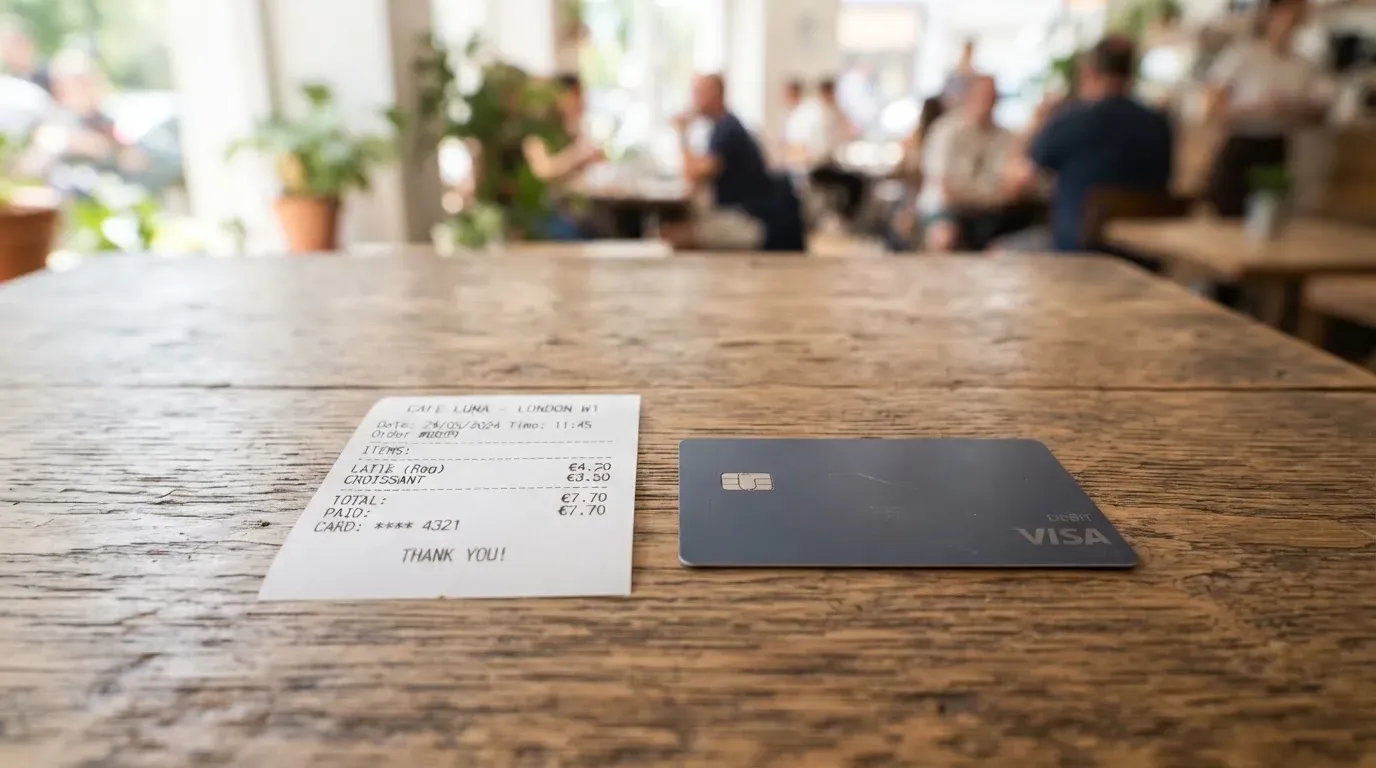
Here is the honest state of the cost picture.
| Item | What BitFree publishes |
|---|---|
| Card issuance | not stated |
| Monthly fee | not stated |
| Crypto-to-fiat conversion | performed by the partner; amounts not stated |
| Reference rate | visible before you confirm a top-up |
| Foreign exchange | not stated |
| ATM | not stated |
| Daily limit | not stated |
| Monthly limit | not stated |
| Tiers | not stated |
| Card currency | not stated |
Now let me take that table into three ordinary situations, because an abstract “not stated” tells you less than a walk-through does.
Buying a coffee. You want to spend the equivalent of what would be four dollars in a local café. What happens is: the balance you hold is converted or loaded in a currency the card uses — which is itself not named — and the payment goes through. Whether a conversion fee, a network fee or a cross-currency spread comes off depends on the partner’s terms, which are not published. The one thing you can do is watch the reference rate at the moment you top up, since that is the moment the card’s own app shows you a number.
A monthly subscription in another currency. You have heard the general warning already: some merchants decline prepaid cards, and some apply extra scrutiny when the issuing country on the card differs from the billing address. Add an unstated foreign-exchange rate and an unstated monthly fee to a recurring charge, and the effective cost of that subscription is something you can only discover by watching a statement you may not receive, because I could not find any mention of statements or export.
A withdrawal or a top-up from a crypto balance. Two costs meet here, and only one of them is the card’s. The card’s conversion cost is unstated. The network fee for moving crypto on the blockchain is charged by the blockchain, not by BitFree. If you hold, say, a dollar-pegged token on a chain where fees are paid in the chain’s own coin, you need a small amount of that coin to make the transfer work at all. That is a category fact, not a BitFree one, but it is the kind of thing that catches people out on their first top-up.
My advice is the unglamorous one: before you load anything you would miss, find out what a conversion costs and what your limits are, in writing, from support. If the answer is not on the public pages, ask. A provider that cannot tell you what a payment costs is telling you something too.
How to top up
Top up is the card’s actual job. The app is where the balance comes from, and the assets that go into it are described in one sentence: supported digital assets may be used only for prepaid card top-up requests. That is a clean statement of intent — this card does not hold crypto for you and does not let you spend from a self-custody wallet; crypto comes in, converted into a card balance, and that is the end of it.
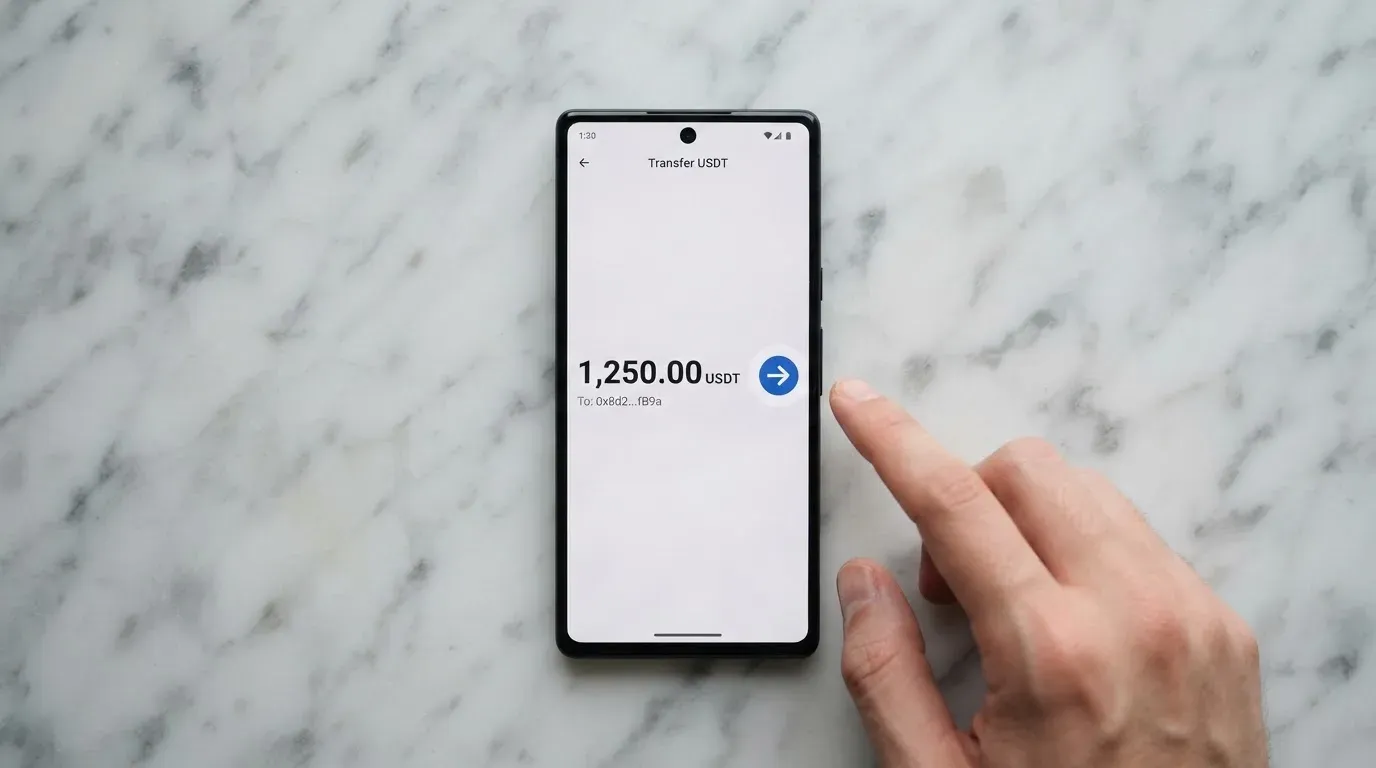
What is not named is which digital assets, on which networks. That is a bigger gap here than anywhere else, because in crypto the network is not a detail. The same token can exist on several chains with different addresses and different transfer costs, and a transfer sent on a chain the provider does not support, or to an address belonging to a different chain, can be lost or need manual support recovery with no guarantee. Blockchain transfers do not reverse. So the practical consequence of the card not naming its coins and networks is that you are relying on the app’s own instructions being right at the moment you copy an address, and on nothing else.
There are three things you would want to know that are simply not there: the minimum top-up, whether there are tiers of top-up, and how to take money back out. The last one matters more than it sounds. If the card is prepaid and the balance is what you spend from, then a withdrawal is the reverse of a top-up, and the card does not describe one. That is the single question I would put at the top of my list if I were about to load a meaningful balance.
Two things about the shape of it are worth holding onto. First, the reference rate is shown before you confirm, which means the top-up screen is the one place where you can actually see what you are getting. Second, network fees on the deposit are the blockchain’s, not the card’s, so the amount that lands in the card can be slightly less than the amount you sent, and that difference is not a BitFree fee.
Paying with it every day
Day-to-day, the BitFree card is a virtual prepaid card held in the app. That is the honest summary, and it defines both its convenience and its ceiling. Convenience: no plastic to wait for, a card number available as soon as you are verified, and a balance that cannot go negative because there is nothing to overdraw. Ceiling: no physical card, and no disclosed information about wallets.
On wallets the card says nothing. That means the question readers ask most — can I add BitFree to Apple Wallet or a phone wallet — cannot be answered from what I read, and I am not going to answer it for you. I can tell you how this works in general: adding a card to a phone wallet replaces the number with a device-specific token stored in the Secure Element on the device, each payment generates a fresh code, and the issuer can still restrict the token for certain payment channels. Whether BitFree supports any of that is a question for their support, and it is a question worth asking, because a virtual card you can only paste into a website is a different product from one you can tap.
On rewards, nothing is stated. No cashback, no points, no fee waiver for spending certain categories. I would plan as though there are none.
Two things that do affect daily use, both general rather than BitFree-specific. First, a merchant category code governs what a business is; gambling is 7995, and many issuers block particular categories on particular cards by policy rather than by law, with the list differing by issuer. Second, address verification, which compares the numeric parts of a billing address against issuer records, is mostly a US, Canada and UK service and is generally unavailable for foreign-issued cards — which can produce declines. Neither of these tells you anything about BitFree specifically, but both tell you that a virtual card with an unnamed issuer in an unnamed country will sometimes be declined, and prepaid cards are declined more often than debit cards.
The app itself is a small comfort. On the Japanese App Store listing the iOS app, published by Bitfree Limited, showed 3.3 from 99 ratings when the listing was read; that figure was not re-read and you should treat it as a snapshot rather than a current value. The Android listing carries the app id com.yykj.bitfree.en. Ratings that thin tell you very little either way, but the existence of a Japanese listing tells you something: this is an app with a Japanese-facing storefront presence.
What can go wrong
Start with the boring but real risk, which is that you are trusting an unnamed entity with a card. BitFree is Bitfree Limited on iOS and BITFREE INC. on Android as the app publisher, and the card is issued by an unnamed licensed card issuing partner operating under its own financial licenses. Registration details are not stated. So the entity whose name would appear on a charge at a shop, and which would stand behind a dispute, is not the entity whose name you can read here. That is not evidence of a problem. It is a fact you should weigh.
Second: there are no complaints to read, and that cuts both ways. I found no official incidents, and I found no third-party reviews for BitFree at all — no Trustpilot page either. A card with no track record means no pattern of failures has been documented, which is mildly reassuring, and it also means there is no evidence of anyone else’s long-term experience. You would be the early case either way.
Third: the money side. KYC with AML monitoring and device checks is a real safeguard, and it is standard. What is not stated is the custody model — who holds your funds while they are in the system, and how they are safeguarded. In this category that matters more than most card questions. If the provider is an e-money institution, customer funds should be segregated or insured; if they are not a bank, they are not deposits and a deposit guarantee scheme does not cover them. I am describing the standard, not asserting BitFree is or is not covered, because the card does not say.
Fourth: irreversible transactions. Crypto transfers do not reverse. A stolen key has no recovery mechanism because the network cannot freeze or return funds. The history of this category is not reassuring on that front: Mt. Gox at roughly US$350 million, Coincheck at roughly US$400 million in 2018, and Ronin Network at US$625 million in 2022. And stablecoins themselves are not what their name suggests — USDC briefly lost its peg during the March 2023 US banking crisis, and TerraUSD collapsed in May 2022. Tether also says it disables tokens in wallets on the OFAC sanctions list and has frozen funds tied to illicit activity, which means the asset you hold is not outside anyone’s reach.
Fifth: the app can go away. Programme closures follow a pattern: a notice period, then loading and spending stop, then users are asked to withdraw remaining balances. In November 2022 Visa said it had terminated its global agreements with FTX and the FTX US debit card programme was wound down by its issuer; WaveCrest, a Visa issuer that supplied crypto card brands, was suspended by Visa in Europe in 2018, closing every WaveCrest-issued Visa programme. Programme managers are not networks, and networks do not guarantee that a programme continues.
Sixth: support. There is an address for support and a separate address for media and regulatory inquiries. Languages and opening hours are not stated. The site is available in Russian. If your first language is not English or Russian, that is worth knowing before you need it.
And one more that costs cardholders real money in this category: a declined authorisation can leave a hold on your funds for several days, typically up to seven. With a prepaid balance, a hold is a bigger bite than it would be on a bank account with money behind it.
The alternatives
If the reason you are here is a card that converts crypto and spends it, BitFree is not alone, and the other options are not obviously worse on the things it leaves blank. Here is how the three I looked at compare.
| BitFree | Cardex | CardFlow | HyperCard | |
|---|---|---|---|---|
| My score | 5.2 / 10 | 5.6 / 10 | 4.9 / 10 | 4.7 / 10 |
| Card type | Virtual prepaid, unnamed issuer | Debit card on VERVE, VISA, Mastercard and UnionPay; virtual and physical | Virtual USD Mastercard | Prepaid “HyperCard”, network not stated |
| Who it is for | Supported App Store regions except mainland China, Hong Kong, Macau, US | “One crypto card, 200+ countries”; App Store listing is Naira-focused | Nigeria, “Nigerians and global users” | App Store says works in “more than 176 countries” (acceptance, not eligibility) |
| Card creation fee | not stated | not stated | “Creating a virtual card is completely free” | not stated; App Store page lists no fees |
| Conversion | by the unnamed partner; amounts not stated | real-time crypto-to-fiat conversion at payment, with an “AI-Powered Conversion Rate”; no percentage stated | not stated | not stated on pages I could read |
| Top-up | Supported digital assets only, coins and networks not named | USDT, USDC and BTC wallets; networks not stated | Bitcoin, USDT, ETH or Naira bank transfer; networks not stated | Deposit crypto such as USDT, BTC, ETH; converted to USD or EUR; networks not stated |
| Rewards | not stated | not stated | not stated | not stated |
Cardex is the one that scores highest of the four, and its reason is structural rather than cosmetic: it names its networks — VERVE, VISA, Mastercard and UnionPay — and offers both virtual and physical cards. Naming networks is what makes a card legible; you can check them in a store’s terminal, you can reason about foreign-exchange exposure, and you know what is standing behind the number. Its conversion story is real-time at the moment of payment with a stated mechanism and an unstated percentage, and its app store presence is Naira-focused, so it is built for a market rather than for everywhere at once. For a reader outside that market, that focus is the thing to weigh.
CardFlow is thinner still but cleaner in one respect: it tells you the card is a virtual USD Mastercard, created in about 3 minutes, and that creating one is completely free. “Free” here means the creation, which is not the same as free to use — monthly fee not stated, fees not stated. It is aimed at Nigeria.
HyperCard is the weakest of the four on the evidence I have, and it earns that mostly by vagueness: no country list on its official pages, network not stated on the app store page, no fees listed, no rewards. What it does state is that the balance is in USD or EUR and that you deposit crypto such as USDT, BTC or ETH to load it. Note carefully the difference between its “more than 176 countries” and BitFree’s exclusions — that is where the card is accepted, not who is eligible.
The category has one structural habit worth naming. In these arrangements the card network routes the payments and sets the rules, the issuer is the licensed institution that actually holds the card programme, and the crypto brand is often only a programme manager or front end. Visa and Mastercard do not issue crypto cards to consumers themselves; they license issuers, and they can suspend a programme. That is why an unnamed issuing partner is such a common gap, and it is also why two cards with identical marketing can behave very differently.
If your priority is a card that is not blocked, the currency is not in question and you want something you can hold in your hand, Cardex is worth a look before BitFree, on the strength of naming its networks and offering physical. If your priority is the lowest barrier to a card number and you are in Nigeria, CardFlow states more than BitFree does about what it is and what it charges to make one. If you are outside both markets, the honest summary is that all four of these cards are thin on the details you would want, and the real differentiator is how responsive support is when you ask.
Who I would recommend it to
I would recommend BitFree to someone in a supported App Store region who already holds crypto, wants a card number without waiting for anything to arrive in the post, and is content to have the conversion rate and the balance visible in the app before each top-up. I would recommend it to a person who treats it as one card among several rather than as their main spending card, and who has read the top-up section above and knows which network they are sending on.
I would not recommend it to someone who needs to know what a payment costs, in advance, in writing. That is not a unreasonable requirement; it is the requirement. A card that will not say what its conversion fee is, or what its daily limit is, or which currency it holds, is a card you have to test with money to understand, and the tests are not free.
I would not recommend it to anyone choosing a card for their salary, for travel where a declined authorisation would be expensive, or for anyone who needs a dispute process they can rely on. I could not find anything about how disputes are handled, about reversing a charge, or about exporting a statement, and in this category that silence is expensive: prepaid-card coverage varies by jurisdiction and should not be assumed to match a bank’s. If a purchase goes wrong, you want to know who orders the refund. That answer is not on the pages I read.
I would also not recommend it to someone who has been burned before by a frozen account and is hoping for discretion. A card with KYC, liveness checks and AML monitoring is doing exactly what the law requires, and if your situation involves anything a screening system is likely to stop, this is not the place to test it. Nor would I recommend it as a place to hold a balance you cannot afford to lose: the custody model is not stated, and in this category that is the question that determines who absorbs a failure.
If you want a card that converts crypto and spends it, BitFree does that and asks for little beyond an ID. If you want a card you can reason about — named issuer, named network, published fee — you will have a longer search, and that is a reasonable thing to want before you hand over money.
Frequently asked questions
What is BitFree card?
It is a virtual, prepaid payment card that lives in the BitFree app. You verify your identity, load the card from crypto you already hold, and the app gives you a card number to spend from a stored balance. The card is issued by a licensed partner whose name the public pages do not give, and the card’s own description of its digital assets is limited to top-up requests.
How does the BitFree card work?
Supported digital assets may be used for prepaid card top-up requests, so crypto goes in and a card balance comes out; the conversion itself is performed by the issuing partner, and the reference rate is shown before you confirm a top-up. You then pay with the card as you would with any card, drawing down that stored balance. Because it is prepaid, it cannot overdraw — the limit is what you have loaded.
Is BitFree a bank?
No, not on the evidence of what it publishes. It is an app publisher — Bitfree Limited on iOS, BITFREE INC. on Android — that fronts a card issued by an unnamed “licensed card issuing partner operating under its own financial licenses.” It does not describe itself as a bank, and I would not treat it as one. If you need deposit protection, that is not what this is.
Is BitFree card available in my country?
It is available in supported App Store regions, excluding mainland China, and it is not available in Hong Kong, Macau or the United States. Availability also depends on the issuing partner’s terms and local regulations, so a downloaded app is a good sign but not a guarantee. The app store region you are in is the fastest honest check you can make.
Does BitFree card require KYC?
Yes, and you cannot use it before it is done. The card requires a government-issued ID and a liveness check. Proof of address and an age requirement are not stated, and the number of verification tiers is not stated either — a version note mentions improvements to the document upload flow, so the process exists and has been worked on.
What does BitFree card cost?
Not stated — that is the short answer. Card issuance, monthly fee, conversion fee, foreign exchange, ATM fees, daily limits and monthly limits are all absent from the public pages, as is the card currency. The one thing offered is that the reference rate can be reviewed before you confirm a top-up. Ask support in writing what a conversion costs before you load anything you would miss.
How do I top up the BitFree card?
You send supported digital assets for a prepaid card top-up request through the app. The coins and networks are not named on the public pages, which matters more than it sounds, because a transfer on an unsupported network, or to an address belonging to another chain, can be lost or need manual recovery with no guarantee. The blockchain’s own network fee is separate from anything BitFree charges.
Can I withdraw money from the BitFree card?
The public pages do not describe a withdrawal. That is a genuine gap rather than a detail I have glossed over, and it is the question I would ask first if I were about to load a meaningful balance. If the balance is the balance you spend from, a withdrawal is the reverse of a top-up, and here the card simply does not say.
Is the BitFree card safe?
Safety has several layers and they have different answers. There is real identity verification with AML monitoring and device checks. The custody model is not stated, so who holds your funds while they are in the system is unknown, and crypto transfers cannot be reversed. There is also no track record either way: I found no official incidents and no third-party reviews for BitFree at all.
Is BitFree card worth it?
Worth it if you already hold crypto, want a card number immediately rather than in the post, and are comfortable watching the rate in the app each time you top up. Not worth it if you need published fees, a named issuer, known limits, a wallet, or a dispute process you can rely on. At 5.2 out of 10 the card is not weak on what it does, it is thin on what it tells you.
Virtual card reviews – cryptocardcheck
Content created by the «cryptocardcheck» team