
A premium Visa Infinite aimed at high-net-worth stablecoin holders, but very little about it is publicly stated
 Available in US
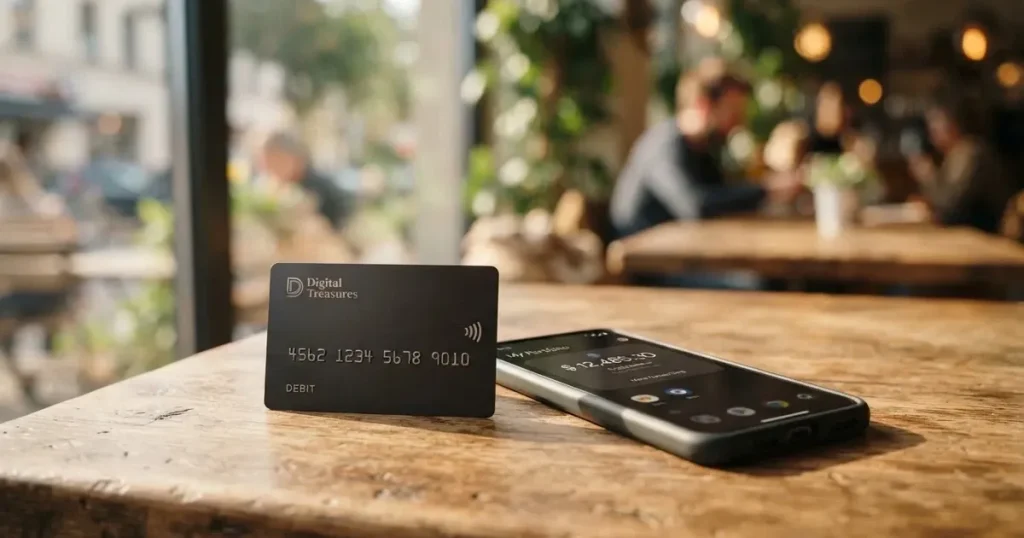
The Digital Treasures Card is a Visa Infinite payment card tied to the dtcpay Wallet, a Singapore-based crypto payments product that converts stablecoins such as USDT and USDC into fiat at the moment of spend. That positioning sounds attractive if you hold crypto and want to use it like ordinary money, and the underlying brand is licensed as a Major Payment Institution by the Monetary Authority of Singapore. What makes this card hard to evaluate, though, is how little the issuer publishes about it: an official country list, fee schedule, ATM terms, daily limits, supported networks and the issuing bank are all absent from the pages a normal reader can read. In this review I go through what the card actually says, what third parties have reported, and where the gaps leave you exposed.
Conditions in this article are current as of October 28, 2026.
Verdict
The card earns 4.7 out of 10 in my scoring, and the headline conclusion is that this is a niche product for a narrow audience that is comfortable with incomplete public information. If you are an ultra-high-net-worth individual already inside the dtcpay ecosystem who wants a Visa Infinite for stablecoin-funded spending, the basic mechanics appear to be in place. If you are an ordinary user, a small business, or anyone who compares cards on transparent fee tables, there is not enough published detail to make an informed decision.
| Criterion | Score | Why it scored this way |
|---|---|---|
| Who can get it | 4 / 10 | Official country list and eligibility criteria are not stated; the card is reported to target ultra-high-net-worth clients, is Singapore-issued and the United States is reported as excluded |
| Cost | 5 / 10 | Issuance, monthly and ATM fees are not stated; the only cost claim is “competitive exchange rates” with no numbers behind it |
| Top-up options | 6 / 10 | Stablecoins convert to fiat in real time through the dtcpay Wallet; USDT, USDC, BTC and ETH are listed at launch, but supported networks are not stated |
| Reliability and complaints | 4 / 10 | The operating company is a MAS-licensed Major Payment Institution, yet the card-issuing bank is not named; Trustpilot reviews for the company report blocked accounts and unreturned funds |
| Everyday use | 5 / 10 | It is a Visa Infinite, available virtually or physically, and works with Apple Pay and Google Pay, but ATM terms and acceptance limits are not stated |
The score reflects a product where the brand and licence are solid on paper, but the public documentation does not let a typical card shopper run a normal comparison. The card is aimed at high-net-worth holders converting stablecoins to fiat on a Visa card, and the rest of the review explains which of its moving parts you can actually see and which you cannot.
Who will they give you the card
The card’s official pages do not publish a country list, age requirement, minimum balance or income threshold. That is the single most important fact about this section: at the time of checking, the eligibility page is not in the readable public surface. So if you are weighing this card against another, you cannot point to a country table or a “we do not serve X” footnote on the issuer’s own site.
What third-party reporting adds is direction rather than detail. Fintech News Singapore wrote in February 2025 that the card targets ultra-high-net-worth individuals, which is a marketing positioning rather than a written eligibility rule. Starting data I have seen, again from third-party sources, says the card is issued from Singapore and that United States persons are excluded under the issuer’s terms, but that exclusion is not confirmed by a readable source on the issuer’s own pages. Treat both of those statements as unofficial until you see them in writing when you apply.
The licence underneath is real: the operating company, Digital Treasures Center Pte Ltd, describes itself as a Major Payment Institution licensed by the Monetary Authority of Singapore, and the Visa partnership was announced in September 2024. The card-issuing bank is not named in any source I could read, and the BIN, which is the six- or eight-digit number at the start of any card number that identifies the issuer, is not public either. That matters because, in practice, the bank behind a Visa programme decides which countries it underwrites, which merchant categories it blocks, and which sanctions lists it screens against, and you cannot read any of that policy here.
For the rest of the section, I take the most common reader question first: “Is this card for me, given what I know about myself?” If you live outside Singapore, the absence of a public country list is itself a risk. If you are a US person, the unofficial exclusion should make you assume the answer is no until you confirm otherwise with the issuer directly. If you are a European resident, the card does not appear to be marketed under any EU authorisation in the public materials, so any rights you would expect from a MiCA-regulated or e-money-licensed product in the EU do not show up in the documentation I have read.
A practical check, before you spend any time applying, is to ask the issuer in writing for the eligibility criteria, the bank that issues the card, the BIN range, and the country exclusions. If they cannot or will not give you those four pieces of information, that is itself an answer.
How to get the card
Application is through the dtcpay app, the mobile application of the operating company, according to Fintech News Singapore’s February 2025 coverage. That is the only public description of the application flow. The press release language around the launch described the card as a Visa Infinite called the Digital Treasures Card, and the same sources describe it as available in both virtual and physical form, though I did not see a public statement of the card currency, the supported device platforms, or the delivery times for the physical card.
The KYC, or “know your customer,” process, meaning the identity checks a regulated payments firm is required to run before it can take you on as a customer, is not described in the readable public pages. There is no public list of accepted documents, no stated turnaround time, and no description of the different verification tiers. The only thing the public materials establish is that the company is a Major Payment Institution under MAS, which means it is supervised and must, by rule, verify customers and screen for sanctions. What that looks like in practice for this specific card is not stated.
The Virtual or physical card question is the kind of thing that is usually clear on a card’s product page, with separate prices, separate order forms and a clear answer to “do I need the physical card to add it to Apple Pay or Google Pay”. Here the answer is partial: the card exists in both forms, both work with Apple Pay and Google Pay, and the differences in cost or features between the two are not published. If you only need a card for online spending or for mobile wallet payments, the virtual version is usually the cheaper route, but I have not seen a public price for either.
Activation steps, what happens between “you are approved” and “you can swipe”, and how a user would replace a lost physical card or upgrade from virtual to physical, are also not stated. So the practical advice in this section is short: do not assume the application is fast. A Major Payment Institution in Singapore will run full customer due diligence, which in the EU equivalent framework covers name, address, date of birth, nationality, identity documents, a sanctions check and an assessment of whether you are a politically exposed person. The Singapore framework is comparable in scope, so expect to upload a government-issued ID, a proof of address and possibly a source-of-funds declaration, and to wait for review before the card is issued.
What it really costs
This is the section where the card is hardest to recommend on the public record. The only cost claim the issuer makes in the materials I could read is “competitive exchange rates” for real-time stablecoin-to-fiat conversion. There are no published numbers, no markup over mid-market, no percentage, no spread disclosure, and no sample worked example of what a $100 payment would cost in fees.
| Fee or limit | What the public source says |
|---|---|
| Card issuance | Not stated |
| Monthly or annual fee | Not stated |
| Crypto-to-fiat conversion | “Competitive exchange rates” only |
| Foreign exchange (FX) | Not stated |
| ATM withdrawal | Not stated |
| Daily spending limit | Not stated |
| Monthly spending limit | Not stated |
| Tiers | Single product, Visa Infinite; no public tier list |
To put a face on what that means, let me walk through three everyday payments the way a cardholder would actually experience them.
A coffee in Singapore paid from USDT is the simplest case. The dtcpay app converts your USDT to Singapore dollars at the moment of payment, the merchant sees a normal Visa transaction in Singapore dollars, and you see the USDT deducted in the app. The fee you are really paying is the spread between the rate you get and the mid-market rate, the midpoint between the buy and sell price on the wholesale FX market that benchmarks like Reuters or Bloomberg publish. The card’s public material does not say what that spread is, and on a premium product the spread can be wider than on a card that publishes its terms. If you are a high-net-worth holder with a large balance, a wider spread can still leave you with a good effective rate, but for a small purchase the spread as a percentage of the transaction can be material.
A dinner in London paid from USDC is a more revealing case. The flow is the same: USDC converts to pounds, the merchant sees pounds, and the issuer takes the cut. But now there is also a Visa cross-border component, because the card is Singapore-issued and the merchant sits in the UK, and the card’s “BIN” — the first six to eight digits of the card number — looks like a Singapore-issued card to the UK merchant. That is the BIN look-up the card network exposes so the merchant can see which institution and country issued a card, and it is a normal reason a merchant may apply extra scrutiny to a foreign-issued card. On top of that, the issuer’s cross-border markup and any foreign-exchange loading sit on top of the conversion spread, and none of those numbers are published.
An ATM withdrawal in Tokyo is the case where the unknowns hurt the most. ATM fees on most cards are a flat fee plus a percentage, and the card’s ATM terms are not stated, so I cannot tell you whether the issuer charges you, the ATM operator charges you, or both. Some Visa Infinite products bundle a number of free ATM withdrawals, and others bill every withdrawal as a transaction. If you travel, this is the area where unstated fees tend to surprise people.
Across all three cases, the practical point is the same: a card that does not publish its fees effectively asks the cardholder to trust the spread and the foreign-exchange loading without verification. For a high-net-worth holder, that is sometimes acceptable, because the absolute cost on a large payment is small in relation to the balance. For a smaller balance or a frequent traveller, that opacity is a real cost.
Top up
Funding the card happens through the dtcpay Wallet app, the same application you use to apply. Stablecoins are converted to fiat in real time through the app, and the launch coverage lists USDT, USDC, BTC and ETH as the starting set of supported crypto assets. So far, so clear: the supported assets at launch are stablecoins, Bitcoin and Ether, and the flow is app-based.
The networks on which those tokens must be sent are not stated, and that is the single biggest practical risk in the funding flow. Stablecoins such as USDT and USDC are issued on many blockchains, and the same ticker on two different networks is a different token at the address level. If you send USDT on a network the card does not support, the deposit can be lost, because blockchain transfers are typically irreversible. A network the wallet does not support is not a small detail: it is the difference between your money arriving and your money being in an address that no system is watching on your behalf. With Circle, USDC is natively supported on 38 networks as of mid-September 2026, including Ethereum, Solana, Base, Polygon, Avalanche, Arbitrum and Stellar, and Circle itself stopped supporting USDC on Tron in February 2024, so “USDC over TRC20” is not a native option. Tether’s USDT has been issued on Ethereum, Tron, Solana, Polygon and Avalanche among others, and the wallet you use will pick a subset.
Top-up options, in the practical sense, are therefore four:
- USDT, the dollar-pegged token issued by Tether, across whichever networks the wallet supports
- USDC, the dollar-pegged token issued by Circle, across the same networks minus Tron since 2024
- BTC, Bitcoin, with the network implied to be the Bitcoin network itself
- ETH, Ether, on the Ethereum mainnet or a Layer 2 the wallet exposes
The limits and the timing, meaning how long a top-up takes to be available to spend, are not stated. The on-chain network fees for the deposit, which are the gas or bandwidth fees charged by the blockchain, are charged by the blockchain itself, not by the card provider, and on Ethereum that gas is paid in ETH, so a wallet holding USDT but no ETH cannot actually send. Tron uses a different model, paying fees via bandwidth and energy resources that often burn TRX, so a Tron address with USDT but no TRX can be stuck. None of those mechanics are addressed in the public card materials.
The withdrawal question, meaning whether you can move fiat back out of the card to a bank account, is not stated either. Most prepaid-style crypto cards do allow a refund to the original funding source or to a linked bank account, but the public materials do not confirm it, the timelines are not given, and the fees are not published. If you need a regular flow of fiat out of the card, treat this as an open question.
Paying with it every day
The card is a Visa Infinite, and the launch coverage says it is accepted at “over 150 million Visa locations” worldwide, an earlier release putting that figure at 130 million across more than 200 countries. Acceptance on the Visa network is genuinely wide, and the same Apple Pay and Google Pay support that any modern Visa card has will let you add the card to a phone or watch and pay contactless at the till.
Mobile wallets, meaning Apple Pay and Google Pay, work by replacing the card number with a device-specific number, often called a DAN for “Device Account Number” or a token, stored in the secure element of the device. The actual card number is never stored on Apple’s or Google’s servers, and each contactless payment uses a one-time dynamic security code. The issuer can then restrict that token, for example by blocking magnetic-stripe use, by blocking online use, or by setting a per-token spending cap. The public materials do not say which of those controls are turned on, off, or configurable by the cardholder.
What the card does for you as a reward or a perk is not stated. Cashback percentages, lounge access, concierge services, travel insurance, purchase protection: none of these are described in the public material. On most Visa Infinite products, the perks are the reason a cardholder accepts a high annual fee, and the absence of any published perk list here means either the product is perk-light or the issuer has chosen not to publish the benefits. Either reading is a guess, and the practical effect is the same: you cannot compare the value of the perks against the cost of any fee you might not see.
The app that runs the card is the dtcpay Wallet. App Store and Google Play ratings for the app are not part of the materials I could read, so I cannot tell you how the app is reviewed by users. What I can say is that the app is the only interface you have for KYC, top-ups, currency choice, card controls, transaction history and any dispute process, so the app’s quality is the product’s quality in a very direct sense.
Disputes, meaning the process for contesting a transaction you did not authorise or a service you paid for and did not receive, are not described. On a normal Visa product, the cardholder raises a chargeback, which is a refund the issuer orders to settle the dispute, and the issuer assigns a reason code such as fraud, duplicate billing or goods not received. The cardholder’s rights on a US debit card come from Regulation E, on a US credit card from Regulation Z, and prepaid-card coverage varies and should not be assumed. Singapore’s Payments Services Act and the rules of a Major Payment Institution set a floor for dispute handling, but the issuer’s own dispute process, its timelines, its evidence requirements and its success rate are not in the public materials.
What can go wrong
The risks on this card fall into two broad groups: the risks any crypto card has, and the specific risks that come from this product’s public posture.
The first group is the category risk. Stablecoins are not necessarily stable, despite the name. Tether’s USDT and Circle’s USDC are the two largest dollar-pegged tokens and account for about 90% of the stablecoin market by capitalisation, but USDC briefly lost its peg in March 2023 during the US banking crisis, and the TerraUSD stablecoin collapsed in May 2022. The balance you hold in stablecoins is exposed to those depegs, however briefly. Crypto transfers are typically irreversible, and a deposit sent on a network the card does not support, or to an address on a different network, can be lost or need manual support recovery with no guarantee. Stablecoins are not censorship-proof either: Tether has publicly stated it disables tokens in wallets on the OFAC sanctions list and has frozen funds tied to illicit activity.
The card-specific risks start with the operating company. dtcpay is a brand of Digital Treasures Center Pte Ltd, Singapore, and the company describes itself as a Major Payment Institution licensed by the Monetary Authority of Singapore. The card-issuing bank is not named in the public materials, and the BIN range is not public. Without a named issuer, you cannot independently check the bank’s regulatory standing, its programme history or its track record. Major card programmes have been wound down before: Visa terminated its global agreements with FTX in November 2022, and the FTX US debit card was wound down by its issuer; WaveCrest, a Visa card issuer that supplied several crypto card brands, was suspended by Visa in Europe in 2018, closing all WaveCrest-issued programmes. Those precedents show that even licensed programmes can be shut down, sometimes with short notice.
Trustpilot, the consumer review platform, shows a company-wide score of 2.6 out of 5 for dtcpay from four reviews, all of them one-star, dated January 2024, January 2026, May 2026 and July 2026, as of 21 October 2026. The themes in those reviews, and these are user reports rather than adjudicated findings, are blocked or inaccessible accounts, delayed or unreturned funds, allegations of fraud, and slow support. The company has not replied to those reviews. I do not treat a small sample of one-star reviews as proof of misconduct, and a Trustpilot page with four reviews is statistically thin, but the absence of any company response, the recurrence of the same themes over more than two years, and the consistency of the one-star pattern are signals a careful reader should not ignore.
Support quality is not stated, which is itself a risk. A regulated payments firm is required to have a complaint-handling process and to report on it, but the public materials do not describe how a cardholder contacts support, what the response-time commitment is, or how escalations are handled. If a cardholder’s account is blocked or a top-up is delayed, the absence of a public support commitment is the moment it hurts.
Security controls, meaning 2FA, instant card freeze, spending limits, 3-D Secure confirmation and tokenised mobile wallets, are standard on most modern cards and are presumably in place here, but the public materials do not describe them. 3-D Secure is the identity check added to online card payments, branded as Visa Secure by Visa and Identity Check by Mastercard, and the EMV 3-D Secure 2 specification published in 2016 supports one-time passcodes and app-based authentication aligned with EU strong customer authentication. The card’s specific 3-D Secure behaviour, including the way it handles overseas addresses, is not described, and that matters because Address Verification Service, which compares the numeric parts of a billing address with the issuer’s records, is generally offered in the US, Canada and the UK and is generally unavailable for foreign-issued cards, which can cause declines at checkout.
The list of merchant categories that the card blocks is not stated either. Merchant category codes, or MCCs, are four-digit numbers assigned under ISO 18245 that classify a business, and many issuers block specific codes on specific cards by policy rather than by law. The most common example is MCC 7995, which covers gambling, and the blocked list varies by issuer. Without a public list, you cannot know in advance whether a particular type of spend will be declined.
What to take instead
If the gaps in this product’s public documentation are deal-breakers for you, the three cards below are the natural comparison set. They are not the only options, and they are not direct equivalents, but they are the cards I would weigh against the Digital Treasures Card on the same broad question of “a card that lets me spend a crypto balance like fiat”.
Cardex scores 5.6 out of 10 in my scoring. It is a debit crypto card on the networks VERVE, Visa, Mastercard and UnionPay, available as virtual and physical cards, and the card currency is the Naira, the Nigerian currency, per its App Store listing. The product says it works in 200+ countries, although the listing is Naira-focused, and the conversion feature is described as an “AI-Powered Conversion Rate” that scans global exchanges and picks the best rate at the moment of payment. The supported assets at the wallets level are USDT, USDC and BTC, with no networks stated. The fees are not published, so the same opacity problem appears here, but the product is aimed at a different user.
CardFlow scores 4.9 out of 10. It is positioned as Nigeria’s fintech card platform, aimed at Nigerians and global users, and the card is a virtual USD Mastercard created quickly. The cost is “completely free” for creating the virtual card, with no monthly fee stated. The funding set is Bitcoin, USDT, ETH or Naira bank transfer, again with no networks stated. CardFlow is the cheapest entry in the comparison, but the fee schedule beyond the free creation is not stated, and the geo-focus is Nigerian.
HyperCard scores 4.7 out of 10. It is a prepaid card with the network not stated on the App Store page, the card balance in USD or EUR, and the marketing claim that the card works in “more than 176 countries”, which is an acceptance claim rather than an eligibility claim. The funding is crypto such as USDT, BTC and ETH deposited in the app, converted to USD or EUR on the card, and the App Store page lists no fees. The official pages do not state a country list for eligibility, and the fees are not on the pages I could read.
| Card | Score | Type | Funding assets | Where it is aimed | Main gap |
|---|---|---|---|---|---|
| Digital Treasures | 4.7 | Visa Infinite, virtual/physical | USDT, USDC, BTC, ETH | High-net-worth, Singapore-issued | Fee schedule, country list, issuing bank not stated |
| Cardex | 5.6 | Debit crypto, multi-network | USDT, USDC, BTC | 200+ countries, Naira card | Networks and fees not stated |
| CardFlow | 4.9 | Virtual USD Mastercard | BTC, USDT, ETH, Naira | Nigeria, global users | Fees beyond free creation not stated |
| HyperCard | 4.7 | Prepaid | USDT, BTC, ETH | 176+ countries acceptance | Eligibility, network, fees not stated |
The honest summary of this comparison is that the alternatives do not solve the opacity problem. Each of them publishes less than a fully transparent card product would, and each of them sits at a similar score in my framework. The differences are in target audience, network and funding assets, not in transparency.
Who I would recommend it to
I would recommend the Digital Treasures Card to a narrow reader profile, and I would steer everyone else toward a product with more published detail.
The card suits you if you are an existing dtcpay customer who is already comfortable with the app, the KYC process and the company’s communication style; if you hold a meaningful balance in USDT or USDC and you spend in fiat frequently enough that the convenience of a Visa Infinite outweighs the unknown spread on conversion; if you are based in or comfortable transacting through Singapore, and you are not a US person; and if you have asked the issuer for the fee schedule, the country list, the issuing bank and the BIN range in writing, and you have received answers you can verify. If all of those conditions hold, the card is a reasonable tool for the use case the issuer appears to have designed it for.
The card does not suit you if you are a casual crypto holder who just wants to spend small monthly amounts; if you are a US person, where the unofficial exclusion should be treated as exclusion; if you are an EU resident looking for a product under MiCA, the EU’s markets-in-crypto-assets regulation, or under an e-money institution in your own member state; if you need ATM access and want to know the fee before you travel; if you need clear dispute or chargeback rights; or if you are uncomfortable with a company that has a small number of one-star reviews and no public responses. In any of those cases, the right next step is to compare against a card that publishes its fee schedule, names its issuing bank, and lists a customer service contact that responds.
The deepest reason the score is 4.7 rather than higher is not the card itself, but the public surface around it. A premium product that does not publish its fees, its country list, its issuing bank or its support process asks the cardholder to take the brand on trust. For a regulated Singapore payments institution that trust may be reasonable in principle, but in practice a cardholder cannot budget, cannot plan travel, and cannot defend a dispute without that information, and the absence of it is the headline finding of this review.
Frequently asked questions
What is the Digital Treasures Card?
The Digital Treasures Card is a Visa Infinite payment card issued under the dtcpay brand by Digital Treasures Center Pte Ltd, a Singapore-licensed Major Payment Institution. It is designed to convert stablecoins such as USDT and USDC into fiat at the moment of spend, so a cardholder can pay at any Visa-accepting merchant as if they were paying with a normal bank card. The card is available in virtual and physical form, works with Apple Pay and Google Pay, and is accepted at the merchant locations Visa serves.
How does the Digital Treasures Card work?
The cardholder applies through the dtcpay Wallet app, completes the issuer’s KYC checks, and tops up the card by sending stablecoins such as USDT or USDC, or Bitcoin or Ether, to the address the app provides. At the moment of payment, the app converts the crypto to fiat at the current rate and the merchant receives a normal Visa transaction in their local currency. The card is prepaid in the sense that it draws on a converted balance, so it cannot overdraw, and the cardholder’s crypto remains in the dtcpay ecosystem between transactions.
Is Digital Treasures a bank?
No, Digital Treasures is not a bank. The operating company, Digital Treasures Center Pte Ltd, is licensed by the Monetary Authority of Singapore as a Major Payment Institution under Singapore’s Payment Services Act, which is a different category from a banking licence. The card’s issuing bank is not named in the public materials I could read, so the card may ultimately be issued by a partner bank that holds the actual banking licence, while Digital Treasures acts as the programme manager or front-end that markets and runs the card.
Who owns Digital Treasures?
The brand is owned by Digital Treasures Center Pte Ltd, a Singapore-incorporated company. The owners, shareholders and parent group are not described in the public materials I could read, and the company describes itself as a Major Payment Institution licensed by the Monetary Authority of Singapore. The Visa partnership was announced in September 2024, and the Digital Treasures Card as a Visa Infinite product was launched in February 2025.
Is the Digital Treasures Card available in my country?
The official pages do not publish a country list or any country exclusions. Third-party reporting describes the card as aimed at ultra-high-net-worth individuals, says it is Singapore-issued, and suggests that United States persons are excluded, but that exclusion is not confirmed by a readable source on the issuer’s own pages. The right step is to ask the issuer in writing, before you apply, whether your country of residence and your citizenship are eligible.
How do I get the Digital Treasures Card?
You apply through the dtcpay Wallet app, the only public application channel I have seen described. The app handles the KYC, or identity verification, the issuing of a virtual card on approval, and the ordering of a physical card if you choose that option. Activation steps, delivery times for the physical card, and the process for replacing a lost or damaged card are not stated in the public materials.
How do I top up the Digital Treasures Card?
You top up by sending supported crypto to the address the dtcpay Wallet app provides. The starting set of supported assets is USDT, USDC, BTC and ETH, and the supported networks are not stated in the public materials, which is a real risk: a stablecoin sent on a network the wallet does not support can be lost, because blockchain transfers are typically irreversible. Send a small test amount first, on the network the app explicitly shows, before sending the rest.
What fees does the Digital Treasures Card charge?
The only cost claim in the public materials is “competitive exchange rates” for real-time stablecoin-to-fiat conversion. The card’s issuance fee, monthly or annual fee, foreign-exchange loading, ATM fees, daily and monthly limits, and the markup over mid-market on the conversion are not stated. Until the issuer publishes a fee schedule, the effective cost of any payment is the spread between the rate you receive and the wholesale mid-market rate, plus any foreign-exchange loading the issuer chooses to apply.
Is the Digital Treasures Card safe?
The operating company is licensed by the Monetary Authority of Singapore as a Major Payment Institution, and the card is on the Visa network, both of which are positive signals. The card’s specific security controls, including 2FA, instant card freeze, spending limits, 3-D Secure and tokenised mobile wallets, are not described in the public materials, and Trustpilot reviews for the company report blocked accounts, delayed or unreturned funds, and slow support, with the company not having replied to those reviews. Treat the brand and licence as positives and the small set of one-star reviews as a caution, and confirm the support and dispute process in writing before you commit a large balance.
How do I add the Digital Treasures Card to Apple Wallet or Google Pay?
The card supports Apple Pay and Google Pay, the two main mobile wallet systems that store a tokenised version of a card on a phone. The exact steps are not described in the public materials, but the standard flow is to open the dtcpay Wallet app, choose “Add to Apple Wallet” or “Add to Google Pay”, and follow the verification prompt. If the option is not visible, the most common reason is that the virtual card has not been issued yet, the device is not on a supported version, or the issuer has not enabled tokenisation for your account.
Virtual card reviews – cryptocardcheck
Content created by the «cryptocardcheck» team