
Digitap gives you a free Visa virtual card and 100+ crypto assets, but leaves the important numbers unstated
 Available in US

Digitap is a crypto-linked Visa card. You load it, you spend it, it converts. That part is simple enough. What is not simple is the paperwork around it: the card’s own pages describe plans and features in detail but leave the numbers that decide whether it is worth your money — conversion fees, ATM charges, actual spending limits, minimum top-ups — unstated. The company behind it is described as “a fintech application powered by licensed financial partners” without naming the issuer or the licence. Its Trustpilot score is 2.7 out of 5, and the app on the App Store shows “not enough ratings or reviews.”
I scored it 6.2 out of 10. That is not a rejection. It is a card with a genuinely attractive free entry point and a free tier that costs nothing to try, wrapped in enough disclosure gaps that you should commit small amounts, not your balance.
The conditions described below are current as of October 28, 2026.
Verdict: 6.2 out of 10, and what that number hides
Here is the breakdown, criterion by criterion, with the marks as I found them.
| Criterion | Mark | Why |
|---|---|---|
| Who can get it | 9 / 10 | Works in 180+ countries worldwide; issuing countries not named |
| Cost | 5 / 10 | Virtual tier free with 2 free virtual cards; top-up fee 2.5% (Wallet, Virtual), 2.2% (Pro); Pro costs $299 to open and $95 a year; no foreign transaction fees |
| Top-up options | 7 / 10 | Crypto (100+ assets) or fiat USD, EUR, GBP; networks not disclosed |
| Reliability and complaints | 3 / 10 | Issuer and legal entity not named; Trustpilot 2.7 out of 5, complaints about silence from support and doubts over the $TAP presale; app in beta |
| Everyday use | 7 / 10 | Virtual card instantly, plastic available, ATMs worldwide; unofficially: Google Pay works, Apple Pay does not |
| Total | 6.2 / 10 |
The 9 out of 10 for eligibility is the reason this card is worth writing about at all. If you cannot get an ordinary bank card where you live — because of residency rules, banking history, documentation, or a country your bank will not serve — a card that says “works in 180+ countries” solves a real problem. That is the audience this card is built for: people who want a working Visa number funded from crypto, ideally without a large balance sitting in a traditional bank.
Where it falls down is everything around that promise. A 5 out of 10 on cost reflects a free tier that is genuinely free but a paid tier with an unusually steep entry fee ($299 to open, then $95 a year), plus a top-up fee on every deposit. The 3 out of 10 on reliability is the weakest number and the one that should govern your decision. An unnamed issuer, an unnamed licence, a token presale dominating the marketing, and a support team that users say does not reply — that is a profile, not a rounding error.
My advice: if your problem is “no ordinary card,” try the free Virtual tier with a small amount and treat it as a convenience, not as infrastructure. If your problem is “I want to spend crypto cheaply and reliably,” there are better-characterised options, which I cover at the end.
Will they give you the card?
Yes, broadly — this is the strong part.
Digitap states that it “works in 180+ countries worldwide.” That is the widest claim of any card in my comparison. The site’s own footer adds the standard qualifier: the site is not directed at places where use would be contrary to local law. So the honest reading is: eligibility is broad, but you are responsible for whether the card is lawful in your country.
What the card’s pages do not do is name the countries it issues in. So the 180+ figure describes reach, not the issuing footprint. You cannot check from the public pages whether your country is issuing, holding, or merely accepting.
The eligibility tiers are organised by verification level rather than by geography, which is unusual and worth knowing:
- Wallet ($0) — no KYC, no card, Medium Limits, basic cashback, support in business hours
- Virtual (free) — light KYC, virtual card only, 2 free virtual cards, Medium Limits
- Pro ($299 opening + $95/year) — full KYC, High Limits, high cashback, 5 free virtual and 3 free physical cards
- Premium (on request) — full KYC, No Limits, 24/7 private-banking manager, unlimited cards including metal, “Up to Double Digit % Cashback + Loyalty Benefits”
- Business (on request) — multi-user, custom limits and rewards, 24/7 support
Because Wallet requires no KYC and issues no card, and Virtual needs only “light KYC,” the practical answer to “will they give me the card” depends on which tier you want. The free Virtual tier is the entry point.
One point of background on why that structure exists at all: in the EU, customer due diligence covers name, address, date of birth, nationality, identity documentation, a sanctions check, the purpose of the relationship, and whether you are a politically exposed person. If due diligence cannot be completed, the institution must refrain from the transaction or end the relationship — which is why accounts get closed or frozen pending documents. Nationality is screened separately from residence because sanctions screening often applies to citizenship and country of birth, not just your address. Prepaid and debit cards are generally available to adults aged 18 or over. None of that is specific to Digitap; it is the environment every card operates in.
What the card does not state anywhere: the KYC documents required, the proof of address needed, the age minimum, the processing time, or the reasons a rejection might happen. I want to be plain about that rather than guess — the public pages simply do not say.
How to get it
The stated flow is short. You open a Digitap account online “in a few minutes,” pick a plan, get a virtual card instantly or order a physical one. The virtual card comes with an EMV chip and PIN and a custom design; it runs on Visa. Fiat accounts are offered in USD, EUR, and GBP.
That is the whole official signup story, and it is thin. Not stated: what documents you need, how long verification takes, age requirements, delivery countries, delivery time, delivery cost. The only replacement figure given is $40 for a replacement physical card on the Pro tier.
Verification levels differ by plan, and this is the part that most affects whether you get in:
- Wallet — no KYC
- Virtual — “light KYC”
- Pro, Premium, Business — full KYC
For documents and processing time within those levels, the card says nothing. Rejection reasons are also not stated.
One unofficial data point, offered as unofficial and not confirmed by the card: a MEXC promotional article from January 2026 describes the virtual card arriving after a simple identity check processed in under 24 hours, and the physical card requiring more verification including a passport scan and a selfie. Take that article for what it is — it is a token-promotion piece, and it also promotes the $TAP presale.
A note on activation, which readers search for and which the official pages do not describe as a separate step: with the virtual card being available “instantly,” there is no waiting period described to activate it.
Fees: what it really costs
The costs table is where this card gets hard to judge, because the entries that would matter most are blank. Here is everything the card states, and I have marked the gaps rather than filling them in.

| Fee or limit | What the card states |
|---|---|
| Issuance | Virtual free (2 free virtual cards, replacement free); Pro: $299 account opening fee, replacement physical $40 / virtual $2.50; Wallet has no physical cards |
| Monthly / yearly fee | Virtual free; Pro $95 yearly admin fee; page also shows a toggle of $15.99/month or $155/year, not mapped to a tier; Wallet $0; Premium and Business on request |
| Conversion fee | Crypto conversion fee: not stated |
| Foreign transaction fees | “No foreign transaction fees” |
| ATM | ATM withdrawals worldwide with crypto-to-fiat conversion; fee and free allowance not stated |
| Top-up / deposit fee | 2.5% (Wallet, Virtual); 2.2% (Pro, Premium) |
| Withdrawal to external wallet | 1% (Wallet, Virtual, Pro); 0% (Premium, Business) |
| Withdrawal to external bank | 1% (Virtual, Pro); 0% (Premium, Business); N/A for Wallet |
| Limits | Labels only: Wallet/Virtual “Medium Limits”, Pro “High Limits”, Premium/Business “No Limits”; amounts not stated |
| Currencies / FX | Fiat accounts USD, EUR, GBP; FX on payments in other currencies and multi-currency balance rules not stated |
So the honest cost picture is: the Virtual tier is free to hold, has no foreign transaction fee, and costs 2.5% to top up. The unknown is what a purchase actually costs when crypto is converted, and what a cash withdrawal costs. Both are central to how you would use the card, and both are unstated.
The Pro tier deserves its own paragraph, because $299 is not a rounding error. You pay it to open the account, then $95 a year. In exchange you get High Limits (amount unstated), high cashback (percentage unstated), 5 free virtual and 3 free physical cards including “virtual, plastic or metal cards.” If you are considering Pro, the missing conversion fee figure matters more than the headline price — you would be paying $394 across the first two years to access a limit nobody has quantified.
Top up: how to get money onto it
Two routes, both stated clearly.
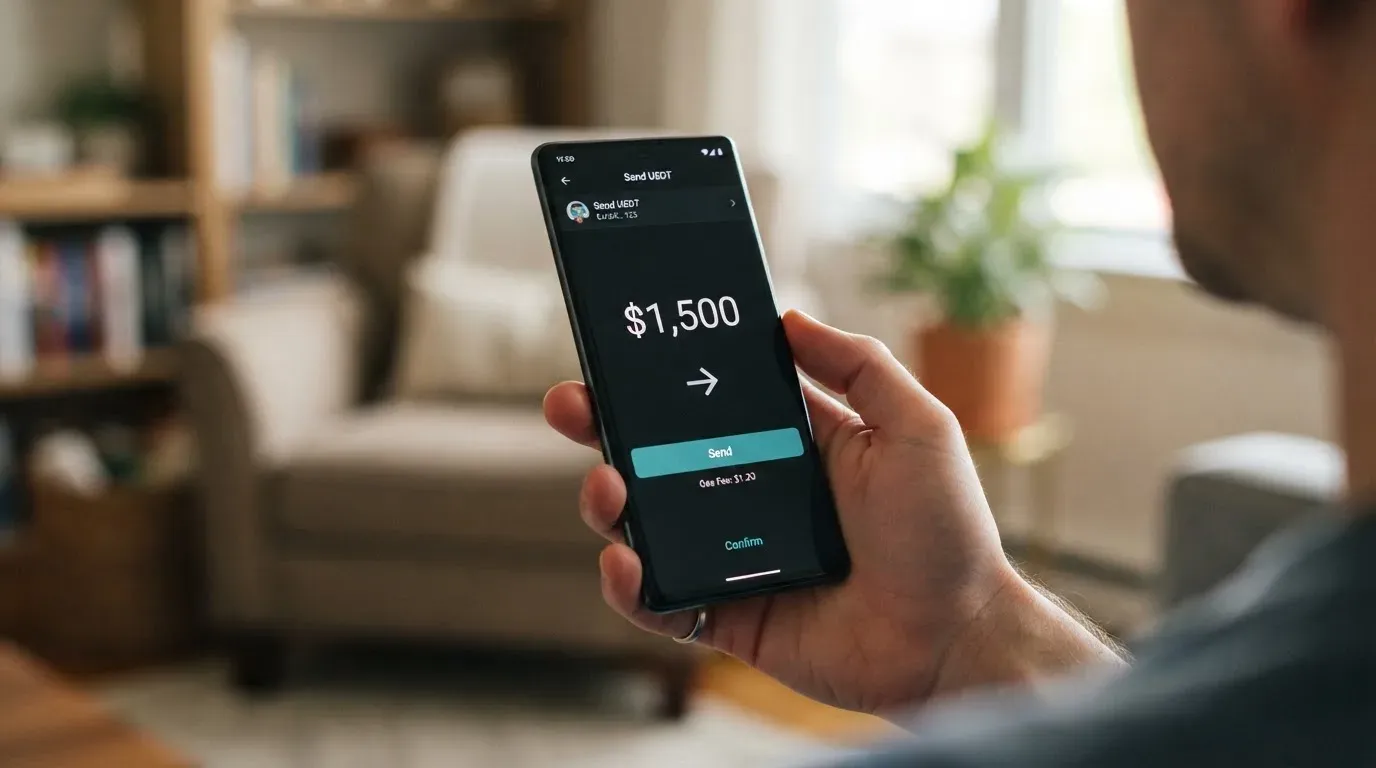
Crypto. Over 100 assets. You pick the asset at checkout. What the card does not say is which networks are supported — and that omission has real consequences, which I come back to below.
Fiat. USD, EUR, and GBP, matching the three fiat account currencies.
The deposit fee is 2.5% on Wallet and Virtual, and 2.2% on Pro and Premium. Minimum top-up is not stated. Who pays the blockchain network fee is not stated. Fiat top-up fees beyond this table are not stated.
Two structural facts about crypto top-ups are worth understanding before you send anything, because they are properties of the technology rather than of this card:
- ERC-20 fees are paid only in ETH. A wallet holding USDT but no ETH cannot send. So even a supported asset can be unsendable if the gas token is missing.
- Transfers are irreversible. A deposit sent on a network the provider does not support, or to an address belonging to a different network, can be lost or need manual support recovery with no guarantee. Since Digitap does not publish its supported networks, you are relying on the app at the moment of sending.
Other category facts that bear on your choice of asset and network:
- A stablecoin aims to hold a stable value against a fiat currency, but “despite the name, stablecoins are not necessarily stable.”
- Tether’s USDT and Circle’s USDC are US-dollar-pegged; the BIS (July 2025) put about 90% of stablecoin market capitalisation in these two.
- Circle lists USDC as natively supported on 38 networks (as of 16 September 2026), including Ethereum, Solana, Base, Polygon PoS, Avalanche, Arbitrum and Stellar.
- Tether describes USDT as issued on multiple blockchains including Ethereum, Tron, Solana, Polygon and Avalanche.
- Circle stopped supporting USDC on Tron in February 2024, so “USDC over TRC20” is not a native option.
- Circle says USDC is redeemable 1:1 for USD and 100% backed by cash and cash equivalents, mostly in an SEC-registered government money market fund, with monthly reserve attestations.
- Tron prices fees with bandwidth and energy, often burning TRX.
- Stablecoins can depeg: TerraUSD collapsed in May 2022, and USDC temporarily lost its peg in March 2023.
- Tether says it disables tokens in wallets on the OFAC sanctions list and has frozen funds tied to illicit activity — stablecoins are not censorship-proof.
One last funding note: on withdrawal out, the card does state fees. To an external wallet, 1% on Wallet, Virtual and Pro, and 0% on Premium and Business. To an external bank, 1% on Virtual and Pro, 0% on Premium and Business, and not applicable on Wallet. What happens to a remaining balance when you close an account is not stated.
Paying with it every day
The practical day-to-day picture is decent, with two gaps.
What works. The virtual card is available instantly. A physical card can be ordered, with a custom design, EMV chip and PIN. ATM withdrawals are offered worldwide with crypto-to-fiat conversion. The card runs on Visa, so wherever Visa is accepted, the card should be accepted — subject to the blocklist caveats below.
Apple Pay and Google Pay: not stated. The card’s own pages say nothing about either mobile wallet. Unofficial reports — from Trustpilot reviews dated November 2025 and May 2026 — say Apple Pay is missing, and reports from December 2025 and February 2026 say Google Pay works. Give that as unofficial: not confirmed by the card. If tap-to-pay on a phone is a requirement for you, treat it as unverified before you rely on it.
Rewards. Paid in $TAP tokens. The rate depends on plan: Wallet and Virtual get “basic cashback”, Pro gets “high cashback”, Premium gets “up to double digit %”. No percentages are given, no monthly caps, and no staking is required per the page. This is the part that most rewards sceptics will care about: your cashback arrives as a token, not as money, and that token is the same one the marketing is pushing through a presale.
Blocked merchant categories: not stated. That is worth understanding in general terms. A merchant category code is a four-digit number classifying a business by goods or services. MCC 7995 covers gambling — casinos, betting, lotteries — and many issuers block it on specific cards by policy rather than by law, with the blocked list varying by issuer. Digitap does not publish a blocklist.
The app. iOS (iPhone iOS 12.0+, iPad, Mac M1) and Android (my.digitap.card). The official page itself calls it “the official beta version.” On the UK App Store storefront, read 2026-10-20, no rating is shown — “not enough ratings or reviews”. The Google Play rating was not readable. So there is no independent rating to lean on here, and the card’s own word is beta.
Disputes and chargebacks: not stated. In general, a chargeback is a refund ordered by the card issuer to settle a dispute, with reason codes such as fraud, duplicate billing or goods not received. In the US, debit card reversal rights come from Regulation E and credit card rights from Regulation Z; prepaid-card coverage varies and should not be assumed. Whether any of that applies to a Digitap card, the card does not say.
Payments may occasionally decline, and this is not always the card’s fault. Some merchants decline prepaid or foreign BINs because the BIN lookup reveals the card type and issuer country. Address Verification Service compares the numeric parts of the billing address a buyer typed with issuer records; it is mainly offered in the US, Canada and the UK and is generally unavailable for foreign-issued cards, which can cause declines. A declined authorisation may also leave a hold on funds for several days, typically up to 7. For online payments, 3-D Secure adds an issuer-side risk check — Visa’s brand is Visa Secure, Mastercard’s is Identity Check — which can send you a one-time code or a biometric challenge.
What can go wrong
This is where I have the least patience, and it is where the score of 3 out of 10 comes from.
The company behind the card is not identified. As noted earlier, Digitap uses this description, without identifying its issuer or licence. The issuer, the registered entity and the licences are not named. For a card that handles your money, that is the first thing you should want to see and the thing you cannot find.
The general background explains why this matters. A payment card number starts with a 6- or 8-digit issuer identification number identifying the card-issuing institution; merchants can look it up and see which institution and country issued the card. Card payments involve three parties: the network (Visa, Mastercard) routes messages and sets rules, the issuer — a bank or e-money institution licensed to issue — holds the programme, and the crypto brand is often only a programme manager or front-end that markets the card. If you cannot name the issuer, you cannot check the licence. In the EU, an electronic money institution can issue e-money, payment cards and e-wallets but cannot lend, and must safeguard customer funds by segregating them in dedicated accounts or insuring them — such funds are not the same as bank deposits and may not be covered by deposit guarantee schemes. A card itself is regulated as a payment service under e-money and payment-services law, separately from the crypto side, so a crypto card often depends on two licences. None of this is Digitap-specific, but it is exactly what “licensed financial partners” leaves you unable to verify.
Custody. The card does not describe its custody model. No wording about 2FA, card freeze or spending controls appears on the plans page — the usual safeguards for this category. In general, control of crypto belongs to whoever holds the private key; with a custodial wallet the provider holds the credentials and you must trust them completely. A seed phrase is typically 12 to 24 words in unencrypted form, and anyone who obtains it can restore the wallet and spend its funds. Transfers are typically irreversible and a stolen key has no built-in recovery — the network cannot freeze or return the funds. Custodial platforms have a real record of failure: Mt. Gox (about US$350 million reported stolen 2011-2014), Coincheck (about US$400 million, 2018), Ronin Network (US$625 million, 2022). A self-custody-linked card keeps funds in your own wallet until the moment of payment but leaves you carrying all of it, including phishing and clipboard-hijacking malware that swaps copied addresses.
User complaints. There are no Digitap-specific Trustpilot, Reddit or news complaints that I found, and no official incidents. But that is partly because the service is new and small, and the Trustpilot record is thin in a way that cuts against it. Read on 2026-10-20: 2.7 out of 5, from 13 reviews in the last 12 months, 54% one-star. The themes:
- No reply from support — January, April, June 2026, one of them after a $299 Pro upgrade
- A refund request on the Pro plan left unanswered (April 2026)
- Doubts about who runs the company and its regulation, plus “scam” claims tied to the token presale — running from November 2025 to June 2026, with one report saying the website was unavailable in April 2026
- No Apple Pay (November 2025, May 2026)
- Slow KYC (June 2026)
- A few positive notes on Google Pay (December 2025, February 2026)
The token presale is tangled up with the card. The marketing site heavily promotes a $TAP presale, which is separate from the card. Several of the “scam” claims in the reviews attach to the presale rather than to card use. My read: keep the two judgements apart. The presale is not evidence that your card funds are unsafe, and a low Trustpilot score driven partly by token complaints is not purely a payments-service signal. But a company whose marketing is dominated by a token sale has divided attention, and you should not read card goodwill as cover for the token.
Support hours do not match the promise. The page says “here to help 24/7 on email or submit a contact form,” yet the tier table gives “Business Hours” for Wallet, Virtual and Pro, and 24/7 only for Premium and Business. Contact routes are [email protected]’s domain — specifically [email protected] — plus a contact form and an FAQ. So on the free tier, the 24/7 claim does not hold.
Programme closure is a real category risk. Visa and Mastercard do not issue crypto cards to consumers themselves; they license issuers and can suspend a programme. In November 2022 Visa said it had “terminated our global agreements with FTX” and the FTX US debit card programme was being wound down by its issuer. WaveCrest, a Visa card issuer that supplied crypto card brands, was suspended by Visa in Europe in 2018, closing all WaveCrest-issued Visa programmes. Closures typically give notice, then stop spending and loading, then ask users to withdraw remaining balances. Because Digitap does not name its issuer, you cannot look up its track record — and if your balance is stuck, the “balance on closure is not stated” gap becomes the whole problem.
No dated licence or programme events are published. I found no dated announcements on the official pages that would reassure you the service is in good standing.
One thing I will not do here is tax or legal advice, but flag the shape of it: the IRS treats digital assets as property, so exchanging them for goods, services or dollars generally produces a taxable gain or loss, measured in local fiat currency at fair market value on the date of the transaction. Each card payment funded from crypto may be a separate disposal. Your own jurisdiction’s rules are worth checking with a professional.
What to take instead
Three alternatives, all with the same broad shape — a card you fund and spend — and better-disclosed in different ways.
International Visa Card — 6.7 / 10. A US-issued Platinum Visa card, virtual, paying in USD; a physical card is “coming soon”. The trade-off is strict eligibility: the account and card are not available to residents or legal registrants of Belarus, mainland China, North Korea, Cuba, India, Iraq, Iran, Israel, Myanmar, Nepal, Nicaragua, Russia, Syria, Turkey, Ukraine, Venezuela or Vietnam, and FATF grey-list countries are reviewed case by case with compliance approval. Purchases are blocked in North Korea, Cuba, Iran, Russia, Syria, Ukraine and Venezuela. The rule is by residence or registration, not citizenship. Cost is $5 one-time for the virtual card with no maintenance fee; plans are Classic free, Pro $9.00/month, Max $19.00/month. Card use in USD is free on all plans, foreign currency costs “Visa exchange rate + 2% FX fee”, and deposits of any kind are free. Funding is USDC or USDT into the USD account, free at 1:1, plus USD, EUR, SEPA, SWIFT and FedNow. No cashback stated.
UNi Card — 6.1 / 10. A multicurrency card on the Mastercard network, spending from the UNi.Global account balance. “No annual fee or foreign transaction fee”; assets converted at “live OTC (Over-the-Counter) rates” with “No hidden exchange fees”. Spend-to-Earn rewards up to 3%. Not stated: who can get it, physical or virtual form, issuance fee, funding routes.
Whop Cards — 5.2 / 10. Visa, working anywhere Visa is accepted online and in stores. Availability is the widest of the three but the most list-heavy: consumers in 31 US states (Alabama, Alaska, Arkansas, California, Colorado, Connecticut, Florida, Hawaii, Illinois, Indiana, Iowa, Kansas, Kentucky, Maine, Massachusetts, Michigan, Minnesota, Montana, Nebraska, New Hampshire, New Jersey, New York, North Carolina, Oklahoma, Pennsylvania, South Carolina, Texas, Utah, Virginia, West Virginia, Wyoming), businesses in 41 states. Unsupported consumer countries: Belarus, China (Mainland), Cuba, Hong Kong, India, Iran, Iraq, Israel, Myanmar, Nepal, Nicaragua, North Korea, Russia, Syria, Turkey, Ukraine, Venezuela, Vietnam. Whether the basis is citizenship or residence is not stated. The page says “No extra fees” with no amounts; no conversion or FX fee figures. Spending draws on a Whop balance — a pending balance is usable as soon as a payment arrives, standard withdrawals use settled funds — and starting data is backed by stablecoin collateral from a linked wallet, with coins and networks not stated. 5% cashback at select merchants, currently Uber, with more planned; payout currency and conditions not stated.
| Digitap | International Visa | UNi Card | Whop Cards | |
|---|---|---|---|---|
| Score | 6.2 / 10 | 6.7 / 10 | 6.1 / 10 | 5.2 / 10 |
| Network | Visa | Visa (US-issued, Platinum) | Mastercard | Visa |
| Form | Virtual instant + physical | Virtual; physical coming soon | Not stated | Not stated |
| Annual / opening cost | Free tier; Pro $299 + $95/yr | $5 once; plans free / $9 / $19 per month | No annual fee; issuance not stated | “No extra fees”, no amounts |
| Top-up fee | 2.5% (Wallet, Virtual), 2.2% (Pro, Premium) | Deposits free | Not stated | Not stated |
| Foreign currency | No FX fee | Visa rate + 2% FX fee | No FX fee; live OTC rates | Not stated |
| Rewards | $TAP cashback, % unstated | None stated | Up to 3% | 5% at select merchants |
| Main gap | Issuer unnamed; conversion fee unstated | Long exclusion lists | Eligibility and funding unstated | US-state and country limits |
Read the table a few ways. If you live outside the US, the International Visa Card’s exclusion list may rule you out before price matters. If you want no foreign transaction fee and a Mastercard rather than a Visa, UNi is the tidier fit on fees but says almost nothing about who qualifies. If you are in one of the 31 listed US states, Whop’s cashback is the strongest number on this page. And if none of them will serve your country — which is the situation Digitap addresses — the absence of alternatives is the whole reason the free tier matters.
Who I would recommend it to
Yes, if you cannot open an ordinary bank card where you are, you want a Visa number that works online and at ATMs worldwide, you hold crypto and are comfortable converting it, and you are willing to treat this as a convenience rather than your main payment rail. Start on the free Virtual tier. Keep the balance small.
No, if any of these apply: you need to know who the issuer is and what licence it holds; you need a stated conversion fee before you spend; you need Apple Pay; you need to count on 24/7 support on a free tier; you are planning to hold a significant balance on it; or you are in a country where crypto funding is restricted for you personally.
Think twice if the reason you are here is rewards. The cashback is denominated in $TAP, the percentage is unstated on every tier, and the token is the subject of an active presale promotion. I would not plan spending around an unquantified, token-denominated return.
The categories that matter for this card, for reference. MiCA is the EU’s markets-in-crypto-assets regulation, which ESMA states took legal effect in June 2023; its rules on asset-referenced tokens and e-money tokens applied from 30 June 2024, with remaining provisions including crypto-asset service provider rules from 30 December 2024. Under it, e-money tokens may be issued only by a credit institution or an electronic money institution (Article 48), and providers operating under national law could continue only until 1 July 2026 or until they received or were refused an authorisation, whichever came first. ESMA keeps an interim register of authorised providers and white papers that you can check. In the US, FinCEN guidance (FIN-2013-G001) treats administrators and exchangers of convertible virtual currency as money transmitters, while mere users buying goods or services are not.
None of that resolves the question you actually have, which is whether this particular issuer is properly licensed and who it is. That answer is not on the site.
Frequently asked questions
What is Digitap card?
Digitap is a crypto-linked Visa card. You fund it from over 100 crypto assets or from fiat in USD, EUR or GBP, and it converts that balance into ordinary card payments. The free Virtual tier gives you a virtual Visa card with an EMV chip and PIN straight away, with no physical card included. The card also repeats this description.
Is Digitap a bank?
No — not on the evidence available. Digitap repeats the same description, which is the language of a programme manager or front-end, not a bank. The issuer, the registered legal entity and the licences are not named on the public pages. So you cannot tell from the card’s own material whether the entity behind it is a bank, an e-money institution, or something else.
Who owns Digitap?
The card does not say. No owning company, registered entity or licence is named on the pages I checked. This is the gap that most affects my score, because the issuer is normally identifiable from the card’s BIN, and without the issuer there is nothing to verify against a licence register. Some Trustpilot reviewers raise the same question directly.
Does the Digitap card require KYC?
It depends on the plan. The Wallet tier ($0) requires no KYC but issues no card. The free Virtual tier requires “light KYC”. Pro, Premium and Business require full KYC. What documents you need, what proof of address is accepted, the age minimum, and the processing time are not stated on the card’s pages — so budget for uncertainty rather than assuming a same-day answer.
How much does the Digitap card cost?
The free Virtual tier costs nothing to hold and includes two free virtual cards with free replacement, and there are no foreign transaction fees. Topping up costs 2.5% on Wallet and Virtual, 2.2% on Pro and Premium. The Pro tier is $299 to open plus $95 a year. The crypto conversion fee is not stated, which is the number that would actually tell you what a purchase costs.
Is Digitap card free?
The Virtual tier is free, with two free virtual cards and free replacement, and a 2.5% deposit fee on each top-up. The Wallet tier is $0 but issues no card at all. The Pro tier is $299 to open and $95 a year, and the page also shows a $15.99/month or $155/year toggle that is not mapped to any named tier. Premium and Business are available on request only.
How do I top up the Digitap card?
You can deposit over 100 crypto assets, choosing the asset at checkout, or use fiat in USD, EUR or GBP. The deposit fee is 2.5% on Wallet and Virtual and 2.2% on Pro and Premium. Neither the minimum top-up nor the supported networks is stated — and since transfers are irreversible, sending on an unsupported network or to a wrong-network address can lose the funds.
Can I add the Digitap card to Apple Wallet?
Unofficial reports from Trustpilot reviews in November 2025 and May 2026 say Apple Pay is not available, and reports from December 2025 and February 2026 say Google Pay works. The card’s own pages state nothing about either mobile wallet. Treat all of this as unconfirmed — if tap-to-pay on your phone matters, test it before relying on it.
Is the Digitap card safe?
That is the hardest question to answer, because safety here rests on facts the card does not publish. The issuer and licence are unnamed, the custody model is not described, and there is no 2FA, freeze or spending-control wording on the plans page. Trustpilot shows 2.7 out of 5 from 13 reviews in the last 12 months, with 54% one-star, including repeated reports of unanswered support. No specific incidents have been reported against the card itself.
Where can I use the Digitap card?
Anywhere Visa is accepted, online and in stores, plus ATMs worldwide with crypto-to-fiat conversion, subject to a few caveats. Some merchants decline prepaid or foreign-issued cards because the BIN lookup reveals the issuer country, and address verification is generally unavailable for foreign-issued cards, which can cause declines. Blocked merchant categories are not stated, and a declined authorisation can leave a hold on your funds for several days. The footer also notes the site is not directed at places where use would be contrary to local law.
App and neobank card reviews – cryptocardcheck
Content created by the «cryptocardcheck» team