
A digital Visa funded from crypto, priced by what you spend it on
 Available in US
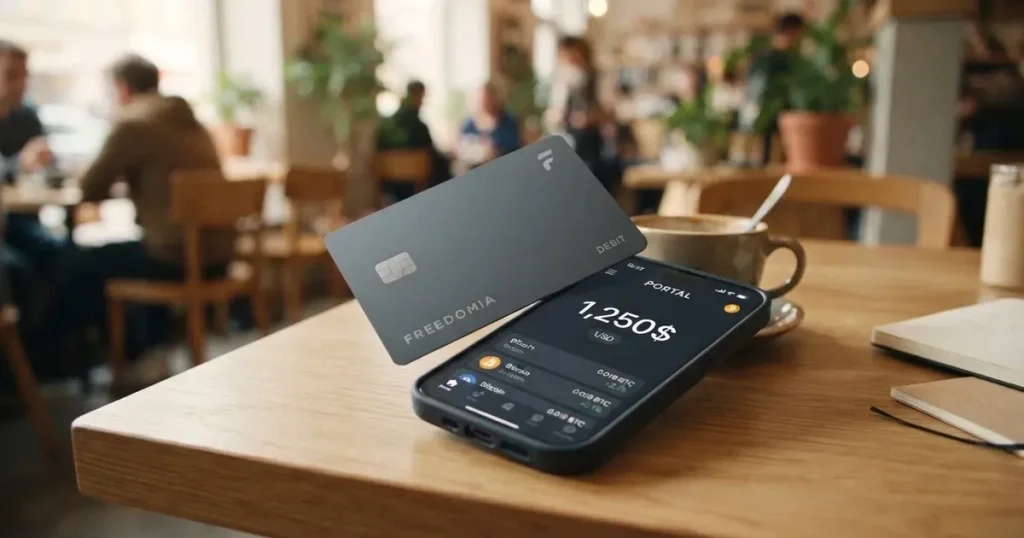
Freedomia is not a bank and it is not a typical crypto exchange either. It is a digital Visa card — a card number, not a piece of plastic — that you load from your own crypto, mostly over the Lightning Network, and then spend like an ordinary virtual card at any shop that takes Visa. The pitch is unusually specific: privacy-minded users who want to fund a virtual Visa with BTC or Lightning and pay with it. The card is described as “Global”, signup is by email, and the marketing line is “No verification. No approval.”
I scored it 6.1 out of 10. That is not a rejection, but it is not a recommendation either, and the reasons are worth walking through before you decide anything. The product is narrow — a virtual card, USD-denominated, no cash withdrawal — and that narrowness is both what makes it interesting and what will frustrate you if you expected a normal everyday card. The fees are cheap in one direction and expensive in another: spending USD costs nothing, but converting non-dollar balances costs 2.5%. And the details you would want before signing up — which countries are restricted, whether an issuance fee exists, whether there is a minimum top-up — are simply not stated on the public pages.
The conditions described here are current as of October 28, 2026.
Verdict: 6.1 / 10
The single word I would use for Freedomia is *narrow*. It does one thing — turn crypto into a Visa card balance — and it does it with a fairly low ceiling on fees for USD spending. If your crypto is already in dollars or dollar-pegged tokens, the conversion cost is where you pay, and it is 2.5%. If your money is in Bitcoin or Lightning and you want it to be a card payment without touching a traditional bank, Freedomia is one of the more direct routes I have seen.
What holds it back is not a scandal or a complaint; it is thinness. There is no physical card, no ATM, no named issuing bank, no licences named on the pages I could read, no standalone app, and Apple Pay is still “coming soon”. The card works in the app-free era of banking: you freeze it, read your card data and set limits from a web account. If you want a card that lives in your phone’s wallet and works at a terminal without thought, today it only does that on Google Wallet.
Here is the breakdown, criterion by criterion.
| Criterion | Mark | Why |
|---|---|---|
| Who can get it | 8 / 10 | Described only as “Global”, no country list or restrictions on the home page; the FAQ answer on restricted countries was not readable |
| Cost | 4 / 10 | Founder $5/month or $60/year; top-up 1.3%, standard conversion 2.5%, USD spending 0%; issuance fee not disclosed |
| Top-up options | 9 / 10 | Lightning, BTC, XMR, ETH, LTC, SOL, TRX, BNB, USDT (Polygon), USDC (Polygon) “and more”, plus swapping to USD |
| Reliability and complaints | 5 / 10 | Freedomia Digital Group LLC, Delaware; issuer and licences not named; unofficial reports describe a custodial, closed-source service; no Trustpilot reviews found |
| Everyday use | 5 / 10 | Digital Visa only, instant issuance, 3DS Secure; Google Wallet enabled, Apple Pay “coming soon”; no plastic and no ATM |
| Total | 6.1 / 10 | Strong at funding crypto, unproven at everything else |
The reader this card suits: you hold BTC, Lightning or stablecoins; you want a Visa number that spends instantly without a bank account in your name; you are comfortable with a custodial provider and with a 2.5% conversion when you leave the dollar. The reader it does not suit: anyone who needs cash, a plastic card, Apple Pay today, a clear answer on which countries are blocked, or reassurance that a named, licensed institution stands behind the balance.
Will they give you the card?
Short answer: on the public pages, almost anyone with an email. The card is described only as “Global”, and there is no country list and no set of restrictions on the home page. That is genuinely unusual — most cards in this category tell you up front where they do not work.
There is a catch. The site’s FAQ contains a question titled “Which countries are restricted?” — the question is there, but the answer behind it was not readable. So I cannot tell you what the restriction list is, only that one exists and that the site acknowledges it. That is a real gap, and for the person reading this who is asking “will they issue to me, here?” it is the most important gap. You would have to open that FAQ page yourself and read the answer before you commit anything.
Beyond geography, the card’s eligibility story is about identity rather than country. It is marketed as “No verification. No approval.” and signup is by email. Officially, the card’s public pages do not state any KYC level or tier of identity checks at all — I am marking that as *not stated* rather than guessing at it. What exists is unofficial: a September 2026 piece from CriptoNoticias describes Freedomia as pseudonymous with no KYC at or below USD 5,000 in monthly spend, and notes that section 4.3 of the terms allows KYC/AML checks above that monthly figure. Treat that as a third-party reading of the terms, not as something the card confirms. It is directionally plausible and it is the reason I would still describe this as a low-friction card rather than a no-friction one.
The company behind it is Freedomia Digital Group LLC, registered at Newark, New Castle, Delaware 19713. The issuing bank is not named on the pages I could read, and no licences are named either. For a prepaid-style card that is worth pausing on — see the risks section for why.
How to get it
The short version: email signup, and the card is issued instantly into your web account. There is no application form, no waiting list described, and no approval step in the marketing.
What you actually get is a digital (virtual) Visa card, issued instantly, re-issuable at any time, with 3-D Secure. The card currency is USD. A physical card is not mentioned anywhere in what I could read, so plan on the number existing only inside the account — delivery of anything physical is *not stated*, because there is nothing stated to deliver. “Instant issuance” here means instant issuance of a card number, and a number is all you get.
Activation is not something I can describe step by step, because the public pages do not lay out an activation flow beyond the card appearing in the account and the marketing promising no approval. What you do get in the interface is the set of controls I would want: Freeze Card, Card Data and Card Limits. Those three, plus instant re-issue, are the whole day-to-day toolkit.
If you are the type who wants a card in the Apple Wallet, stop here: Apple Pay is listed as “coming soon”. Google Wallet is already enabled for tap-to-pay. And if what you want is to walk up to a cash machine, this card is not it — there is no ATM function, which follows from it being a virtual card, and no cash withdrawal route is stated.
Fees: what it really costs
Freedomia’s fee structure is the part you can actually compute, and it is where the “Cost” mark of 4 out of 10 comes from. Two of the numbers are excellent (0% on USD spending, 1.3% to top up), one is ordinary (2.5% conversion), and one is simply missing (no issuance fee disclosed). Against that, the subscription is not free at the tier most people would start on.
| Fee or limit | Value |
|---|---|
| Founder plan | $5/month or $60/year |
| HODL plan | $9.99/month or $119.88/year (coming soon) |
| MOON plan | $17.99/month or $215.88/year (coming soon) |
| Issuance fee | not stated |
| Top-up (deposit) fee | 1.3% (all tiers) |
| Standard FX fee | 2.5% |
| Spending in USD | 0% |
| ATM / cash withdrawal | not stated (virtual card) |
| Founder limits | $5,000 monthly / $60,000 annual |
| HODL limits | $5,000 monthly / $60,000 annual |
| MOON limits | $10,000 monthly / $120,000 annual |
The tiers differ in more than price. Founder gives priority support and a $5,000 monthly limit. HODL gives standard support and the same $5,000 monthly limit — so on the published numbers, HODL’s extra cost buys you less than Founder’s does, which is worth noticing before you pick a tier. MOON raises the monthly limit to $10,000 and returns to priority support. Only Founder is described as available; HODL and MOON are both “coming soon”. Card limits are settable in the card interface, so the plan ceiling is a cap rather than a fixed daily figure.
Three everyday payments, to make the fee table concrete:
- A $60 subscription you already pay in dollars. If your balance is already USD, that costs 0% in FX — the only fees in play are the 1.3% you paid when you loaded and your plan. This is the cheapest way to use the card.
- A €45 purchase with a euro balance. The funds are swapped to USD, and the standard FX fee of 2.5% applies on top. That is the case that decides whether Freedomia is cheap or not for you: dollar spending is free, everything else is 2.5%.
- A £30 purchase with a dollar balance. Same 2.5% conversion, and beyond it the risk that a foreign-issued prepaid card is declined at the till — a category of friction I come back to below.
What I cannot cost is the one-time issuance fee, because it is not disclosed. And note what “2.5% standard FX fee” leaves open: the pages say “standard”, which implies the possibility of something else, but I found no published schedule of exceptions. Treat 2.5% as the number you will actually pay rather than the best case.
How to Top up: crypto in, USD balance out
Topping up is the strongest part of this product, and it is why the “Top-up options” mark is 9 out of 10. You fund the card directly with crypto and it converts to USD.
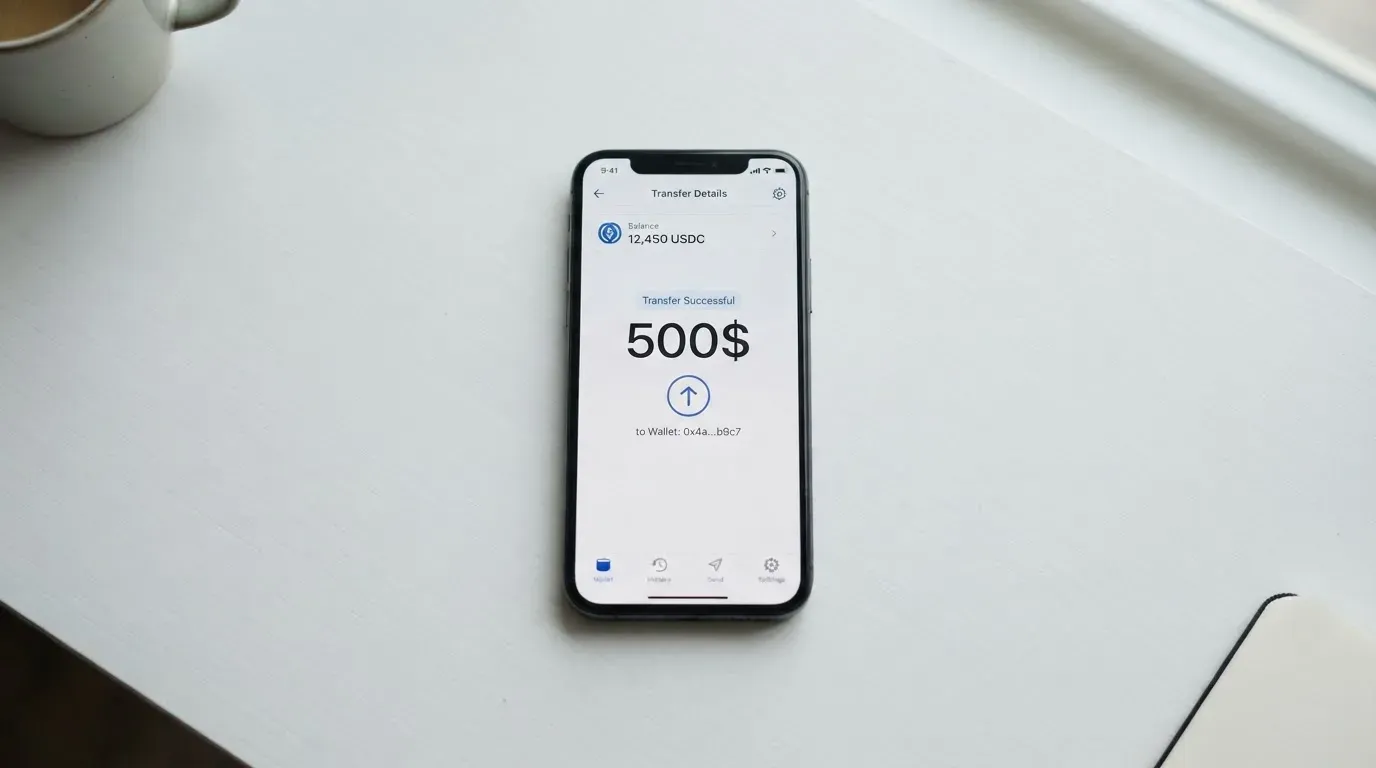
The routes named are:
- Lightning Network to a personal Lightning Address
- BTC, XMR, ETH, LTC, SOL, TRX, BNB
- USDT on Polygon, USDC on Polygon, and “and more”
- Swapping within the account to USD
Everything is auto-swapped into USD, so your card balance is a dollar balance and your 0% USD spending rate applies to it. Lightning is the distinctive one — sending over Lightning rather than on-chain is fast and cheap, and it is the route a privacy-minded user is most likely to want.
Three practical warnings before you send anything:
- Network fees are not in the card’s 1.3%. The 1.3% is the provider’s deposit fee. The blockchain charges its own fee for your transfer — gas on Ethereum, resources on Tron — and that is a separate cost. Who pays it is *not stated* by the provider, so assume it comes out of what you send.
- Minimum top-up: not stated. There is no published floor, which means you cannot be sure a very small transfer will be accepted or is worth making.
- No fiat top-up is listed. The funding is crypto and Lightning only, so if you have no crypto to convert, this card does not help you.
The network question deserves more weight than it usually gets. Transfers on blockchains are irreversible. If you send on a network the provider does not support, or to an address belonging to a different network, the funds can be lost or need manual recovery with no guarantee. That is a category risk, not a Freedomia-specific one — but it is the risk you are actually taking when you fund a card with crypto. And Tether says it disables tokens in wallets on the OFAC sanctions list and has frozen funds tied to illicit activity, so stablecoins are not censorship-proof either.
Paying with it every day
Here is the honest shape of daily use. You have a virtual Visa in USD, you can freeze it instantly, you can change its limits, you can re-issue it, and 3-D Secure handles online authentication. Google Wallet is live for tap-to-pay. That is the whole picture.
- Wallets: Google Wallet enabled, tap-to-pay; Apple Pay “coming soon”.
- Blocked categories: not stated. The card does not publish a list of what it declines — gambling, adult content, ticket resellers and similar categories are exactly where crypto cards differ from ordinary ones, and Freedomia says nothing about them. If a blocked category matters to you, you will find out by being declined.
- App: none described. There is no standalone app. Everything happens in the web account: Freeze Card, Card Data, Card Limits. App-store ratings are therefore not applicable.
- Rewards: not stated. No cashback, no points, nothing published.
- Disputes: a section exists, its text does not. The terms contain a section titled “Returns, disputes and chargebacks” (section 19), but the text behind it was not readable. So the honest answer to “what happens if a shop takes my money and gives me nothing?” is that a mechanism is described and its contents are unknown to me.
Two things about the mechanics are worth knowing regardless of this card. Apple Pay, when it arrives, replaces your card number with a device-specific number stored in the Secure Element, never on Apple servers, and each payment uses a one-time code — so adding a wallet later is not a security downgrade. And 3-D Secure is the layer that decides whether an online payment is approved frictionlessly or challenged with a one-time code or biometric; Freedomia’s 3DS is present, which is the right baseline.
Where a virtual card like this quietly trips people up is at the till. A merchant can look up the BIN and see which institution and country issued the card, and if that country differs from the billing address on file, extra scrutiny is a reasonable response. Some merchants decline prepaid or foreign BINs for exactly that reason. Address Verification, which compares the numeric parts of the billing address against issuer records, is mainly offered in the US, Canada and the UK and is generally unavailable for foreign-issued cards — which can cause declines. This is why a payment is not always guaranteed. And a declined authorisation can leave a hold on your funds for several days, typically up to seven, so a card that gets refused twice in a row can quietly tie up money you thought you had spent nothing of.
What can go wrong
The first thing to say plainly: I found no official incidents involving Freedomia, and no Trustpilot or Reddit reviews for it at all. That is not a clean bill of health — it is an absence of history, which for a young service is neutral at best. A card with no complaints also has no track record to complain about. Treat “no reviews found” as *not stated* rather than as evidence of quality.
What I can weigh is structure. The company is a Delaware LLC; the issuing bank is not named and no licences are named on the pages I could read. That matters more than it sounds, because of how these cards are built. A card payment involves several parties: the network routes the messages and sets the rules, the issuer holds the card programme under the network’s licence, and the crypto brand is often just a programme manager and front-end. Visa and Mastercard do not issue crypto cards to consumers themselves — they license issuers, and they can suspend a programme. Visa terminated its global agreements with FTX on 13 November 2022 and the FTX US debit card was wound down by its issuer. WaveCrest, a Visa issuer that supplied crypto card brands, was suspended by Visa in Europe in 2018, closing every WaveCrest-issued Visa programme. So the counterparty you are trusting is not only Freedomia; it is also an issuer whose name is not published, under a network that can switch a programme off. Program closures tend to follow a pattern: a notice period, then loading and spending stop, then users are asked to withdraw remaining balances.
The second risk is custody. Unofficial reporting from September 2026 describes the service as custodial and closed-source. If that is right, the credentials that control your crypto sit with the provider, not with you, and you have to trust them completely. Crypto transfers are typically irreversible and a stolen private key has no recovery — the network cannot freeze or return funds. Custodial platforms have a real record of failure: Mt. Gox (about US$350 million reported stolen, 2011–2014), Coincheck (about US$400 million, 2018), Ronin Network (US$625 million, 2022). Holding funds with a custodian carries counterparty and hack risk; holding them in your own wallet carries key-loss and phishing risk instead. Neither is free.
What Freedomia does offer on the safety side is reasonable: 3-D Secure, freeze the card any time, and Tor/Onion support. Support is email at [email protected] and Telegram @Freedomiaio, with priority support on the Founder and MOON tiers — note that means the $5 tier, not the $9.99 one.
And there is the identity question. KYC rules require regulated businesses to verify customers and assess risk as part of anti-money-laundering law, including ongoing monitoring and suspicious-activity reporting. In the EU that due diligence covers name, address, date of birth, nationality, identity documents, a sanctions check, the purpose of the relationship, and whether you are a politically exposed person; if it cannot be completed, the institution must refrain from the transaction or, where necessary, end the relationship. In the US the customer identification programme requires name, date of birth, address and an identification number. Nationality is screened separately from residence, because sanctions screening and issuer risk policy often apply to citizenship and country of birth, not just to your address. The card’s terms, as read by CriptoNoticias, allow KYC/AML checks above USD 5,000 in monthly spend. That threshold is unofficial, but the direction it points is the important one: the frictionless experience belongs to the small spender, and the checks belong to the larger one. If you are about to run serious volume through this card, assume you are entering the checked regime.
MiCA is worth knowing about too, though it does not bind a US LLC directly. It is the EU’s markets-in-crypto-assets regulation; ESMA states it took legal effect in June 2023, with the rules on stablecoins applying from 30 June 2024 and the crypto-asset service provider rules from 30 December 2024. Under it, e-money tokens may be issued only by a credit institution or an electronic money institution, and the transitional period let providers operating under national law continue only until 1 July 2026 or until a MiCA authorisation, whichever came first. A card is a payment service regulated separately, so a crypto card often depends on two licences. The point for you is not the detail — it is that this product sits in a category where “who is actually regulated, and by whom” is a fair question, and Freedomia’s public pages do not answer it.
What to take instead
If Freedomia’s shape does not fit — no plastic, no cash, an unstated country list, a 2.5% conversion — the alternatives below all scored lower overall, which is worth saying up front: none of these is a straight upgrade. They are different bets.
| Card | Score | Shape | Notable differences |
|---|---|---|---|
| Freedomia | 6.1 / 10 | Digital Visa, crypto-funded | Lightning top-up, 0% USD spend, 2.5% FX, Apple Pay pending |
| Cardex | 5.6 / 10 | Debit crypto card on VERVE, VISA, Mastercard, UnionPay | Virtual *and* physical; “200+ countries”; Naira-focused listing; conversion rate described as AI-optimised, no fee % published |
| CardFlow | 4.9 / 10 | Virtual USD Mastercard, created in about 3 minutes | Free to create; aimed at Nigeria; funds with BTC, USDT, ETH or Naira bank transfer |
| HyperCard | 4.7 / 10 | Prepaid card, USD or EUR balance | Works in “more than 176 countries” per its App Store page (acceptance, not eligibility); deposit USDT, BTC, ETH in the app |
If you need a physical card, Cardex is the only one of the four that publishes a physical option, and it runs on four networks rather than one. If you need to hold a non-dollar balance, HyperCard is the one that lets your card sit in EUR or USD — but its pages list no fees at all, which is not the same as no fees. If you need to get a card instantly for almost nothing, CardFlow creates a free virtual Mastercard in about 3 minutes, though it is aimed at Nigeria and its monthly fee is not stated. And if you are paying in dollars from crypto, none of the three publishes a number you can compare against Freedomia’s 0%, so Freedomia’s honest advantage is that it is the only one of the four whose fees you can actually compute.
Two things all three share with Freedomia: none of them states a country list or exclusions, and none states a rewards programme. The category as a whole is publishing less than you would want it to.
Who I would recommend it to
I would recommend Freedomia to someone specific, and I would not recommend it to most people who ask me about it.
Recommend it if you are funding a virtual Visa from BTC or Lightning, you already think in stablecoins, you are comfortable paying 2.5% when you spend outside dollars, and you want a card number today rather than a banking relationship. If the idea of a custodial provider bothers you, this is not the card — a self-custody-linked card keeps your funds in your own wallet until the moment of payment, but then key loss, phishing and clipboard-hijacking malware that swaps copied addresses become your problem alone.
Do not recommend it if you need cash, a plastic card in the post, Apple Pay this year, or a published answer to “which countries are restricted?”. Do not recommend it as your only card, given that a declined authorisation can hold funds for up to seven days and a programme closure would ask you to withdraw what is left.
The people I would point elsewhere: anyone who wants a physical card should look at Cardex; anyone who wants to hold euros should look at HyperCard; anyone who wants a free instant virtual Mastercard and is comfortable with a Nigeria-focused product should look at CardFlow.
Two things to check yourself before you send a single satoshi: open the FAQ and read the answer to “Which countries are restricted?”, since that answer exists and I could not read it. And establish where your money sits — custodial or not — because the unofficial answer is custodial, and that is the single fact that would change my recommendation most.
Frequently asked questions
What is the Freedomia card?
Freedomia is a digital Visa card you fund with cryptocurrency. It has no plastic and no cash function: you get a card number in a web account, load it with BTC, Lightning or stablecoins, the balance converts to USD, and you spend it online or via Google Wallet tap-to-pay. It is a product of Freedomia Digital Group LLC in Delaware.
How does the Freedomia card work?
You sign up by email, a virtual Visa is issued instantly with 3-D Secure, and you top it up with crypto over the Lightning Network or on-chain. Funds are auto-swapped to USD. Spending that USD balance costs 0% in FX; converting anything else carries a 2.5% standard fee. You control the card from the web account — freeze, card data, limits.
Is Freedomia a bank?
No. Freedomia Digital Group LLC is a Delaware company and the issuing bank is not named on the public pages, nor are any licences. The card is best understood as a prepaid-style card: it spends a stored balance rather than drawing on a bank account. That also means your funds are not bank deposits and any deposit-guarantee scheme does not apply.
Does the Freedomia card require KYC?
Officially, the public pages state no KYC level at all, and the card is marketed as “No verification. No approval.” Unofficially, a September 2026 CriptoNoticias piece describes it as pseudonymous below USD 5,000 in monthly spend, with terms section 4.3 allowing KYC/AML checks above that. Treat that threshold as unconfirmed and read the terms yourself.
Is the Freedomia card free?
No. The Founder tier is $5/month or $60/year. HODL at $9.99/month or $119.88/year and MOON at $17.99/month or $215.88/year are both listed as coming soon. On published figures, HODL costs more than Founder for the same $5,000 monthly limit but standard rather than priority support. An issuance fee is not stated anywhere.
What are the fees on the Freedomia card?
Top-up is 1.3% on all tiers, the standard FX fee is 2.5%, and spending in USD is 0%. On-chain network fees are separate — charged by the blockchain, not the provider — and who pays them is not stated. ATM and cash withdrawal do not apply to a virtual card. Any one-off issuance fee is not disclosed.
How do I top up the Freedomia card?
Send crypto to the card: Lightning to a personal Lightning Address, or BTC, XMR, ETH, LTC, SOL, TRX, BNB, USDT on Polygon or USDC on Polygon, with “and more” listed beyond that. Everything is swapped to USD automatically. No fiat top-up route is listed. Check the network carefully — transfers are irreversible, and one sent on an unsupported network or to the wrong chain’s address can be lost.
Can I add the Freedomia card to Apple Wallet?
Not yet. Apple Pay is listed as “coming soon”. Google Wallet is already enabled for tap-to-pay. When Apple Pay does arrive it tokenises the card into a device-specific number in the Secure Element with a one-time code per payment, so adding it later is not a security downgrade.
Where can I use the Freedomia card?
The card is described only as “Global”, with no country list on the home page, and the FAQ question about restricted countries exists but its answer was not readable — so check that page yourself. In practice, a virtual prepaid Visa is accepted wherever Visa online and Google Wallet tap-to-pay work, but some merchants decline prepaid or foreign-issued cards, and address verification is generally unavailable for foreign-issued cards.
Is the Freedomia card safe?
There are no red flags in what I found, and no track record either — no Trustpilot or Reddit reviews for Freedomia were found, which is absence of history rather than reassurance. It does offer 3-D Secure, instant card freeze and Tor/Onion support. Unofficial September 2026 reporting describes the service as custodial and closed-source, so you would be trusting the provider with your crypto, counterparty risk included.
Virtual card reviews – cryptocardcheck
Content created by the «cryptocardcheck» team