
A self-custody-friendly Mastercard that spends USDC, if you can live inside its list of 38 countries
 Available in US

The Immersve card is one of the more unusual crypto payment products on the market right now. Instead of a custodial wallet that converts your coins into a prepaid balance, Immersve is built around a smart contract: you send USDC to a contract address on a blockchain you choose, and a Mastercard number is generated that draws on that balance at the moment of each purchase. The card is digital-first, surfaces inside partner apps rather than a standalone Immersve-branded application, and runs on a payments-as-a-service model aimed at wallets, dApps and crypto brands that want to offer their users a card without becoming a card issuer themselves.
If you have ever been frustrated by a foreign bank refusing to issue you a debit card, or by a crypto exchange collapsing and taking your card with it, the architecture here is genuinely interesting. Funds sit in a smart contract, not on a balance sheet you cannot see. The card itself is a standard Mastercard that works wherever Mastercard tokenisation is accepted. But the product is not finished in the consumer-facing sense: there is no published monthly fee, no clear ATM story, no announced rewards programme, and a long list of “not stated” details that any careful reader will want answered before committing real money.
I have spent time going through Immersve’s public pages, the Pera Card announcement that brought Immersve into the Algorand ecosystem, and the regulatory filings the company points to. What follows is a section-by-section review of who can get the card, what it costs to run, how top-up and daily spending work, where the risks sit, and which alternatives are worth comparing it against. The score I give the card is 7.1 out of 10, with the reasoning broken down in the verdict below.
Conditions are current as of October 28, 2026.
Verdict
Immersve scores 7.1 out of 10. That figure is the result of weighing five criteria against what the company actually publishes and what users in the partner ecosystem have reported.
| Criterion | Score | Why |
|---|---|---|
| Who can get it | 7 / 10 | Onboarding in 38 countries, including most of the EU, the UK, Switzerland, Australia, New Zealand and a Latin American bloc; the US is on a Q1 2026 roadmap but not live yet |
| Cost | 8 / 10 | No application or issuance fee, no published monthly or annual fee; blockchain gas is on you, and a foreign-currency conversion fee “may apply” at an unstated rate |
| Top-up options | 8 / 10 | USDC on five chains (Algorand, Arbitrum, Base, Ethereum, Polygon PoS), converted at authorisation; no other coins or fiat rails described |
| Reliability and complaints | 7 / 10 | Real licences (AFSL 545925 in Australia, NZ FSP1003031), three named smart-contract auditors, an identifiable issuer (Monavate UAB); but the issuing bank is not named on the public site, and there are no Immersve-branded Trustpilot or Reddit threads to mine |
| Everyday use | 5 / 10 | Digital Mastercard that works online and in store via Apple Pay and Google Pay; no announced physical card, no documented ATM access, no published rewards or merchant-category restrictions |
The card is a strong fit if you already keep USDC in your own wallet, you live in one of the 38 supported countries, and you want a payment card that draws directly from that balance without an exchange acting as custodian in the middle. It is a poor fit if you are looking for a card with a glossy standalone app, a published fee schedule, cashback, a physical card in the post, or any of the things most consumers expect from a “credit card” or even a modern neobank debit card.
The audience Immersve is built for is narrow but real: self-custody wallet users paying with USDC in Europe or Australasia. If that is you, the rest of this review will tell you what to check, what to confirm with the partner app you actually use, and where the product is still rough.
Who they will give the card to
Immersve states that card onboarding is supported in 38 countries. The full list, taken from the company’s own page, is: Argentina, Australia, Austria, Belgium, Brazil, Bulgaria, Chile, Colombia, Croatia, Cyprus, Czech Republic, Denmark, Estonia, Finland, France, Germany, Greece, Guatemala, Hungary, Ireland, Italy, Latvia, Lithuania, Luxembourg, Malta, Mexico, Netherlands, New Zealand, Peru, Poland, Portugal, Romania, Slovakia, Slovenia, Spain, Sweden, Switzerland and the United Kingdom.
There are two important qualifications on top of that list. The first is that the United States is described as “Q1 2026” on the company’s roadmap, which means US sign-ups are not yet open as of the date this review was written. The second is that the MENA region is described as “to follow shortly after”, so readers in the Gulf states or North Africa should not assume imminent access either.
If you are reading from a country that is not on the list, the situation is straightforward: card creation will not work. There is no published work-around and the company does not describe any region-lift mechanism, so attempting to onboard from a non-supported country is likely to fail at the KYC stage rather than at the form stage.
A few practical things to keep in mind as you read the country list:
- The list mixes EU member states, three EFTA countries (Switzerland, plus the UK which left the EU), and a separate bloc of Latin American jurisdictions. It is not a single regulatory regime, so the KYC and complaints procedures differ by region.
- For the EU/EEA countries, the card is offered by a partner (Pera Card is the most visible example, issued by Monavate UAB). The licence that backs your card is therefore the issuer’s, not Immersve’s own.
- The Australian Financial Services Licence number (545925) and New Zealand Financial Service Provider registration (FSP1003031) are real and can be checked on the public registers. This is reassuring for readers in those two markets.
- “Supported” here means the card can be created. It does not mean the card is necessarily useful for spending in every local context; cross-border decline risk is a separate matter covered later in this review.
If you are a dual citizen, hold a residency permit in one of the listed countries but citizenship in another, or travel frequently, the relevant question is which document the KYC partner asks for. Immersve names FrankieOne, Sumsub and Chainalysis as its KYC partners, but does not publish a full document matrix. In practice this means you may need to complete onboarding with the specific partner app (Pera Wallet, or whichever dApp you came through) before you know whether your document set will pass.
How to get it
Immersve does not run a direct-to-consumer app where you download “Immersve” from the App Store and sign up. Instead, the card is surfaced through partner applications. The most visible of these at the time of writing is the Pera Wallet app, which gained a Pera Card feature in 2025 and is rolling out in Immersve’s licensed jurisdictions starting with the UK, Germany, Italy, Spain and New Zealand. The Pera support page (updated October 2025) describes the Pera Card as being issued by Monavate UAB and as in a “Beta Phase” in selected countries.
What this means in practical terms is that your route to the card looks something like this:
- Find the partner application that is live in your country. Pera is the current flagship, but other wallet and dApp partners may be added over time.
- Install the partner app and complete whatever onboarding the partner requires. This typically includes identity verification.
- Verify your identity within the card-creation flow. Immersve’s pages state that “verify your identity” is part of the process; the specific documents, proof-of-address requirements, and age threshold are not stated in Immersve’s public materials. The partner app’s own onboarding screens will tell you what to upload.
- Receive a digital Mastercard. Immersve describes the card as a multi-use digital card that can be used online or in store after adding to Apple Pay or Google Pay. There is no published physical or metal card option for cardholders.
- Add the card to Apple Pay or Google Pay to use it in physical stores. Online checkout works directly with the card number.
Delivery timelines for a physical card are not stated. Given that no physical card is described, the practical answer is: you do not wait for delivery. The card is digital, and the wallet integration is the delivery mechanism.
A few things to flag about this process:
- KYC levels are not stated. Some issuers tier their KYC (basic, plus, enhanced), and the limits, payment volume and product features available to you can change depending on which tier you have completed. The partner app you go through will tell you what tier you are on.
- Age and document requirements are not stated. As a rule of thumb across the industry, prepaid and debit cards are available to adults aged 18 and over, and you should expect a government-issued photo ID plus a proof of address.
- The card currency is not stated. In practice the card will settle in whatever fiat the merchant requests, and the conversion happens at the point of authorisation, but the card’s “native” currency is not made explicit in the public materials.
- Activation is implicit in the digital issuance: once the card is created, it is live. There is no separate “activate” step described.
If you have used a self-custody wallet before, the onboarding will feel familiar. If you have not, expect to be asked to confirm control of an email address, possibly a phone number, and to upload documents through a third-party KYC vendor (Sumsub is one of the most common in this space).
Fees
The headline cost story is favourable: Immersve states that there are “no charges for application or issuance”, and its pricing page says the service is “provided at no cost to either integrated dApps or to cardholders”. There is no monthly fee, no annual fee, and no maintenance fee published.

| Fee or limit | What Immersve says |
|---|---|
| Application / issuance | No charge |
| Monthly or annual fee | Not stated |
| Foreign currency conversion fee | “May apply” on foreign-currency transactions; rate not stated |
| Blockchain network fee (gas) when funding | Applies; paid to the network, not Immersve |
| ATM withdrawal | Not stated |
| Daily / monthly spending limits | Not stated |
| Card tiers | Not stated |
| Card currency | Not stated |
The two fees you should expect to pay in practice are the blockchain gas fee when you send USDC to the funding smart contract, and any foreign-currency conversion fee if you spend in a currency other than the card’s base.
The gas fee is charged by the network (Ethereum, Polygon PoS, Arbitrum, Base or Algorand), not by Immersve. On Ethereum mainnet, gas can easily run into tens of dollars during busy periods. On Polygon PoS, Arbitrum or Base, the cost is typically a few cents. On Algorand, fees are negligible. If you are moving large balances, choose the network with care.
The foreign-currency conversion fee is the more opaque line. Immersve tells you the fee “may apply” but does not publish a percentage. In the absence of a published rate, the only honest advice is to test with a small transaction first, and to assume that a cross-border spend in a non-base currency will carry some premium over the mid-market rate.
Three everyday payments to think about:
- Buying coffee in your home city. You tap the card at a local café, the merchant’s acquirer routes the transaction through Mastercard, Immersve’s system converts USDC held in the smart contract to the merchant’s currency at the authorisation moment, and the network fee is zero. The only cost is the gas you already paid when funding the card. If your home currency is the same as the card’s base (whatever that turns out to be), you should not see any FX line on the receipt.
- Paying for an online subscription in US dollars from a euro-based account. The merchant charges in USD, the card converts at whatever rate Immersve’s system applies, and a conversion fee “may apply”. The cost you can verify is the gas you paid on the way in; the cost you cannot verify without testing is the FX markup.
- Buying something from a merchant based in a different region. Cross-border merchant surcharges, acquirer fees and MCC-driven routing rules can all affect the final cost in ways that have nothing to do with Immersve. The card behaves like any other Mastercard; the merchant side is out of Immersve’s control.
What is not in the public materials, and what you should ask the partner app about, includes: ATM fees, declined-transaction fees, inactivity fees, replacement fees, currency-conversion markup, and any tier-based perks or limits. None of these appear on Immersve’s site.
Top up
Top-up is the part of the product that is genuinely well documented, because it is the part that distinguishes Immersve from custodial competitors. The model is this: you send USDC from your own wallet to an Immersve smart contract, the smart contract holds the funds, and a conversion to fiat happens at the moment of card authorisation.
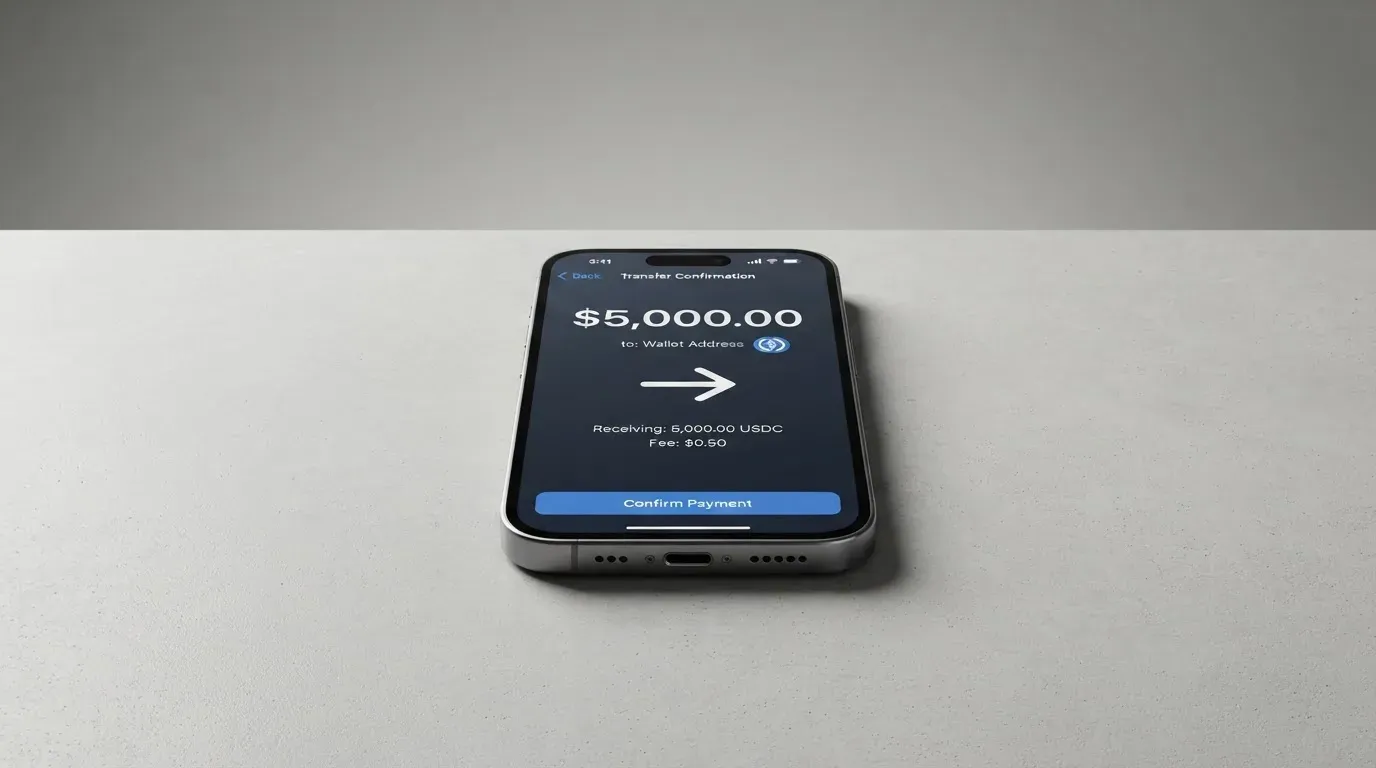
The supported networks for USDC deposits are:
- Ethereum
- Polygon PoS
- Arbitrum
- Base
- Algorand
There are no other coins, tokens or stablecoins described, and no fiat on-ramp (no bank transfer, no card top-up, no Apple Pay top-up). If you do not already hold USDC on one of these five networks, Immersve is not a useful product for you until you have moved some in.
A few practical points about the top-up flow:
- The minimum top-up is not stated. In practice, the only floor is the gas cost of the deposit itself, which on Ethereum mainnet can be higher than a small top-up is worth. On Polygon, Arbitrum or Base, the floor is essentially zero.
- The maximum top-up is not stated. The relevant constraint is likely the smart contract’s per-transaction cap, which the partner app will enforce, and your own KYC tier.
- The smart contract is the address you send to. Get the network wrong and the funds are lost. The general rule across crypto is that a deposit sent to an address on the wrong network is irrecoverable, and only manual support recovery, with no guarantee of success, is the fallback. The partner app’s deposit screen is the source of truth for the correct address and network.
- Conversion happens at authorisation, not at top-up. The USDC sits in the contract at its USDC value; when you tap to pay, the system converts the right amount of USDC into the merchant’s currency at that moment’s rate. This means your USDC balance does not get converted into a fiat balance upfront, and you do not have a “card balance” in the traditional sense.
There is no published way to withdraw funds from the card back to your wallet or to a bank account. In practice, the model is one-way: USDC goes in, fiat goes out at the point of sale. If you have leftover USDC in the smart contract, the partner app’s flow for spending or refunding it is the only way to access it.
The blockchain fee structure matters here. A USDC transfer on Ethereum can cost several dollars during peak congestion; on Polygon, Arbitrum or Base, it is usually under ten cents; on Algorand, it is effectively free. The same USDC amount reaches the card on every network, but the cost of getting it there varies by two orders of magnitude. The Pera Card launch specifically chose Algorand for a reason, and that reason is fee economics.
Paying with it every day
In day-to-day use, the Immersve card behaves like a standard tokenised Mastercard. You add it to Apple Pay or Google Pay on your phone, and you can tap to pay at any contactless terminal. Online, you type the card number, expiry and CVV into the checkout, with 3-D Secure kicking in for higher-risk transactions as the issuer sees fit.
What works well in practice:
- Apple Pay and Google Pay support is explicit, and the card number is tokenised, so the actual PAN never leaves your device’s Secure Element. This is the same security model any modern contactless card uses.
- Online acceptance is broad, because the card runs on Mastercard’s standard rails. Anywhere Mastercard is taken, the card should be accepted, subject to the merchant’s own BIN and MCC policies.
- Multi-use digital means you can use the same card for many transactions, not as a single-voucher disposable card. There is no published limit on the number of transactions.
What is not clear in the public materials:
- Blocked merchant category codes are not stated. Crypto cards in this category often block gambling (MCC 7995), adult content, and certain financial-services MCCs, but the exact list varies by issuer. The partner app’s cardholder agreement is the place to look.
- Reward or cashback programmes are not stated. There is no published cashback percentage, points scheme, or sign-up bonus. If you are comparing the card to consumer cards that advertise 1-3% cashback, this is a real gap.
- The standalone Immersve app does not exist for cardholders. Card management, transaction history, freeze and dispute flows are all surfaced through the partner app. Pera Wallet is the current visible example.
- The complaints procedure is country-specific. Immersve publishes complaints pages for Australia (/complaints/au), the EEA (/complaints/eea), the UK (/complaints/gb) and New Zealand, Latin America and other regions (/complaints/nz). If you have a problem, the right complaints URL depends on where you live.
- Chargeback timeframes are not stated. Under the card networks’ rules, issuers have deadlines for raising disputes, but the exact window for Immersve-issued cards is not published.
A subtle but important point about the BIN: when a card is issued in one country and used in another, the merchant’s BIN lookup will reveal the issuer country, and a small number of merchants treat cross-BIN transactions with extra caution. The card works the vast majority of the time, but if you travel and notice a higher decline rate at certain merchants, the issuer country on the BIN is often the cause, not the card itself.
What can go wrong
The risks here are partly the usual crypto-card risks and partly specific to how Immersve is built.
Regulatory and counterparty risk. The card is issued by Monavate UAB for the Pera Card product, but Immersve’s own site does not name the issuing bank for the cardholder-facing programme in every jurisdiction. The licences Immersve does publish are AFSL 545925 in Australia and NZ FSP1003031 in New Zealand. The company has regulation “in progress” in Europe, Hong Kong, Singapore, the UAE, the UK and the US, but the timing of those authorisations is not committed. If you are in a jurisdiction where the licence is not yet final, the card’s legal status is provisional. Under MiCA, the EU’s crypto regulation, providers already operating under national law can continue only until 1 July 2026 or until they receive (or are refused) a MiCA authorisation. This is a real, dated deadline that affects every EU-domiciled crypto card programme.
Smart-contract risk. The funds sit in a smart contract. The contract is audited by three named firms: Hashlock, Red4Sec and Coinspect. That is a healthier audit posture than most crypto products, but audits are not a guarantee. A bug that no auditor caught, an upgrade that introduces a regression, or a governance attack on the contract’s admin keys could all put user funds at risk. The general principle is that the more you hold, the more carefully you want to think about which contract holds it.
Issuer programme risk. The card runs on a Mastercard programme. If the issuer (whichever bank or e-money institution is behind the card in your country) loses its Mastercard licence, or if Mastercard decides to wind the programme down, the card can be suspended. This is not a hypothetical: in 2018, Visa suspended WaveCrest in Europe, closing every WaveCrest-issued Visa programme overnight. In November 2022, Visa terminated its global agreements with FTX and the FTX US debit card programme was wound down. Programme closures are rare but not unprecedented, and they typically come with a notice period, a stop on new spending and a deadline to withdraw any remaining balance.
Stablecoin risk. The card’s funding model assumes USDC stays redeemable and on-peg. USDC has, in the past, temporarily lost its peg (notably during the March 2023 US banking crisis). Tether has had periods of stress as well. Holding USDC for a short period while you spend it down is a different risk profile from holding USDC for months. The card model, which converts at the moment of authorisation, absorbs short windows of volatility but not extended ones.
No published consumer-protection details. There is no published safeguarding statement, no deposit guarantee scheme mention, and no chargeback timeframe. The product’s public materials are clearer on the technical design than on the consumer rights. If you are someone who reads the small print before signing up, the absence of these details is itself a risk indicator.
Customer support. The contact page is a generic “Get in touch” form. Languages and hours are not stated. The partner app (Pera Wallet, or whichever you use) typically provides the actual support path, but the Immersve-side support experience is not well documented.
No Trustpilot or Reddit footprint. As of the date of writing, there is no Immersve page on Trustpilot and no meaningful Reddit thread titled with the brand. This is partly because Immersve is a B2B payments layer rather than a consumer brand, and partly because the product is still early. The absence of complaint volume is not, by itself, evidence of quality; it is evidence that there are not yet many consumers in a position to complain.
What to take instead
If Immersve is not quite right for you, three alternatives cover the same general ground (crypto-funded Mastercard or Visa payment cards) with different trade-offs. None of them is a direct substitute: each one tilts the balance in a different direction.
| Card | Score | Best for | Trade-off |
|---|---|---|---|
| Immersve | 7.1 / 10 | Self-custody USDC users in 38 countries | No standalone app, no published FX rate, no rewards |
| MetaMask Card | 7.1 / 10 | MetaMask wallet users who want to spend from the wallet directly | US and UK sign-ups temporarily closed; Metal tier is $199/year |
| KAST | 6.1 / 10 | Heavy spenders who want tier-based cashback and a polished card range | Annual membership on the paid tiers ($1,000 / $10,000) |
| TokenPocket (Fiat24) | 5.8 / 10 | European users happy with a virtual-only Visa on Arbitrum | Virtual-only, 1% deposit fee, limited geographies |
MetaMask Card scores the same 7.1 out of 10 as Immersve, but for different reasons. Sign-up is open in 45 listed countries and territories (Andorra, Argentina, Brazil, Canada, Mexico, Germany, France, Spain, Uruguay among them); other regions join a waitlist. You get a Mastercard, with a virtual card issued instantly and a Metal version available for $199 a year. The card is issued by Monovate, with Crypto Life as the card provider, and you spend directly from your connected wallet on Linea, Base, Monad or Solana. Tokens accepted include mUSD, wETH, EURe, GBPe, USDC and USDT (the page says nine in total). The headline cashback is 1% on Virtual and 3% on Metal, with the 3% capped at the first $10,000 of spend and then dropping to 1%. There is a $FLY bonus via the Blackbird dining app (5X on Virtual, 7X on Metal). The catch: US and UK sign-ups are temporarily closed per the FAQ, and proof of residency is required.
KAST scores 6.1 out of 10. It targets a more mainstream audience, with Visa Platinum (Standard), Visa Infinite metal (Premium) and Visa Infinite gold-plated (Private) cards, plus co-branded designs (Pengu, Solana, Bitcoin). Account balances are held in USD with stablecoin deposits converted 1:1 at a 0% spread. The fee structure is more developed than Immersve’s: stablecoin top-up 0%, card spend in USD 0%, transaction fee 0%, but a non-USD FX fee of 0.5-1.75% depending on residence, transaction country and card programme. The cashback ladder is generous if you are a high spender: 1.5% on the first $2,000 a month on Standard, 2% on the first $10,000 on Premium, 3% on the first $40,000 on Private, with extra KAST Points on the paid tiers. The membership is the catch: Premium is $1,000 a year and Private is $10,000 a year, billed annually. The standard tier is free.
TokenPocket’s TP Card (issued on the Fiat24 stack) scores 5.8 out of 10. It is a virtual-only card on Arbitrum, with balances in EUR24 and USD24, and operates in a defined list of European territories for Visa and a separate list including Australia, Canada, Hong Kong, Japan, Singapore and the UK for Mastercard. The Americas were “planned for Q2 2025”, with no confirmation since. Costs are low apart from a 1% deposit fee on crypto top-ups, which the documentation says is later refunded via rewards or reduced transaction fees. There is no published cashback programme.
If you are choosing between these, the cleanest way to frame it is: Immersve is the self-custody-first option and accepts the friction of no consumer app in return for not having a custodian hold your crypto. MetaMask is the natural choice if you already live in MetaMask and want your card to spend from the same wallet. KAST is for people who want a polished, multi-currency card with a real fee schedule and tiered rewards, and who do not mind paying for the higher tiers. TokenPocket is for European users who are happy with a virtual-only card and do not need a physical or metal option.
Who I would recommend it to
I would recommend the Immersve card to a fairly specific reader. If you are a self-custody wallet user in one of the 38 supported countries, you already hold USDC on Ethereum, Polygon, Arbitrum, Base or Algorand, and you want a Mastercard that draws on that USDC at the moment of purchase, the product is genuinely useful and the architecture is cleaner than most custodial alternatives. The five-chain top-up range is a real advantage, particularly if you already use Base or Arbitrum for cheap transfers. The lack of monthly fees, application fees and issuance fees is also a real advantage over consumer cards that charge for the privilege of holding them.
I would not recommend it to readers who:
- Want a physical card. No physical card is published for cardholders.
- Live in the United States, the Gulf states or anywhere outside the 38-country list. The roadmap is encouraging, but the card is not live in those regions yet.
- Care about cashback, points, lounge access or any rewards programme. There is none published.
- Want a clear, written fee schedule including FX rate, ATM fees and inactivity fees. Those details are not in the public materials.
- Are not comfortable with a partner-app model. The card is surfaced through Pera Wallet and similar apps, and the support experience runs through the partner, not a dedicated Immersve consumer app.
- Plan to hold large long-term balances on the card. Smart-contract risk, stablecoin depeg risk and programme-closure risk all argue against parking money on the card rather than spending from it.
If you do decide to use it, the practical advice is straightforward. Start small. Top up a modest USDC amount on Polygon, Arbitrum, Base or Algorand to minimise gas. Test a domestic contactless payment to confirm the card works in your country. Test a cross-border online payment to see what the FX line looks like. Read the partner app’s cardholder agreement for the specific MCC blocks, KYC tier rules and chargeback windows. Do not hold more on the card than you would be comfortable losing if the smart contract, the issuer programme or USDC itself ran into trouble.
The card is a real product, with real licences and a real architecture. It is also an early-stage product, with a long list of details that have not been published. The 7.1 out of 10 reflects that balance: the foundation is solid, the consumer experience is incomplete, and the gap between the two is where your decision has to be made.
Frequently asked questions
What is the Immersve card?
The Immersve card is a digital Mastercard issued through partner apps such as Pera Wallet. You fund it by sending USDC to a smart contract on one of five blockchains, and the card spends that balance at the point of sale. It is built primarily as a payments service for wallet and dApp partners rather than as a standalone consumer product.
How does the Immersve card work?
You create the card through a partner application and verify your identity. You then send USDC to a smart contract address on Ethereum, Polygon PoS, Arbitrum, Base or Algorand. When you make a purchase, the system converts the right amount of USDC into the merchant’s currency at the moment of authorisation and routes the payment through Mastercard.
Is Immersve a bank?
No. Immersve is a payments infrastructure provider, not a bank. The card is issued by partner institutions (Monavate UAB for the Pera Card, for example). Immersve holds an Australian Financial Services Licence (AFSL 545925) and a New Zealand Financial Service Provider registration (FSP1003031), and has regulation in progress in other regions.
Who owns Immersve?
The company behind the card is Immersve Pty Ltd, with operations in Australia, New Zealand, the UAE, the UK and the US. Detailed ownership information is not laid out in the consumer-facing materials.
Is the Immersve card available in my country?
Onboarding is supported in 38 countries: most of the EU, the UK, Switzerland, Australia, New Zealand, Argentina, Brazil, Mexico, Chile, Colombia, Peru and Guatemala. The US is described as “Q1 2026” and the MENA region is described as “to follow shortly after”. If your country is not on the list, sign-up will not work.
How do I apply for the Immersve card?
You apply through a partner application, not directly through Immersve. The Pera Wallet app is the most visible partner, and the Pera Card is described as being in a Beta Phase in selected countries. The application flow includes identity verification through one of Immersve’s KYC partners.
Does the Immersve card require KYC?
Yes. Identity verification is part of the card creation process. The KYC partners named on Immersve’s site are FrankieOne, Sumsub and Chainalysis. The specific documents, age threshold and KYC tiers are not stated in the public materials.
How do I add the Immersve card to Apple Wallet or Google Pay?
Once the card is created in the partner app, you add it to Apple Pay or Google Pay in the same way you would add any other Mastercard. The card is digital-first, so the wallet integration is the primary way to use it for in-store payments.
How do I top up the Immersve card?
You top up by sending USDC from your own wallet to the smart contract address provided in the partner app. The supported networks are Algorand, Arbitrum, Base, Ethereum and Polygon PoS. You pay the blockchain’s own gas fee; there is no published minimum or maximum.
Is the Immersve card safe?
The funds sit in a smart contract that has been audited by Hashlock, Red4Sec and Coinspect, and the card runs on Mastercard’s standard rails with tokenised mobile wallet support. The risks are the usual ones for crypto cards: smart-contract bugs, stablecoin depeg, issuer programme changes, and the absence of a published safeguarding or deposit-guarantee statement. Treat the card as a spending tool, not a long-term store of value.
Wallet card reviews – cryptocardcheck
Content created by the «cryptocardcheck» team