
Karma card — a Visa that spends from your own wallet, with strings attached
 Available in US
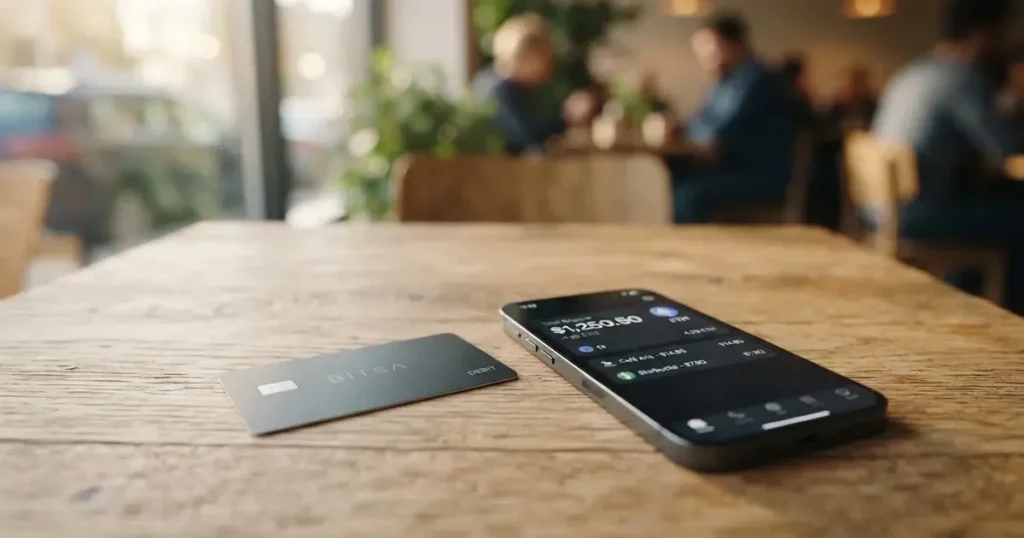
The Karma card sits in an unusual corner of the crypto-card market. It is a Visa, it is non-custodial (your private keys stay with you), and it loads in USDC on Solana rather than asking you to hand your coins to a card company. That combination is what makes it interesting, and it is also where the practical headaches begin. Some of the most basic questions a cardholder normally expects answered (whether the card is physical or virtual, what its daily limit is, what the ATM situation looks like) are simply not stated on the issuer’s own pages. Where I could not confirm a figure, I say so plainly.
The conditions described here are current as of October 28, 2026. The publication year is 2026; any date drawn from the card’s own materials keeps the year the card states.
Verdict
Karma earns 6.4 out of 10 in my scoring. That is a middle-of-the-pack result: it does a few things well (no monthly or signup fees, a clear 0.5% service fee per transaction, a non-custodial setup) and a few things badly (the country list excludes a large share of the world’s population, the list of supported top-up coins is not disclosed, and Apple Pay / Google Pay support is unconfirmed). The card is best understood as a niche product for self-custody users who specifically want to keep their own keys while still spending crypto at a Visa terminal, not as a general-purpose everyday card.
| Criterion | Mark | Reason |
|---|---|---|
| Who can get it | 8 / 10 | Seventeen countries are blocked for issuance; FATF grey-list residents need case-by-case approval |
| Cost | 8 / 10 | No registration, subscription, or hidden fees; 0.5% per transaction, 1% FX outside USD plus $0.30; on-ramp 1%, off-ramp 0.5% |
| Top-up options | 5 / 10 | Card loads with USDC; Solana is mentioned; list of supported coins for top-up is not disclosed |
| Reliability and complaints | 6 / 10 | Issued by Third National under a Visa licence; Karma Fintech LTD is the programme manager on Rain; no complaints found; App Store rating 5.0 from 6 ratings |
| Everyday use | 3 / 10 | Apple Pay and Google Pay not confirmed; cash advance and ATM not available; virtual versus physical not stated |
| Total | 6.4 / 10 |
The card suits self-custody users who want to keep their keys and are happy to work inside a USDC-on-Solana rail. It does not suit anyone who relies on a wallet-style mobile pay, who needs cash from an ATM, or who lives in one of the seventeen excluded countries. If you need a card that “just works” with Apple Pay at the supermarket checkout, this is not the one to pick on the available evidence.
Who they will give the card to
The single most concrete thing Karma says about eligibility is the country list. Issuance is blocked for residents or registrants of Belarus, mainland China, Cuba, India, Iran, Iraq, Israel, Myanmar, Nepal, Nicaragua, North Korea, Russia, Syria, Turkey, Ukraine, Venezuela, and Vietnam. The rule reads “residents or registrants,” which means the restriction attaches to where you actually live or are officially registered, not only to citizenship on its own. Residents of FATF grey-list countries are not auto-blocked, but the company says it checks those applications case by case.
Spending is blocked in a smaller set: Cuba, Iran, North Korea, Russia, Syria, Ukraine, and Venezuela. That is a different list from the issuance list, which is worth noticing: a card issued in, say, Turkey (blocked for issuance) is one thing, but a card issued in a permitted country cannot be used in any of those seven for transactions. Residents or registrants of Russia and Belarus are excluded from getting the card; if you are from a permitted country, you can hold the card but cannot tap it in Moscow or Havana.
The card terms are written in a way that reads more like a credit line than a prepaid Visa: 0% APR, a late-payment fee of up to $40, a returned-payment fee of up to $29, and a survival of the repayment obligation even after closure. That language sits oddly next to the App Store description of the card being “loaded with USDC.” The public documents do not reconcile those two descriptions, and I cannot tell you which one will apply at your checkout.
Karma is not a bank, exchange, or custodian, and the company says so itself. The programme is powered by Rain, and the cards themselves are issued by Third National pursuant to a Visa licence. Karma Fintech LTD is the entity named in the App Store listing, but the country in which it is registered is not stated on the public pages. That kind of uncertainty about who exactly is on the other side of the card is worth factoring in if you care about recourse.
How to get it
The signup path is not described step by step on Karma’s own pages. The KYC level is not stated in the official documentation. The card terms are unusually thin on this: they say only that the user must confirm they are not a U.S. citizen and are not sanctioned, and that the card is for users with no KYC process. Taken together, that language points one way, while a third-party write-up of a page about “Karma Card by Karma Wallet” (Visa, Solana, SEPA focus) describes a Level 3 identity check with email, phone, and an identity document, but no proof of address or selfie. I treat that third-party description as unofficial and not confirmed by the card; the official line is just that the user must confirm the two non-status conditions above.
On the card itself, the terms say it is a Visa “accepted at 80M+ merchants” (per the App Store description), but the public pages do not say whether you receive a physical card, a virtual card, or both, and they do not say what currency the card is denominated in. The card terms mention that physical or virtual cards may be limited and that replacements can be requested through the account, possibly with new numbers, but they give no countries, no delivery time, and no cost. If you need a definite physical card in a specific number of days, that gap is a real unknown.
The fastest way to read the situation is that this is a mobile-first product where the app is the front door. But because the official pages do not list the steps, I cannot walk you through them in the way I would for a card that publishes a clear application flow.
Fees: what it really costs
There is a useful split between what Karma charges and what the underlying rails charge. Karma’s own pricing is plain: no signup fee, no monthly fee, no hidden fee (“No subscriptions”). A 0.5% service fee is charged per card transaction, and on non-USD spending you also pay a 1% foreign-transaction fee plus a flat $0.30 international fee. On the funding side, the on-ramp is 1%, the off-ramp is 0.5%, and swaps inside Karma cost 0.5%. Cash advances and balance transfers are not available. The FX fee is described as charged by Visa with no Karma markup, currently capped at 1% on non-USD, with the issuer’s contractual ceiling at 3%.
| Item | Amount | Notes |
|---|---|---|
| Signup fee | None | |
| Monthly fee | None | |
| Service fee per card transaction | 0.5% | |
| FX fee on non-USD | 1% (Visa, no Karma markup; ceiling 3%) | |
| International fee (flat) | $0.30 on non-USD | |
| On-ramp | 1% | |
| Off-ramp | 0.5% | |
| Swap | 0.5% | |
| Cash advance | Not available | |
| Balance transfer | Not available | |
| ATM withdrawal | Not available | |
| Daily and monthly limits | Not stated |
If you hold the $KARMA token, fee discounts and swap rebates kick in by amount held. At $10 held you get 10% off the swap fee but the full card service fee. At $100 that becomes 20%. At $500, 35%. At $2,500, 50% off both. At $5,000, 70% off the swap and 50% off the card service fee. At $10,000, you get 90% off the swap and the card service fee is free. No card-product tiers (a metal version, a premium version, etc.) are mentioned.
Three everyday payments make the fee stack concrete. A coffee at home in dollars: you pay the 0.5% Karma service fee and nothing else, because there is no foreign-currency leg and the card is loaded in USDC. A €40 dinner in Paris on a non-USD foreign transaction: the 0.5% service fee applies, the 1% FX fee applies, and the $0.30 international fee applies. On €40 that is roughly €0.20 in Karma’s slice, €0.40 for the FX margin, and $0.30 flat. A SEPA top-up of €200 from your bank: that is the 1% on-ramp (€2) plus the SEPA transfer fee ($1.45, charged at roughly the current euro rate), and the EUR-to-crypto conversion runs at mid-market plus 0.50%. You can see how the small flat fees start to matter on small purchases and how the percentage fees dominate larger ones.
Two further things are worth noticing. First, an unofficial third-party page describes ATM withdrawals as free and “unlimited” on a virtual Visa, but that directly contradicts the official line that cash advances and balance transfers are not available; I treat the official line as the one to rely on. Second, the same unofficial source claims daily and monthly spend are “unlimited,” which the official documents contradict: Karma says it sets the spending limit, the issuer may add per-card or total limits, and either can be changed at any time, including to $0. I do not have numbers for those limits in either direction, and I would not plan around an unofficial upper bound.
Top up: how to fund the card
The funding story is split into a fiat side and a crypto side, and they connect through a partner.
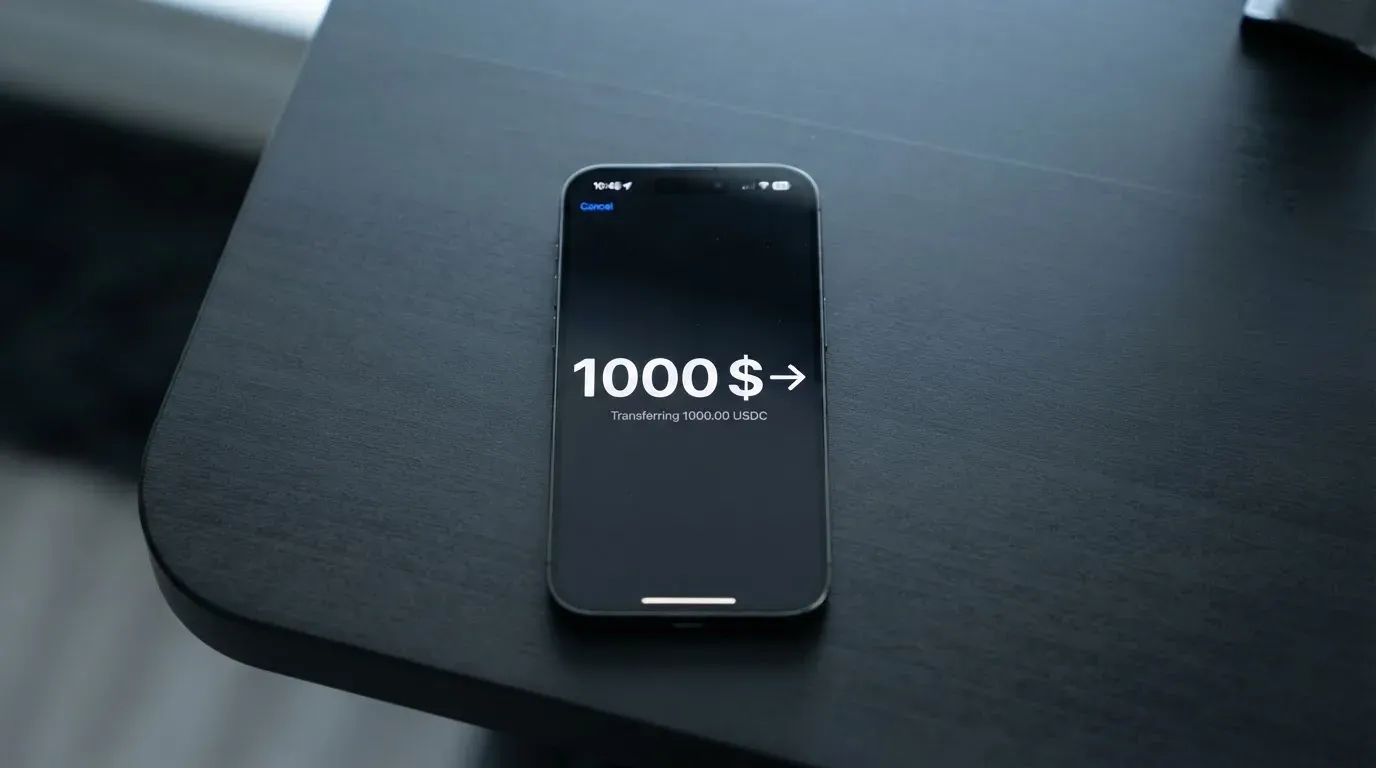
On the fiat side, you can send USD, EUR, or GBP into your Karma account. The fiat is then converted to crypto by Bridge and deposited into your wallet. On the cost side of that path, you pay a 1% on-ramp fee (with the caveat that “additional fees may apply”), a SEPA transfer fee of $1.45 for euro bank transfers, and an ACH transfer fee of $0.95 for U.S. dollar bank transfers. EUR, GBP, and MXN conversions run at mid-market plus 0.50%. A “high-risk payments” extra fee is capped at 5% of the deposit. Karma says it sponsors network gas on the default routes, which is why the App Store can describe USDC transfers on Solana as having “no on-chain transaction costs.” There is no minimum top-up stated. There is no monthly or signup fee on this side either.
On the crypto side, the card itself is loaded with USDC, and Solana is the network the App Store description points to. The list of coins you can use to top up the card is not stated. That is a real gap: if you hold BTC, ETH, or anything outside the USDC-on-Solana line, the official pages do not tell you whether you can convert and load it.
Withdrawals work in reverse. The wallet converts back to fiat, and the off-ramp fee is 0.5%. Per the App Store, you can withdraw to a bank or to an external wallet “at any time.” Closure is a different matter: the issuer may suspend or cancel access at any time, and the card terms are written in the language of a credit line, with clauses about a repayment obligation surviving closure, that do not match the “loaded with USDC” description. I would not assume a smooth exit.
The limits story is also unclear. Karma sets the spending limit; the issuer may add per-card or total limits; and either may be changed at any time, even to $0. No numbers are published.
Paying with it every day
The honest answer here is that several things you would expect to know are not stated.
Apple Pay and Google Pay are not mentioned on Karma’s public pages. An unofficial third-party page says neither is supported, and on the official evidence I have, I cannot confirm either. If mobile wallet support matters to you, that is a serious gap to check in the app before relying on the card at a tap-to-pay terminal.
Card type: virtual or physical, or both, is not stated. The card terms mention physical or virtual cards “may be limited,” which is the opposite of a clear commitment to either. The card currency is not stated. The official terms describe foreign-currency transactions as converted to US dollars by the card network, which is a hint that the card is denominated in dollars internally, but the card itself is not labelled with a currency on the public materials.
What the card will not do at the till: there is a long list of prohibited merchant categories, including digital currency purchases (except via Karma itself), cannabis and CBD, the dark web, unlicensed pharmacies, firearms, escort services, payday lending, MLM and Ponzi schemes, and counterfeit goods. “Regulated gambling or fantasy sports,” crypto platforms and exchanges, and money-service businesses need enhanced review. That means if you regularly buy from a crypto exchange using this card, expect friction.
Rewards exist but the rates are not stated. App Store version 1.1 notes “reward tiers with cashback on fees,” a points balance called Karma Points earned on card spend, and “pending cashback tracking.” I cannot tell you the percentage because the official pages do not.
The app itself is on the App Store, where the iOS app is rated 5.0 out of 5 from 6 ratings, requires iOS 15.1 or later, and is currently at version 2.0.2. There is a Google Play listing at xyz.karmapay.app; the rating is not readable from the materials I have. That sample of six ratings is too small to be meaningful as a quality signal, but it is not negative.
Disputes follow a familiar shape. Try the merchant first; if that fails, report the chargeback in the Karma account no more than 60 days after the charge posts. If you win, the amount is credited on a current or future statement. Unresolved disputes can lead to fees, lower limits, or suspension.
What can go wrong
There are five risks worth taking seriously with this card, and the first is the simplest to explain.
You might not get a card at all. Seventeen countries are blocked for issuance, and FATF grey-list residents are reviewed case by case. The 0.5% service fee and the 1% FX are not enough savings to make the card useful if you are excluded from holding one.
The published information is thin. Card type, card currency, daily and monthly limits, KYC level, ATM behaviour, delivery time, replacement cost, and Apple Pay / Google Pay support are all either unstated or only confirmed by unofficial third-party sites. Third-party sites can be wrong; I would not plan a budget around an unconfirmed number.
The company behind the card is partly opaque. Karma Fintech LTD runs the App Store listing, the programme is on Rain, and the issuer is Third National under a Visa licence. The registration country of Karma Fintech LTD is not stated. Karma says it is not a bank, exchange, or custodian. The card is non-custodial (“you control your wallet and your keys”; Karma “cannot freeze, seize, or move your funds”), but that claim is about the wallet, not about your access to the card itself: the issuer can suspend or cancel access at any time, and the card terms are written in the language of a credit line. A card you cannot use at the moment you need it is not much of a card.
No insurance and limited audit visibility. Karma explicitly says it does not provide FDIC insurance, and that audits happen “under NDA.” For a custodial product, the absence of public attestations is a meaningful signal; for a self-custody product, it is less acute, because you hold the keys, but it is still worth knowing.
Support is thin. Support channels and hours are not stated on the site or the App Store. There is an X account at @KarmaWallet. If something goes wrong with a charge, a top-up, or a closure, the path to a human is unclear. There is no public Trustpilot or Reddit page about Karma Pay that I could find, and no Karma-specific complaints turned up in a search; that is a small positive, but it is also a small sample.
A small bonus risk worth flagging: a transfer sent on the wrong network, or to an address on a network Karma does not support, can be lost or require manual support recovery with no guarantee. USDC on Solana is the rail the App Store points to, but the official top-up coin list is not stated. If you copy an Ethereum USDC address into a Solana USDC field, the funds do not arrive at Karma and the network cannot reverse it.
What to take instead
Three reasonable alternatives, with their own trade-offs.
MetaMask Card (7.1 / 10) is the closest comparable in spirit. Sign-up is open in 45 listed countries and territories, with proof of residency required, and a waitlist for others; U.S. and U.K. sign-ups are temporarily closed per the FAQ. The card is a Mastercard; a Virtual card is issued first, and a Metal version can be pre-ordered in the app after approval, with one card per user. Virtual is free with no annual or maintenance fee; Metal is $199 per year. Fees are described as a “minimal fee for each transaction” with no MetaMask fees and no foreign-transaction fee, using the Mastercard rate. The card spends directly from the connected wallet across Linea, Base, Monad, and Solana, and the named tokens are mUSD, wETH, EURe, GBPe, USDC, and USDT (the source page says nine). Cashback is paid in mUSD into the Money Account: 1% on Virtual, headline 3% on Metal with a footnote limiting 3% to the first $10,000 spent and then 1%, plus a $FLY bonus of 5X on Virtual and 7X on Metal via the Blackbird dining app. The eligibility list is larger than Karma’s, but the U.S. and U.K. closures are real for now.
KAST (6.1 / 10) is the most generous on rewards but the most expensive to enter. Eligibility is residence-based at KYC; the country list is not published, and “if your country isn’t listed, it means KAST is not available there.” Citizenship matters: if you live in a supported country but only hold an ID from a restricted region, you may still be ineligible. The card is Visa Platinum (Standard), Visa Infinite metal (Premium), or Visa Infinite gold-plated (Private), with up to 10 cards per user; the account balance is in USD, with stablecoin deposits converted 1:1 at 0% spread. Annual membership is 0 USD for Standard, 1,000 USD for Premium, 10,000 USD for Private (billed annually upfront, with no monthly option). Stablecoin top-up is 0%, card spend in USD is 0%, transaction fee is 0%, and Apple Pay / Google Pay is 0%. Non-USD FX is 0.5%–1.75% depending on residence country, transaction country, and card programme; non-USD transactions under $25 add $0.10, and a declined transaction for insufficient balance costs $0.50. Rewards are paid in USD at authorisation: Standard 1.5% on the first $2,000 per month, Premium 2% on the first $10,000, Private 3% on the first $40,000, plus KAST Points. If you spend heavily, KAST can outperform Karma, but the membership cost is the entry price.
TokenPocket (TP) Card (5.8 / 10) is a smaller product with narrower reach. Visa debit is available in a list of European countries and territories including Germany, France, Spain, and Switzerland; Mastercard debit is available in Australia, Canada, Hong Kong, Japan, Taiwan, New Zealand, Singapore, South Korea, the U.K., and others, with the Americas “planned for Q2 2025.” The card runs on Arbitrum, balances are in EUR24 and USD24, and Fiat24 cards are virtual (no physical card mentioned). Costs include a partly-covered NFT creation fee, with the user paying “a small portion” (amount not stated), and “apart from these, TP Card does not charge any additional fees.” A 1% fee is charged when depositing cryptocurrency into the TP Card, with the promise that it will be refunded later through rewards or reduced transaction fees; FX fees are not stated. There is no cashback in the traditional sense. If you already live in the TokenPocket wallet world, this is the natural pick; outside that, the geography is restrictive.
| Card | Score | Best for | Main cost | Cashback | Big caveat |
|---|---|---|---|---|---|
| Karma | 6.4 | Self-custody USDC users | 0.5% per transaction | Not stated | 17 countries blocked; mobile pay unconfirmed |
| MetaMask | 7.1 | Multi-chain wallet users | Metal $199/year | 1% / 3% (capped) | U.S. and U.K. sign-ups temporarily closed |
| KAST | 6.1 | High spenders | 0 / 1,000 / 10,000 USD/year | 1.5% / 2% / 3% | Country list unpublished; high membership tiers |
| TokenPocket | 5.8 | Arbitrum / European users | 1% on crypto deposit | Refunded via rewards | Americas not yet available |
Who I would recommend it to
I would recommend the Karma card to a fairly specific reader: a self-custody user who already keeps USDC on Solana, who wants a Visa for in-person spend, who does not need a mobile wallet at the till, who does not need cash from an ATM, who lives outside the seventeen excluded countries, and who is comfortable with the limits and KYC rules as the official pages describe them (or as the third-party description of the KYC step suggests). The 0.5% service fee is competitive, the lack of monthly or signup fees is a clear positive, and the non-custodial posture is the right answer for people who do not want to hand their keys to a card company.
I would not recommend it to anyone who relies on Apple Pay or Google Pay at the checkout, who needs an ATM, who wants a published daily or monthly limit they can plan around, who lives in one of the seventeen blocked countries, or who needs a clear, step-by-step sign-up flow on the issuer’s own pages. If you want a card with broader country coverage and a stronger mobile-wallet story, MetaMask is the better fit. If you want higher cashback and you can pay for a membership, KAST is the better fit, provided you are in a supported country. If you want a self-custody card with clearer published costs and a Metal upgrade path, MetaMask is also the better fit. The honest case for Karma is the self-custody case; outside that case, the gaps in the public information become the main story.
Frequently asked questions
What is the Karma card?
The Karma card is a Visa that lets you spend from a non-custodial crypto wallet. The card is loaded in USDC, the App Store points to the Solana network for that loading, and transactions are converted and processed by the card network in the usual way. Karma Fintech LTD markets the programme, which runs on Rain, and cards are issued by Third National under a Visa licence.
How does the Karma card work?
You fund the wallet with USDC (Solana), and the card draws on that balance at the point of sale. Foreign-currency transactions are converted to US dollars by the card network, and you pay a 0.5% Karma service fee per transaction plus a 1% FX fee and a $0.30 international fee on non-USD spending. Karma holds your keys; the issuer can change limits, including to $0, at any time.
Is Karma a bank?
No. Karma says it is not a bank, exchange, or custodian. The card programme is run by Karma Fintech LTD on Rain, and the cards themselves are issued by Third National pursuant to a Visa licence. The registration country of Karma Fintech LTD is not stated on the public pages.
Who owns Karma?
Karma Fintech LTD is the company named in the App Store listing as the seller and developer of the “Karma Pay” app. The site mentions the Karma ICM Association, a Swiss non-profit, as overseeing the protocol and treasury. The exact corporate ownership chain and the registration country of Karma Fintech LTD are not stated on the materials I read.
Is the Karma card available in my country?
Issuance is blocked for residents or registrants of Belarus, mainland China, Cuba, India, Iran, Iraq, Israel, Myanmar, Nepal, Nicaragua, North Korea, Russia, Syria, Turkey, Ukraine, Venezuela, and Vietnam, with case-by-case review for FATF grey-list residents. Spending is blocked in Cuba, Iran, North Korea, Russia, Syria, Ukraine, and Venezuela. If you are outside those sets, the public materials do not list additional restrictions.
How do I get the Karma card?
The application flow is not described step by step on Karma’s own pages. The card terms say only that the user must confirm they are not a U.S. citizen and are not sanctioned, and that the card is for users with no KYC process; a third-party page about a related Karma Card product describes email, phone, and identity document checks, but I treat that as unofficial. The fastest practical step is to install the app and follow its flow.
Does the Karma card require KYC?
The official KYC level is not stated. The card terms describe a non-KYC product with a self-confirmation of citizenship and sanctions status, while a third-party write-up of a “Karma Card by Karma Wallet” page describes a Level 3 identity check with email, phone, and an ID document but no proof of address or selfie. I would not rely on the third-party description without checking the app directly.
How do I top up the Karma card?
You can top up with USD, EUR, or GBP bank transfers; the fiat is converted to crypto by Bridge and deposited to your wallet. SEPA costs $1.45, ACH costs $0.95, and the on-ramp fee is 1% with the caveat that “additional fees may apply”; EUR, GBP, and MXN conversions run at mid-market plus 0.50%. On the crypto side, the card loads with USDC, and the App Store points to the Solana network; the list of supported top-up coins is not stated.
Is the Karma card free?
There is no signup fee, no monthly fee, and no hidden fee. You pay a 0.5% Karma service fee per card transaction, a 1% FX fee on non-USD spending plus a $0.30 international flat fee, a 1% on-ramp on fiat top-ups, a 0.5% off-ramp on withdrawals, and a 0.5% swap fee inside Karma. Holding $KARMA reduces the swap fee and, at higher tiers, the card service fee.
How do I add the Karma card to Apple Wallet?
Karma’s own pages do not state whether Apple Pay is supported. An unofficial third-party source says it is not. The card terms do not address mobile wallets at all. I would check the app directly before assuming tap-to-pay will work, and not rely on the unofficial answer.
Wallet card reviews – cryptocardcheck
Content created by the «cryptocardcheck» team