
MaxSwap in practice: cheap to open, easy to spend, thin on paperwork
 Available in US
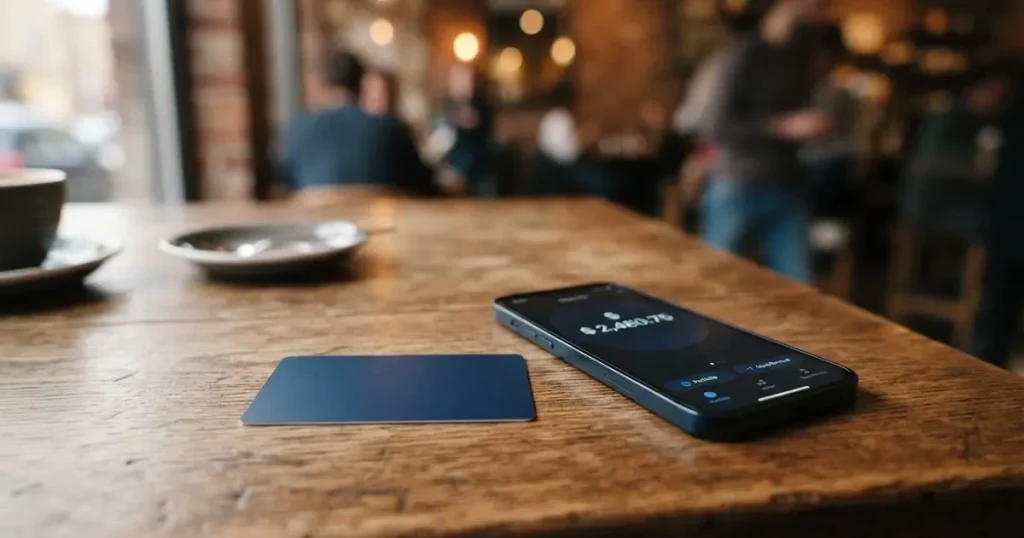
MaxSwap is a crypto wallet with a payment card attached to it — a virtual Mastercard you create inside a Telegram bot, fund with cryptocurrency, and then spend wherever Mastercard is accepted. That is the whole product, and it is either exactly what you want or completely beside the point. There is no bank account behind it, no branch, no banking relationship in the usual sense, and no physical card in the post. If you have been trying to get an ordinary bank card and have run into walls — a country your bank will not serve, a document it will not accept, a proof-of-address address nobody recognises — this is the category of thing people end up trying. If you already have a working debit card and a bank you like, read the fees section before you start, because this one is not cheap to use.
The conditions described below are current as of October 28, 2026.
Verdict: 5.2 out of 10
I scored MaxSwap 5.2 / 10. That is a middling number and I want to be honest about why it is not lower and not higher. The top-up side of this card is genuinely good — a wide list of coins, one flat percentage, no monthly fee. The card side is thin: virtual only, no ATM details at all, no named issuer, no stated currency, and a terms page that tells you almost nothing about what happens when something goes wrong. Half of what you would want to know before trusting a new card with your money is simply not published.
Here is how the criteria broke down, and where each mark comes from:
| Criterion | Mark | Why |
|---|---|---|
| Who can get it | 8 / 10 | The site claims “no geographical restrictions” and lists no closed countries; you are expected to follow the laws of your own jurisdiction |
| Cost | 1 / 10 | The card is 50 USD with 25 USD required as a first deposit, top-up runs 4.5% + 1 USD, and each payment costs 0.25 USD + 0.4% |
| Top-up options | 8 / 10 | A wide coin list: BTC, ETH, TRX, USDT, USDC, TON, XRP and others — but the networks are not named |
| Reliability and complaints | 5 / 10 | Operator MW Profit Ltd (London), issuer not named, custodial wallet; Trustpilot shows 4.6 out of 5 across 40 reviews, one of them about a lost deposit |
| Everyday use | 5 / 10 | Virtual Mastercard only, Apple Pay and Google Pay available; no ATM information at all, unofficially: a “Premium Card with ATM USA” appears in the menu |
Read that cost row again. A card that costs money to open, money to load, and money on every single payment, with no monthly fee offsetting it, is not going to score well with someone who pays for coffee. The 8 out of 10 for who can get it is real, but it is partly a claim on a website rather than a documented policy — the terms say you must comply with your own jurisdiction’s laws and give no country list at all, which cuts both ways.
Who this suits. Someone who already holds crypto, has no usable ordinary card, and wants to spend it at ordinary shops this week rather than sit on a chain. Who it does not suit. Anyone whose priority is cheap everyday spending, anyone who needs a physical card for a shop that insists on one, anyone who needs cash from an ATM, and anyone who needs a clear, published answer about who is behind the card.
Will they give you the card?
The short answer is that the site says almost nothing restrictive, and what it does say is consistent rather than detailed. The public pages claim “no geographical restrictions”. There is no closed-country list, no restricted list, and no carve-out for particular nationalities. The Terms of Use do not add a country list either — they simply put the responsibility on you, saying users must comply with the laws of their own jurisdiction.
That is the honest picture, and it deserves a little unpacking. “No geographical restrictions” as marketing copy tells you the service is not advertising an exclusion. It does not tell you how the company screens applicants, which is the thing that would matter if you wanted to know whether your own country is quietly a problem. I have no way to close that gap from the public pages, and I am not going to pretend otherwise.
If you are somewhere your own government restricts crypto use, or somewhere your bank has been discouraging it, the card’s silence is not permission. The card itself cannot override a law in your country — the Terms of Use are explicit that you must obey it, and that is a real constraint rather than a formality. Conversely, if you are in a large, ordinary jurisdiction and merely unlucky with banks, the absence of a country list is genuinely useful information.
Two further points on eligibility:
- Cards are generally available to adults, 18 and over, in this category of product; some issuers set higher limits.
- Nationality is recorded and screened separately from residence in regulated financial businesses, because sanctions screening often applies to citizenship and country of birth as well as address. MaxSwap does not publish anything on this, so I cannot tell you how they handle it.
Where the card is silent and a third party is not: a comparison site describes MaxSwap as no-KYC, with a single Mastercard and a balance returned to USDT when the card is closed. Treat that as unofficial, affiliate-linked background rather than something the card has confirmed — and see the next section for what the card’s own pages actually say.
How to get it
There is no application form, no PDF, no branch. The card lives entirely inside the MaxSwap Wallet Telegram bot, and the card itself appears through an “Open MaxSwap Card” prompt in that bot. The site advertises “no paperwork or long registration process” and a card issued “in less than a minute”. No separate app is involved — there is nothing to download from an App Store or a Google Play store, so there are no store ratings, no update cycle, and no way to hold the provider to a published mobile quality bar.
What is actually required of you, from the terms rather than the marketing: the Terms of Use say users “may be required to complete a verification process” at account setup, and there is an anti-money-laundering policy in the terms. The site, meanwhile, promises “no complicated verification”. Neither statement excludes the other — “no complicated verification” is not “no verification” — and the practical reading is that a check may appear at some point, possibly at funding or at a limit increase, rather than necessarily at sign-up.
What the card does not publish, and I would want to know before I loaded real money:
- No identity document types are listed.
- No proof-of-address requirement is described.
- No verification tiers, no processing times, and no stated reasons a check might be refused.
- No age requirement is spelled out.
One unofficial data point, from the same third-party comparison page mentioned earlier, claims KYC is optional for some transactions. That page is affiliate-linked and has no second source behind it, so I would not plan around it. The site’s own claim of an instant card and the terms’ allowance for verification are both things you can hold it to; anything else you will have to discover by trying.
Fees: what it really costs
This is where MaxSwap loses most of its points, and I want to walk through it plainly because the numbers look reasonable one at a time and add up quickly. First, the full price list as the card publishes it:
| Fee or limit | Value |
|---|---|
| Card issuance | 50 USD |
| First deposit required at issue | 25 USD |
| Total listed at issuance | 77.125 USD |
| Monthly fee | not stated |
| Top-up | 4.5% + $1 |
| Card payment | 0.25 USD + 0.4% |
| FX / currency conversion | no separate rate stated; the site says to take into account possible fees when paying and converting currencies |
| ATM | not stated |
| Top-up minimum | 10 USD |
| Top-up maximum, single | 5,000 USD |
| Top-up maximum, monthly | 200,000 USD |
| Maximum card balance | 200,000 USD |
| Maximum single online payment | 50,000 USD |
| Transaction limit, single | 50,000 |
| Transaction limit, daily | 200,000 |
| Transaction limit, monthly | 2,000,000 |
| Tiers | one virtual Mastercard; a “Premium Card with ATM USA” appears in the site menu with no details |
Currency is not stated on the card’s home page, even though the fees are quoted in USD, and the currencies of those transaction limits are not stated either. I would not assume they are dollars.
Now let me run three ordinary payments through those figures, because a percentage fee that sounds small is not small when it repeats.
A $30 supermarket shop. Top up first, because the card spends a loaded balance. The site does not publish the fee for converting crypto into that balance beyond the top-up charge itself — so if you are converting, that is 4.5% plus $1. On a $30 load that is $1.35 plus $1. Then the payment itself: 0.25 USD plus 0.4% of $30, which is $0.12, so $0.37. If you had to top up twice to cover it, the load fee appears twice. Roughly $2.72 for a $30 shop, and that is before any conversion cost inside the top-up.
A $4.80 coffee. The fixed 0.25 USD is the problem here, not the percentage. The payment fee alone is $0.27. The $1 in the top-up fee does not shrink either, so loading $10 — the stated minimum — costs $0.45 plus $1, and that is the cheapest possible top-up. Coffee costs roughly $1.72 in fees for the privilege.
A $120 flight or a monthly online subscription. Payment fee: 0.25 plus 0.4% of $120, so $0.73. A $200 order costs $1.05 in the payment fee. The load fee is the bigger number: on a $500 top-up, 4.5% is $22.50 plus $1. Because you load ahead of spending and the balance sits there, the percentage hits your whole balance, not just what you spend that day.
Two things about the fee structure are worth flagging. First, the currency wording on purchases is promotional — “in any currency” — while the rate itself is not stated, so you cannot know the conversion margin before you pay. Second, the listed total issuance cost of 77.125 USD includes something beyond the 50 USD card price and the 25 USD first deposit, which the card does not break down on the face of the pricing. Whatever that difference is, it is the number you actually pay to walk in with a card.
There is no monthly fee published, which is a genuine plus. But an unstated monthly fee is not the same as no monthly fee — “not stated” means the public pages do not say, and I would want to see it in writing before treating this as a card you can leave loaded for a year.
How to top it up
Top-ups are in crypto, entered as a USD amount, and the system adds 4.5% plus $1 on top. Minimum $10, maximum $5,000 per top-up, $200,000 per month. At card issue you must deposit at least $25. You pay from the chosen MaxSwap crypto wallet, so this is a load from inside your own balance rather than a bank transfer.
The coin list is long, which is the single best thing about this card:
- ADA, ALGO, AVAX, BCH, BNB, BTC, DOT, ETH
- HBAR, HT, KRRX, LINK, LTC, MATIC, NEAR
- SHIB, SUSHI, TON, TRX, UNI
- USDC, USDT, XLM, XRP
That breadth is why the top-up criterion scores 8 out of 10. But notice what is missing from that list: the networks. The card does not say whether USDT should go on Tron or Ethereum, whether USDC arrives on Ethereum or Base, or what happens if you pick the wrong one. This is not a small detail. Blockchain transfers are irreversible, and a deposit sent on a network the provider does not support — or to an address belonging to another network — can be lost outright, or need manual support recovery with no guarantee of success. Every time you top up, you are making that decision.
There are network conventions worth knowing, and they are not the same as card rules:
- ERC-20 is the Ethereum token standard. Gas is paid only in ETH, so a wallet holding USDT and no ETH cannot actually send.
- Tron prices transactions with bandwidth and energy and often burns TRX, which is why TRC-20 transfers are usually the cheap ones.
- Circle stopped supporting USDC on Tron in February 2024, so “USDC on TRC-20” is not a native option any more. If you hold USDC in your wallet, check what it is actually on before assuming anything.
- Circle lists USDC as natively supported on 38 networks, as of 16 September 2026.
And the elephant: on-chain network fees for your deposit are charged by the blockchain, not by MaxSwap. Whatever network fee your coin needs is on top of the 4.5% plus $1.
What is not published here matters too. Fiat top-up: not stated — I found no bank-transfer option, and it is not advertised, so assume crypto is the route. And the reverse direction is genuinely undocumented: withdrawals from the card are not stated. The Terms of Use say withdrawals follow platform procedures, and that an account may be terminated under conditions the terms do not specify, but there is no described balance-return process. A comparison site claims your balance comes back as USDT when you close the card; that is an affiliate-linked claim with no second source, so I would ask support directly before you load anything you expect to get back. There is a review on Trustpilot from a user who reported a lost deposit with no compensation, which is exactly the scenario where the absence of a written withdrawal process hurts.
Paying with it every day
The card is virtual — there is no plastic. The site menu references a “Premium Card with ATM USA” but publishes no fees, no limits, and no detail of any kind about it, and no ATM data is available from third parties either. So cash, for practical purposes, is not a feature you can count on.
Mobile wallets are the intended route. You can add the card to Apple Pay. Google Pay is supported too, and the setup is verified with a code from the bot sent by your email; the virtual-cards page also describes a user who linked it to PayPal. Worth knowing how that works in general terms: Apple Pay replaces your card number with a device-specific number stored in the Secure Element, never on Apple’s servers, and each payment carries a one-time dynamic code. The issuer can also restrict the tokenised number — blocking it, for example, on phone or website use — which is a lever the provider holds over your wallet setup without telling you.
What you will feel in the wild, if you take the reasonable view that unspecified things go wrong sometimes:
- Some merchants decline prepaid or foreign cards, because a lookup of the card’s first six or eight digits reveals the card type and issuer country. That is the same lookup that lets a shop see which institution issued you and apply extra scrutiny when the issuer country differs from your billing address.
- Address verification, which compares the numeric parts of the billing address you type against issuer records, is mainly offered in the US, Canada and the UK and is generally unavailable for foreign-issued cards. That causes declines on their own.
- A declined authorisation can leave a hold on your funds for several days, typically up to seven.
- Blocked merchant categories are not stated. That means I cannot tell you whether gambling is blocked, and in this category many issuers block it by policy rather than by law — with the list varying by issuer.
- 3-D Secure may challenge your payment. Mastercard’s brand is Identity Check; the system either approves frictionlessly or sends a challenge such as a one-time code.
Two more everyday things the card does not mention: no cashback or rewards of any kind is stated, and no separate app exists — everything runs through the Telegram bot, which offers balance checks and instant payment notifications. On disputes, the Terms of Use tell you to contact MW Profit Ltd, with no procedure, no refund policy and no time frames, and the terms are governed by Seychelles law. Whether chargebacks are available is not stated, and I would not assume them.
What can go wrong
Nobody has published an incident for this card: no official incidents, no user reports found. That is not the same as nothing having gone wrong. It means nobody has written it down publicly in a way I could find.
The counterparty risk is the real one. The wallet is custodial. Whoever holds the private key controls the funds, and here that is MaxSwap, not you — so trusting this card means trusting the operator completely, with no recourse of your own if the key management fails. Custodial platforms have a documented history of it: Mt. Gox with about US$350 million reported stolen across 2011–2014, Coincheck with about US$400 million in 2018, Ronin Network with US$625 million in 2022. None of those was this company. All of them are the shape of the risk you are taking.
The company is thin on paper. The operator is MW Profit Ltd, registered in London, company number 15541776, in a set of Terms of Use effective 1 October 2023. The card issuer or BIN sponsor is not named anywhere I could find — and it is the issuer, not the crypto brand, that holds the card programme, that Visa and Mastercard license, and that a payment dispute would sit with. The terms mention no registration or licensing. There is also no stated news, announcements, or dated updates beyond the 2026 footer.
Suspension is on the table and under-specified. The Terms of Use allow the account to be suspended for suspected unlawful activity, and to be terminated under conditions the terms do not specify. You do not get a description of what “suspected” means or what happens to your balance afterwards.
Security features: mostly not stated. The site lists data encryption, privacy protection, instant payment notifications and balance checks in the bot. Two-factor authentication, card freeze, and any insurance or fund protection are not stated. In this category the usual safeguards are app-based 2FA, instant freeze, spending limits, 3-D Secure confirmation and tokenised wallets — I could confirm none of them here except that a virtual card number is inherently hard to skim, which is a modest consolation.
Stablecoins are not risk-free. USDT and USDC are dollar-pegged and the BIS put about 90% of stablecoin market capitalisation in these two as of July 2025, but stablecoins are not necessarily stable: TerraUSD collapsed in May 2022, and USDC temporarily lost its peg in March 2023 during the US banking crisis. Circle says USDC is redeemable 1:1 for USD and fully backed by cash and equivalents, mostly in an SEC-registered government money market fund, with monthly reserve attestations. Tether describes USDT reserves as intended to back it one-to-one. And Tether says it disables tokens in wallets on the OFAC sanctions list and has frozen funds tied to illicit activity — so stablecoins are not censorship-proof in either direction.
Support is a coin flip, according to the reviews. “24/7 Support” is claimed, with a Telegram support channel and an FAQ page. But the review themes are mixed: one report describes a slow reply and a lost deposit with no compensation; another says the minimum BTC deposit was not clearly disclosed. The Trustpilot page for maxswap.cc, read on 20 October 2026, shows 4.6 out of 5 from 40 reviews, 92% five-star, with two reviews in the last twelve months and a note that the company has not invited reviews recently. Positive themes include fast setup, sometimes without documents, and PayPal and Apple Pay linking. A 4.6 across 40 reviews is a good number for a small sample. Forty reviews is a small sample, and positive themes clustering around “no documents needed” is a warning dressed as a compliment.
Regulation context, briefly. The EU’s markets-in-crypto-assets regulation, MiCA, took legal effect in June 2023; its rules on stablecoins applied from 30 June 2024 and the crypto-asset service provider rules from 30 December 2024. Under MiCA, e-money tokens may be issued only by a credit institution or an electronic money institution. Transitional arrangements run until 1 July 2026 or until a provider is authorised or refused, whichever comes first, and ESMA keeps an interim public register you can check. In the US, FinCEN guidance treats administrators and exchangers of convertible virtual currency as money transmitters, while ordinary users buying things are not. None of this tells you whether MaxSwap holds any particular licence — I simply could not find that stated.
And the standing structural risk. Card programmes close. Visa terminated its global agreements with FTX on 13 November 2022 and the FTX US debit card was wound down by its issuer. WaveCrest, a Visa issuer that supplied crypto card brands, was suspended by Visa in Europe in 2018, closing all its programmes. A closure typically means a notice period, then loading and spending stop, then you are asked to withdraw. I am not predicting that here — I am telling you that a card with no named issuer and no published withdrawal process has no documented path through that scenario.
On taxes I will stop, because this is not advice and you should not take it as any. The general background: the IRS treats digital assets as property, so exchanging them for goods, services, dollars or other digital assets generally produces a taxable gain or loss, measured in local fiat currency at fair market value on the transaction date. Whether and how that applies to you depends entirely on your jurisdiction and your situation.
What to take instead
None of these are better in every respect, and I am not going to pretend otherwise. Here is the comparison, with scores from the same exercise:
| Card | Score | Card type | Up-front cost | Ongoing fees |
|---|---|---|---|---|
| MaxSwap | 5.2 / 10 | Virtual Mastercard | 50 USD plus 25 USD first deposit, listed total 77.125 USD | Top-up 4.5% + $1; payment 0.25 USD + 0.4%; monthly fee not stated |
| Azul Card | 5.3 / 10 | Virtual, anywhere Mastercard is accepted | $20 creation, refunded after $2,000 in spending | $5 monthly maintenance; crypto top-up 4%; $0.25 per transaction; FX not stated |
| Telecard | 6.1 / 10 | Virtual Mastercard | $5 standard plan; $99 minimum deposit, stated as not a fee | 1.5% currency conversion on non-USD payments; 0.5 USDT gas fee per successful transaction; FX and cross-border fees up to 3% each |
| OnCards | 4.6 / 10 | Virtual Mastercard / Visa in Telegram | Not stated | Not stated |
On eligibility, the difference is stark. MaxSwap publishes nothing — no country list at all, just a claim of “no geographical restrictions”. Azul Card is the opposite: usable worldwide except Russia, Belarus, North Korea, Iran, Syria, Cuba, Sudan, Venezuela, Ukraine and the Crimea, Donetsk, Luhansk, Zaporizhzhia and Kherson regions, with the restriction applying regardless of nationality. Telecard says usable in over 150 countries wherever Mastercard is accepted, with an identity check “available in most major regions”, and its terms bar only users “blocked or sanctioned by the United States Government, including OFAC”. OnCards states nothing about countries.
Where MaxSwap is genuinely stronger than the alternatives is the coin list and the absence of a monthly fee. Azul takes $5 a month, which quietly wipes out its cheap $20 creation price by the end of year one. Telecard’s fee structure is heavier per transaction and its $99 deposit to activate is a real barrier. OnCards publishes no fees at all, which is not a selling point when you are trying to work out what a coffee costs.
Where it is weaker: you cannot compare the FX rate, because MaxSwap states none; the withdrawal process is not stated, while Telecard at least specifies its deposit networks (USDT on TRC-20 or ERC-20, USDC on ERC-20, Polygon not supported); and no card here names its ATM terms, so if you need cash, none of these solve it. OnCards has the thinnest disclosure of the four. Rewards are similarly mixed: MaxSwap states none, Azul runs a referral programme paying “up to 40% of our fees from every transaction made by your referrals”, and Telecard pays Fiorini per activated friend plus cashback at an unspecified rate.
My own reading: Telecard scores highest at 6.1 and is the one I would look at first if named networks and a stated conversion fee matter to you. MaxSwap wins if you want to load from an unusual coin and dislike monthly fees.
Who I would recommend it to
I would recommend MaxSwap to someone in exactly this shape: you already hold crypto, you cannot get an ordinary card for reasons that are not going away, you spend at mainstream shops rather than needing cash, and you are treating the loaded balance as money you can afford to have sitting in someone else’s hands. Under those conditions, a virtual card created in a minute and spendable through Apple Pay is a genuinely useful tool, and the wide coin list makes it adaptable.
I would not recommend it, and would suggest you look elsewhere first, if any of these apply:
- You need a physical card. There is one, virtually. That is the entire product.
- You pay for small things daily. A $0.27 fee on a $4.80 coffee adds up, and loading $10 costs 4.5% plus $1 on top.
- You need an ATM. No ATM fees, limits, or details are published anywhere.
- You plan to load and leave money. The 4.5% top-up fee is charged on the whole balance, and the monthly fee is not stated either way.
- You need a clear answer on getting your money back. The withdrawal process is not published, and the account can be terminated under conditions the terms leave open.
- You want to know who stands behind the card. The issuer is not named.
One thing I would do regardless of which card you pick: before you load more than you would mind losing, ask support in writing how a balance is returned when an account is closed, and in what asset. It is the single question I could not answer from the published pages, and it is the one that matters most.
Frequently asked questions
What is the MaxSwap card?
It is a virtual Mastercard issued through the MaxSwap crypto wallet, created inside a Telegram bot rather than posted to you. You load it with cryptocurrency, it converts to a spendable balance, and it pays anywhere Mastercard is accepted. There is no bank account behind it and no physical version, so it behaves much like a prepaid card rather than a debit card tied to your current account.
How does MaxSwap card work?
The MaxSwap Wallet Telegram bot holds a crypto wallet and issues you a Mastercard number from inside it. You top up in USD terms from coins already in that wallet, paying 4.5% plus $1, and then spend the loaded balance. Each payment costs 0.25 USD plus 0.4%. You can add the card to Apple Pay or Google Pay, the latter verified by a code sent from the bot.
Does the MaxSwap card require KYC?
The card’s own pages do not give a clear answer. The site advertises “no paperwork or long registration process”, while the Terms of Use say users “may be required to complete a verification process” at account setup, with an AML policy in place. No document types, proof-of-address rules, tiers, processing times, or refusal reasons are published. A third-party comparison site calls it no-KYC, but that claim is affiliate-linked and unconfirmed.
Is MaxSwap a bank?
No — nothing published says it is. MaxSwap is presented as a custodial crypto wallet with a card attached. The operator named in the Terms of Use is MW Profit Ltd, a London company, number 15541776, and the terms are governed by Seychelles law. The card issuer or BIN sponsor is not named, and no banking or e-money licence is stated.
Who owns MaxSwap?
The Terms of Use, effective 1 October 2023, name MW Profit Ltd as the operator, registered in London with company number 15541776, and that is the only ownership detail published. No parent company, funding source, registration or licence appears on the pages I could read. Card issuer, BIN sponsor and registration are all not stated.
Is the MaxSwap card free?
No. The card itself is listed at 50 USD and requires a first deposit of at least 25 USD, with a listed issuance total of 77.125 USD. On top of that, loading costs 4.5% plus $1 and each payment costs 0.25 USD plus 0.4%. A monthly fee is not stated either way, so I would not assume there is none.
How do I top up the MaxSwap card?
You send crypto from your MaxSwap wallet and enter the amount in USD; the system adds the fee. Minimum $10, maximum $5,000 per top-up and $200,000 per month. The coin list is broad — BTC, ETH, TRX, USDT, USDC, TON, XRP, SOL-adjacent names, ADA, BCH, BNB and others — but the supported networks are not published, which is the detail to confirm before every transfer.
Can I use the MaxSwap card in my country?
The site claims “no geographical restrictions” and publishes no closed-country list, so the card does not advertise excluding anyone. The Terms of Use simply require you to comply with the laws of your own jurisdiction, which is a real constraint wherever crypto use is restricted locally. Because there is no published country list, the safest check is asking support directly with your specific country before you load money.
Is the MaxSwap card safe?
Treat it as custodial, which means the provider holds the credentials and you rely on them entirely. No incidents are on record, and Trustpilot shows 4.6 out of 5 across 40 reviews as of 20 October 2026, with one report of a lost deposit and no compensation. Two-factor authentication, card freeze and any fund insurance are not stated, and no withdrawal process is published — which is the first thing to ask about.
Can I withdraw money from MaxSwap?
The published pages do not describe it. The Terms of Use say withdrawals follow platform procedures and that an account may be terminated under unspecified conditions, with no balance-return process set out. A third-party comparison site claims the balance returns as USDT on card closure, but that is an affiliate-linked claim with no second source, so ask support directly before you commit funds.
Virtual card reviews – cryptocardcheck
Content created by the «cryptocardcheck» team